
Introduction to Edge Computing in Autonomous Vehicles
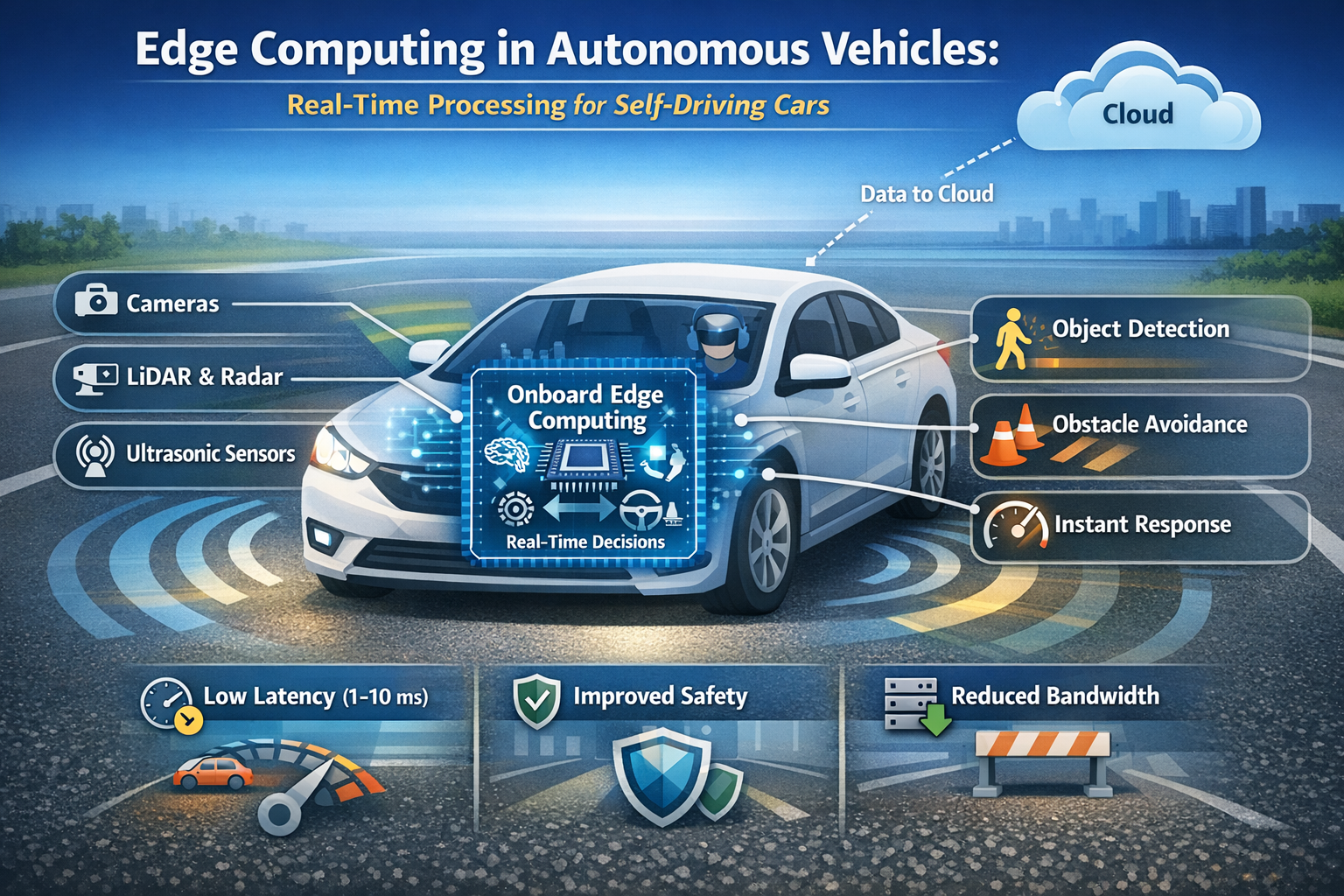
Edge computing in autonomous vehicles is one of the most important technologies shaping the future of self-driving cars. It allows vehicles to process massive amounts of data locally and in real time, instead of relying entirely on distant cloud servers. Autonomous vehicles generate enormous streams of information every second from cameras, LiDAR, radar, GPS, ultrasonic sensors, and vehicle-to-everything (V2X) communication systems. Turning this data into immediate driving decisions is critical for safety and performance.
Cloud computing alone cannot meet the demands of autonomous driving. Even slight network delays can lead to dangerous outcomes. A delay of just a few milliseconds can affect braking, steering, or obstacle avoidance. This is why edge computing has become a core part of autonomous vehicle design. By processing data directly inside the vehicle, edge computing enables ultra-low latency, high reliability, and continuous operation, even when network connectivity is limited or unavailable.
In simple terms, edge computing allows autonomous vehicles to “think on the spot.” Instead of sending raw sensor data to the cloud and waiting for instructions, self-driving cars analyze their surroundings instantly. Edge-based AI systems detect pedestrians, recognize traffic signs, track nearby vehicles, and predict movement patterns in real time. This local intelligence is especially important in complex driving situations such as busy intersections, sudden lane changes, or unexpected obstacles.
Edge computing in autonomous vehicles also reduces bandwidth usage and improves data privacy. Rather than transmitting all sensor data to external servers, only critical insights or summarized information is sent to the cloud. This approach lowers communication costs and keeps sensitive driving data within the vehicle. As autonomous technology continues to evolve, edge computing is becoming the backbone that enables safer, faster, and more reliable self-driving systems.
In this guide, you will gain a clear and in-depth understanding of how edge computing in autonomous vehicles works, why it is essential for real-time decision-making, and how it supports advanced AI-driven driving capabilities. We will explore the technology behind edge computing, real-world use cases, key benefits, challenges, and future trends that are shaping the next generation of autonomous vehicles.
What Is Edge Computing?
Edge computing is a distributed computing model that processes data closer to where it is created, instead of sending it to a centralized cloud or data center. In the context of autonomous vehicles, this means that data generated by onboard sensors is analyzed inside the vehicle itself or at nearby edge nodes, allowing for immediate action without waiting for a round trip to the cloud.
Traditional cloud computing works well for tasks like long-term data storage, fleet analytics, or software updates. However, it struggles with time-critical applications. Autonomous driving requires decisions to be made in milliseconds, not seconds. Edge computing solves this problem by eliminating unnecessary delays and ensuring continuous performance, even when internet connectivity is weak or unavailable.
At its core, edge computing combines local processing power, artificial intelligence, and real-time data analytics. These components work together to interpret sensor data, identify objects, predict behavior, and execute driving actions instantly. This makes edge computing an ideal foundation for autonomous vehicle systems that must operate safely in fast-changing environments.
Definition of Edge Computing
Edge computing refers to the practice of performing computation at or near the source of data generation. Instead of transmitting raw data to the cloud for processing, edge systems analyze data locally and only send relevant insights when necessary.
In autonomous vehicles, edge computing systems handle tasks such as:
- Object detection and classification
- Lane detection and road condition analysis
- Collision avoidance and emergency braking
- Real-time navigation and path planning
This approach dramatically reduces latency and improves reliability. According to industry research, edge-based systems can reduce response times by up to 90% compared to cloud-only processing, making them far better suited for safety-critical applications like self-driving cars.
Edge Computing vs Cloud Computing Explained Simply
Understanding the difference between edge computing and cloud computing is essential when discussing autonomous vehicles.
| Feature | Edge Computing | Cloud Computing |
|---|---|---|
| Data Processing Location | Inside the vehicle or nearby edge node | Remote data centers |
| Latency | Extremely low (milliseconds) | Higher due to network delays |
| Internet Dependency | Minimal | High |
| Real-Time Decision Making | Excellent | Limited |
| Best Use Cases | Safety, perception, control | Analytics, storage, training |
Cloud computing still plays an important role in autonomous vehicle ecosystems, especially for training AI models, analyzing fleet data, and updating software. However, when it comes to real-time driving decisions, edge computing is the clear choice.
Why “Edge” Means Processing Data Closer to the Vehicle
The term “edge” refers to the point where data is generated. For autonomous vehicles, this edge is the car itself. Processing data at the edge allows vehicles to respond instantly to their surroundings without relying on external infrastructure.
Consider a real-world scenario. A pedestrian suddenly steps into the road. If the vehicle had to send camera data to the cloud and wait for a response, the delay could result in an accident. With edge computing, the vehicle detects the pedestrian, calculates braking distance, and applies the brakes within milliseconds.
This ability to act independently makes edge computing a non-negotiable requirement for autonomous driving. It ensures that vehicles remain safe, intelligent, and responsive under all driving conditions.
Key Components of Edge Computing Systems in Autonomous Vehicles
Edge computing in autonomous vehicles relies on a tightly integrated set of hardware and software components that work together to process data in real time. These systems must operate reliably under extreme conditions, including high speeds, temperature fluctuations, and constant vibration. Each component plays a critical role in enabling autonomous vehicles to perceive their environment, make decisions, and act instantly.
At a high level, an edge computing system inside a self-driving car consists of sensors, onboard computing hardware, AI models, and communication interfaces. Together, they form a real-time intelligence layer that replaces slow, cloud-dependent processing with immediate, localized decision-making.
Sensors and Data Sources at the Edge
Sensors are the foundation of edge computing in autonomous vehicles. They continuously collect data about the vehicle’s surroundings and internal state. A single autonomous vehicle can generate several terabytes of data per day, making local processing essential.
Common sensors used in autonomous vehicles include:
- Cameras for visual recognition of lanes, traffic signs, pedestrians, and vehicles
- LiDAR for creating high-resolution 3D maps of the environment
- Radar for detecting objects at long distances and in poor weather conditions
- Ultrasonic sensors for short-range detection during parking and low-speed maneuvers
- GPS and IMU systems for precise vehicle localization and motion tracking
These sensors feed raw data directly into edge computing units, where it is immediately analyzed and filtered. Only the most relevant insights are stored or shared with other systems.
Onboard Edge Computing Hardware
To process sensor data in real time, autonomous vehicles are equipped with powerful onboard computing hardware. These edge devices are specifically designed to handle AI workloads while maintaining energy efficiency and thermal stability.
Key hardware components include:
- Central processing units (CPUs) for general-purpose computing
- Graphics processing units (GPUs) for parallel processing and AI inference
- Neural processing units (NPUs) optimized for deep learning tasks
- Automotive system-on-chip (SoC) platforms that integrate multiple processors into a single unit
Leading automotive and technology companies have developed specialized edge AI chips capable of processing billions of operations per second. These chips enable complex tasks such as object recognition, sensor fusion, and decision-making to happen instantly inside the vehicle.
AI Models and Edge Intelligence
Artificial intelligence is the brain of edge computing in autonomous vehicles. Deep learning models running at the edge interpret sensor data and turn it into actionable insights. These models are trained in the cloud using massive datasets and then deployed to vehicles for real-time inference.
Common edge AI tasks include:
- Computer vision for detecting pedestrians, vehicles, and road signs
- Sensor fusion to combine data from cameras, LiDAR, and radar
- Behavior prediction to anticipate the movement of nearby objects
- Path planning to determine the safest and most efficient driving route
To operate efficiently on edge hardware, AI models are optimized using techniques such as model compression, quantization, and pruning. This ensures high accuracy without overwhelming computing resources.
Connectivity and V2X Communication
While edge computing minimizes reliance on the cloud, connectivity still plays an important role. Autonomous vehicles use vehicle-to-everything (V2X) communication to exchange data with other vehicles, infrastructure, and pedestrians.
Edge computing systems manage this communication by:
- Processing V2V data locally to avoid collisions
- Interacting with smart traffic signals and road sensors
- Sharing safety alerts and road condition updates
This combination of local intelligence and selective connectivity creates a resilient, scalable system that supports safe autonomous driving.
What Are Autonomous Vehicles?
Autonomous vehicles, often called self-driving cars, are vehicles capable of sensing their environment and navigating without direct human input. They rely on a combination of edge computing, artificial intelligence, sensors, and advanced software to make real-time driving decisions. Edge computing in autonomous vehicles plays a critical role by ensuring that these decisions are made instantly and reliably.
Unlike traditional vehicles that depend entirely on human drivers, autonomous vehicles continuously analyze their surroundings, predict outcomes, and execute driving actions. This level of automation requires immense computational power and real-time intelligence, which is why edge computing has become a foundational technology for modern self-driving systems.
Understanding Autonomous Vehicles and Self-Driving Cars
At a basic level, autonomous vehicles are designed to perform the same tasks as a human driver. These tasks include perceiving the environment, understanding road rules, making decisions, and controlling the vehicle. What makes autonomous vehicles unique is their ability to perform these tasks simultaneously and continuously, without fatigue or distraction.
Key capabilities of autonomous vehicles include:
- Detecting and classifying objects such as cars, pedestrians, and cyclists
- Interpreting traffic signals, signs, and lane markings
- Predicting the behavior of nearby road users
- Planning safe driving paths in real time
- Executing steering, braking, and acceleration automatically
All of these capabilities depend on fast and reliable data processing. Edge computing allows these functions to operate locally, ensuring that autonomous vehicles can respond immediately to changing road conditions.
Levels of Vehicle Autonomy Explained
The Society of Automotive Engineers (SAE) defines six levels of driving automation, ranging from no automation to full autonomy. Understanding these levels helps explain where edge computing fits into autonomous vehicle development.
| Level | Description | Edge Computing Role |
|---|---|---|
| Level 0 | No automation | Minimal |
| Level 1 | Driver assistance (cruise control) | Limited |
| Level 2 | Partial automation (lane assist, adaptive cruise) | Moderate |
| Level 3 | Conditional automation | High |
| Level 4 | High automation | Very High |
| Level 5 | Full automation | Essential |
As vehicles move toward Level 4 and Level 5 autonomy, reliance on edge computing increases dramatically. At these levels, vehicles must operate safely in complex environments without human intervention, making real-time edge intelligence indispensable.
ADAS vs Fully Autonomous Vehicles
Advanced Driver Assistance Systems (ADAS) are often confused with autonomous vehicles. While ADAS features such as lane keeping assist and automatic emergency braking improve safety, they still require human supervision.
Key differences include:
- ADAS systems support the driver but do not replace them
- Fully autonomous vehicles can operate independently under defined conditions
- Edge computing in ADAS is used for specific tasks, while fully autonomous vehicles rely on edge computing for complete driving control
As the industry moves toward full autonomy, the role of edge computing expands from assisting drivers to becoming the primary decision-maker within the vehicle.
How Autonomous Vehicles Process Data
Autonomous vehicles generate and process data continuously. A typical self-driving car can analyze millions of data points per second, all of which must be processed instantly to ensure safe operation.
The data processing pipeline typically includes:
- Data collection from sensors
- Edge-based processing and AI inference
- Decision-making using predictive models
- Vehicle control through steering, braking, and acceleration
Edge computing enables this entire pipeline to function in real time. Without it, autonomous vehicles would be unable to react quickly enough to dynamic road conditions.
Why Edge Computing Is Essential for Autonomous Vehicles
Edge computing is not just an enhancement for self-driving cars—it is a fundamental requirement. Autonomous vehicles operate in environments where conditions change in fractions of a second. Pedestrians move unpredictably, vehicles suddenly brake, and road hazards can appear without warning. In these situations, even the smallest delay in data processing can have serious consequences.
This is where edge computing in autonomous vehicles becomes indispensable. By enabling real-time data processing directly inside the vehicle, edge computing ensures that critical driving decisions are made instantly, without waiting for instructions from the cloud.
The Need for Real-Time Decision Making
Autonomous vehicles must continuously make high-stakes decisions at incredible speed. Human drivers typically react in about 200–300 milliseconds. Autonomous systems, powered by edge computing, can react even faster.
Examples of real-time decisions include:
- Applying emergency brakes when a pedestrian steps into the road
- Adjusting steering to avoid sudden obstacles
- Responding to abrupt lane changes by nearby vehicles
- Navigating complex intersections with multiple moving objects
Edge computing allows these decisions to happen within milliseconds. This ultra-fast response time significantly improves road safety and driving accuracy, especially in dense urban environments.
Latency Challenges With Cloud Computing
Cloud computing introduces unavoidable delays. Data must travel from the vehicle to a remote data center, be processed, and then sent back. Even under ideal network conditions, this round trip can take tens or hundreds of milliseconds.
For autonomous vehicles, this latency is unacceptable. Consider the following comparison:
- Edge computing latency: 1–10 milliseconds
- Cloud computing latency: 50–200+ milliseconds
At highway speeds, a vehicle can travel several meters during a cloud processing delay. Edge computing eliminates this risk by keeping computation local and immediate.
Reliability in Poor or No Connectivity Environments
Autonomous vehicles cannot depend on consistent internet connectivity. Rural areas, tunnels, parking garages, and extreme weather conditions can all disrupt network access.
Edge computing ensures that autonomous vehicles remain fully operational even when connectivity is limited or unavailable. All essential driving functions continue to run locally, allowing the vehicle to maintain safe operation at all times.
This independence from the cloud is one of the strongest arguments for edge-first architectures in autonomous vehicle design.
Safety and Regulatory Requirements
Safety regulations for autonomous vehicles demand predictable and reliable system behavior. Edge computing helps meet these requirements by reducing uncertainty caused by network variability.
Benefits for safety and compliance include:
- Consistent performance regardless of network conditions
- Reduced risk of communication-related failures
- Easier validation and certification of safety-critical systems
Regulatory bodies increasingly recognize edge computing as a key enabler of safe autonomous driving, especially for higher levels of automation.

Comments are closed, but trackbacks and pingbacks are open.