
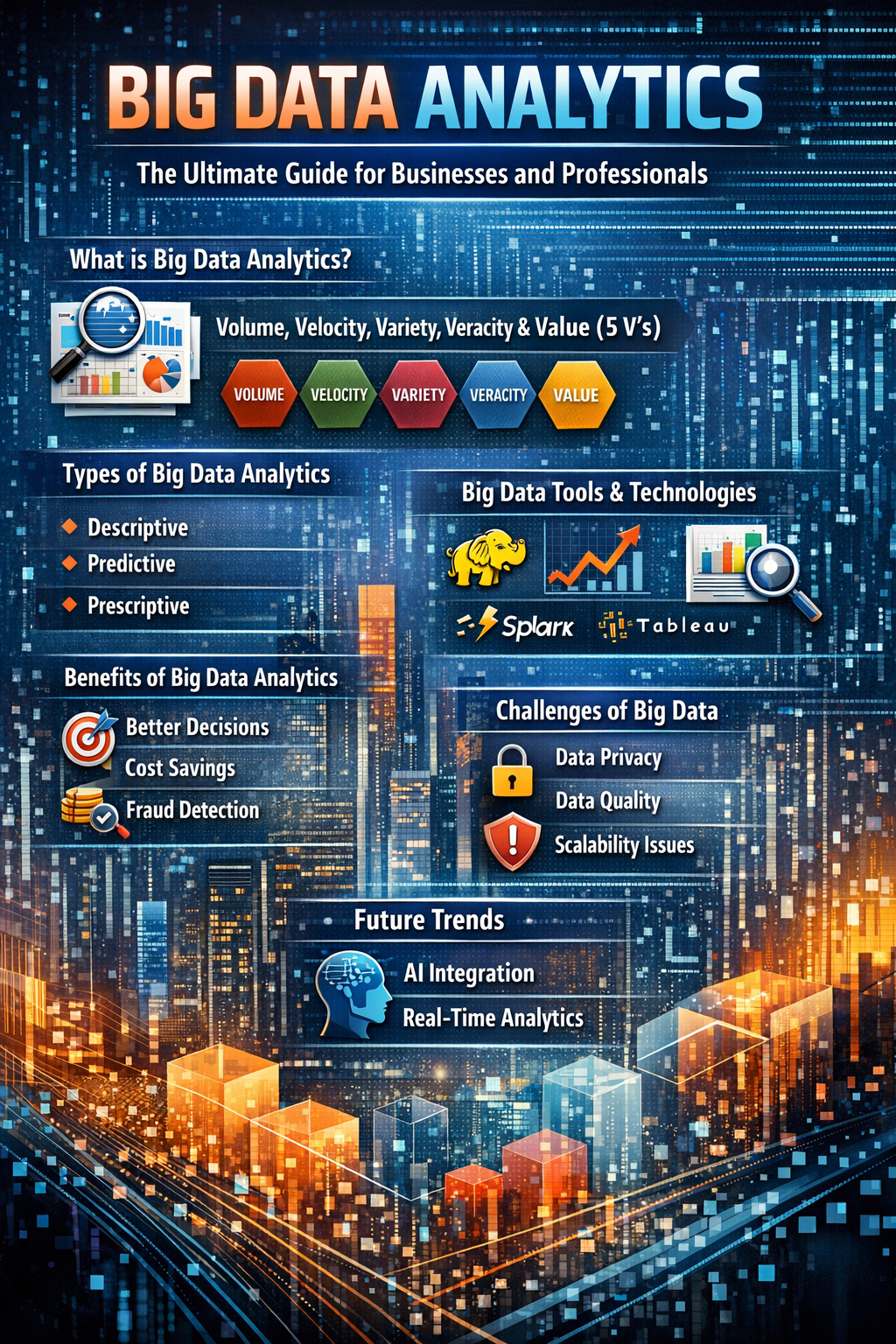
What is Big Data Analytics?
Big data analytics is the process of examining large and diverse datasets to uncover hidden patterns, correlations, market trends, customer preferences, and other useful business insights. Unlike traditional data analysis, which typically works with structured and relatively small datasets, big data analytics handles enormous volumes of structured, semi-structured, and unstructured data generated every second from sources like social media, online transactions, sensors, and IoT devices.http://futuretechfrontier.com
The concept of big data is often explained through the 5 V’s:
| V | Definition |
|---|---|
| Volume | The massive amount of data generated daily from multiple sources. |
| Velocity | The speed at which new data is generated and must be processed. |
| Variety | The different types of data, including text, images, video, audio, and sensor readings. |
| Veracity | The reliability and accuracy of data for meaningful insights. |
| Value | The actionable insights extracted from data to drive decision-making. |
In today’s competitive landscape, big data analytics has become crucial for businesses to remain agile and make informed decisions. Companies can analyze customer behavior, detect fraud, optimize supply chains, improve product recommendations, and even predict future trends using advanced analytics techniques.
Why Big Data Analytics Matters
Businesses across industries are leveraging big data analytics to gain a competitive edge. Here are a few examples of its impact:
- Healthcare: Hospitals use big data analytics to predict patient outcomes, personalize treatments, and detect diseases early. For example, Mount Sinai Health System in New York analyzed patient data to identify early signs of heart failure, reducing hospital readmissions.
- Retail: Companies like Amazon and Walmart use big data analytics to recommend products, optimize inventory, and enhance the customer shopping experience.
- Finance: Banks and financial institutions detect fraud, assess risk, and make lending decisions faster with data analytics.
- Manufacturing: Predictive maintenance powered by big data analytics reduces machine downtime and improves operational efficiency.
By converting raw data into actionable insights, big data analytics empowers organizations to make strategic decisions faster, reduce costs, and enhance customer satisfaction. As the volume of data continues to grow, its importance will only increase, making analytics a critical capability for all forward-looking businesses.
Types of Big Data Analytics
Understanding the types of big data analytics is crucial for businesses to apply the right strategies to their data. Each type serves a specific purpose and provides unique insights, helping organizations make smarter, data-driven decisions.
1. Descriptive Analytics
Descriptive analytics focuses on understanding past data to identify trends, patterns, and behaviors. It answers the question: “What happened?” By summarizing historical data, businesses can measure performance, monitor KPIs, and identify areas for improvement.
Examples of descriptive analytics:
- Monthly sales reports showing revenue trends
- Website traffic analysis identifying peak user activity
- Social media engagement reports
2. Diagnostic Analytics
Diagnostic analytics digs deeper into data to determine the causes of past outcomes. It answers: “Why did it happen?” By analyzing correlations and relationships in data, organizations can pinpoint the reasons behind successes or failures.
Examples of diagnostic analytics:
- Investigating the reason behind a sudden drop in sales
- Analyzing customer complaints to identify common issues
- Tracking machine failures in manufacturing plants
3. Predictive Analytics
Predictive analytics uses historical data, statistical models, and machine learning algorithms to forecast future outcomes. It answers: “What is likely to happen?” This type of analytics is highly valuable for planning, risk assessment, and decision-making.
Examples of predictive analytics:
- Predicting customer churn and retention
- Forecasting product demand for inventory optimization
- Financial risk prediction and fraud detection
Case Study:
Netflix leverages predictive analytics to recommend movies and shows to users based on their viewing history, increasing user engagement and retention.
4. Prescriptive Analytics
Prescriptive analytics goes a step further, suggesting actions to achieve desired outcomes. It answers: “What should we do?” By combining predictive models with optimization algorithms, businesses can identify the best course of action for complex problems.
Examples of prescriptive analytics:
- Dynamic pricing strategies in e-commerce
- Optimizing delivery routes in logistics
- Resource allocation in healthcare for better patient outcomes
5. Real-Time Analytics
Real-time analytics processes data as it is generated, allowing immediate insights and actions. This is critical for industries where instant decision-making is essential.
Examples of real-time analytics:
- Fraud detection in banking transactions
- Monitoring and controlling manufacturing equipment
- Social media trend analysis and sentiment tracking
How Each Type Benefits Businesses
- Marketing Optimization: Personalized campaigns based on customer behavior insights
- Fraud Detection: Real-time monitoring of transactions for suspicious activity
- Supply Chain Management: Predicting demand, optimizing inventory, and reducing waste
- Healthcare: Predicting patient outcomes, improving treatment plans, and resource allocation
By understanding these types of big data analytics, organizations can choose the right tools and approaches for their business needs, ensuring maximum value from their data investments.
Big Data Analytics Tools and Technologies
To leverage big data analytics effectively, businesses rely on a variety of tools and technologies. These tools help collect, store, process, analyze, and visualize massive datasets efficiently. Choosing the right tools is critical to extract meaningful insights and gain a competitive edge.
Data Storage and Management Tools
Efficient storage and management of large datasets are the foundation of big data analytics. Popular solutions include:
- Hadoop: An open-source framework that allows distributed storage and processing of big data across clusters of computers. It’s ideal for handling massive volumes of structured and unstructured data.
- HDFS (Hadoop Distributed File System): Stores large files across multiple machines, ensuring fault tolerance and reliability.
- NoSQL Databases: MongoDB, Cassandra, and Couchbase allow flexible storage of semi-structured and unstructured data, ideal for real-time analytics.
- Cloud Storage Solutions: AWS S3, Google Cloud Storage, and Microsoft Azure Blob Storage provide scalable and cost-effective solutions for storing big data.
Data Processing and Analytics Tools
Processing and analyzing large datasets requires robust platforms capable of handling speed and complexity:
- Apache Spark: A fast, in-memory data processing framework for large-scale analytics. Spark supports batch processing, real-time streaming, and machine learning.
- Apache Flink: Designed for real-time stream processing, allowing immediate insights from continuously generated data.
- Google BigQuery: A serverless, highly scalable data warehouse for fast SQL-based analytics.
- AWS Analytics Suite: Includes Redshift, Kinesis, and EMR for comprehensive data processing and analytics.
Data Visualization Tools
Visualizing data helps transform complex insights into actionable knowledge:
- Tableau: Enables interactive dashboards and visual storytelling from raw data.
- Power BI: Microsoft’s solution for data visualization, business intelligence, and reporting.
- QlikView: Offers associative analytics and intuitive dashboards for exploratory analysis.
- Looker: Connects data directly to business workflows for easy decision-making.
Machine Learning and AI Integration
Big data analytics increasingly relies on AI and machine learning to enhance predictive and prescriptive capabilities:
- Predictive Analytics: Algorithms analyze historical patterns to forecast future trends.
- Natural Language Processing (NLP): Extracts insights from unstructured text data such as social media posts, customer feedback, or emails.
- Deep Learning Models: Detect patterns in complex datasets like images, audio, or video for advanced analytics.
Example:
UPS uses predictive analytics and AI to optimize delivery routes, reducing fuel consumption and improving delivery times. By integrating machine learning into their big data analytics, UPS saves millions of dollars annually while enhancing operational efficiency.
Big Data Analytics Techniques and Methods
To extract meaningful insights from massive datasets, organizations employ various big data analytics techniques and methods. These methods help uncover patterns, relationships, and actionable intelligence to support data-driven decision-making.
1. Data Mining
Data mining is the process of discovering hidden patterns and relationships within large datasets. It uses statistical techniques, machine learning algorithms, and database systems to identify trends that are not immediately obvious.
Applications:
- Customer segmentation for targeted marketing
- Identifying fraudulent transactions in finance
- Discovering inefficiencies in supply chain operations
2. Statistical Analysis
Statistical analysis involves applying mathematical models and statistical tests to summarize and interpret data. It helps in identifying correlations, trends, and anomalies in datasets.
Applications:
- Measuring product performance across regions
- Analyzing customer satisfaction survey data
- Forecasting sales trends based on historical data
3. Text and Sentiment Analysis
A significant portion of big data is unstructured, such as emails, social media posts, and reviews. Text and sentiment analysis techniques process this information to understand opinions, trends, and emotions.
Applications:
- Monitoring brand reputation on social media
- Analyzing customer feedback for product improvements
- Detecting emerging market trends
4. Predictive Modeling
Predictive modeling uses historical data and machine learning algorithms to predict future outcomes. It is widely used for anticipating customer behavior, market changes, or operational risks.
Applications:
- Predicting customer churn to retain valuable clients
- Forecasting product demand for inventory planning
- Identifying high-risk loans in banking
5. Prescriptive Techniques
Prescriptive analytics combines predictive models with optimization algorithms to recommend the best course of action. It answers the question: “What should we do next?”
Applications:
- Dynamic pricing strategies in e-commerce
- Optimizing supply chain routes to reduce costs
- Allocating hospital resources to maximize patient care efficiency
6. Real-Time Analytics Techniques
Real-time analytics processes data as it is generated, enabling immediate insights and action. This is particularly crucial for industries where timing is critical.
Applications:
- Fraud detection during live financial transactions
- Monitoring manufacturing machines for predictive maintenance
- Real-time recommendation engines for e-commerce websites
Case Study:
Airbnb leverages predictive modeling and real-time analytics to dynamically adjust pricing for listings. By analyzing user behavior, seasonal trends, and competitor pricing, Airbnb maximizes revenue for hosts while maintaining competitive rates for users.
How Big Data Analytics Works – Step by Step
Understanding how big data analytics works helps organizations implement effective strategies to extract meaningful insights from their data. The process involves several key steps, from data collection to actionable decision-making.
1. Data Collection
The first step in big data analytics is gathering data from multiple sources. These sources can be:
- Structured Data: Transaction records, CRM databases, spreadsheets
- Semi-Structured Data: JSON files, XML, logs
- Unstructured Data: Social media posts, images, videos, emails, sensor readings
Modern organizations often collect data in real-time from IoT devices, websites, mobile apps, and social media platforms. Ensuring that data is accurate and relevant at this stage is critical for reliable analytics.
2. Data Cleaning and Preprocessing
Raw data is often messy, incomplete, or inconsistent. Data cleaning and preprocessing involve:
- Removing duplicates and errors
- Handling missing values
- Standardizing formats
- Normalizing data for analysis
Proper preprocessing improves data quality and ensures that subsequent analytics produce accurate and meaningful results.
3. Data Storage and Management
Once cleaned, data needs to be stored in a way that supports efficient processing and analysis. Storage options include:
- On-Premises Systems: Traditional databases and Hadoop clusters
- Cloud Storage: AWS, Google Cloud, Microsoft Azure
- Hybrid Storage: Combines local and cloud storage for flexibility
Good storage architecture allows fast retrieval, scalability, and secure management of massive datasets.
4. Data Analysis and Processing
This step is the core of big data analytics. It involves using analytical tools and techniques to extract insights:
- Descriptive Analytics: Summarizing historical trends
- Diagnostic Analytics: Understanding causes behind trends
- Predictive Analytics: Forecasting future outcomes
- Prescriptive Analytics: Recommending actions based on predictions
Advanced processing may also include machine learning algorithms, AI models, and real-time stream processing to handle dynamic data and complex patterns.
5. Data Visualization and Reporting
After analysis, insights are often communicated through visualizations and reports. Tools like Tableau, Power BI, and Looker help create:
- Interactive dashboards
- Charts and graphs showing trends
- Real-time alerts for critical metrics
Visualizations make complex data more understandable and actionable for business stakeholders.
6. Insights and Decision-Making
The ultimate goal of big data analytics is actionable insights. Businesses can use analytics to:
- Improve marketing strategies
- Optimize operations
- Enhance customer experience
- Identify new growth opportunities
Example:
UPS analyzes real-time GPS data, traffic, and delivery schedules to optimize routes. This big data analytics workflow reduces fuel consumption, improves delivery speed, and increases operational efficiency.
Benefits of Big Data Analytics
Implementing big data analytics offers significant advantages for organizations across industries. By analyzing large volumes of data, businesses can make smarter decisions, improve efficiency, and gain a competitive edge.
1. Improved Decision-Making
Big data analytics enables data-driven decision-making by providing insights grounded in evidence rather than intuition. Businesses can:
- Identify market trends and consumer behavior patterns
- Monitor KPIs and operational performance in real time
- Make informed strategic decisions with confidence
Example: Retailers like Target use big data analytics to predict customer purchasing behavior, allowing them to personalize promotions and inventory decisions.
2. Enhanced Customer Experience and Personalization
Analyzing customer data helps businesses deliver personalized experiences:
- Tailored product recommendations
- Customized marketing campaigns
- Optimized customer service interactions
Fact: A study by Epsilon found that 80% of consumers are more likely to make a purchase when brands offer personalized experiences, demonstrating the value of big data analytics in customer engagement.
3. Operational Efficiency and Cost Reduction
Big data analytics can streamline processes, reduce waste, and lower costs:
- Predictive maintenance in manufacturing reduces downtime and repair costs
- Supply chain optimization improves logistics efficiency
- Workforce management can be enhanced through data-driven scheduling
Case Study: General Electric (GE) uses big data analytics to monitor industrial machines and predict failures, saving millions in maintenance costs and improving productivity.
4. Risk Management and Fraud Prevention
Organizations can identify anomalies, monitor transactions, and detect potential threats using analytics:
- Banks detect fraudulent activities in real-time
- Insurance companies analyze claims data to reduce fraud
- Cybersecurity systems monitor network activity for suspicious patterns
Example: PayPal leverages big data analytics to track millions of transactions daily, using predictive models to flag potentially fraudulent activity.
5. Competitive Advantage
By leveraging big data analytics, businesses can stay ahead of competitors by:
- Identifying emerging market trends before others
- Launching products or services tailored to customer needs
- Optimizing pricing and promotional strategies
Fact: According to McKinsey, organizations that use big data analytics effectively are 23 times more likely to acquire customers, 6 times more likely to retain customers, and 19 times more likely to be profitable.
Comments are closed, but trackbacks and pingbacks are open.