
Artificial intelligence (AI) is no longer a futuristic concept—it is actively transforming the way we live, work, and innovate. From healthcare to finance, education to manufacturing, AI-driven innovations are creating new possibilities that were unimaginable a decade ago. These innovations go beyond simple automation; they encompass intelligent systems, predictive analytics, and adaptive technologies that can learn, reason, and make decisions with minimal human intervention.
In this article, we explore the most impactful AI-driven innovations, their applications across industries, the technologies powering them, and the opportunities and challenges they present. By understanding these innovations, businesses and individuals can stay ahead of the curve, leveraging AI to improve efficiency, enhance customer experiences, and drive meaningful change.http://futuretechfrontier.com
What Are AI-Driven Innovations?
AI-driven innovations refer to technologies, products, and processes that leverage artificial intelligence to deliver smarter, faster, and more efficient solutions. Unlike traditional technological improvements, these innovations learn from data, adapt to changing conditions, and make intelligent decisions. This makes them highly transformative in industries that rely on complex decision-making and large-scale data analysis.
For example, while conventional software can follow a set of predefined rules, AI-powered innovations can identify patterns in data, predict outcomes, and optimize operations in real time. This capability is what sets AI-driven solutions apart and explains why industries across the globe are investing heavily in AI research and deployment.
Key Features of AI-Driven Innovations
- Automation and Efficiency Improvements
AI-driven systems can handle repetitive and time-consuming tasks with accuracy, freeing human workers to focus on creative and strategic roles. For instance, AI chatbots can manage thousands of customer queries simultaneously without fatigue. - Data-Driven Decision Making
By analyzing vast datasets, AI can provide actionable insights that guide strategic decisions. This is particularly important in sectors like finance, healthcare, and logistics, where timely, accurate decisions can have a major impact. - Learning Capabilities
Modern AI systems employ machine learning and deep learning algorithms to continuously improve over time. They refine their predictions and outputs based on new data, making them increasingly intelligent and effective. - Integration with Next-Gen Technologies
AI-driven innovations are often combined with IoT, cloud computing, and robotics, creating complex systems capable of autonomous operation and advanced problem-solving.
Why AI-Driven Innovations Matter
Adopting AI-driven solutions offers numerous benefits for organizations and individuals alike:
- Competitive Advantage: Businesses using AI can deliver faster services, reduce costs, and outperform competitors.
- Operational Efficiency: AI optimizes workflows and resource management across multiple domains.
- Enhanced Customer Experiences: Personalized recommendations, predictive analytics, and AI-powered interfaces improve satisfaction and engagement.
- Innovation Opportunities: AI enables entirely new products and services that were previously impossible.
Case Study:
IBM Watson Health has leveraged AI-driven innovations to analyze medical records, provide diagnostic insights, and assist in drug discovery. Hospitals using Watson’s AI solutions have reported faster diagnostic times and improved patient outcomes, demonstrating the transformative power of AI in healthcare.
This section establishes a clear understanding of AI-driven innovations, highlights their features, and explains why they are reshaping industries worldwide.
Top AI-Driven Innovations in 2025
The landscape of AI-driven innovations is evolving rapidly, with new applications emerging every year. These innovations are not limited to a single industry—they are transforming healthcare, finance, manufacturing, retail, education, and more. Understanding the top AI-powered trends in 2025 helps businesses, researchers, and consumers identify opportunities to leverage these technologies effectively.
AI in Healthcare
Artificial intelligence is revolutionizing healthcare by enhancing diagnostics, treatment, and patient care.
Applications:
- Diagnostics: AI algorithms analyze medical images like X-rays, MRIs, and CT scans with high accuracy.
- Personalized Treatment Plans: AI considers patient history, genetics, and lifestyle to optimize therapies.
- Drug Discovery: Machine learning models predict molecular interactions, accelerating drug development.
- Robotic Surgery: AI-powered robotic systems assist surgeons with precision and minimal invasiveness.
Benefits: Faster, more accurate diagnoses, reduced medical errors, and improved patient outcomes.
Case Study:
IBM Watson Health uses AI-driven innovations to provide diagnostic insights and treatment recommendations. Hospitals leveraging Watson have seen up to a 30% reduction in diagnostic errors and faster treatment planning for complex cases.
AI in Finance
AI-driven innovations are transforming finance by improving security, decision-making, and operational efficiency.
Applications:
- Fraud Detection: Real-time monitoring identifies suspicious transactions instantly.
- Algorithmic Trading: AI models predict market trends and optimize investment strategies.
- Credit Scoring: Machine learning analyzes unconventional data points to assess creditworthiness.
- Customer Service: AI chatbots handle thousands of queries efficiently, improving service quality.
Impact: AI reduces operational costs, enhances accuracy, and enables more informed financial decisions.
Fact: According to Deloitte, financial institutions implementing AI-driven systems have achieved cost reductions of up to 30% in back-office operations.
AI in Manufacturing and Logistics
Next-generation AI innovations are optimizing production lines, supply chains, and logistics operations.
Applications:
- Predictive Maintenance: AI predicts equipment failures, minimizing downtime.
- Quality Control: Computer vision detects defects in products in real-time.
- Warehouse Automation: AI-powered robots handle inventory, packing, and distribution.
Emerging Trends:
- Collaborative Robots (Cobots): Work alongside human operators to enhance efficiency.
- Autonomous Vehicles: AI-driven delivery vehicles optimize logistics routes and reduce costs.
Case Study:
Siemens has implemented AI-powered predictive maintenance in factories, resulting in 20% higher production efficiency and significant cost savings.
AI in Retail and E-Commerce
AI-driven innovations are enhancing customer experience, personalization, and operational efficiency in retail.
Applications:
- Personalized Recommendations: AI analyzes browsing and purchase history to suggest products.
- Dynamic Pricing: Machine learning models adjust prices based on demand and competition.
- Inventory Management: AI predicts stock needs and prevents overstocking or shortages.
- Customer Support: Chatbots and virtual assistants provide instant assistance.
Benefit: AI improves sales, increases customer satisfaction, and streamlines inventory management.
Trend Example: Amazon’s AI recommendation engine drives 35% of total revenue, demonstrating the impact of AI-driven personalization.
AI in Education and Learning
AI is transforming education by creating personalized, adaptive, and scalable learning experiences.
Applications:
- Adaptive Learning Platforms: AI adjusts content based on student performance.
- AI Tutors: Provide one-on-one guidance for personalized learning.
- Learning Analytics: Predict student outcomes and identify learning gaps.
Benefit: AI enables tailored education experiences, supports teachers, and helps students achieve better results.
Fact: HolonIQ predicts that AI-powered learning technologies will serve over 50 million learners globally by 2025.
This section highlights the most impactful AI-driven innovations in 2025, showing how AI is transforming diverse industries and driving measurable outcomes.
Emerging AI Technologies Driving Innovations
The remarkable impact of AI-driven innovations across industries is powered by a suite of advanced AI technologies. These technologies enable machines to analyze data, learn patterns, make decisions, and interact with humans intelligently. Understanding these foundational technologies is crucial for businesses and individuals looking to leverage AI effectively.
Machine Learning and Deep Learning
Machine learning (ML) is a subset of AI that allows systems to learn from data and improve performance over time without being explicitly programmed. Deep learning, a more advanced branch of ML, uses neural networks to model complex patterns.
Applications:
- Predictive analytics in finance and healthcare.
- Recommendation engines in e-commerce platforms.
- Fraud detection and risk assessment.
Benefits:
- Enables data-driven decisions.
- Reduces human error in complex operations.
- Supports continuous improvement of systems.
Case Study: Netflix uses deep learning algorithms for its recommendation system, driving a significant increase in user engagement and retention.
Natural Language Processing (NLP)
NLP allows machines to understand, interpret, and generate human language. This technology powers intelligent communication between humans and machines.
Applications:
- Chatbots and virtual assistants like Siri, Alexa, and Google Assistant.
- Sentiment analysis for social media and market research.
- Automated content generation and summarization.
Benefits:
- Improves customer service and user experience.
- Provides actionable insights from unstructured text data.
- Supports real-time communication and engagement.
Fact: According to Gartner, 70% of customer interactions will be powered by AI and NLP by 2025, emphasizing its role in business operations.
Computer Vision
Computer vision enables machines to see, interpret, and act upon visual information from the world, similar to human sight.
Applications:
- Autonomous vehicles for navigation and obstacle detection.
- Facial recognition for security and authentication.
- Quality control in manufacturing lines.
Benefits:
- Reduces manual inspection errors.
- Enhances safety and security applications.
- Enables real-time visual decision-making.
Example: Tesla’s autonomous vehicles rely heavily on computer vision to navigate complex road conditions safely.
Robotics and Intelligent Automation
AI-powered robotics and intelligent automation combine physical machines with AI to perform complex tasks autonomously or collaboratively with humans.
Applications:
- Industrial cobots working alongside human operators in factories.
- Robotic surgery in hospitals for precision operations.
- Autonomous drones for delivery and inspection.
Benefits:
- Increases operational efficiency.
- Reduces human exposure to hazardous tasks.
- Supports scalability of high-precision operations.
Case Study: Amazon’s fulfillment centers use AI-driven robots to move products efficiently, enabling faster delivery times and reduced operational costs.
Reinforcement Learning and Predictive Analytics
Reinforcement learning allows AI systems to learn optimal actions through trial and error, often applied in gaming, robotics, and decision-making systems.
Predictive analytics leverages machine learning to forecast outcomes, enabling proactive business strategies.
Applications:
- Inventory management and supply chain optimization.
- Predictive maintenance in industrial settings.
- Personalized marketing campaigns based on behavioral predictions.
Fact: According to McKinsey, businesses using AI-driven predictive analytics see an average of 15–20% improvement in operational efficiency.
This section explains the key AI technologies that drive innovations across industries. By understanding machine learning, NLP, computer vision, robotics, and predictive analytics, businesses and individuals can better leverage AI-driven solutions for strategic advantage.
Benefits of AI-Driven Innovations
AI-driven innovations are not just theoretical—they deliver real, measurable value across businesses, governments, and personal applications. From increasing efficiency to enabling new capabilities, the benefits are transforming the way we work, interact, and solve problems.
1. Enhanced Operational Efficiency
AI automates repetitive, time-consuming tasks, allowing humans to focus on higher-level decision-making and creative problem-solving.
Examples:
- AI-powered chatbots handling customer service queries instantly.
- Predictive maintenance in factories reducing unplanned downtime.
- AI-driven scheduling systems optimizing workforce allocation.
Impact: Companies experience faster workflows, reduced errors, and cost savings, which increases overall productivity.
2. Data-Driven Decision Making
AI systems can analyze massive datasets that would be impossible for humans to process manually. This enables businesses to make decisions based on real-time insights.
Applications:
- Financial institutions predicting market trends for better investments.
- Retailers analyzing purchase patterns to optimize stock levels.
- Healthcare providers predicting patient outcomes and treatment plans.
Fact: According to PwC, organizations leveraging AI for decision-making improve their operational efficiency by up to 40%.
3. Cost Reduction
Automation, predictive analytics, and AI-powered systems help reduce operational and labor costs.
Examples:
- AI-driven energy management systems in buildings reduce utility expenses.
- Robotics in warehouses lower human labor costs while increasing throughput.
- AI-powered fraud detection prevents financial losses.
Case Study: UPS uses AI for route optimization in deliveries, saving millions of gallons of fuel and significantly reducing operational costs.
4. Improved Customer Experience
AI innovations enable personalized experiences and faster service delivery, enhancing customer satisfaction and loyalty.
Applications:
- Personalized recommendations on e-commerce platforms.
- AI-driven virtual assistants providing 24/7 support.
- Sentiment analysis improving brand engagement strategies.
Impact: According to Salesforce, 70% of customers say AI-enhanced interactions improve their perception of a brand.
5. Innovation and New Opportunities
AI-driven innovations enable entirely new products, services, and business models that were previously impossible.
Examples:
- AI-powered autonomous vehicles creating new transportation services.
- AI-driven healthcare diagnostics enabling remote patient care.
- Predictive analytics platforms offering personalized financial advice.
Fact: A McKinsey study predicts that AI-driven innovations could add $13 trillion to the global economy by 2030, demonstrating their transformative potential.
Table: Key Benefits of AI-Driven Innovations
| Benefit | Description | Example |
|---|---|---|
| Enhanced Efficiency | Automates repetitive tasks and optimizes workflows | AI chatbots, predictive maintenance |
| Data-Driven Decisions | Analyzes large datasets for accurate insights | Financial market predictions |
| Cost Reduction | Reduces operational and labor expenses | AI route optimization in logistics |
| Improved Customer Experience | Provides personalized interactions | E-commerce recommendation engines |
| Innovation & Growth | Enables new products and business models | Autonomous vehicles, AI healthcare solutions |
Quote:
“AI-driven innovations are not just a technological upgrade—they are a business transformation, enabling efficiency, growth, and smarter decision-making.” — Harvard Business Review, 2024
This section demonstrates that AI-driven innovations deliver measurable benefits, helping organizations improve efficiency, reduce costs, and innovate faster than ever before.
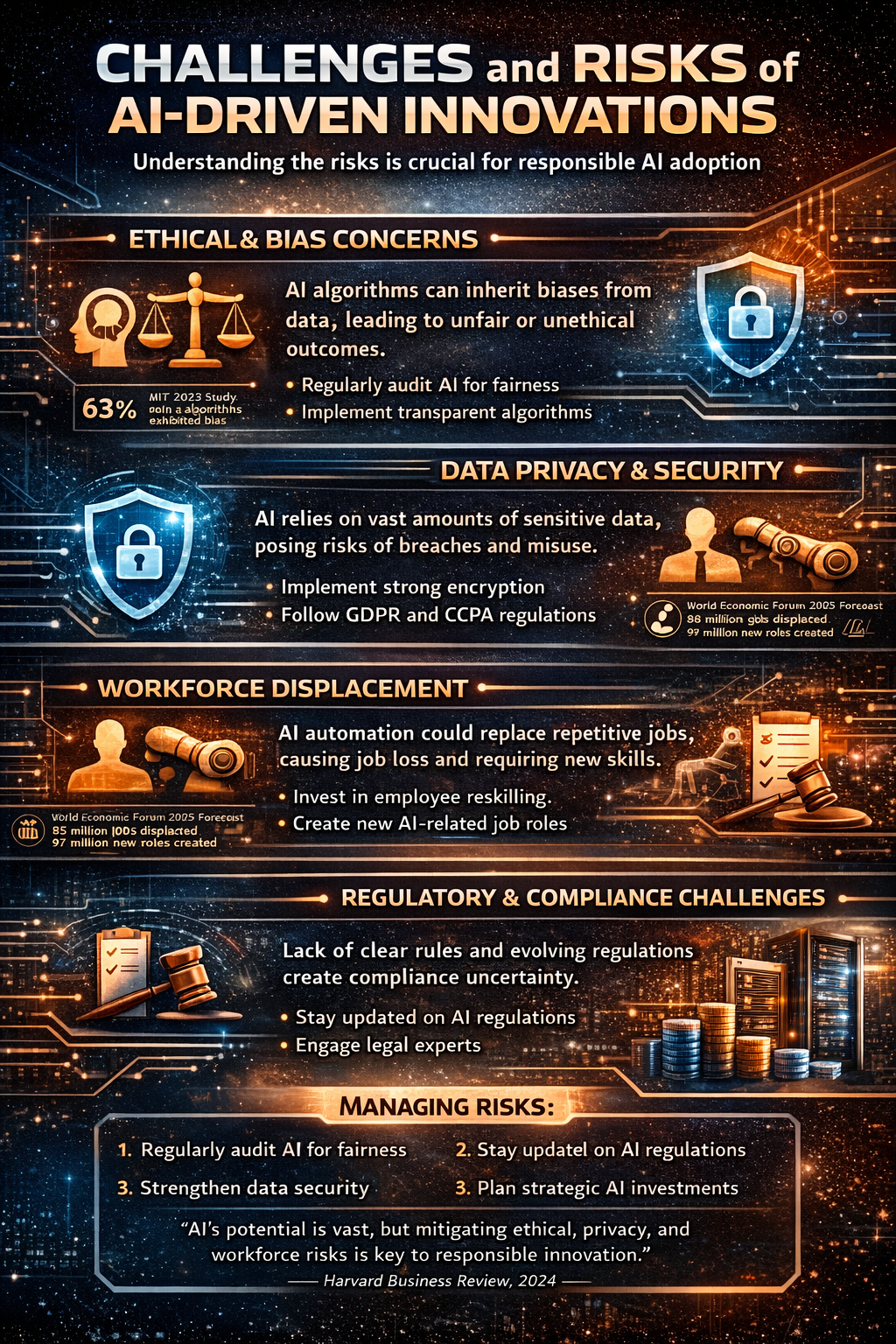
Challenges and Risks of AI-Driven Innovations
While AI-driven innovations offer tremendous opportunities, they also come with significant challenges and risks. Organizations and individuals must be aware of these potential issues to adopt AI responsibly and sustainably.
1. Ethical and Bias Concerns
AI systems can unintentionally inherit biases from historical data or algorithmic design, leading to unfair outcomes.
Examples:
- Biased hiring algorithms favoring certain demographics.
- AI-powered lending tools denying loans unfairly based on skewed data.
Solutions:
- Implement transparent AI frameworks.
- Regularly audit algorithms for fairness and bias.
Fact: A 2023 study by MIT found that over 60% of AI algorithms in HR tools exhibited some form of bias, highlighting the need for ethical oversight.
2. Data Privacy and Security
AI relies heavily on large volumes of data, including sensitive personal or business information. This introduces risks of data breaches and misuse.
Risks:
- Unauthorized access to personal healthcare or financial data.
- Misuse of consumer behavior data for manipulative marketing.
Solutions:
- Implement strong encryption and access controls.
- Follow regulations like GDPR and CCPA.
- Use anonymized datasets whenever possible.
3. Workforce and Job Displacement
Automation and AI can replace repetitive or routine jobs, raising concerns about workforce displacement.
Impacted Areas:
- Manufacturing assembly lines.
- Data entry and administrative roles.
- Customer service positions.
Opportunities:
- New roles emerge in AI management, data science, and AI ethics.
- Reskilling programs help employees adapt to AI-driven workplaces.
Fact: According to the World Economic Forum, by 2025, 85 million jobs may be displaced due to AI, but 97 million new roles could emerge.
4. Regulatory and Compliance Challenges
AI is evolving faster than regulations, creating uncertainty and compliance risks.
Issues:
- Lack of clear guidelines for AI accountability.
- Industry-specific compliance requirements in healthcare, finance, and transportation.
Solutions:
- Stay updated with emerging AI regulations.
- Engage with legal experts when deploying AI solutions.
Fact: McKinsey reports that 63% of organizations view regulatory compliance as a key barrier to AI adoption.
5. High Costs and Infrastructure Requirements
Implementing AI-driven innovations often requires substantial investment in infrastructure, software, and talent.
Considerations:
- High-performance computing resources for AI models.
- Integration with existing legacy systems.
- Continuous maintenance and updates.
Solution:
- Start with pilot programs and scale gradually.
- Leverage cloud-based AI solutions to reduce upfront infrastructure costs.
Summary of Risk Management Strategies
- Implement ethical AI practices and regular algorithm audits.
- Ensure robust data privacy and security protocols.
- Invest in workforce reskilling and new career pathways.
- Monitor regulatory changes and maintain compliance.
- Plan strategic AI investments and phased implementation.
Quote:
“AI-driven innovations hold immense promise, but responsible adoption requires careful consideration of ethics, security, and workforce impact.” — Harvard Business Review, 2024
This section highlights that while AI offers transformative benefits, addressing its risks is essential for sustainable and responsible implementation.
Comments are closed, but trackbacks and pingbacks are open.