
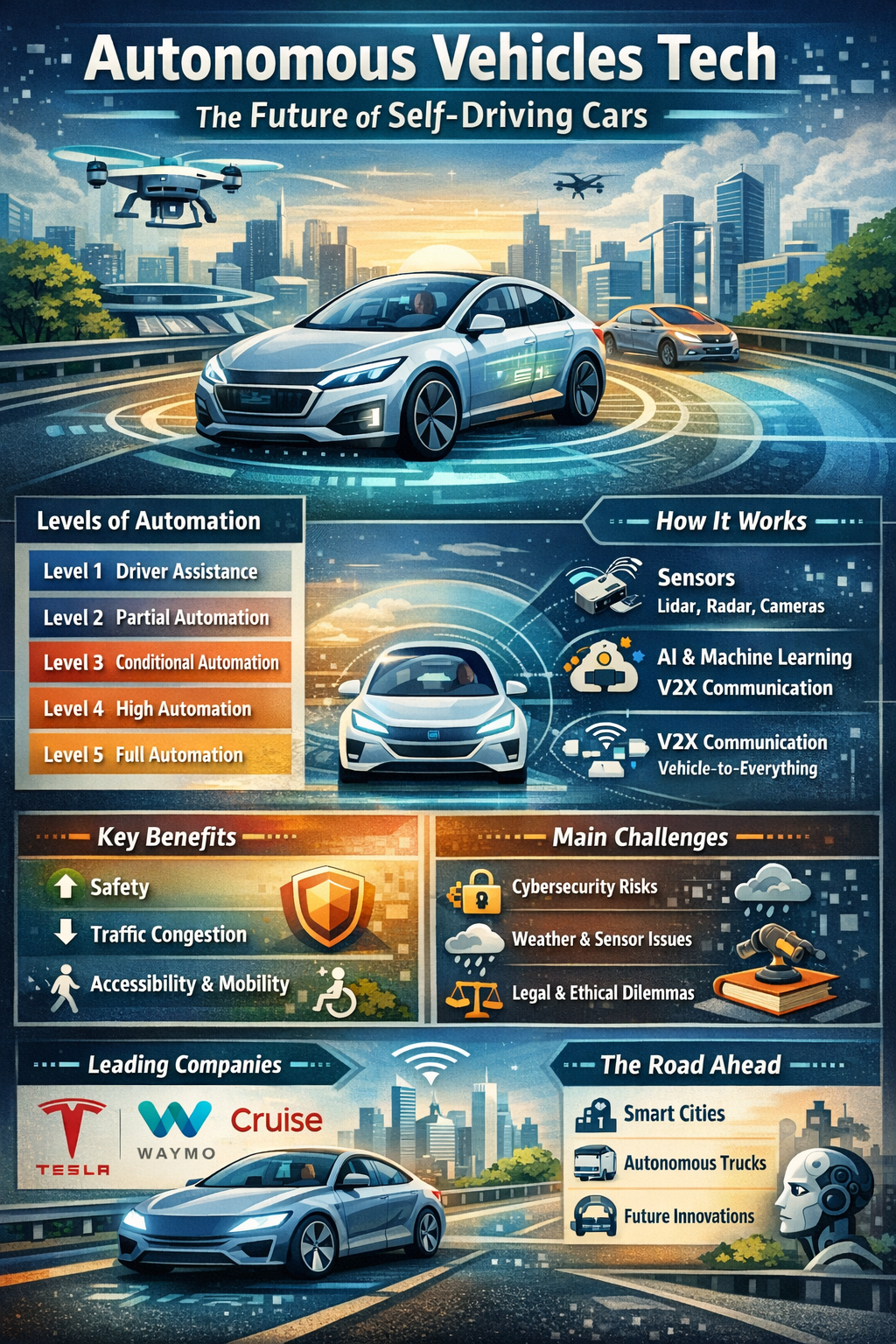
Autonomous Vehicles Tech – The Future of Self-Driving Cars
The world of autonomous vehicles tech is evolving rapidly, transforming the way we think about transportation. From AI-driven decision-making to sophisticated sensor systems, self-driving cars are no longer just a futuristic concept—they are becoming a reality on roads worldwide. The rise of autonomous vehicles promises a safer, more efficient, and convenient driving experience, potentially reducing traffic accidents caused by human error and opening new possibilities for mobility.
Understanding autonomous vehicles tech is essential not only for car enthusiasts and tech professionals but also for everyday drivers who may soon share the road with self-driving cars. This technology encompasses a variety of systems, including advanced sensors, artificial intelligence (AI), machine learning, and vehicle-to-everything (V2X) communication, all working together to enable cars to navigate complex urban and highway environments without human intervention.http://futuretechfrontier.com
In this comprehensive guide, we will explore every aspect of autonomous vehicles tech, from the basic principles and levels of automation to the benefits, challenges, and future trends. Whether you are curious about how AI makes split-second decisions or how autonomous cars might reduce traffic congestion, this article covers everything you need to know.
By the end of this post, you will have a clear understanding of how autonomous vehicles tech is shaping the future of mobility, the companies leading the way, and what to expect in the years ahead.
What Are Autonomous Vehicles?
Autonomous vehicles, often called self-driving or driverless cars, are vehicles capable of sensing their environment and operating without human input. Unlike traditional vehicles that rely entirely on a driver, autonomous vehicles tech allows cars to make decisions in real time—such as changing lanes, braking for obstacles, or navigating complex city streets—using a combination of sensors, AI algorithms, and mapping systems.
At the core, autonomous vehicles aim to reduce human error, increase road safety, and improve traffic efficiency. According to the World Health Organization, over 1.3 million people die in road traffic accidents every year, with human error accounting for approximately 94% of these accidents. Autonomous vehicles have the potential to drastically reduce this number, making roads safer for everyone.
Levels of Autonomous Driving
Autonomous vehicles tech is categorized into six levels of automation, ranging from no automation to full self-driving capability:
| Level | Description | Driver Involvement |
|---|---|---|
| Level 0 | No automation; the human driver performs all driving tasks | Full |
| Level 1 | Driver assistance; features like cruise control or lane assist | Partial |
| Level 2 | Partial automation; combined functions like adaptive cruise and lane keeping | Limited |
| Level 3 | Conditional automation; car handles most driving, driver intervenes when needed | Moderate |
| Level 4 | High automation; car can handle all driving in certain conditions without driver input | Minimal |
| Level 5 | Full automation; no driver needed under any conditions | None |
Most commercially available autonomous vehicles today, such as Tesla Autopilot and GM’s Super Cruise, fall under Level 2 or 3, meaning drivers still need to pay attention and be ready to take control. Fully autonomous Level 5 vehicles are still in testing stages, but they are expected to transform urban mobility over the next decade.
Key Features of Autonomous Vehicles
Autonomous vehicles tech combines multiple systems to make self-driving possible. Some of the key features include:
- Lane Keeping Assistance: Uses sensors and cameras to maintain the vehicle within lane boundaries.
- Adaptive Cruise Control: Adjusts speed automatically based on traffic conditions.
- Collision Avoidance Systems: Detects potential obstacles and automatically applies brakes if necessary.
- Traffic Sign Recognition: Identifies and responds to speed limits, stop signs, and other road signals.
- Intelligent Navigation: Integrates GPS, real-time traffic data, and AI to plan the safest and most efficient route.
These features, when integrated together, allow autonomous vehicles to perceive the environment, predict potential hazards, and make real-time decisions—all without human intervention.
Autonomous vehicles not only represent a leap in technology but also signal a shift in how society will interact with transportation. Understanding these basics is essential before diving into how autonomous vehicles tech actually works, which we will cover in the next section.
How Autonomous Vehicles Tech Works
Autonomous vehicles tech is a complex blend of hardware, software, and artificial intelligence, all working together to enable vehicles to drive themselves safely. The system’s goal is simple: allow a car to perceive its surroundings, make intelligent decisions, and navigate roads without human input. Achieving this requires multiple technologies working in harmony, including sensors, AI, high-definition mapping, and vehicle-to-everything (V2X) communication.
At a high level, self-driving cars perform three key tasks:
- Perception: Understanding the environment using sensors like cameras, lidar, and radar.
- Decision-making: Using AI and machine learning to predict and react to road scenarios.
- Control: Executing driving actions such as steering, braking, and accelerating.
Sensors in Autonomous Vehicles
Sensors are the “eyes and ears” of an autonomous vehicle, collecting real-time data about the surrounding environment. The main types include:
- Lidar (Light Detection and Ranging): Uses laser pulses to create a 3D map of the environment. Extremely accurate in detecting objects and measuring distance.
- Radar: Uses radio waves to detect objects and calculate their speed. Works well in poor weather conditions.
- Cameras: Provide visual data for recognizing traffic signs, signals, pedestrians, and lane markings.
- Ultrasonic Sensors: Short-range sensors used for parking, object detection at low speeds, and blind-spot monitoring.
Fact: Most autonomous vehicles combine multiple sensors (sensor fusion) to improve accuracy. For example, Waymo vehicles use a combination of lidar, radar, and cameras to achieve near-perfect perception of their surroundings.
Artificial Intelligence & Machine Learning in Autonomous Vehicles
AI is the brain of autonomous vehicles tech, enabling cars to interpret sensor data and make real-time driving decisions. Machine learning algorithms are trained on millions of miles of driving data to recognize patterns and predict potential hazards.
Key AI applications include:
- Object Detection: Identifying pedestrians, cyclists, other vehicles, and road obstacles.
- Behavior Prediction: Estimating how other drivers or pedestrians might act.
- Decision-Making: Calculating the safest path, lane changes, and stopping distances.
Example: Tesla Autopilot uses neural networks to process visual data from cameras, enabling the car to navigate highways, respond to traffic signals, and even perform automated lane changes.
Mapping and GPS Systems
Autonomous vehicles rely heavily on high-definition (HD) maps for navigation. Unlike standard GPS maps, HD maps provide:
- Lane-level details, including curvature and width
- Location of traffic lights and stop signs
- Road slopes and landmarks for precise positioning
Combined with real-time GPS data and traffic information, these maps allow autonomous vehicles to plan routes efficiently and respond dynamically to changes in traffic conditions.
Fact: Waymo vehicles are mapped down to a few centimeters, allowing accurate navigation even in complex urban environments.
Vehicle-to-Everything (V2X) Communication
V2X technology enables vehicles to communicate with other vehicles (V2V), infrastructure (V2I), and sometimes even pedestrians (V2P). This technology enhances road safety and traffic efficiency by allowing autonomous cars to anticipate potential hazards before sensors even detect them.
Examples of V2X benefits:
- Vehicles receive warnings about traffic jams or accidents ahead.
- Traffic signals communicate with cars to optimize speed and reduce waiting time.
- Emergency vehicles can alert nearby autonomous cars to clear the way.
Quote: According to the U.S. Department of Transportation, V2X communication could reduce vehicle crashes by up to 80% when combined with autonomous vehicles tech.
Autonomous vehicles tech is essentially a system of systems, where sensors, AI, mapping, and V2X communication integrate to create a self-driving car capable of safe, efficient, and intelligent navigation.
Benefits of Autonomous Vehicles Tech
The rise of autonomous vehicles tech offers a wide range of benefits that extend beyond convenience. From improving road safety to reducing environmental impact, self-driving cars have the potential to revolutionize the way we travel.
Safety Improvements
One of the biggest advantages of autonomous vehicles tech is enhanced safety. Human error accounts for approximately 94% of road accidents, according to the National Highway Traffic Safety Administration (NHTSA). Autonomous vehicles, equipped with AI-driven decision-making, sensors, and V2X communication, can significantly reduce accidents caused by:
- Distracted driving (e.g., texting while driving)
- Fatigue or sleep-deprived driving
- Speeding or aggressive driving
- Poor judgment in complex traffic situations
Fact: A study by the Eno Center for Transportation estimates that widespread adoption of self-driving cars could save over 30,000 lives annually in the United States alone.
Convenience and Comfort
Self-driving vehicles also provide unparalleled convenience:
- Hands-free driving: Drivers can engage in other activities while commuting.
- Reduced stress: No more worrying about traffic jams or navigating unfamiliar routes.
- Time efficiency: AI navigation systems optimize routes to reduce travel time.
For commuters, this could mean less stressful daily drives and more productive time in transit.
Efficiency and Traffic Management
Autonomous vehicles tech can improve traffic flow and reduce congestion by coordinating with other vehicles and infrastructure:
- Cars communicate through V2V and V2I systems to maintain optimal spacing.
- AI algorithms can reduce stop-and-go traffic patterns.
- Smart routing can avoid congested areas, improving overall road efficiency.
Fact: Research from the University of Illinois suggests that autonomous vehicles could reduce city traffic congestion by up to 40% when fully integrated with smart infrastructure.
Accessibility for Everyone
Autonomous vehicles tech also has the potential to make transportation accessible to people who cannot drive, including:
- Elderly individuals who face mobility challenges
- People with disabilities or limited vision
- Communities with limited public transport options
By offering safe, reliable, and independent transportation, self-driving cars can significantly enhance quality of life for millions of people.
Environmental Impact
Autonomous vehicles can also contribute to sustainability and environmental protection:
- Reduced emissions: Efficient driving patterns and optimized routes lower fuel consumption.
- Integration with electric vehicles (EVs): Many autonomous cars are electric, further reducing carbon footprints.
- Less congestion: Fewer traffic jams mean less idling and lower overall pollution.
Data Point: A 2022 study by the International Transport Forum found that autonomous electric vehicles could reduce urban transportation emissions by up to 50% by 2040.
In summary, the benefits of autonomous vehicles tech go far beyond convenience. By enhancing safety, increasing efficiency, improving accessibility, and reducing environmental impact, self-driving vehicles promise a transformative future for transportation.
Challenges and Risks of Autonomous Vehicles
While autonomous vehicles tech promises a safer and more efficient future, it also faces significant challenges and risks. Understanding these limitations is critical for both consumers and policymakers, as they will shape the adoption and regulatory framework of self-driving vehicles.
Technological Limitations
Despite rapid advancements, autonomous vehicles are not flawless. Some key technological limitations include:
- Sensor failures: Lidar, radar, or camera malfunctions can lead to inaccurate environmental perception.
- Weather conditions: Heavy rain, fog, or snow can interfere with sensors and reduce reliability.
- Complex urban environments: Navigating crowded cities with unpredictable pedestrians or cyclists remains challenging.
- Edge cases: Uncommon or unexpected situations (e.g., animals on the road, unusual construction zones) can confuse AI algorithms.
Even advanced AI systems, like those used in Waymo and Tesla, are continuously trained to handle edge cases, but complete reliability in all scenarios is still a work in progress.
Cybersecurity Threats
Autonomous vehicles rely heavily on software, connectivity, and cloud systems, making them vulnerable to cyberattacks. Risks include:
- Hacking: Unauthorized access could allow attackers to control vehicle functions.
- Data breaches: Personal information collected by autonomous vehicles may be targeted by cybercriminals.
- System disruption: Malware or software bugs could disable vehicle functionality or compromise safety.
Fact: A 2021 report by the RAND Corporation highlighted that autonomous vehicles could become a high-value target for cyberattacks, emphasizing the need for robust cybersecurity measures.
Ethical Dilemmas and Decision-Making
Autonomous vehicles tech raises complex ethical questions, often referred to as the “trolley problem” in AI ethics:
- If an accident is unavoidable, how should the car decide between harming different parties?
- Should the vehicle prioritize passenger safety over pedestrians?
- How do we encode moral decision-making into AI algorithms?
These dilemmas illustrate that ethics in self-driving AI is as important as the technology itself, requiring careful thought from manufacturers and policymakers.
Regulatory and Legal Issues
Regulation is a major barrier to widespread adoption of autonomous vehicles:
- Lack of standardized laws: Different countries and states have varying rules for testing and operating self-driving cars.
- Liability concerns: Determining who is at fault in an accident—driver, manufacturer, or software developer—is complex.
- Insurance models: Traditional insurance may not apply to vehicles controlled primarily by AI.
Case Study: In 2018, an autonomous Uber test vehicle struck and killed a pedestrian in Arizona, highlighting legal and safety challenges associated with autonomous vehicles tech.
Public Acceptance and Trust
Even with advanced technology, many people remain skeptical about self-driving cars:
- Concerns about AI reliability and potential accidents
- Fear of hacking or system failure
- Cultural and psychological resistance to giving up control of a vehicle
Fact: A 2022 survey by AAA found that only 1 in 5 Americans felt comfortable riding in a fully autonomous car, emphasizing the need for education, testing, and trust-building.
Autonomous vehicles tech offers immense potential, but these technological, ethical, regulatory, and social challenges must be addressed before self-driving cars become a common sight on our roads.

Comments are closed, but trackbacks and pingbacks are open.