
Introduction
Autonomous Vehicles Technology is no longer just a futuristic idea seen in science fiction films. It has become a fast-growing reality that is already changing how people travel and how goods are transported. Self-driving taxis, advanced driver-assistance systems, and smart vehicles are clear signs that autonomous driving technology is moving from research labs to real roads.
Autonomous vehicles technology refers to the combination of artificial intelligence, sensors, software, and high-performance computing that enables a vehicle to drive with little or no human involvement. Unlike traditional vehicles that depend entirely on a driver’s decisions, autonomous vehicles are built to understand their surroundings, detect objects, predict risks, and respond instantly to changing road conditions.
The rising interest in self-driving cars is fueled by real-world problems. According to global road safety studies, human error is responsible for the majority of traffic accidents. Congestion in urban areas continues to waste time, fuel, and economic resources. Autonomous vehicles technology aims to reduce these issues by improving road safety, optimizing traffic flow, and making transportation more efficient and accessible.
Another major reason autonomous driving technology is gaining attention is its potential to transform mobility. For elderly individuals, people with disabilities, and those without access to reliable transportation, self-driving vehicles could provide new levels of independence. When combined with electric vehicles and smart city infrastructure, autonomous vehicles could also play a key role in reducing emissions and supporting sustainable transportation systems.
This in-depth guide will help you understand how autonomous vehicles technology works, why it matters, and where it is headed. You will learn about the core technologies behind self-driving cars, the different levels of vehicle automation, real-world use cases, and the challenges that still need to be solved. Whether you are new to the topic or looking to deepen your knowledge, this article will give you a clear and practical overview of the future of autonomous transportation.
What Is Autonomous Vehicles Technology?
Autonomous Vehicles Technology refers to the systems, tools, and intelligence that allow vehicles to operate without direct human control. These vehicles, often called self-driving cars, rely on a combination of hardware sensors, advanced software, artificial intelligence (AI), and machine learning to perceive their surroundings, make decisions, and navigate safely on roads.
At its simplest, autonomous vehicles are designed to replace or assist the human driver. While a traditional vehicle relies entirely on human judgment for steering, braking, and acceleration, autonomous vehicles technology enables the car itself to perform these functions. The ultimate goal is to create vehicles that can operate safely in a variety of conditions, from highways and city streets to complex intersections and crowded urban environments.
A key part of this technology is perception. Self-driving cars use sensors such as LiDAR, radar, ultrasonic sensors, and cameras to detect nearby objects, pedestrians, other vehicles, and obstacles. This data is then processed in real time using AI algorithms, which allow the vehicle to predict potential risks and make driving decisions.
Autonomous vehicles also rely on mapping and localization technologies. High-definition maps, combined with GPS and real-time sensor data, help the vehicle understand its exact location and navigate efficiently. Additionally, vehicle-to-everything (V2X) communication—including vehicle-to-vehicle and vehicle-to-infrastructure systems—enables cars to communicate with other vehicles, traffic signals, and road infrastructure to improve safety and traffic flow.
One important distinction in autonomous vehicles technology is between full autonomy and driver-assist systems. Many modern cars already include features like adaptive cruise control, lane-keeping assist, and automated parking. These systems are considered early stages of autonomous technology, often referred to as partial or conditional automation, whereas fully autonomous vehicles are capable of navigating without human intervention in nearly all conditions.
In short, autonomous vehicles technology is the foundation of self-driving cars and the future of mobility. It combines advanced sensors, AI, real-time decision-making, and communication systems to create safer, more efficient, and smarter transportation.
Levels of Autonomous Vehicles Explained (SAE Levels 0–5)
Autonomous vehicles are not all the same—there are different levels of automation, defined by the Society of Automotive Engineers (SAE). These levels range from 0 to 5 and indicate how much control the vehicle has versus the human driver. Understanding these levels is crucial for anyone exploring autonomous vehicles technology because it explains what is currently available and what the future may hold.
Level 0 – No Automation
Level 0 vehicles provide no automation. The human driver is responsible for all aspects of driving, including steering, braking, and acceleration. While some warning systems may exist—like collision alerts or blind-spot notifications—there is no active control by the vehicle.
Level 1 – Driver Assistance
Level 1 vehicles include basic driver assistance features, such as adaptive cruise control or lane-keeping assistance. The car can assist in one function at a time, but the human driver must remain fully engaged and ready to take control immediately.
Level 2 – Partial Automation
Level 2 automation allows the vehicle to control both steering and acceleration/deceleration simultaneously under certain conditions. Examples include Tesla’s Autopilot and GM’s Super Cruise. However, the driver is still required to monitor the system and remain alert.
Level 3 – Conditional Automation
At Level 3, the vehicle can handle most aspects of driving in specific conditions, such as highway travel. The human driver can disengage from active driving tasks but must be ready to take over if the system encounters a scenario it cannot manage.
Level 4 – High Automation
Level 4 vehicles can operate without human intervention in most environments, such as urban streets or closed campuses. The vehicle can handle unexpected situations on its own but may still require a human driver in certain complex scenarios, like extreme weather or construction zones.
Level 5 – Full Automation
Level 5 represents full autonomy. The vehicle can drive itself under all conditions, with no human intervention required. At this stage, there may not even be a steering wheel or pedals in the vehicle. Level 5 is the ultimate goal of autonomous vehicles technology, but it is still under development and testing.
Comparison Table: Levels of Vehicle Automation
| Level | Name | Human Control Required? | Example Systems |
|---|---|---|---|
| 0 | No Automation | Full | Basic cars with warnings |
| 1 | Driver Assistance | Yes | Adaptive cruise control |
| 2 | Partial Automation | Yes | Tesla Autopilot, GM Super Cruise |
| 3 | Conditional Automation | Limited | Audi A8 Traffic Jam Pilot |
| 4 | High Automation | Minimal | Waymo self-driving taxis |
| 5 | Full Automation | None | Future autonomous taxis |
Understanding these levels helps consumers, policymakers, and businesses evaluate what current vehicles can do versus what to expect from future autonomous vehicles. It also highlights the incremental nature of autonomous vehicles technology, where safety, reliability, and legal frameworks improve gradually rather than all at once.
How Autonomous Vehicles Technology Works
Autonomous vehicles technology relies on a complex combination of sensors, artificial intelligence, and software systems that allow a vehicle to perceive its environment, make decisions, and navigate safely without human intervention. Understanding how this technology works helps explain why self-driving cars are becoming increasingly capable and what challenges remain.
Sensors Used in Autonomous Vehicles
Sensors are the “eyes and ears” of a self-driving car. They collect real-time data about the vehicle’s surroundings to ensure safe navigation. The most common sensors include:
- LiDAR (Light Detection and Ranging): Uses laser pulses to create a 3D map of the environment. LiDAR can detect objects, measure distances, and identify shapes even in low light.
- Radar: Uses radio waves to detect the speed and distance of nearby objects, making it useful in bad weather conditions.
- Cameras: Provide visual information for object recognition, lane detection, and traffic sign reading. They are often combined with AI vision algorithms.
- Ultrasonic Sensors: Used for short-range detection, such as parking assistance or detecting obstacles close to the vehicle.
Each sensor has strengths and weaknesses, which is why autonomous vehicles technology combines multiple sensors for redundancy and accuracy.
Artificial Intelligence and Machine Learning
Artificial intelligence is the brain of autonomous vehicles. AI algorithms process the data from sensors to identify objects, predict their behavior, and make driving decisions. Machine learning allows the system to improve over time by learning from real-world driving experiences. Key AI components include:
- Perception systems: Recognize pedestrians, vehicles, animals, and road obstacles.
- Prediction systems: Estimate how other road users will behave.
- Decision-making algorithms: Determine acceleration, braking, and steering actions in real time.
Deep learning, a subset of machine learning, enables self-driving cars to handle complex and unpredictable scenarios that traditional programming cannot anticipate.
Mapping and Localization Technology
Accurate navigation depends on advanced mapping and localization. Self-driving cars use:
- High-definition (HD) maps: Provide detailed road layouts, lane markings, and traffic information.
- GPS and real-time positioning: Allow the vehicle to understand its exact location.
- Sensor fusion: Combines data from LiDAR, cameras, and GPS to ensure precise localization, even in areas with poor GPS signals.
These technologies help vehicles stay on the correct route, follow traffic rules, and avoid hazards.
Vehicle-to-Everything (V2X) Communication
V2X communication allows vehicles to interact with each other and the surrounding infrastructure. This includes:
- Vehicle-to-vehicle (V2V): Cars share information about speed, position, and intentions to avoid collisions.
- Vehicle-to-infrastructure (V2I): Vehicles communicate with traffic lights, road signs, and other infrastructure to improve traffic flow and safety.
- Vehicle-to-network (V2N): Provides real-time traffic, weather, and hazard updates from central systems.
V2X enhances the safety and efficiency of autonomous vehicles, enabling smarter and more connected transportation systems.
In summary, autonomous vehicles technology works by combining sensors, AI, mapping, and communication systems to create a vehicle capable of understanding its environment and navigating safely. This integration of technologies allows self-driving cars to respond to complex road scenarios in ways that mimic or even surpass human driving abilities.
Key Components of Autonomous Vehicles
Autonomous vehicles technology relies on a carefully integrated system of hardware and software that works together to make self-driving cars safe, efficient, and reliable. These components are the building blocks that allow a vehicle to perceive its environment, make intelligent decisions, and operate without human input.
Autonomous Driving Software
The software in self-driving cars is the “brain” that interprets sensor data, predicts outcomes, and controls the vehicle. Key software components include:
- Perception Systems: These analyze input from cameras, LiDAR, radar, and ultrasonic sensors to detect objects, lanes, traffic signs, pedestrians, and other vehicles.
- Planning and Control Systems: Determine the best path for the vehicle, calculate speed and steering adjustments, and manage lane changes or turns safely.
- Operating Systems for Autonomous Vehicles: Special real-time operating systems coordinate all software and hardware components, ensuring rapid, reliable decision-making under all conditions.
Modern autonomous software also relies heavily on machine learning models, which allow the vehicle to improve over time as it encounters more driving scenarios.
Hardware Requirements
Hardware is the backbone of autonomous vehicles technology. Without robust physical components, even the smartest software cannot function reliably. Key hardware includes:
- Chips and Processors: High-performance processors capable of handling vast amounts of data in real time are essential for AI computations. Many self-driving vehicles use specialized chips optimized for deep learning tasks.
- Sensors and Cameras: As mentioned earlier, multiple sensor types provide redundant and reliable detection for safety.
- Edge Computing Units: These devices process sensor data locally, reducing latency and enabling split-second decisions.
- Power and Redundancy Systems: Autonomous vehicles often include backup systems for brakes, steering, and computing to ensure safety in case of a component failure.
Connectivity and Communication Systems
To operate effectively, autonomous vehicles need to communicate with their environment. This includes V2X communication, cellular networks, and cloud connectivity to receive traffic updates, map changes, and software updates. Connectivity ensures the car stays informed and synchronized with other vehicles and infrastructure.
Integration of Hardware and Software
The real power of autonomous vehicles technology comes from the integration of hardware and software into a seamless system. Sensors collect data, processors and AI software interpret it, and the vehicle’s control systems take action. Redundant systems ensure that if one component fails, others can maintain safe operation.
By combining these key components—advanced software, high-performance hardware, and robust communication systems—autonomous vehicles can navigate complex urban streets, highways, and unpredictable traffic scenarios. This integration is what makes fully or partially autonomous vehicles possible today and sets the foundation for the future of mobility.
Benefits of Autonomous Vehicles Technology
Autonomous vehicles technology offers a wide range of benefits that could fundamentally change how we move, work, and live. By reducing human involvement in driving, these vehicles have the potential to improve safety, efficiency, accessibility, and environmental sustainability.
Improved Road Safety
One of the biggest advantages of autonomous vehicles is reducing accidents caused by human error, which accounts for over 90% of traffic accidents globally. Self-driving cars are designed to:
- Detect obstacles, pedestrians, and other vehicles faster than humans.
- Maintain safe following distances and consistent speed control.
- Avoid distractions like mobile phones, fatigue, or impaired driving.
For example, Waymo’s autonomous taxi fleet has driven millions of miles with a significantly lower accident rate than human-driven vehicles, demonstrating the potential safety benefits of widespread adoption.
Traffic Efficiency and Reduced Congestion
Autonomous vehicles can improve traffic flow by communicating with each other and traffic infrastructure. This can:
- Reduce stop-and-go traffic patterns.
- Optimize lane usage on highways.
- Minimize delays caused by sudden braking or human error.
Studies estimate that widespread adoption of self-driving cars could reduce traffic congestion by up to 40% in urban areas, saving billions in lost productivity and fuel costs.
Accessibility and Mobility Solutions
Self-driving cars have the potential to transform mobility for elderly, disabled, or visually impaired individuals who may not be able to drive themselves. Autonomous ride-hailing services could provide convenient, affordable transportation for millions of people who currently face mobility limitations.
Environmental Benefits
Autonomous vehicles technology can contribute to a cleaner, greener future. By optimizing routes, maintaining consistent speeds, and reducing unnecessary braking or acceleration, self-driving cars can:
- Reduce fuel consumption and greenhouse gas emissions.
- Encourage the adoption of electric autonomous vehicles.
- Support shared mobility models, reducing the number of cars on the road.
For instance, autonomous electric ride-sharing fleets could lower individual car ownership rates, helping cities decrease traffic and air pollution simultaneously.
Economic and Social Advantages
In addition to safety and environmental benefits, autonomous vehicles technology can create economic opportunities:
- Lower logistics and delivery costs through self-driving trucks.
- Reduce costs associated with accidents, insurance, and traffic congestion.
- Open new markets for tech companies and mobility service providers.
In summary, autonomous vehicles technology is not just about convenience—it offers real-world solutions to safety, environmental, and social challenges, paving the way for smarter and more sustainable transportation systems.
Challenges and Limitations of Autonomous Vehicles
While autonomous vehicles technology offers incredible benefits, it still faces significant technical, legal, and social challenges. Understanding these limitations is essential for anyone exploring self-driving cars, whether as a consumer, policymaker, or business professional.
Technical Challenges
Self-driving cars rely on complex hardware and software systems, which are not yet perfect. Some key technical challenges include:
- Sensor Limitations: Cameras, LiDAR, and radar can struggle in heavy rain, snow, fog, or direct sunlight, affecting object detection.
- Edge Cases: Unusual or unpredictable road scenarios—like a pedestrian running into the street or an object falling from a truck—can confuse autonomous systems.
- Software Reliability: AI models must process massive amounts of real-time data. Any glitch in decision-making could compromise safety.
Despite advances in machine learning and sensor technology, achieving 100% safe operation in all environments remains a complex challenge.
Legal and Regulatory Issues
Autonomous vehicles also face regulatory hurdles. Laws governing self-driving cars vary widely between countries and even between states or cities. Key concerns include:
- Liability: Determining responsibility in the event of a crash is complex. Is it the manufacturer, software developer, or human occupant?
- Insurance: Traditional insurance models need to adapt to vehicles where the “driver” is an AI system.
- Road Approval: Vehicles must meet safety standards before being allowed on public roads.
These legal challenges are slowing widespread adoption, even as technology continues to advance.
Ethical Concerns
Autonomous vehicles must make decisions in critical situations, raising ethical questions:
- How should a car prioritize safety if a collision is unavoidable?
- How do AI systems make life-and-death decisions in rare scenarios?
- Who decides the ethical framework for autonomous vehicles—manufacturers, regulators, or society?
These questions highlight the importance of ethical AI design in autonomous vehicles technology.
Cybersecurity Risks
As connected devices, self-driving cars are vulnerable to cyberattacks. Potential risks include:
- Hacking: Unauthorized access to control systems could compromise safety.
- Data Privacy: Vehicles collect vast amounts of personal and location data, which must be protected.
- Network Attacks: Disruptions to V2X communication or cloud-based systems could affect navigation or traffic management.
Robust cybersecurity measures are essential to prevent misuse and maintain public trust.
In short, while autonomous vehicles technology promises safer, more efficient transportation, technical limitations, regulatory hurdles, ethical dilemmas, and cybersecurity risks must be addressed before full adoption can occur.
Autonomous Vehicles vs Traditional Vehicles
Autonomous vehicles technology is fundamentally changing the way we think about driving, but how do self-driving cars compare to traditional human-driven vehicles? Examining safety, efficiency, cost, and user experience highlights the advantages—and limitations—of this emerging technology.
Safety Comparison
Traditional vehicles rely entirely on human drivers, who are prone to distractions, fatigue, and errors. In contrast, autonomous vehicles use sensors, AI, and real-time decision-making to predict hazards and respond faster than a human can. For example:
- According to studies by the National Highway Traffic Safety Administration (NHTSA), human error causes 94% of traffic accidents.
- Autonomous vehicles, with proper testing and regulation, have the potential to drastically reduce these accidents, especially at intersections and highways.
However, fully autonomous vehicles are still in testing phases, and unexpected “edge cases” can still pose risks.
Efficiency and Traffic Flow
Autonomous vehicles have the advantage of optimized driving patterns. They can maintain consistent speeds, minimize unnecessary braking, and communicate with other vehicles to improve traffic flow. Traditional vehicles often cause congestion due to inconsistent human behavior, inefficient lane changes, and traffic signal delays. Autonomous fleets could reduce urban congestion by up to 40% according to traffic simulation studies.
Cost and Ownership
Traditional vehicles require a human driver and have predictable maintenance costs. Self-driving cars, on the other hand:
- Can be more expensive upfront due to advanced sensors and processors.
- Could lower long-term costs through reduced accidents, fuel savings, and potential use in shared mobility fleets.
- May reduce the need for personal car ownership in urban areas, as shared autonomous taxis become more prevalent.
User Experience and Convenience
Autonomous vehicles offer a completely new driving experience. Passengers can work, rest, or enjoy entertainment during travel instead of focusing on driving. Traditional vehicles require constant attention, limiting productivity and convenience.
In summary, autonomous vehicles provide clear advantages in safety, efficiency, and convenience, while traditional vehicles remain dependent on human skill and judgment. However, high costs, regulatory restrictions, and technological limitations currently slow widespread adoption.
Companies Leading Autonomous Vehicles Technology
The race to develop and deploy autonomous vehicles technology is being led by a mix of tech giants, startups, and traditional automakers. These companies are driving innovation in AI, sensors, mapping, and self-driving software, shaping the future of mobility.
Tesla Autonomous Driving Technology
Tesla is one of the most well-known names in autonomous vehicles. Its Autopilot and Full Self-Driving (FSD) software use a combination of cameras, radar, and neural networks to assist with highway driving, lane changes, and traffic navigation. Tesla focuses on real-world data collection, using its massive fleet to continuously train its AI models. While Tesla has made significant progress, its systems are currently considered Level 2 to Level 3 automation, meaning drivers must remain attentive.
Waymo Self-Driving Cars
Waymo, a subsidiary of Alphabet (Google’s parent company), is a pioneer in fully autonomous technology. Waymo’s vehicles are Level 4 autonomous, capable of operating without a driver in specific urban environments. Waymo has deployed autonomous taxis in cities like Phoenix, providing safe, on-demand mobility. Its strength lies in advanced LiDAR, AI algorithms, and extensive real-world testing.
Cruise Autonomous Vehicles
Cruise, backed by General Motors, focuses on autonomous urban mobility. It uses electric vehicles with Level 4 automation to provide ride-hailing services in controlled city areas. Cruise emphasizes safety and reliability, testing vehicles under diverse weather and traffic conditions.
Apple and Autonomous Vehicle Research
Apple is reportedly developing self-driving technology under the project name “Project Titan.” While details are limited, Apple’s approach seems to focus on combining AI, software, and advanced sensors to create a fully autonomous driving experience, potentially integrating with future mobility services.
Traditional Automakers in Autonomous Tech
Established car manufacturers are also heavily investing in autonomous vehicles:
- BMW and Mercedes-Benz: Focus on advanced driver-assistance systems that gradually increase automation levels.
- Ford: Developing autonomous delivery vans and ride-sharing vehicles through its Argo AI subsidiary.
- Volkswagen: Testing autonomous shuttles and integrating AI into urban mobility solutions.
Real-World Use Cases of Autonomous Vehicles
Autonomous vehicles technology is no longer just a concept—it is being applied in practical, real-world scenarios across transportation, logistics, and public mobility. These use cases demonstrate how self-driving cars can improve efficiency, safety, and convenience.
Autonomous Taxis and Ride-Sharing
One of the most visible applications of autonomous vehicles is self-driving taxis. Companies like Waymo, Cruise, and Baidu have launched fleets of autonomous ride-hailing vehicles in select cities. These vehicles:
- Offer on-demand transportation without a human driver.
- Reduce wait times and improve traffic efficiency by optimizing routes.
- Provide safer rides, as autonomous systems minimize human error.
For example, Waymo’s autonomous taxis in Phoenix have provided millions of miles of driverless rides to the public, demonstrating both reliability and scalability.
Self-Driving Trucks and Logistics
Autonomous trucks are transforming the logistics and freight industry. Companies like TuSimple, Aurora, and Kodiak Robotics are testing self-driving trucks for long-haul deliveries. Benefits include:
- Reduced driver fatigue and labor costs.
- Increased delivery efficiency with optimized routes and continuous operation.
- Enhanced safety on highways, where human error often causes accidents.
Long-haul autonomous trucks could eventually reshape the supply chain, lowering shipping costs and improving on-time deliveries.
Autonomous Delivery Vehicles
Smaller autonomous vehicles and robots are being used for last-mile delivery, particularly in urban environments. Companies such as Nuro and Starship Technologies deploy self-driving vans and robots to deliver groceries, packages, and food. Advantages include:
- Faster, contactless deliveries.
- Reduced traffic congestion from delivery vehicles.
- Lower operational costs for businesses.
Public Transportation and Autonomous Buses
Autonomous buses are being trialed in cities around the world to provide safe, efficient public transit. Examples include:
- Electric, self-driving shuttles in Singapore and Germany.
- Routes optimized for passenger demand and traffic conditions.
- Integration with smart city infrastructure to improve commuter experience.
Autonomous public transport can help reduce congestion, improve safety, and make cities more accessible to residents without cars.
Are Autonomous Vehicles Safe?
Safety is one of the most critical concerns when it comes to autonomous vehicles technology. While self-driving cars promise to reduce accidents caused by human error, many people still question whether these vehicles can be trusted on public roads.
Safety Statistics and Testing Data
According to the National Highway Traffic Safety Administration (NHTSA), human error accounts for over 90% of traffic accidents. Autonomous vehicles aim to address this by removing factors such as distraction, fatigue, and impaired driving.
- Waymo, which has logged millions of miles in autonomous mode, reports that its vehicles are involved in far fewer accidents per mile than human-driven cars.
- Tesla Autopilot data indicates that its cars experience fewer crashes while Autopilot is engaged compared to manual driving, though full driver attention is still required.
Autonomous vehicle developers conduct extensive simulations and real-world testing to ensure safety under various conditions, including rain, snow, and heavy traffic.
Comparison with Human-Driven Vehicles
While autonomous vehicles are not perfect, they have some clear advantages over traditional vehicles:
- Consistent decision-making: AI does not suffer from distraction or emotional reactions.
- Faster reaction times: Autonomous systems can process sensor data and respond in milliseconds.
- Predictive awareness: Vehicles can anticipate movements of other cars and pedestrians more accurately using AI algorithms.
However, autonomous systems still face challenges in unpredictable scenarios, such as unusual road obstacles, erratic driver behavior, or complex construction zones. These “edge cases” require continued improvement in AI and sensor technology.
Safety Measures and Regulations
To enhance safety, manufacturers implement:
- Redundant sensors and fail-safe systems.
- Continuous software updates to improve AI performance.
- Strict compliance with government safety standards.
Regulators in countries like the United States, Germany, and Japan are gradually establishing guidelines for autonomous vehicle safety, testing, and deployment.
In conclusion, autonomous vehicles are designed to be safer than human-driven cars, but they are still under active development. Ongoing testing, regulatory oversight, and technological improvements are key to achieving the full safety potential of self-driving vehicles.
When Will Fully Autonomous Vehicles Become Mainstream?
The timeline for fully autonomous vehicles becoming mainstream depends on technological readiness, regulatory approval, infrastructure development, and public acceptance. While partial automation is already available in many vehicles, Level 5 full autonomy—where cars can operate entirely without human intervention—remains in development.
Current Adoption Timeline
Experts estimate that Level 4 autonomous vehicles (high automation in specific environments) may become widely available in urban areas within the next 5–10 years. Full Level 5 autonomy, capable of operating in all weather and road conditions, could take 10–20 years before mainstream adoption. Key factors influencing this timeline include:
- Sensor and AI reliability: Vehicles must handle all possible road scenarios safely.
- Testing and validation: Millions of miles of real-world testing are required to ensure performance.
- Public trust: Drivers and passengers must feel confident in self-driving technology.
Expert Predictions
- Waymo and Cruise plan to expand Level 4 autonomous taxi services in select cities within the next few years.
- Tesla continues to push toward full self-driving capabilities via software updates, though regulatory and technical hurdles remain.
- Industry analysts predict that autonomous commercial fleets (delivery trucks, shuttles) may reach widespread adoption before private Level 5 cars due to controlled operational environments.
Factors Affecting Large-Scale Deployment
Several challenges influence when autonomous vehicles technology will become mainstream:
- Legal and regulatory frameworks: Governments need clear laws governing autonomous vehicle operation and liability.
- Insurance and liability models: Policies must adapt to AI-controlled vehicles.
- Infrastructure readiness: Smart traffic systems, connected roadways, and high-definition maps are essential.
- Cost: High upfront costs may limit adoption until economies of scale make autonomous vehicles affordable.
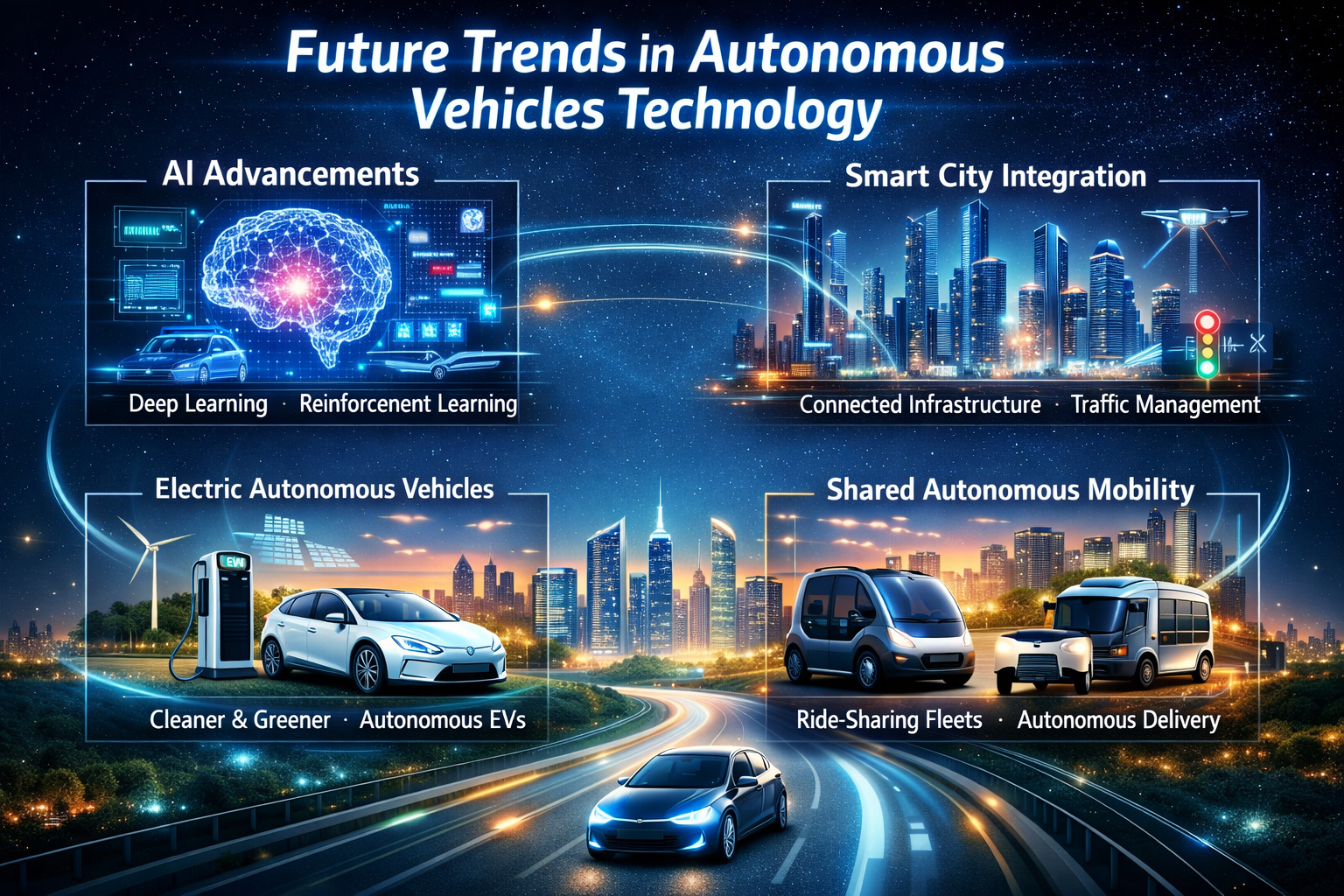
Future Trends in Autonomous Vehicles Technology
The future of autonomous vehicles technology is bright, with rapid advancements in AI, connectivity, and smart mobility shaping the next generation of self-driving cars. These trends indicate not only what will be possible but also how autonomous vehicles will integrate into daily life, cities, and the global transportation ecosystem.
AI Advancements in Self-Driving Cars
Artificial intelligence will continue to improve perception, decision-making, and predictive capabilities:
- Deep learning models will better handle rare or complex driving scenarios, reducing accidents caused by edge cases.
- Reinforcement learning will allow vehicles to learn from real-world interactions, improving driving behavior over time.
- Natural language processing (NLP) may enable passengers to communicate directly with vehicles for route planning or emergency instructions.
These AI improvements will make autonomous vehicles safer, more reliable, and more adaptable to diverse driving environments.
Integration with Smart Cities
Autonomous vehicles will increasingly connect to smart city infrastructure, enabling:
- Real-time traffic management to reduce congestion.
- Dynamic routing based on city-wide data on accidents, road closures, or public events.
- Coordination with autonomous public transit, ride-sharing, and delivery fleets for a seamless mobility ecosystem.
This integration will transform urban planning, reduce travel times, and optimize transportation efficiency.
Autonomous Electric Vehicles
Electric vehicles (EVs) and autonomous vehicles are converging. Self-driving EVs will:
- Reduce greenhouse gas emissions by combining electric power with efficient autonomous routing.
- Support shared autonomous mobility, lowering the number of vehicles on the road and reducing urban congestion.
- Benefit from connected charging infrastructure, allowing vehicles to autonomously find and schedule charging sessions.
Shared Autonomous Mobility Models
Autonomous vehicles will facilitate new mobility models, including:
- Autonomous ride-sharing fleets, providing affordable, on-demand transportation.
- Self-driving delivery networks, improving logistics efficiency and reducing human labor costs.
- Autonomous micro-transit systems, like shuttles for campuses, airports, and urban neighborhoods.
These models could dramatically change car ownership patterns, reduce traffic congestion, and make transportation more accessible to everyone.
Comments are closed, but trackbacks and pingbacks are open.