What Is Future Technology Analysis?
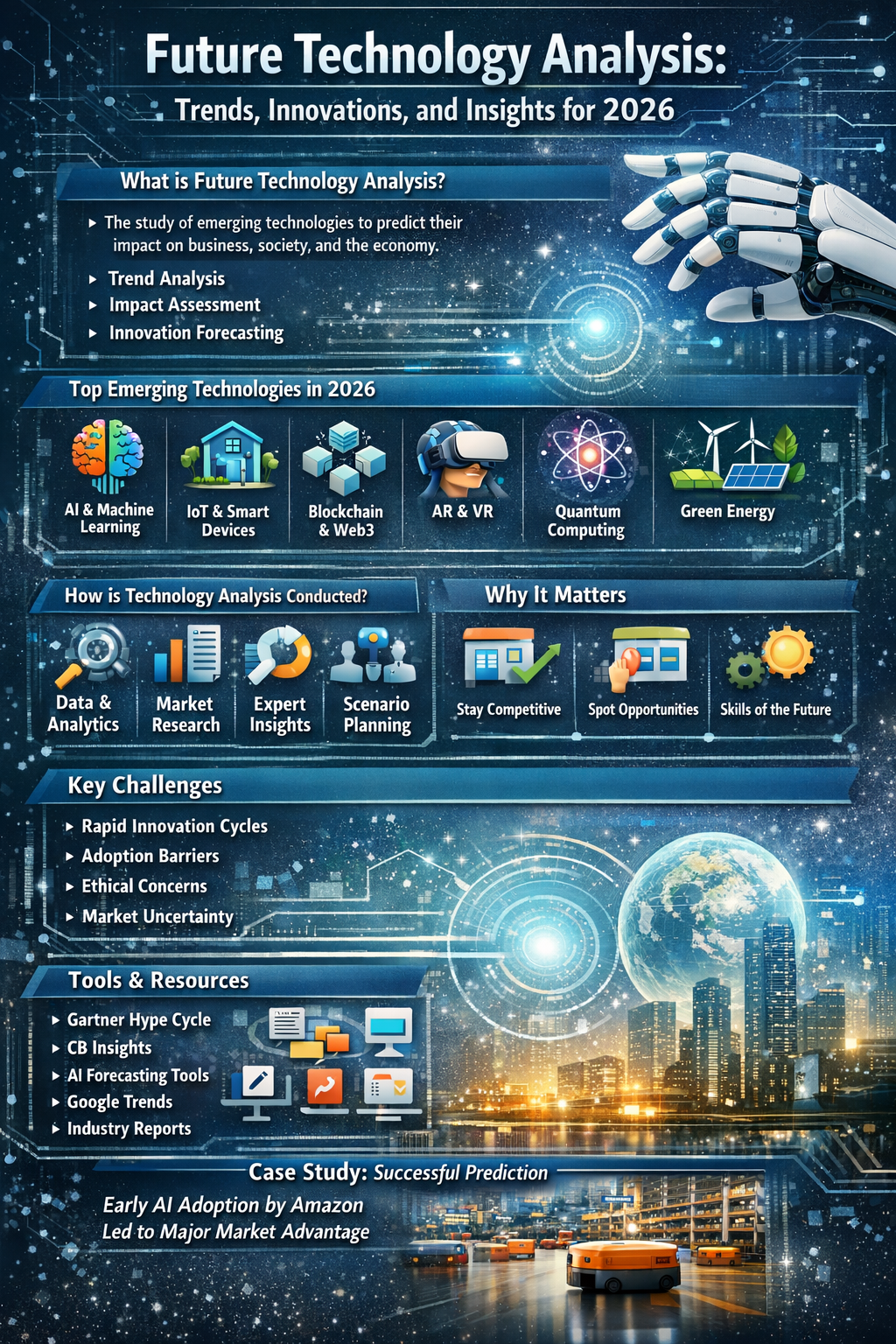
Future Technology Analysis is the process of studying emerging, evolving, and disruptive technologies to understand how they will shape the future. It focuses on predicting trends, evaluating impact, and preparing for change rather than reacting after technology has already transformed industries.
Unlike general tech news, future technology analysis looks deeper. It asks why a technology matters, how it will evolve, and who it will affect most.http://futuretechfrontier.com
Simple Definition
Future Technology Analysis is the systematic evaluation of upcoming technologies to forecast their long-term impact on business, society, and the global economy.
What Makes Future Technology Analysis Different
Future technology analysis is not about speculation or hype. It relies on:
- Data-driven forecasting
- Historical trend analysis
- Market adoption patterns
- Research and development activity
- Economic and social indicators
This helps distinguish between:
- Short-term tech hype
- Sustainable, long-term innovation
Key Goals of Future Technology Analysis
The main objectives include:
- Identifying emerging technologies early
- Understanding risks and opportunities
- Guiding strategic planning
- Supporting smarter investment decisions
- Preparing the workforce for future skills
Core Components of Future Technology Analysis
| Component | Description |
|---|---|
| Trend Analysis | Studying long-term tech patterns |
| Impact Assessment | Measuring effects on industries and society |
| Adoption Forecasting | Predicting how fast tech will scale |
| Risk Evaluation | Identifying ethical, security, and economic risks |
| Opportunity Mapping | Finding new markets and business models |
Who Uses Future Technology Analysis
Future technology analysis is widely used by:
- Corporations – to guide innovation and digital transformation
- Governments – to shape policy and infrastructure
- Investors – to spot high-growth opportunities
- Researchers – to guide long-term studies
- Educators and professionals – to align skills with future demand
Real-World Example
A strong example of future technology analysis in action is Artificial Intelligence:
- Early analysis predicted AI’s role in automation.
- Businesses that adopted AI early gained efficiency and scale.
- Late adopters struggled to compete.
This shows how future technology analysis can create competitive advantage when applied correctly.
Why It’s Becoming More Important in 2026
Technology cycles are getting shorter. Innovations that once took decades now scale in years or even months.
Key drivers include:
- Faster computing power
- Global connectivity
- AI-driven research
- Increased venture capital investment
As a result, future technology analysis is no longer optional—it’s essential.
Top Emerging Technologies in 2026
The field of technology is evolving faster than ever. Future Technology Analysis requires understanding the key innovations shaping the world. Here’s a deep dive into the most important emerging technologies for 2026 and beyond.
Artificial Intelligence (AI) and Machine Learning (ML)
AI continues to dominate as the most transformative technology. It is reshaping industries by automating processes, improving decision-making, and enhancing personalization.
- Applications:
- Healthcare: AI assists in diagnosis, drug discovery, and predictive analytics.
- Finance: AI predicts market trends, automates trading, and detects fraud.
- Retail: AI-driven recommendation engines improve customer experience.
- 2026 Forecasts:
- AI adoption is expected to reach 80% of enterprise applications.
- Generative AI will continue to grow, impacting content creation, design, and software development.
- Ethical AI frameworks will become a business necessity.
Case Study: Google’s AI in healthcare helped reduce diagnostic errors by over 30% in pilot programs, highlighting AI’s transformative potential.
Internet of Things (IoT) and Smart Devices
IoT connects everyday devices to the internet, creating smart ecosystems that improve efficiency and convenience.
- Trends for 2026:
- Smart homes and cities will see increased adoption, integrating energy, traffic, and security management.
- Industrial IoT (IIoT) will optimize manufacturing, logistics, and predictive maintenance.
- Security and privacy will remain the biggest challenge, driving innovations in encrypted and decentralized IoT networks.
- Example: Tesla vehicles use IoT for real-time monitoring, predictive maintenance, and self-driving features.
Blockchain and Web3 Technology
Beyond cryptocurrencies, blockchain is enabling secure and transparent systems for various sectors:
- Applications:
- Supply chain transparency
- Digital identity verification
- Smart contracts for business automation
- Web3 Forecast 2026:
- More decentralized platforms for finance (DeFi), content creation, and governance.
- Integration with IoT and AI for autonomous decentralized systems.
Data Point: Deloitte predicts that 30% of large enterprises will use blockchain for critical operations by 2026.
Augmented Reality (AR) and Virtual Reality (VR)
Immersive technology is revolutionizing how people interact with digital content:
- Applications:
- Education: Virtual classrooms and simulations for learning
- Gaming and Entertainment: Fully immersive experiences
- Retail: Virtual try-ons and interactive shopping
- 2026 Trends:
- AR will become widely integrated in daily life via smartphones and wearables.
- VR will expand beyond gaming to business collaboration, training, and therapy.
Fact: The AR/VR market is projected to reach $125 billion by 2026, driven by enterprise adoption.
Robotics and Automation
Robotics is not just about manufacturing—automation is transforming services, logistics, and healthcare.
- Trends:
- Collaborative robots (cobots) working alongside humans in factories.
- AI-driven automation in logistics, warehouse management, and retail.
- Robotic surgery and care assistants in healthcare.
- Impact:
- Reduced operational costs
- Increased efficiency and safety
- Shift in workforce skill requirements
Quantum Computing
Quantum computing promises to solve complex problems that classical computers cannot.
- Applications:
- Drug discovery and molecular simulation
- Cryptography and cybersecurity
- Optimization problems in logistics and finance
- 2026 Predictions:
- Quantum computers will be more accessible via cloud platforms.
- Early adoption will provide a significant advantage in research-intensive industries.
Quote: “Quantum computing is the next frontier in solving problems that were previously impossible,” – IBM Research.
Renewable Energy and Green Technology
Sustainability is becoming a key driver for technological innovation.
- Trends in 2026:
- Solar, wind, and hydrogen energy solutions gaining efficiency and scale
- Smart grids and energy storage improving reliability
- AI-driven energy management systems reducing consumption
- Impact:
- Reduced carbon footprint for industries and cities
- Integration of green tech into urban planning and infrastructure
Fact: Global investment in renewable energy technologies is projected to exceed $2 trillion by 2026, highlighting the strategic importance of green tech.
Summary Table: Emerging Technologies 2026
| Technology | Key Applications | Predicted Impact 2026 |
|---|---|---|
| AI & ML | Healthcare, finance, retail | 80% enterprise adoption, ethical AI frameworks |
| IoT & Smart Devices | Homes, cities, industry | Integrated smart ecosystems, security improvements |
| Blockchain & Web3 | Finance, supply chains, governance | 30% enterprise adoption for critical ops |
| AR & VR | Education, gaming, retail | $125B market, immersive business & learning tools |
| Robotics & Automation | Manufacturing, logistics, healthcare | Cost reduction, increased efficiency, workforce shift |
| Quantum Computing | Research, optimization, cybersecurity | Cloud accessibility, competitive edge in R&D |
| Green Tech & Renewable Energy | Energy management, sustainability | $2T investment, global carbon footprint reduction |
This section provides a comprehensive view of the technologies shaping 2026, forming the foundation for any future technology analysis.
How Future Technology Analysis is Conducted
Conducting Future Technology Analysis is both an art and a science. It involves systematic research, forecasting, and evaluation to predict which technologies will succeed, how fast they will scale, and what their broader impact will be. Analysts combine data-driven methods, expert insights, and market observation to create actionable intelligence.
Trend Forecasting Techniques
Trend forecasting is at the heart of future technology analysis. Analysts use several methods:
- Historical Trend Analysis
- Examining past technology adoption patterns to predict future behavior.
- Example: Studying how smartphones rapidly replaced feature phones helped forecast the adoption of AI-powered mobile applications.
- Predictive Analytics
- Using data models, machine learning, and statistical tools to forecast future tech trends.
- Example: AI models predicting autonomous vehicle adoption based on traffic patterns, urban planning, and regulatory trends.
- Market Research and Surveys
- Gathering insights from businesses, consumers, and industry experts.
- Example: Surveys of enterprises on their cloud computing adoption helped estimate the growth trajectory of cloud services in 2026.
- Patent and Investment Analysis
- Tracking patents filed and venture capital investments to identify emerging technologies.
- Example: A spike in quantum computing patents can indicate rapid innovation in the field.
Identifying Disruptive Technologies
Not all technologies are created equal. Some will redefine industries, while others fade away. Analysts identify disruptive technologies using these criteria:
- Market Potential – Can it scale to millions of users?
- Innovation Gap – Does it solve problems current tech cannot?
- Adoption Barriers – Are there regulatory, cost, or technical hurdles?
- Cross-Industry Impact – Will it affect multiple sectors?
Case Study: Blockchain was initially limited to cryptocurrency, but analysis of its potential led to adoption in supply chains, finance, and healthcare. Early recognition of disruptive potential allowed companies like IBM and Maersk to create competitive advantages.
Tools and Software for Technology Analysis
Modern technology analysis is powered by software and AI tools. Examples include:
| Tool/Software | Purpose |
|---|---|
| Gartner Hype Cycle | Evaluates maturity and adoption of technologies |
| CB Insights | Tracks tech startups, patents, and investments |
| Google Trends & Analytics | Monitors search trends and user interest |
| AI Forecasting Tools | Predicts adoption speed and market impact |
| Industry Reports (McKinsey, Deloitte, PwC) | Provides expert insights and statistical forecasts |
Using these tools, analysts can quantify trends, validate assumptions, and generate data-driven predictions, making their future technology analysis much more reliable.
Steps in Conducting Future Technology Analysis
- Define the Scope – Decide which industries, technologies, or regions to study.
- Collect Data – Use patents, research papers, investment reports, and market surveys.
- Analyze Patterns – Apply forecasting models, trend analysis, and expert insights.
- Assess Impact – Examine economic, social, ethical, and environmental consequences.
- Create Actionable Insights – Translate findings into strategies for businesses, investors, or policy-makers.
Why Methodology Matters
Without a proper methodology, future technology analysis risks being speculative or biased. Structured analysis ensures that predictions are credible, evidence-based, and actionable, which is why organizations rely heavily on professional analysts, AI tools, and research frameworks.
This section explains how experts conduct future technology analysis, combining data, expert opinion, and tools to forecast trends accurately.
Why Future Technology Analysis Matters
Understanding and analyzing future technologies is no longer just a “nice-to-have.” For businesses, investors, and professionals, it has become an essential strategic tool. Future technology analysis helps organizations anticipate disruption, seize opportunities, and stay competitive in an increasingly fast-paced world.
For Businesses and Startups
Businesses that embrace future technology analysis can:
- Plan strategic innovation: By identifying emerging technologies early, companies can develop products or services ahead of competitors.
- Optimize resource allocation: Businesses can invest wisely in technologies with high ROI potential.
- Stay resilient: Companies prepared for tech disruptions can adapt faster during market changes.
Example: Amazon’s early adoption of AI and robotics in its warehouses allowed it to reduce delivery times, cut costs, and scale globally, giving it a competitive advantage over traditional retailers.
For Investors and Venture Capitalists
Investors rely heavily on future technology analysis to spot high-growth opportunities:
- Identify lucrative markets: By analyzing emerging tech trends, investors can predict which sectors are poised for rapid growth.
- Minimize risk: Understanding potential adoption barriers and market saturation reduces investment mistakes.
- Strategic timing: Early investments in disruptive technologies often yield higher returns.
Fact: According to Crunchbase, startups focusing on AI and blockchain attracted over $120 billion in investments in 2025, reflecting investor confidence in these future technologies.
For Professionals and Tech Enthusiasts
Future technology analysis is also crucial for individuals planning careers in tech:
- Career preparation: Professionals can acquire in-demand skills aligned with emerging tech.
- Stay competitive: Awareness of future trends allows individuals to anticipate industry shifts.
- Upskilling opportunities: Analysis highlights areas like AI, IoT, and green technology where talent demand will increase.
Quote: “Those who understand future technologies today will lead the industries of tomorrow.”
Broader Impacts on Society
- Economic growth: Emerging technologies create new industries and jobs.
- Improved quality of life: Innovations in healthcare, energy, and transportation enhance living standards.
- Global competitiveness: Countries that invest in technology analysis can maintain a competitive edge in the global economy.
Example: South Korea and Singapore use government-led technology analysis to guide investments in AI, robotics, and smart city infrastructure, making them leaders in innovation adoption.
Summary Table: Impact of Future Technology Analysis
| Stakeholder | Benefits |
|---|---|
| Businesses | Strategic innovation, cost optimization, resilience |
| Investors | Early opportunity identification, risk reduction, higher ROI |
| Professionals | Career planning, upskilling, industry foresight |
| Society | Economic growth, better quality of life, global competitiveness |
In short, future technology analysis is a roadmap for navigating uncertainty. It empowers businesses, investors, and individuals to make informed decisions, reduce risks, and capture opportunities before others do.
Challenges in Predicting Future Technologies
While future technology analysis provides valuable insights, it is not without challenges. Predicting what technologies will succeed and how they will impact society is complex and uncertain, requiring analysts to navigate several obstacles. Understanding these challenges is crucial for creating realistic and actionable forecasts.
1. Rapid Pace of Innovation
Technological advancement is accelerating, making predictions increasingly difficult:
- New breakthroughs can suddenly disrupt forecasts.
- Technologies that seemed niche a few years ago, like AI-generated content, can rapidly become mainstream.
- Analysts must continuously update models to account for unexpected innovations.
Example: The unexpected rise of generative AI tools like ChatGPT in 2023 reshaped industries almost overnight, proving how quickly trends can shift.
2. Technology Adoption Barriers
Even promising technologies may face adoption hurdles:
- High costs of implementation
- Regulatory restrictions or government policies
- Public resistance or ethical concerns
- Integration challenges with existing systems
Example: Autonomous vehicles have existed for years, but adoption remains slow due to regulatory, safety, and infrastructure challenges.
3. Ethical and Social Considerations
Future technologies often raise ethical questions that impact adoption:
- AI bias and privacy concerns
- Genetic editing and biotechnology ethics
- Environmental impacts of energy-intensive tech like blockchain or quantum computing
Analysts must weigh these factors to predict whether a technology will be widely accepted or restricted.
4. Uncertainty in Market Trends
Markets can behave unpredictably, even for promising technologies:
- Consumer preferences may change rapidly.
- Global economic shifts can alter investment priorities.
- Competitors may introduce alternative solutions that outperform predictions.
Fact: The early 2000s saw a huge push for 3D TVs, but consumer adoption failed due to high costs and limited content, despite technological feasibility.
5. Difficulty in Measuring Long-Term Impact
Some technologies take years or decades to reveal their full impact:
- Early metrics may underestimate potential benefits.
- Conversely, some “hyped” innovations may never achieve significant adoption.
Example: Blockchain was initially hyped for every industry but only gained substantial traction in finance, supply chain, and digital identity over time.
Summary Table: Challenges in Future Technology Analysis
| Challenge | Explanation | Example |
|---|---|---|
| Rapid Innovation | Unexpected breakthroughs disrupt predictions | Generative AI’s sudden rise |
| Adoption Barriers | High costs, regulations, or public resistance | Autonomous vehicles |
| Ethical & Social Issues | Privacy, bias, environmental concerns | AI surveillance & biotech ethics |
| Market Uncertainty | Consumer preferences & economic shifts | 3D TV adoption failure |
| Long-Term Impact | Hard to measure potential success or failure | Blockchain adoption over a decade |
Despite these challenges, structured analysis, data-driven forecasting, and expert insights help mitigate uncertainty and make predictions more reliable.
Future Technology Analysis Tools and Resources
Conducting a thorough future technology analysis requires the right tools, resources, and frameworks. Analysts rely on a combination of data analytics, expert insights, research reports, and AI-driven platforms to predict trends accurately. Using the right tools helps minimize errors and identify actionable opportunities in emerging technologies.
1. Industry Reports and Research Publications
Analysts often start with authoritative reports and studies from leading institutions:
- Gartner Hype Cycle – Evaluates the maturity, adoption, and potential impact of technologies.
- Deloitte Tech Trends – Provides insights into emerging technologies and their business implications.
- McKinsey & Company Reports – Offers data-driven research on industry trends and digital transformation.
- PwC Future of Industries – Highlights how technologies like AI, blockchain, and robotics impact global markets.
Tip: Regularly monitoring these reports helps analysts identify early signals of adoption and understand which technologies are gaining momentum.
2. Patent and Investment Tracking Tools
Tracking patents and investments can indicate where innovation is accelerating:
- CB Insights – Tracks startup funding, patents, and market trends.
- Crunchbase – Provides information on company growth, venture funding, and emerging sectors.
- Patent Analytics Platforms – Analyze the volume and scope of patents in specific tech domains.
Insight: A spike in patents or venture funding often signals a high-growth technology poised for adoption.
3. AI-Powered Trend Forecasting Tools
Modern technology analysis increasingly leverages AI and machine learning:
- Predicts adoption rates of emerging tech
- Analyzes large datasets to find patterns in investment, research, and consumer behavior
- Generates scenario modeling to evaluate potential market impact
Example Tools:
- DataRobot – AI forecasting for technology trends
- SAS Analytics – Predictive modeling for innovation analysis
4. Market Research and Analytics Platforms
Platforms that track real-time market trends provide valuable insights:
- Google Trends – Shows search interest for emerging technologies
- Statista – Provides statistical data on adoption, market size, and technology penetration
- LinkedIn Insights – Monitors hiring trends in emerging tech sectors
Benefit: These tools allow analysts to validate predictions with real-world interest and adoption data.
5. Academic and Open Research Sources
- Research papers from IEEE, Nature, and MIT Technology Review
- Open-access journals and university-led research on AI, quantum computing, and biotechnology
- These sources provide technical insights and early-stage innovation trends that may not yet be mainstream.
Summary Table: Key Tools for Future Technology Analysis
| Tool/Resource | Purpose | Example Use |
|---|---|---|
| Gartner Hype Cycle | Tech maturity and adoption | Evaluate AI and blockchain potential |
| CB Insights / Crunchbase | Patents & investments | Identify high-growth startups |
| AI Forecasting Tools | Predict adoption & market trends | ML-powered adoption predictions |
| Market Analytics Platforms | Real-time market data | Google Trends, Statista for consumer insights |
| Academic Research | Early-stage innovations | MIT, IEEE papers for cutting-edge technologies |
Best Practices for Using Tools
- Combine multiple sources – Avoid relying on a single report or platform.
- Validate with real-world data – Use market analytics to confirm trends.
- Track over time – Technology adoption patterns change rapidly.
- Integrate expert insights – Combine quantitative data with qualitative analysis.
Insight: Tools alone are not enough; analysts need context, expertise, and strategic thinking to produce actionable future technology analysis.
Comments are closed, but trackbacks and pingbacks are open.