
Introduction to Entertainment Technology Trends
The landscape of media and entertainment is evolving faster than ever, driven by breakthroughs in digital technology, artificial intelligence, virtual reality, and immersive experiences. When we talk about entertainment technology trends, we are referring to the technologies that are transforming how people create, consume, and interact with content across movies, music, gaming, live events, and digital media.
The past decade has already shown remarkable innovations. Streaming platforms like Netflix and Disney+ revolutionized the way we access content, while AI-driven recommendation engines personalized user experiences, ensuring viewers get precisely what they want to watch. Simultaneously, immersive experiences powered by virtual reality (VR) and augmented reality (AR) are beginning to blur the lines between the digital and physical worlds, giving rise to entirely new forms of storytelling and engagement.http://futuretechfrontier.com
Why Understanding Entertainment Technology Trends Matters
Understanding the latest entertainment technology trends is essential for multiple stakeholders:
- For creators and studios: Knowing which technologies are rising helps in planning productions that are both innovative and cost-effective.
- For consumers: Awareness of new tech enables access to more immersive, interactive, and personalized entertainment experiences.
- For businesses and investors: Staying updated ensures they can identify profitable opportunities, adapt to shifting market demands, and maintain a competitive edge.
Key takeaway: Technology is not just enhancing entertainment—it is redefining the very way we experience media, from the movies we watch and games we play to the concerts we attend and the music we stream.
Quote: “The future of entertainment lies not just in content creation, but in creating experiences that immerse, engage, and resonate with audiences worldwide.”
What This Guide Covers
In this comprehensive guide on Entertainment Technology Trends, you will learn:
- The definition and significance of entertainment technology trends
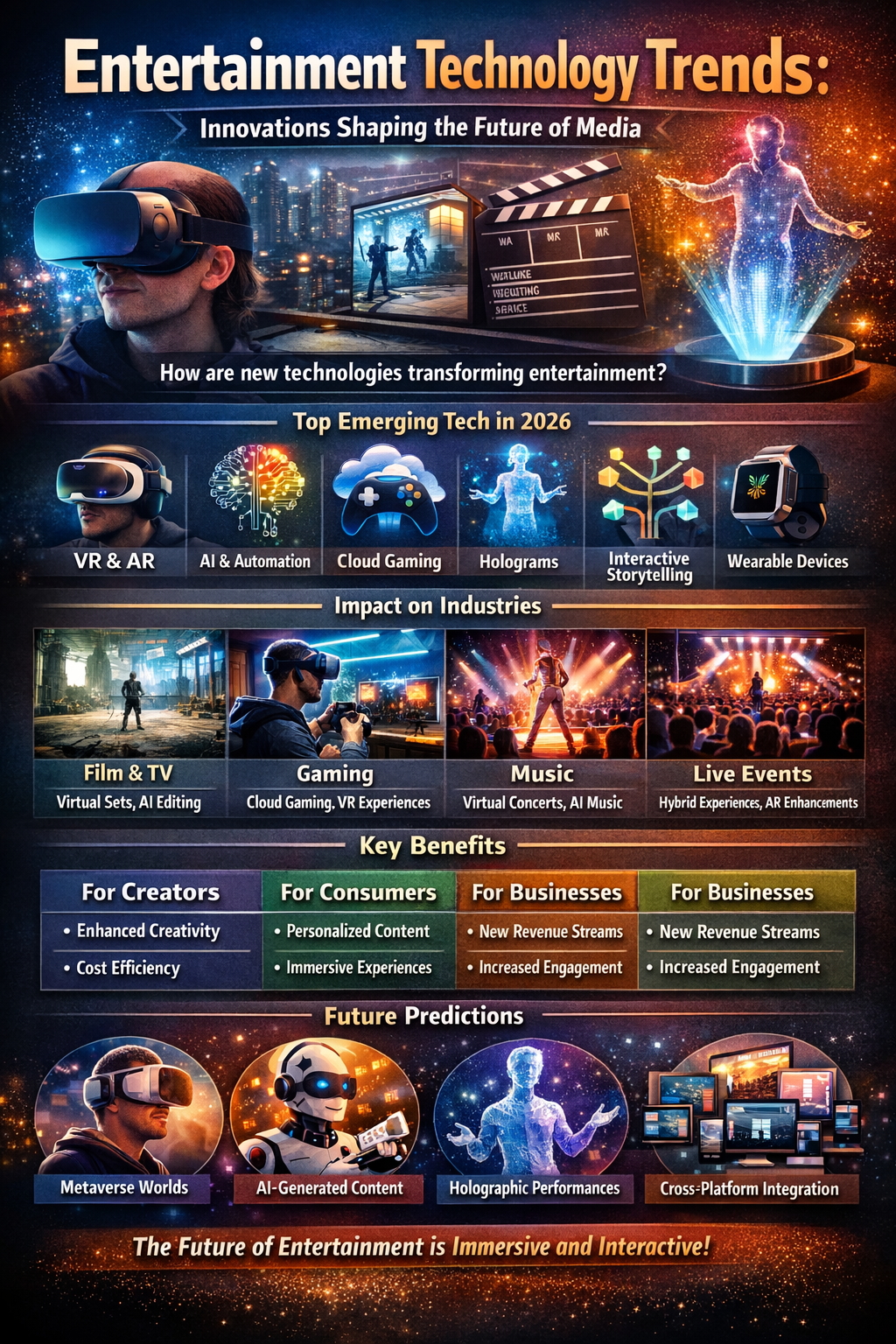
- The top emerging technologies in media and entertainment for 2026
- How these technologies are transforming industries such as gaming, music, film, and live events
- The benefits and challenges of adopting new technologies
- Tools and platforms that are driving innovation
- Real-world case studies demonstrating successful applications of emerging tech
- Predictions for the future of entertainment technology
With this knowledge, creators, businesses, and consumers alike can anticipate changes, leverage innovations, and enhance experiences in the entertainment world.
What Are Entertainment Technology Trends?
Entertainment technology trends refer to the latest innovations and technological advancements that are shaping the creation, distribution, and consumption of media and entertainment content. These trends encompass a wide range of industries, including film, television, gaming, music, live events, and digital media platforms. Essentially, they are the technologies that change the way audiences experience entertainment, making it more immersive, personalized, and interactive.
Over the past decade, we’ve witnessed a dramatic shift in entertainment consumption. Traditional media formats like DVDs, CDs, and cable television have largely been replaced by streaming platforms, digital downloads, and cloud-based experiences. Similarly, the rise of mobile gaming, interactive apps, and virtual concerts has redefined engagement, making it increasingly participatory rather than passive.
Key Components of Entertainment Technology Trends
Entertainment technology trends can be broadly classified into several areas:
- Content Creation Innovations
- AI-driven scriptwriting and editing
- CGI and special effects in films and video games
- Automated music and sound production
- Distribution and Delivery Innovations
- High-speed streaming platforms
- Cloud gaming services
- 5G-enabled immersive experiences
- Consumption Enhancements
- Personalized recommendation systems
- VR/AR-based immersive storytelling
- Interactive media and gamified experiences
- Hardware and Device Innovations
- Wearable tech for haptic feedback and AR
- Smart devices that integrate seamlessly with media platforms
- High-definition displays and projection technologies
Example: The introduction of AI recommendation engines by streaming platforms like Netflix and Spotify is a perfect example of an entertainment technology trend that has transformed the way audiences discover and enjoy content. By analyzing viewing habits, these systems suggest content tailored to individual preferences, increasing engagement and retention.
Why These Trends Are Important
Understanding entertainment technology trends is essential because they help stakeholders:
- Anticipate changes in audience behavior
- Invest wisely in technologies with high adoption potential
- Create competitive advantage in a saturated market
- Enhance user experience through personalized and immersive content
Historical Context
Looking back, some of today’s entertainment tech trends have roots in earlier innovations:
| Era | Key Technological Shift | Impact on Entertainment |
|---|---|---|
| 1980s | VHS & CD | Shift from theaters and live music to home media |
| 1990s | DVD & Internet | Digital content distribution begins |
| 2000s | Streaming & MP3 | On-demand media consumption emerges |
| 2010s | Mobile & AI | Personalized media and app-based experiences |
| 2020s | VR/AR, Cloud Gaming, AI Content | Immersive and interactive media revolution |
Insight: Each new technology not only changes how content is delivered but also reshapes the business models, audience expectations, and creative possibilities for media creators.
Top Emerging Entertainment Technologies in 2026
The entertainment industry is undergoing a massive transformation thanks to cutting-edge technologies. Entertainment technology trends in 2026 focus on immersive, interactive, and AI-driven innovations that are reshaping the way audiences experience media. From VR and AR to AI-generated content, these technologies are creating new possibilities for creators, businesses, and consumers alike.
Virtual Reality (VR) and Augmented Reality (AR)
VR and AR are no longer niche technologies—they are becoming mainstream tools for gaming, live events, and immersive storytelling.
- Virtual Reality (VR): Completely immerses users in a digital environment using headsets and sensors. Popular in gaming, virtual concerts, and immersive movie experiences.
- Augmented Reality (AR): Overlays digital elements onto the real world using smartphones, tablets, or smart glasses. AR is increasingly used in interactive live events, music videos, and theme park attractions.
Trends in 2026:
- VR and AR adoption is expected to grow by over 40% in entertainment applications.
- AR-enabled concerts and virtual festivals will provide interactive experiences for global audiences.
- VR esports and social VR platforms will expand, allowing gamers to interact in fully immersive environments.
Case Study: The Wave, a virtual reality concert platform, hosted live events where attendees’ avatars could interact with performers and each other, drawing thousands of participants worldwide.
Artificial Intelligence (AI) in Entertainment
AI is revolutionizing content creation, distribution, and personalization:
- Content Creation: AI generates scripts, edits videos, and even produces music tracks.
- Recommendation Engines: Streaming platforms use AI to predict audience preferences, boosting engagement.
- Predictive Analytics: Studios use AI to forecast box office success or streaming popularity.
2026 Outlook:
- AI-generated content will become standard in indie filmmaking and digital media.
- Personalized AI-driven playlists, shows, and games will dominate user experiences.
- Ethical AI frameworks will become crucial for content creators to avoid bias and misinformation.
Fact: Netflix credits its AI-powered recommendation system for driving over 80% of all viewed content, demonstrating the immense impact of AI in entertainment.
Streaming Technology and Cloud Gaming
The shift to on-demand digital experiences continues:
- Streaming Platforms: High-speed, low-latency streaming ensures cinematic-quality content anywhere.
- Cloud Gaming: Platforms like Google Stadia, Nvidia GeForce Now, and Xbox Cloud Gaming allow users to play high-end games without expensive hardware.
- Mobile Streaming: 5G technology enables real-time, interactive experiences on smartphones.
Key Insight: Cloud gaming and streaming platforms are converging, allowing interactive, multi-device entertainment with minimal delays.
Holographic and 3D Projection Technology
Holograms and 3D projection are transforming live events:
- Holographic Performances: Musicians and performers can “appear” on stage in multiple locations simultaneously.
- 3D Projections: Cinemas and theme parks use projection mapping to create immersive visual experiences.
- Hybrid Experiences: Combines physical and digital audiences in concerts, conferences, and exhibitions.
Example: The ABBA hologram tour used photorealistic 3D projections to sell out arenas, blending nostalgia with cutting-edge entertainment tech.
Interactive Storytelling and Immersive Media
Audiences no longer just watch—they participate:
- Choose-Your-Own-Adventure: Platforms like Netflix experimented with interactive shows allowing viewers to make story decisions.
- Gamified Experiences: Media content integrates gameplay elements to increase engagement.
- Multi-Sensory Experiences: Some VR and AR platforms add sound, haptic feedback, and even smell simulation to create fully immersive worlds.
Insight: Interactive storytelling increases viewer retention and engagement by 50–60% compared to passive content consumption.
Wearable Technology and Smart Devices
Wearables are creating new ways to consume and interact with entertainment:
- Haptic Suits: Allow users to feel digital sensations during gaming or VR experiences.
- Smart Glasses: Overlay AR content seamlessly into everyday life.
- IoT Integration: Wearables connect to smart homes, lighting, and sound systems for synchronized entertainment experiences.
2026 Forecast: Wearables will be widely used in gaming, live concerts, fitness-integrated entertainment, and immersive storytelling.
Summary Table: Emerging Entertainment Technologies 2026
| Technology | Applications | Predicted Impact 2026 |
|---|---|---|
| VR & AR | Gaming, concerts, theme parks | 40% growth in adoption, immersive experiences |
| AI | Content creation, recommendation engines | Drives personalization, boosts engagement |
| Streaming & Cloud Gaming | On-demand games & media | Interactive, multi-device entertainment |
| Holograms & 3D Projection | Live performances, cinemas | Global reach with hybrid experiences |
| Interactive Storytelling | VR narratives, gamified media | Increases engagement by 50–60% |
| Wearables & Smart Devices | Haptic suits, smart glasses | Enhances immersion and interactivity |
This section shows how emerging entertainment technologies are converging to create a future where experiences are immersive, interactive, and highly personalized.
How Entertainment Technology Is Transforming Industries
Entertainment technology trends are not just enhancing experiences—they are fundamentally reshaping multiple industries. From film and gaming to music and live events, technology is changing the way content is created, distributed, and consumed, creating new opportunities for businesses, creators, and audiences.
Film and Television
The film and TV industry has been an early adopter of technology, using it to enhance storytelling, streamline production, and reach global audiences:
- AI-Driven Editing and CGI: Studios use artificial intelligence to assist with visual effects, color grading, and scene optimization. AI can also predict audience reactions to storylines, helping producers make data-driven creative decisions.
- Virtual Sets and Digital Production: Technologies like green-screen VR sets reduce costs and allow filmmakers to create immersive worlds without location shoots.
- Streaming Integration: Traditional television is giving way to on-demand streaming platforms, offering personalized content based on user preferences.
Case Study: Disney’s The Mandalorian used virtual production stages powered by LED walls and real-time rendering technology, allowing actors to perform in immersive, digital environments. This approach not only improved efficiency but also opened up new creative possibilities for filmmakers.
Gaming Industry
Gaming is at the forefront of entertainment technology adoption, driving innovations that later spill into other industries:
- Cloud Gaming: Platforms like Nvidia GeForce Now and Xbox Cloud Gaming allow high-quality games to be played on any device without expensive hardware.
- AI in NPC Behavior: Artificial intelligence creates realistic, adaptive non-player characters (NPCs), enhancing player immersion.
- VR and AR Gaming: Games now offer fully immersive experiences where players interact physically with virtual environments.
Fact: The global VR gaming market is projected to reach $45 billion by 2026, highlighting the explosive growth of immersive entertainment.
Music Industry
Technology is revolutionizing how music is created, performed, and experienced:
- AI-Generated Music: AI tools can compose original tracks or assist artists in refining music.
- Virtual Concerts: Platforms like Fortnite and The Wave host digital concerts attended by millions worldwide.
- Personalized Playlists: Streaming platforms like Spotify use AI algorithms to create tailored listening experiences.
Example: Travis Scott’s virtual concert in Fortnite drew 12.3 million concurrent viewers, demonstrating the power of merging gaming and live music experiences.
Live Events and Sports
Live entertainment is being reimagined with technology:
- Hybrid Concerts: Combining physical attendance with virtual streaming allows artists to reach global audiences.
- Augmented Reality Enhancements: AR apps provide additional content during sports games, concerts, and theater performances.
- Digital Ticketing and Crowd Analytics: Smart ticketing and AI-powered audience tracking improve safety, efficiency, and engagement.
Insight: Entertainment technology allows scaling of live experiences, increasing both revenue and fan engagement.
Theme Parks and Attractions
Immersive technologies are also transforming theme parks and physical attractions:
- VR and AR Integration: Visitors can experience interactive rides and augmented tours.
- Smart Wearables: Wristbands and devices enhance user engagement by personalizing experiences, triggering AR effects, or tracking visitor preferences.
- Interactive Shows: Projection mapping, holograms, and robotics are being used to create dynamic, real-time entertainment for guests.
Fact: Disney and Universal Studios are investing heavily in immersive technology, projecting that over 70% of attractions will integrate AR/VR by 2026.
Summary Table: Industry Transformation via Entertainment Technology
| Industry | Technology Impact | Benefits |
|---|---|---|
| Film & TV | AI editing, virtual sets, streaming | Faster production, global reach, creative flexibility |
| Gaming | Cloud gaming, AI NPCs, VR/AR | Immersive gameplay, accessibility, personalized experiences |
| Music | AI music creation, virtual concerts | Global audience reach, content personalization, innovative experiences |
| Live Events | Hybrid concerts, AR, digital ticketing | Scalability, audience engagement, operational efficiency |
| Theme Parks | VR/AR, wearables, interactive shows | Enhanced visitor experience, personalization, engagement analytics |
Benefits of Emerging Entertainment Technology
The rise of entertainment technology trends is not just a novelty—it brings tangible benefits for creators, consumers, and businesses. These technologies are transforming how content is produced, delivered, and experienced, creating new opportunities and enhancing engagement across multiple platforms.
Benefits for Creators and Studios
- Enhanced Creativity: Technologies like VR, AR, and AI allow creators to experiment with new storytelling techniques, immersive worlds, and interactive narratives.
- Cost Efficiency: Virtual sets, AI-assisted editing, and digital production reduce production time and resource expenses.
- Global Reach: Digital platforms enable content to reach audiences worldwide, breaking geographical barriers.
- Data-Driven Insights: AI analytics provide insights into audience preferences, allowing creators to tailor content to maximize engagement.
Example: Netflix uses AI analytics to determine which shows to produce and how to market them, resulting in series like Stranger Things achieving global success.
Benefits for Consumers
- Personalized Experiences: Streaming platforms and AI recommendation engines tailor content based on viewing habits.
- Immersive Entertainment: VR, AR, and holographic performances allow consumers to engage with content in ways never possible before.
- Accessibility and Convenience: Cloud gaming, mobile streaming, and on-demand platforms allow users to access entertainment anytime, anywhere.
- Interactive Engagement: Choose-your-own-adventure shows, gamified apps, and multi-sensory experiences make audiences active participants rather than passive viewers.
Fact: Personalized streaming recommendations now account for up to 80% of user engagement on platforms like Netflix and Spotify.
Benefits for Businesses and Investors
- Revenue Growth: Emerging technologies create new monetization avenues, from virtual concerts to cloud gaming subscriptions.
- Customer Loyalty: Personalized and immersive experiences increase retention and long-term engagement.
- Market Differentiation: Early adoption of technologies like AI, VR, and AR positions companies as industry innovators.
- Data-Driven Strategy: Analytics from streaming and immersive platforms inform marketing, production, and distribution strategies.
Example: Fortnite’s collaboration with artists and brands to host virtual concerts generated millions of dollars while boosting the platform’s user base, demonstrating how immersive tech can create revenue and engagement simultaneously.
Summary Table: Benefits of Entertainment Technology Trends
| Stakeholder | Key Benefits | Examples |
|---|---|---|
| Creators & Studios | Creativity, cost efficiency, global reach, data insights | Netflix AI analytics, virtual film sets |
| Consumers | Personalization, immersion, accessibility, interactivity | VR concerts, cloud gaming, AR apps |
| Businesses & Investors | Revenue growth, customer loyalty, differentiation, data-driven strategy | Fortnite virtual concerts, AI-driven recommendations |
Challenges in Entertainment Technology Adoption
While entertainment technology trends offer exciting opportunities, their adoption comes with significant challenges. Creators, businesses, and consumers face technical, financial, and ethical hurdles that must be addressed for these technologies to reach their full potential.
1. High Costs of Implementation
Cutting-edge technologies like VR/AR headsets, AI-driven content creation, and holographic performances often require substantial investment:
- VR and AR hardware can cost hundreds or thousands of dollars per unit.
- AI tools for video editing, CGI, or music production require expensive software and skilled personnel.
- Large-scale immersive events, such as holographic concerts, require both technology and infrastructure investment.
Insight: Smaller studios and independent creators may struggle to adopt these technologies, creating a gap between major players and emerging content creators.
2. Technical Challenges
Advanced technologies come with inherent technical complexities:
- Bandwidth and Latency Issues: High-quality streaming and cloud gaming require fast, stable internet connections.
- Hardware Limitations: Consumers may not have devices capable of supporting VR, AR, or cloud-based experiences.
- Software Integration: Combining AI, AR, and streaming platforms seamlessly is technically challenging.
Example: Cloud gaming platforms like Google Stadia initially faced adoption hurdles due to latency problems affecting gameplay, highlighting the importance of robust infrastructure.
3. Privacy and Data Security
With AI-powered personalization and cloud-based platforms, user data collection is unavoidable:
- Streaming platforms track viewing habits to recommend content.
- VR and AR devices may collect motion data or biometric information.
- Cloud gaming platforms store user accounts, payment info, and gameplay history.
Risk: Without proper security measures, these platforms are vulnerable to breaches, leading to potential misuse of sensitive user data.
4. Ethical Concerns
Emerging technologies raise ethical questions that the industry must navigate:
- AI-generated content may create copyright or ownership issues.
- Deepfakes and AI-generated media can be used maliciously.
- Holographic performances of deceased artists raise moral and legal debates.
Insight: Establishing ethical standards is crucial to maintain trust among audiences and protect creators’ rights.
5. Accessibility and Adoption Barriers
Despite technological advancements, accessibility remains a challenge:
- Many immersive experiences require expensive hardware.
- Older audiences or users with disabilities may struggle to adapt.
- Global adoption varies based on internet connectivity, device availability, and digital literacy.
Fact: According to a 2025 report by Statista, over 60% of potential VR users cited hardware costs as the primary barrier to adoption, demonstrating the accessibility gap.
Summary Table: Challenges in Entertainment Technology Adoption
| Challenge | Description | Example |
|---|---|---|
| High Costs | Expensive hardware/software limits adoption | VR headsets, holographic concerts |
| Technical Issues | Bandwidth, latency, and integration challenges | Cloud gaming latency |
| Privacy & Security | Data collection and potential breaches | Streaming platform user data |
| Ethical Concerns | AI content misuse, hologram ethics | Deepfake videos, posthumous holograms |
| Accessibility | Hardware and digital literacy barriers | VR adoption among older audiences |
Future Predictions for Entertainment Technology
As we look ahead, entertainment technology trends are set to redefine the way people consume, create, and interact with media. By 2030, emerging technologies such as AI, VR/AR, holograms, and interactive media are expected to reach new levels of sophistication, enabling experiences that were once considered science fiction.
1. Fully Immersive Virtual Worlds
- The rise of metaverse platforms will allow users to explore fully interactive, persistent virtual worlds.
- Users can socialize, attend concerts, play games, and even work in digital environments simultaneously.
- VR and AR integration will make these experiences indistinguishable from reality, blurring the line between physical and digital entertainment.
Prediction: By 2030, over 50% of major gaming and entertainment platforms will integrate metaverse-style experiences.
2. AI-Curated and Generated Entertainment
- AI will create personalized content automatically based on individual tastes, moods, and viewing habits.
- Films, music, games, and interactive narratives will be partially or fully AI-generated.
- Predictive AI analytics will allow studios to forecast trends, optimize content creation, and maximize audience engagement.
Case Study: Amper Music and OpenAI’s MuseNet are already creating AI-generated music tracks that adapt to listener preferences, signaling the future potential of AI in entertainment.
3. Interactive and Multi-Sensory Storytelling
- Future entertainment will engage all senses, including sight, sound, touch, and potentially smell.
- Interactive narratives will allow users to make choices that affect story outcomes, increasing engagement and retention.
- Gamification of traditional media will become commonplace, bridging gaming, film, and live experiences.
Fact: Studies show that immersive and interactive experiences increase retention by up to 60% compared to traditional passive content consumption.
4. Holograms and Digital Avatars
- Holographic concerts, virtual influencers, and AI-generated digital actors will become mainstream.
- Deceased artists could perform “digitally resurrected” shows, raising both opportunities and ethical considerations.
- Digital avatars will host live events, gaming experiences, and social interactions in virtual spaces.
Example: Hatsune Miku, a virtual pop star in Japan, has already performed to millions using holographic projections—an early glimpse of the future of entertainment.
5. Cross-Platform and Hybrid Experiences
- Entertainment will be seamlessly integrated across devices, including smartphones, VR headsets, AR glasses, smart TVs, and wearable tech.
- Hybrid events, combining live and virtual attendance, will become the norm for concerts, sports, and interactive experiences.
- AI will synchronize content across platforms, ensuring users have consistent and personalized experiences regardless of device.
Insight: The convergence of cloud gaming, VR/AR, AI, and streaming technologies will create a fully interconnected entertainment ecosystem, where experiences are immersive, interactive, and tailored to individual preferences.
Summary Table: Future Entertainment Technology Predictions
| Trend | Description | Expected Impact by 2030 |
|---|---|---|
| Fully Immersive Virtual Worlds | Metaverse-style environments for socializing, gaming, and entertainment | 50%+ major platforms integrate VR/AR worlds |
| AI-Curated & Generated Content | Personalized AI-driven films, music, and games | Hyper-personalized entertainment experiences |
| Interactive & Multi-Sensory Storytelling | Gamified narratives engaging all senses | Increased retention by 60% |
| Holograms & Digital Avatars | Virtual concerts, AI actors, digital influencers | Global audience reach, hybrid events |
| Cross-Platform Integration | Seamless experiences across devices | Consistent and connected entertainment ecosystem |
Comments are closed, but trackbacks and pingbacks are open.