The digital landscape is evolving faster than ever, driven by emerging digital technologies that are reshaping industries, businesses, and our everyday experiences. From artificial intelligence (AI) to blockchain, Internet of Things (IoT) devices, and quantum computing, these innovations are not just futuristic concepts—they are actively changing how we work, communicate, and interact with the world. Understanding these technologies is no longer optional; it’s essential for businesses looking to stay competitive and for individuals who want to thrive in an increasingly digital world.
In this comprehensive guide, we will explore the full spectrum of emerging digital technologies, their benefits, challenges, future trends, and actionable insights to help businesses and individuals adapt to this fast-paced digital era.http://futuretechfrontier.com
What Are Emerging Digital Technologies?
Emerging digital technologies refer to the latest innovations in the digital and tech space that are still evolving but have the potential to significantly impact industries and society. Unlike traditional technologies that have matured and become standard tools, emerging technologies are on the cutting edge—they are experimental, rapidly improving, and often transformative.
These technologies are not just new gadgets or software—they are systems and solutions that fundamentally change how we process information, make decisions, and interact with the world. For instance, AI-powered analytics allows companies to predict market trends with high accuracy, while IoT-enabled devices connect millions of everyday products to the internet, creating intelligent networks that improve efficiency and convenience.
Key characteristics of emerging digital technologies include:
- Innovation-driven: Often based on the latest research and breakthroughs.
- Rapidly evolving: Frequent updates, upgrades, and new applications.
- High impact: Potential to disrupt existing business models and social norms.
- Integration potential: Can combine with other technologies for exponential value (e.g., AI + IoT + 5G).
Difference Between Emerging and Traditional Technologies
While traditional digital technologies—like spreadsheets, legacy software, or early enterprise databases—focus on improving efficiency and productivity, emerging digital technologies aim to redefine processes and create new possibilities.
| Aspect | Traditional Technologies | Emerging Digital Technologies |
|---|---|---|
| Adoption | Widely adopted and standardized | Early adoption, still evolving |
| Impact | Incremental improvements | Transformative, can disrupt industries |
| Flexibility | Limited integration | Highly integrable with other systems |
| Innovation Level | Mature, stable | Cutting-edge, experimental |
For example, cloud computing has become mainstream and widely adopted, but AI-driven cloud services are still emerging, providing advanced analytics, automation, and predictive insights that were impossible with older systems.
Why Businesses and Individuals Should Care
The adoption of emerging digital technologies is no longer optional—it’s becoming essential. Businesses leveraging these technologies gain competitive advantages, better customer insights, and improved operational efficiency. For example, a recent McKinsey report found that companies that actively implement emerging technologies see productivity gains of 20–30% within their first few years of adoption.
Individuals who understand and adapt to these technologies can benefit by enhancing their digital skills, staying relevant in the job market, and exploring new opportunities in tech-driven industries. In a world where digital literacy is increasingly tied to career success, staying informed about emerging digital technologies is crucial.
✅ Key Takeaways:
- Emerging digital technologies are innovations that are still evolving but have transformative potential.
- They differ from traditional technologies in impact, adoption rate, and innovation level.
- Understanding and adopting these technologies is essential for both businesses and individuals.
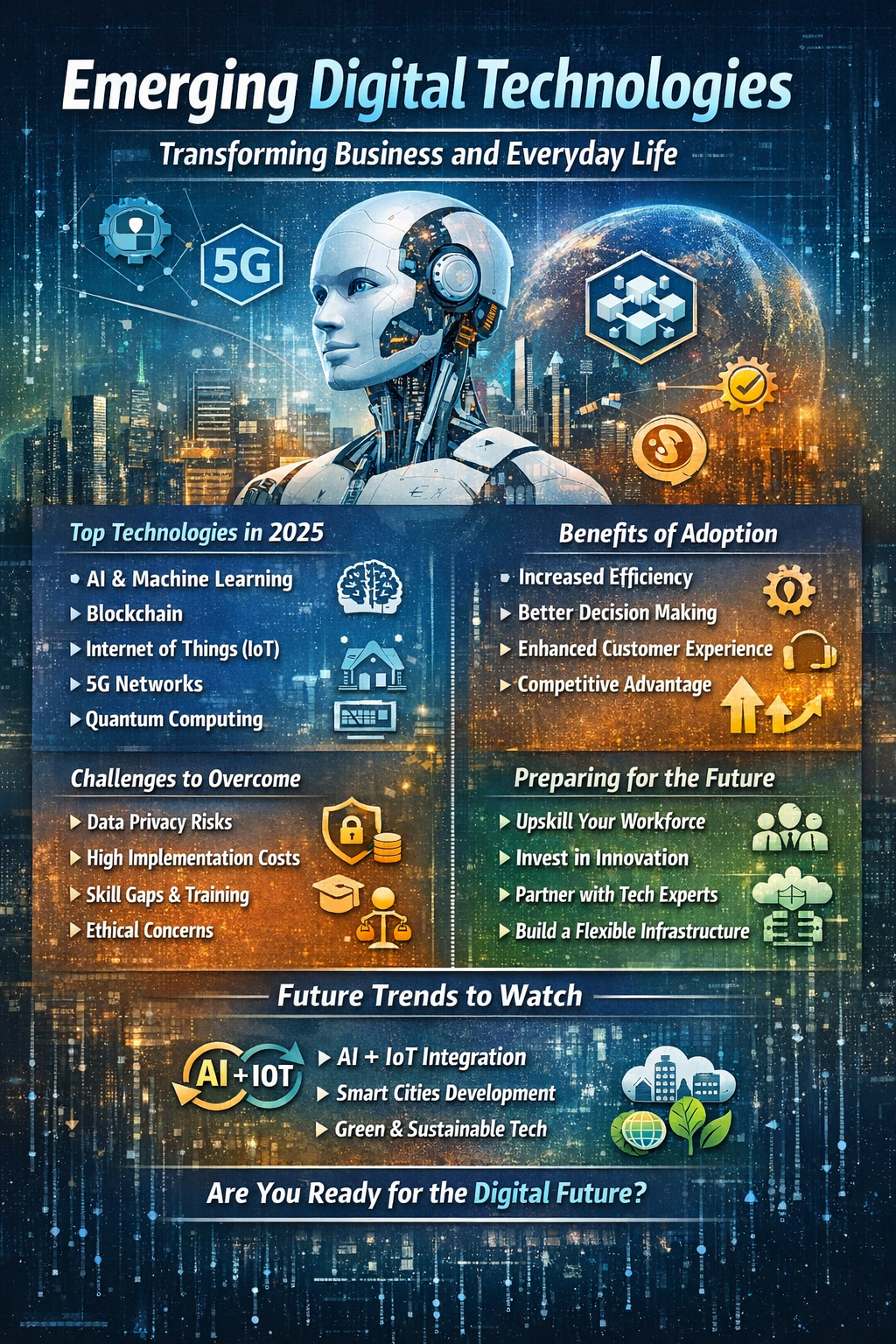
Top Emerging Digital Technologies in 2025
The landscape of emerging digital technologies is vast and continually evolving. These technologies are already shaping industries, enhancing productivity, and changing how we live and work. In 2025, several innovations stand out as transformative tools for businesses and individuals alike. Understanding these technologies is crucial to stay competitive and harness their full potential.
Artificial Intelligence (AI) and Machine Learning (ML)
Artificial Intelligence (AI) and Machine Learning (ML) remain at the forefront of emerging digital technologies. AI involves machines performing tasks that typically require human intelligence, while ML is a subset of AI where systems learn from data and improve over time.
Key Applications:
- Predictive Analytics: Businesses use AI to predict customer behavior, market trends, and operational risks.
- Chatbots & Virtual Assistants: AI-powered tools provide 24/7 customer support and personalized user experiences.
- Automation: AI automates repetitive tasks, from data entry to quality control in manufacturing.
Case Study:
Amazon uses AI for product recommendations, optimizing warehouse operations, and even predicting what products customers might buy next. This AI-driven strategy has significantly boosted their sales and customer engagement.
Blockchain and Decentralized Technologies
Blockchain is more than just cryptocurrency; it’s a revolutionary digital ledger system that ensures secure, transparent, and tamper-proof data management.
Key Applications:
- Supply Chain Management: Real-time tracking of goods, reducing fraud and errors.
- Digital Identity Verification: Enhances security for online transactions.
- Smart Contracts: Self-executing contracts that reduce the need for intermediaries.
Fact: According to Gartner, by 2025, over 50% of global enterprises will have deployed blockchain solutions in some form.
Internet of Things (IoT) and Smart Devices
The Internet of Things (IoT) connects everyday devices to the internet, enabling seamless communication and data collection. IoT is a cornerstone of emerging digital technologies, enabling smart homes, cities, and industries.
Key Applications:
- Smart Homes: Devices like thermostats, lights, and security systems can be remotely controlled.
- Connected Vehicles: Real-time traffic monitoring, predictive maintenance, and autonomous driving.
- Industrial IoT: Sensors in factories improve efficiency, monitor equipment, and reduce downtime.
Stat: The IoT market is expected to reach $1.6 trillion by 2025, highlighting its rapid growth.
Extended Reality (XR): AR, VR, and MR
Extended Reality (XR) encompasses Augmented Reality (AR), Virtual Reality (VR), and Mixed Reality (MR). These technologies are transforming entertainment, education, healthcare, and remote collaboration.
Key Applications:
- AR: Enhances real-world experiences, e.g., IKEA’s app lets users visualize furniture in their homes.
- VR: Immersive simulations for training, gaming, and virtual events.
- MR: Combines real and virtual worlds for interactive experiences in design, medical procedures, and education.
5G and Next-Gen Connectivity
5G technology is a critical enabler of other emerging digital technologies. Its high speed, low latency, and massive connectivity open new possibilities for IoT, AI, and AR/VR applications.
Key Benefits:
- Ultra-fast internet speeds for real-time applications.
- Low latency enabling remote surgeries and autonomous vehicles.
- Enhanced connectivity for smart cities and large-scale IoT networks.
Quantum Computing
Quantum computing represents a leap beyond classical computing, using quantum bits (qubits) to perform complex calculations at unprecedented speeds.
Key Applications:
- Cybersecurity: Breaking traditional encryption or creating more secure systems.
- Drug Discovery & Healthcare: Simulating molecules to accelerate research.
- Financial Modeling: Running complex simulations for risk analysis and portfolio optimization.
Fact: IBM and Google are racing to build commercially viable quantum computers by 2025, signaling massive potential for businesses and research.
Robotics and Automation
Robotics and automation are no longer limited to factories—they are integral to healthcare, logistics, and daily life.
Key Applications:
- Collaborative Robots (Cobots): Work alongside humans to increase productivity and reduce repetitive tasks.
- Autonomous Vehicles: Self-driving cars and drones transforming transportation and logistics.
- Medical Robotics: Performing precise surgeries and aiding rehabilitation.
Case Study: Boston Dynamics’ robots are now deployed in warehouses and logistics centers to handle heavy lifting, reducing workplace injuries and improving operational efficiency.
✅ Key Takeaways:
- The top emerging digital technologies in 2025 include AI, blockchain, IoT, XR, 5G, quantum computing, and robotics.
- These technologies are already transforming industries and shaping the future of business and daily life.
- Understanding these innovations is essential for businesses and individuals looking to stay competitive.
Benefits of Adopting Emerging Digital Technologies
Adopting emerging digital technologies is no longer a luxury—it’s a strategic necessity for businesses and individuals alike. These technologies offer numerous advantages, from boosting productivity to enhancing customer experiences. Organizations that effectively integrate these innovations gain a significant competitive edge in today’s fast-paced digital economy.
Increased Efficiency and Productivity
One of the most immediate benefits of emerging digital technologies is enhanced efficiency. Automation, AI, and robotics can take over repetitive tasks, allowing employees to focus on higher-value activities.
Examples:
- AI-driven analytics can automate data processing and generate insights in seconds, a task that previously took days.
- Robotic Process Automation (RPA) can handle payroll, invoicing, and customer support, freeing up human resources.
- IoT-enabled factories track machinery in real-time, preventing breakdowns and minimizing downtime.
Stat: According to a McKinsey report, businesses that implement AI and automation see an average 20–30% increase in productivity within the first year.
Improved Decision-Making with Data Insights
Emerging digital technologies like AI, IoT, and big data analytics provide actionable insights that help organizations make better decisions. By analyzing large volumes of data, companies can identify trends, optimize operations, and predict future market behaviors.
Examples:
- Retailers using AI to analyze purchasing patterns can predict inventory needs and reduce overstocking.
- Financial institutions employ machine learning algorithms to detect fraud and assess credit risk in real-time.
- Smart cities utilize IoT data to optimize traffic flow, energy consumption, and public services.
Case Study: Netflix leverages AI and data analytics to recommend content to users, increasing engagement and reducing churn. This personalization strategy is a core driver of their success.
Enhanced Customer Experience and Engagement
Adopting emerging technologies allows organizations to deliver personalized, seamless, and interactive experiences to their customers.
Examples:
- AI chatbots provide 24/7 customer support and instant responses to inquiries.
- AR apps enable customers to visualize products before purchase, improving satisfaction and reducing returns.
- IoT devices can anticipate customer needs, such as smart refrigerators notifying users when groceries are low.
Fact: A Salesforce survey found that 84% of customers say the experience a company provides is as important as its products or services, highlighting the critical role of digital innovation in customer engagement.
Competitive Advantage in Business
Organizations that adopt emerging digital technologies can differentiate themselves from competitors. Early adopters gain market share, improve operational agility, and are better positioned to innovate.
Examples:
- Companies using AI for predictive maintenance reduce operational costs and avoid downtime, outperforming competitors.
- Blockchain adoption improves transparency and trust in supply chains, providing a market advantage.
- Businesses leveraging 5G and IoT can offer faster, smarter services that competitors cannot match.
Quote: Satya Nadella, CEO of Microsoft, says:
“Every company is a software company. You have to start thinking and operating like a digital company.”
This emphasizes how emerging technologies are central to staying competitive in the modern economy.
✅ Key Takeaways:
- Emerging digital technologies improve efficiency, productivity, and decision-making.
- They enhance customer experience, engagement, and satisfaction.
- Early adoption provides a significant competitive edge, making businesses more agile and innovative.
Challenges and Risks of Emerging Digital Technologies
While emerging digital technologies offer tremendous benefits, they also come with challenges and risks that cannot be ignored. Understanding these potential pitfalls helps businesses and individuals adopt these technologies safely and effectively, minimizing disruptions and maximizing long-term value.
Data Privacy and Security Concerns
With the rapid adoption of technologies like AI, IoT, and cloud computing, data privacy and cybersecurity have become critical concerns. These technologies collect, process, and store vast amounts of sensitive information, making them attractive targets for cyberattacks.
Examples:
- IoT devices, if not properly secured, can be hacked to access personal or corporate data.
- AI systems can be manipulated with biased or malicious data, leading to inaccurate predictions or decisions.
- Cloud storage solutions require robust security protocols to prevent data breaches.
Stat: According to IBM’s Cost of a Data Breach Report 2023, the average cost of a data breach is $4.45 million, highlighting the financial risk associated with poor digital security practices.
High Implementation Costs
Adopting emerging digital technologies often requires significant investment in infrastructure, software, and training. For small and medium-sized enterprises (SMEs), these costs can be a barrier to adoption.
Considerations:
- Initial investment in AI, robotics, or IoT solutions can be high.
- Ongoing costs include software updates, maintenance, and cloud service subscriptions.
- Return on investment (ROI) may take time, depending on adoption speed and integration success.
Example: Deploying a smart manufacturing system with IoT sensors and AI predictive maintenance tools can cost hundreds of thousands of dollars, but it can reduce downtime and improve efficiency in the long term.
Skill Gaps and Workforce Adaptation
Emerging technologies often require new skills and expertise. Organizations may face challenges in finding qualified professionals to operate, maintain, and optimize these systems.
Examples:
- AI engineers, data scientists, and cybersecurity experts are in high demand but short supply.
- Employees may resist adopting new tools due to fear of redundancy or lack of training.
- Upskilling programs are essential to ensure smooth transitions and effective utilization of technology.
Fact: A World Economic Forum report predicts that by 2025, over 50% of employees will need reskilling due to technological advancements.
Ethical Implications of AI and Automation
Emerging digital technologies also raise ethical questions that businesses must navigate carefully. Decisions made by AI systems can have unintended consequences if not monitored and regulated.
Examples:
- AI bias in hiring or lending decisions can reinforce existing inequalities.
- Autonomous vehicles and robots may face ethical dilemmas in critical decision-making scenarios.
- Privacy concerns with surveillance technologies must be balanced against business benefits.
Quote: Tim Cook, CEO of Apple, emphasizes:
“Technology must be guided by values and ethics to benefit humanity, not just profit.”
✅ Key Takeaways:
- Data privacy, cybersecurity, and ethical considerations are critical when adopting emerging technologies.
- High costs and skill gaps can pose adoption challenges, especially for smaller businesses.
- Addressing these challenges proactively ensures safer and more effective technology integration.
How to Prepare for Emerging Digital Technologies
Adopting emerging digital technologies requires more than just purchasing new software or devices. Success comes from strategic preparation, workforce readiness, and thoughtful integration. Businesses and individuals who proactively prepare for these innovations are better positioned to harness their benefits while minimizing risks.
Upskilling and Reskilling Workforce
One of the most critical steps in preparing for emerging technologies is ensuring your workforce has the necessary skills. Rapid advancements in AI, IoT, blockchain, and robotics mean that traditional skill sets may become outdated quickly.
Strategies:
- Training Programs: Offer workshops, online courses, and certifications in relevant technologies like AI, cloud computing, and data analytics.
- Continuous Learning: Encourage employees to pursue lifelong learning and stay updated with tech trends.
- Collaborative Learning: Foster knowledge-sharing within teams to accelerate adoption of new tools.
Example: IBM’s SkillsBuild program provides free AI, cybersecurity, and cloud computing training to help workers transition into technology-driven roles.
Investing in Research and Innovation
To fully benefit from emerging digital technologies, organizations should allocate resources to research, pilot programs, and innovation initiatives. Experimentation helps identify practical applications and reduces risks associated with large-scale implementation.
Strategies:
- Pilot Projects: Test new technologies in controlled environments before full deployment.
- R&D Investment: Invest in developing custom solutions tailored to specific business needs.
- Technology Monitoring: Track emerging trends and competitive innovations to stay ahead of the curve.
Case Study: Tesla invests heavily in R&D for autonomous driving and battery technologies, allowing it to maintain a competitive advantage in electric vehicles.
Partnering with Technology Providers
Collaboration with technology vendors, startups, or industry consortia can accelerate adoption and provide access to specialized expertise.
Strategies:
- Vendor Partnerships: Work with technology providers for software integration, maintenance, and support.
- Industry Collaboration: Join industry networks to share knowledge and best practices.
- Consulting Services: Leverage experts to assess technology needs and recommend tailored solutions.
Example: Many hospitals partner with AI and IoT solution providers to implement smart patient monitoring systems, improving care while reducing costs.
Building a Flexible Technology Infrastructure
A flexible and scalable digital infrastructure is essential for adopting emerging technologies successfully.
Key Considerations:
- Cloud-Based Solutions: Enable remote access, scalability, and faster deployment of AI or IoT tools.
- Integration Capabilities: Ensure new technologies can integrate with existing systems seamlessly.
- Data Management: Establish protocols for collecting, storing, and analyzing large volumes of data securely.
Fact: According to Deloitte, organizations with flexible digital infrastructures are 3x more likely to successfully implement emerging technologies.
✅ Key Takeaways:
- Upskilling and reskilling your workforce ensures effective technology adoption.
- Investing in research, pilot programs, and partnerships accelerates innovation.
- Flexible and secure digital infrastructure is crucial for scaling emerging technologies.
Comments are closed, but trackbacks and pingbacks are open.