
Introduction to the Future of Smart Cities
The future of smart cities is no longer a distant vision—it is becoming a reality as urban areas around the world leverage cutting-edge technology to improve the quality of life for citizens, enhance sustainability, and streamline city operations. A smart city integrates digital technology, IoT devices, artificial intelligence, and data analytics into infrastructure and services to create more efficient, responsive, and sustainable urban environments. From intelligent transportation systems to energy-efficient buildings and AI-driven public safety solutions, smart cities represent a revolutionary shift in how cities are planned, managed, and experienced.http://futuretechfrontier.com
Why smart cities are important:
- Improved Quality of Life: Smart cities make daily life easier for citizens through enhanced mobility, healthcare, and e-governance services.
- Environmental Sustainability: By leveraging smart grids, renewable energy, and real-time environmental monitoring, cities can significantly reduce pollution and resource waste.
- Economic Growth and Innovation: Technology-driven urban environments attract businesses, startups, and innovators, fostering economic development.
- Data-Driven Decision Making: The integration of IoT and AI allows city planners to make informed decisions, optimize resources, and respond proactively to challenges.
A practical example of a smart city is Singapore, which uses IoT sensors and AI-powered analytics to manage traffic flow, reduce energy consumption, and monitor environmental quality. Similarly, Amsterdam emphasizes sustainability by integrating smart energy systems and digital citizen services into urban life. These examples demonstrate that the future of smart cities is not just about technology, but about creating urban ecosystems that are sustainable, inclusive, and intelligent.
In this comprehensive guide, we will explore the technologies driving smart cities, core features, global examples, challenges, and future trends, providing readers with a complete understanding of how the future of smart cities will transform urban living.
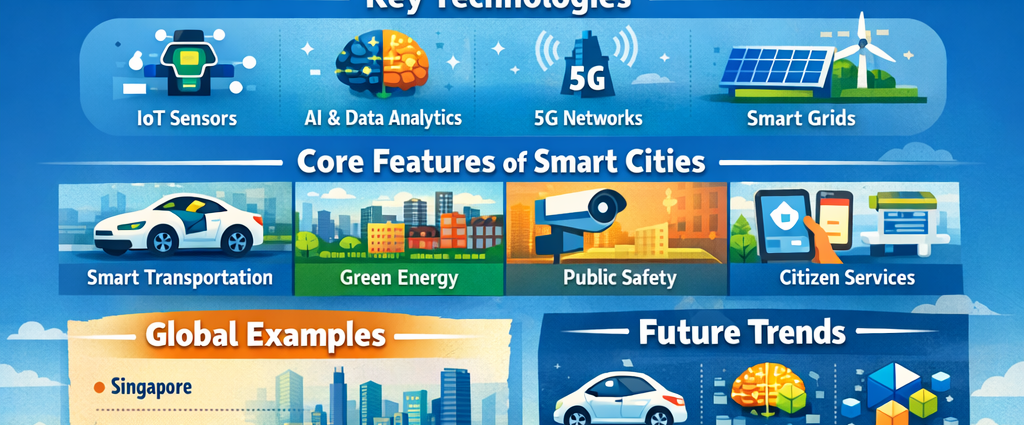
Key Technologies Driving the Future of Smart Cities
The future of smart cities relies heavily on advanced technologies that connect infrastructure, services, and citizens in real time. These technologies not only enhance efficiency but also make urban life more sustainable, safe, and convenient. Let’s explore the core technologies driving smart cities and how they are transforming modern urban environments.
Internet of Things (IoT) in Smart Cities
The Internet of Things (IoT) is the backbone of smart city infrastructure. IoT devices include sensors, cameras, and smart meters that collect and transmit data across urban systems. By integrating IoT, cities can monitor traffic, manage energy, track waste, and improve public safety in real time.
Key IoT applications in smart cities:
- Smart Traffic Management: IoT sensors analyze traffic flow, reducing congestion and optimizing signal timings.
- Waste Management: Smart bins monitor fill levels, reducing unnecessary pickups and improving efficiency.
- Environmental Monitoring: Sensors track air quality, noise levels, and water usage, enabling cities to respond quickly to pollution or other hazards.
- Smart Lighting: Streetlights automatically adjust brightness based on movement, saving energy and improving safety.
For instance, Barcelona has implemented IoT-based smart lighting and parking systems, resulting in a 30% reduction in energy consumption and 20% faster traffic flow, demonstrating how IoT can significantly improve urban efficiency.
Artificial Intelligence (AI) and Data Analytics
Artificial intelligence (AI) plays a pivotal role in the future of smart cities by turning data into actionable insights. AI algorithms analyze data from IoT devices, social media, and city databases to predict trends, optimize resources, and automate processes.
AI applications in smart cities include:
- Predictive Traffic Management: AI forecasts congestion patterns and suggests route changes in real time.
- Public Safety: AI-powered cameras detect unusual activity and alert authorities proactively.
- Energy Optimization: Smart grids use AI to balance electricity demand and reduce energy waste.
- Healthcare Services: AI monitors hospital capacities, predicts disease outbreaks, and manages emergency response logistics.
Cities like Dubai are leveraging AI for governance and city management, including real-time traffic control, automated policing support, and AI-driven public services, illustrating the potential of AI to make urban environments more intelligent and responsive.
5G Connectivity and High-Speed Networks
The adoption of 5G networks is essential for smart cities to function efficiently. High-speed connectivity allows real-time communication between devices, vehicles, and city infrastructure, enabling faster decision-making and smoother operations.
Benefits of 5G in smart cities:
- Seamless integration of autonomous vehicles and traffic management systems.
- Real-time monitoring of environmental and energy sensors.
- Enhanced performance of IoT devices and AI-driven applications.
- Support for augmented reality (AR) and virtual reality (VR) urban services, such as smart navigation or virtual city planning.
Case Study: In Seoul, South Korea, 5G-enabled smart city infrastructure allows citizens to monitor public services, track public transport in real time, and interact with city authorities via mobile apps, showcasing how connectivity transforms urban life.
Renewable Energy and Smart Grids
Energy management is a critical aspect of the future of smart cities. Smart grids integrate renewable energy sources, such as solar and wind, with traditional power networks to improve efficiency and reduce carbon footprints.
Key advantages of smart grids in smart cities:
- Dynamic energy distribution: Smart grids monitor demand and adjust supply in real time.
- Integration of renewable energy: Reduces dependency on fossil fuels and lowers emissions.
- Energy savings: IoT-enabled meters help consumers and businesses optimize energy use.
For example, Amsterdam uses smart grids to manage electricity from solar panels and wind farms, improving energy efficiency and reducing overall environmental impact.
Robotics and Automation in Urban Services
Robotics and automation are emerging as vital components of smart city operations. From autonomous drones for deliveries to robotic maintenance of streets and utilities, automation enhances urban efficiency and reduces human workload.
Robotics applications include:
- Autonomous public transport: Self-driving buses and shuttles improve mobility.
- Urban maintenance: Robots clean streets, inspect pipelines, and maintain parks.
- Delivery and logistics: Drones and automated delivery systems reduce traffic congestion and pollution.
Example: In Dubai, autonomous robots assist in municipal tasks and deliver goods, demonstrating the potential of robotics to complement human efforts in smart cities.
Core Features of Future Smart Cities
The future of smart cities is defined not just by the technologies they use, but by how these technologies are applied to create efficient, sustainable, and citizen-focused urban environments. Smart cities integrate advanced systems into every aspect of urban life—from transportation and energy management to public safety and citizen services. Let’s explore the core features that make a city truly “smart.”
Smart Transportation Systems
Transportation is one of the most critical areas where smart city technology has a visible impact. Smart transportation systems use IoT sensors, AI algorithms, and real-time data to manage traffic, reduce congestion, and provide safer, faster commuting options.
Key aspects of smart transportation include:
- Autonomous Vehicles: Self-driving cars and buses reduce accidents and optimize traffic flow.
- Smart Traffic Lights: Sensors adjust traffic signals based on congestion patterns to minimize delays.
- Mobility-as-a-Service (MaaS): Integrates public and private transportation options into a single platform, offering real-time schedules, ride-sharing, and route optimization.
- Public Transport Optimization: AI predicts demand for buses and trains, ensuring efficient allocation of resources.
Case Study: In Singapore, smart traffic monitoring systems use AI and cameras to predict traffic jams and redirect vehicles in real time, reducing congestion by over 20% in major urban corridors.
Efficient Urban Planning and Smart Buildings
The future of smart cities also focuses on intelligent urban planning and energy-efficient infrastructure. Smart buildings are equipped with sensors and automated systems to optimize energy use, improve comfort, and reduce costs.
Features of smart buildings and urban planning:
- Automated heating, ventilation, and air conditioning (HVAC) systems based on occupancy.
- Smart lighting that adapts to natural daylight and human activity.
- Water and energy monitoring to reduce waste and increase sustainability.
- Urban planning informed by AI, data analytics, and predictive modeling.
For example, in Amsterdam, smart buildings equipped with IoT sensors adjust energy usage automatically, saving residents up to 25% on electricity costs while reducing carbon emissions.
Public Safety and Smart Surveillance
Safety is a cornerstone of smart cities. By using AI-driven surveillance, IoT sensors, and predictive analytics, cities can proactively detect and respond to threats while protecting citizens.
Applications include:
- AI-powered cameras that detect unusual activities and alert authorities instantly.
- Smart emergency response systems that optimize ambulance and firetruck dispatch.
- Predictive policing tools to allocate law enforcement resources efficiently.
Important Consideration: Balancing security and privacy is crucial. Smart cities must ensure data protection, transparent policies, and citizen consent to maintain trust.
Environmental Monitoring and Sustainability
A sustainable future is at the heart of smart city development. By integrating IoT and AI, cities can monitor and manage air quality, water resources, and waste efficiently.
Key initiatives include:
- Air quality sensors alerting citizens to pollution levels.
- Smart waste bins signaling when collection is needed, reducing unnecessary pickups.
- Water usage monitoring to prevent leaks and promote conservation.
- Integration of green spaces and smart energy grids to reduce urban heat and emissions.
Example: Barcelona uses a combination of environmental sensors and data analytics to reduce air pollution and optimize waste management, resulting in cleaner streets and healthier urban living.
Citizen-Centric Services
The hallmark of a smart city is its focus on citizens. From healthcare and education to governance and engagement, smart cities aim to make services accessible, personalized, and efficient.
Citizen-centric features include:
- Digital Health Services: Remote consultations, real-time monitoring of public health metrics.
- E-Governance Platforms: Citizens can report issues, pay bills, or access services online.
- Education & Learning: Smart classrooms, virtual learning platforms, and real-time educational analytics.
- Feedback Systems: Mobile apps allow citizens to provide suggestions, report problems, and participate in decision-making.
Quote: As noted by the World Economic Forum, “The success of smart cities depends not only on technology but on engaging citizens and fostering participation.”
Global Examples of Smart Cities
The future of smart cities is no longer a theoretical concept; several cities around the world have already begun implementing advanced technologies to create efficient, sustainable, and citizen-focused urban environments. By examining these real-world examples, we can understand how smart city technologies are applied in practice, the benefits they deliver, and the lessons other cities can learn.
Leading Smart Cities Around the World
1. Singapore
Singapore is widely regarded as a global leader in smart city development. The city-state integrates IoT, AI, and big data analytics to manage traffic, energy, and public safety efficiently. For instance, Singapore’s Smart Traffic System uses real-time sensor data and predictive AI algorithms to optimize traffic flow, reducing congestion by over 20% in major areas. The government also leverages smart environmental sensors to monitor air quality and water levels, enabling proactive responses to urban challenges.
2. Amsterdam, Netherlands
Amsterdam focuses on sustainability and citizen engagement as core elements of its smart city strategy. The city uses smart grids to manage renewable energy sources and optimize electricity distribution. Additionally, IoT-enabled sensors monitor waste collection, street lighting, and water systems. Citizens benefit from digital platforms that allow them to report issues, access city services, and track environmental data. Amsterdam’s success demonstrates the importance of combining technology with participatory governance.
3. Dubai, UAE
Dubai is investing heavily in futuristic technologies to build a highly connected and autonomous city. AI, robotics, and blockchain are central to Dubai’s smart initiatives. For example, the city employs autonomous drones and robots for public services and delivery, while blockchain technology ensures secure government transactions. Dubai’s smart city strategy emphasizes innovation, efficiency, and a high-tech lifestyle, serving as a model for rapidly growing urban centers.
4. Songdo, South Korea
Songdo is often described as the world’s first fully integrated smart city. Built from the ground up, Songdo incorporates IoT sensors, smart buildings, and advanced transportation networks. The city uses centralized systems to manage energy, water, and waste efficiently, while autonomous transportation options reduce congestion. Songdo demonstrates how smart city technology can be planned and implemented at scale, offering a blueprint for new urban developments.
Lessons from Successful Smart Cities
Analyzing these global examples provides valuable insights for cities planning their smart city transformation:
- Start with citizen needs: Technology should improve quality of life, not just showcase innovation.
- Integrate sustainability: Renewable energy, smart grids, and environmental monitoring are essential for long-term urban health.
- Data-driven governance: AI and IoT should inform decision-making to optimize resources and reduce operational costs.
- Public-private partnerships: Collaboration between governments, tech companies, and startups accelerates innovation and funding.
- Privacy and security: Ensuring data protection and transparency builds public trust, which is critical for smart city adoption.
Table: Comparison of Key Features in Leading Smart Cities
| City | Core Technologies | Focus Areas | Notable Achievements |
|---|---|---|---|
| Singapore | IoT, AI, Big Data | Traffic, Environment, Public Safety | 20% reduction in congestion |
| Amsterdam | Smart Grids, IoT, Digital Platforms | Sustainability, Citizen Engagement | Efficient energy distribution |
| Dubai | AI, Robotics, Blockchain | Autonomous Services, Gov Efficiency | High-tech urban services and robotics |
| Songdo | IoT, Smart Buildings, Transport | Infrastructure, Resource Management | Fully integrated smart city ecosystem |
Challenges and Risks in Developing Smart Cities
While the future of smart cities promises efficiency, sustainability, and improved quality of life, the journey toward building these advanced urban ecosystems comes with significant challenges and risks. Understanding these issues is crucial for governments, planners, and citizens to ensure successful smart city implementation.
High Costs and Funding Challenges
Developing a smart city requires substantial financial investment. From installing IoT sensors and AI infrastructure to upgrading transport systems and smart grids, costs can run into billions of dollars.
Key funding challenges include:
- Infrastructure upgrades: Replacing legacy systems with connected, intelligent infrastructure is expensive.
- Technology procurement: Advanced hardware, software, and IoT devices require significant capital.
- Maintenance costs: Continuous monitoring, software updates, and system maintenance add ongoing expenses.
Example: In India, smart city projects under the Smart Cities Mission faced delays due to budget overruns, showing that even well-planned initiatives can encounter financial hurdles.
Data Privacy and Cybersecurity Concerns
Smart cities rely heavily on data collection from citizens, sensors, and connected devices. While this data is essential for optimizing services, it also raises privacy and security risks.
Risks include:
- Data breaches: Personal and sensitive data can be stolen if systems are not secure.
- Cyber-attacks on critical infrastructure: Hackers could disrupt traffic systems, energy grids, or emergency services.
- Citizen trust issues: Privacy concerns may reduce public participation in smart city programs.
Best Practice: Cities like Amsterdam and Singapore invest heavily in cybersecurity protocols, encryption, and transparent data policies to protect citizens while using data effectively.
Technology Integration and Legacy Systems
Many cities attempting to transition into smart cities must integrate modern technologies with existing infrastructure, which can be complex and time-consuming.
Challenges include:
- Compatibility issues between old and new systems.
- Delays caused by retrofitting older buildings, roads, or utilities.
- Technical expertise gaps among city staff managing smart systems.
Case Study: In the United States, cities like New York faced challenges integrating smart traffic management systems with decades-old road infrastructure, illustrating that planning and phased implementation are key to success.
Social Equity and the Digital Divide
A major concern in smart city development is ensuring that all citizens benefit equally. Technology adoption can inadvertently widen the digital divide between those with access to devices and digital literacy and those without.
Considerations include:
- Ensuring affordable access to digital services for all residents.
- Inclusive planning for marginalized communities.
- Providing digital literacy programs to maximize participation.
Quote: According to the World Bank, “Smart cities must prioritize inclusivity; technology cannot improve lives if large segments of the population remain disconnected.”
Regulatory and Policy Challenges
Smart city projects often face regulatory hurdles, including:
- Approval processes for new technologies and infrastructure.
- Compliance with privacy laws and environmental regulations.
- Coordination between multiple government departments and private stakeholders.
Navigating these challenges requires strong governance, public-private partnerships, and clear policy frameworks.
Future Trends in Smart Cities
The future of smart cities is evolving rapidly, driven by continuous technological innovation, increasing urbanization, and growing citizen expectations. Understanding emerging trends is essential for governments, planners, and businesses to prepare for the cities of tomorrow. Here are the key trends shaping the future of smart cities:
1. AI and Machine Learning Will Drive Smarter Decision-Making
Artificial Intelligence (AI) and machine learning are becoming the core engines of smart city operations. From traffic management to energy optimization, AI allows cities to analyze massive datasets in real-time, identify patterns, and make predictive decisions.
Emerging AI trends include:
- Predictive Traffic Systems: AI predicts congestion and suggests alternative routes before traffic builds.
- Smart Energy Management: AI balances energy supply and demand across smart grids to reduce waste.
- Public Safety Analytics: Machine learning identifies crime patterns, enabling proactive interventions.
Example: In Dubai, AI-driven city operations monitor traffic, environmental sensors, and public services simultaneously, allowing officials to respond instantly to emerging challenges.
2. Expansion of Autonomous Public Transportation
The future of smart cities will see wider adoption of autonomous vehicles (AVs), including buses, shuttles, and taxis. These vehicles reduce human error, improve traffic efficiency, and lower carbon emissions.
Key points:
- Autonomous public transport systems will integrate with real-time traffic and environmental data.
- Cities are experimenting with AV-only zones to test mobility solutions safely.
- Smart city apps will provide citizens with on-demand AV services.
Forecast: By 2030, more than 30% of urban public transport fleets in leading smart cities may be autonomous, transforming mobility and accessibility.
3. Sustainability and Climate-Resilient Smart Cities
Sustainability will remain a central focus of future smart cities. Urban planners are increasingly prioritizing carbon neutrality, renewable energy, and climate resilience.
Trends include:
- Smart Grids and Renewable Integration: Cities will rely more on solar, wind, and smart storage solutions.
- Green Infrastructure: Urban forests, rooftop gardens, and sustainable building materials will mitigate urban heat and improve air quality.
- Environmental AI Analytics: Predicting and managing pollution, flooding, and resource consumption in real-time.
Example: Copenhagen aims to become carbon-neutral by 2025 using smart grids, connected energy systems, and AI-driven environmental monitoring.
4. Blockchain and Decentralized Systems
Blockchain technology is emerging as a key enabler of trust, security, and transparency in smart cities.
Applications include:
- Secure Digital Identity: Citizens can safely access government services and financial systems.
- Transparent Governance: Blockchain ensures accountability in public transactions.
- Smart Contracts for Urban Services: Automates payments and contracts for utilities, transport, and services.
Impact: Blockchain can reduce fraud, enhance citizen trust, and simplify urban administration.
5. Citizen Engagement and Digital Platforms
Future smart cities will focus heavily on empowering citizens to participate in urban planning and service improvement.
Innovations include:
- Digital Apps: Citizens report issues, access city services, and participate in decision-making.
- Gamification: Encouraging sustainable behaviors like recycling or public transport use.
- Virtual Town Halls: Residents can engage directly with city leaders through digital platforms.
Case Study: Barcelona uses digital platforms for citizen feedback, helping local governments make data-driven improvements in urban services.
6. Integration of AR/VR and Immersive Technologies
Augmented Reality (AR) and Virtual Reality (VR) will play a bigger role in city planning, education, and tourism:
- AR-based navigation systems in real-time for commuters.
- VR simulations for urban planning and emergency preparedness.
- Immersive experiences for tourism and public education about sustainability.
7. Focus on Health and Pandemic-Ready Cities
The COVID-19 pandemic highlighted the need for health-conscious smart cities. Future cities will integrate:
- IoT sensors for monitoring air quality and hygiene levels.
- AI-driven healthcare management to track outbreaks and manage hospital resources.
- Remote health monitoring and telemedicine services to reduce healthcare strain.
Table: Future Trends in Smart Cities
| Trend | Description | Expected Impact by 2030 |
|---|---|---|
| AI & Machine Learning | Predictive decision-making, traffic & energy optimization | 40% increase in operational efficiency |
| Autonomous Transport | Self-driving buses, shuttles, AV integration | 30% of urban transport fleets autonomous |
| Sustainability & Smart Grids | Renewable energy, climate resilience | 50% reduction in carbon emissions in leading cities |
| Blockchain | Secure digital services, governance transparency | Improved citizen trust and reduced fraud |
| Citizen Engagement | Digital platforms for feedback & participation | Higher public satisfaction & service efficiency |
| AR/VR Integration | Urban planning, education, navigation | Enhanced city experience & planning accuracy |
| Health & Pandemic Readiness | IoT monitoring, telemedicine | Better preparedness for health crises |
Comments are closed, but trackbacks and pingbacks are open.