
The exploration of space has always fascinated humanity, but today, space technology developments are accelerating at an unprecedented pace. From reusable rockets and advanced satellites to autonomous rovers and interplanetary missions, technological innovations are reshaping how we understand and interact with the cosmos. These developments are not only expanding scientific knowledge but also creating new opportunities in commercial ventures, defense, and global communication networks.
At the heart of these advancements is the integration of cutting-edge engineering, artificial intelligence, and robotics, enabling space missions to be safer, faster, and more efficient. For example, SpaceX’s Falcon 9 rocket has revolutionized launch economics with reusable boosters, drastically reducing costs and making space more accessible. Similarly, small satellite technology and high-throughput communications satellites are transforming global connectivity and Earth observation capabilities.http://futuretechfrontier.com
The significance of space technology developments goes beyond exploration. Satellites provide critical data for weather forecasting, disaster management, and climate monitoring, while robotic systems and AI enable autonomous navigation and data analysis in environments humans cannot easily access. Governments, private companies, and international collaborations are all investing heavily in research and infrastructure to push the boundaries of what is possible.
This article will provide an in-depth exploration of space technology developments, covering everything from the latest innovations and emerging trends to challenges, industry impacts, and the future prospects of space exploration. Whether you are a space enthusiast, technology professional, or student, this guide will give you actionable insights into the exciting frontier of space technology advancements.
What Are Space Technology Developments? A Complete Overview
Space technology developments refer to the innovations and advancements in tools, systems, and processes that enable exploration, observation, and utilization of outer space. Unlike traditional aerospace engineering, which focuses primarily on aircraft and flight, space technology encompasses a broader spectrum, including satellites, spacecraft, propulsion systems, robotic explorers, and space-based infrastructure. These developments are central to humanity’s ability to explore new frontiers, improve communication systems, and gain insights into Earth and the wider universe.
Definition and Scope of Space Technology
At its core, space technology involves designing, building, and deploying equipment and systems capable of functioning in extreme environments beyond Earth. This includes:
- Satellites: Communication, navigation, earth observation, and scientific satellites.
- Spacecraft and Rovers: Vehicles designed for orbital missions, planetary exploration, and human transport.
- Launch Vehicles: Rockets and boosters engineered to carry payloads into orbit or beyond.
- Propulsion Systems: Advanced engines, including chemical, ion, and nuclear propulsion.
- Space Stations and Habitats: Infrastructure supporting long-term human habitation in orbit or on other celestial bodies.
These components work together to support everything from scientific research and climate monitoring to commercial endeavors like satellite internet services and space tourism.
Key Components of Space Technology
- Launch Vehicles and Rockets: These are the backbone of space exploration, determining payload capacity, range, and mission success. Modern developments focus on reusability and efficiency to reduce costs.
- Satellite Systems: Advances include miniaturized satellites, high-throughput communications networks, and satellites capable of real-time Earth observation.
- Space Exploration Vehicles: This includes robotic rovers, lunar landers, and crewed spacecraft equipped with life support systems for extended missions.
- Propulsion Innovations: Modern space technology is moving toward ion propulsion, nuclear thermal engines, and eco-friendly fuels that enhance mission duration and efficiency.
- Space Habitats and Life Support: Advances in closed-loop life support systems and orbital habitats are essential for long-duration human missions to the Moon, Mars, and beyond.
Case Study: NASA’s Artemis program demonstrates a coordinated approach to space technology development by combining advanced rockets, human-rated spacecraft, and lunar habitat systems. This integrated approach allows both robotic and crewed missions to explore new regions of the Moon with a focus on sustainability and long-term presence.
In essence, space technology developments represent a multi-faceted ecosystem of innovation, combining engineering, science, and commercial strategy. These advancements are crucial not only for exploration but also for addressing global challenges, improving communications, and laying the foundation for humanity’s future in space.
The Importance of Space Technology Developments
The rapid evolution of space technology developments is transforming how humanity interacts with both Earth and outer space. These advancements are not merely about exploration—they have profound implications for science, the economy, national security, and the future of human civilization. Understanding their importance helps illustrate why nations and private companies are investing billions into space research and innovation.
Advancing Scientific Knowledge
One of the primary drivers of space technology developments is the quest to expand human knowledge. Advanced satellites, space telescopes, and interplanetary missions allow scientists to study phenomena that are impossible to observe from Earth’s surface.
- Planetary Exploration: Rovers like NASA’s Perseverance and China’s Zhurong provide detailed geological and atmospheric data about Mars, improving our understanding of potential habitability.
- Space Telescopes: Instruments such as the James Webb Space Telescope deliver unprecedented insights into distant galaxies, star formation, and cosmic evolution.
- Earth Observation: Satellites monitor climate change, deforestation, and natural disasters, providing data crucial for environmental planning and disaster management.
Fact: NASA estimates that data from Earth observation satellites help prevent over $2 billion in damages annually from natural disasters.
Economic and Commercial Impact
Space technology developments are driving new economic opportunities. The commercial space sector is booming, with innovations making space more accessible and profitable.
- Satellite Communications: High-throughput satellites provide internet access to remote areas, bridging the digital divide.
- Space Tourism: Companies like SpaceX, Blue Origin, and Virgin Galactic are creating suborbital and orbital tourism experiences for civilians.
- Commercial Launch Services: Private firms are providing cost-effective satellite launches, encouraging innovation and competition.
Statistic: According to the Space Foundation, the global space economy exceeded $469 billion in 2025, with commercial ventures contributing nearly 60% of that value.
Defense and National Security Applications
Space technology is vital for national security and defense operations. Satellites and space-based systems enhance surveillance, communication, and navigation capabilities critical for modern defense strategies.
- Reconnaissance Satellites: Monitor global military activities and provide intelligence in real-time.
- Navigation Systems: GPS and other satellite navigation services are essential for military operations and civilian applications.
- Space-Based Defense Technologies: Emerging technologies, including missile detection and orbital defense systems, are increasingly reliant on advanced space capabilities.
Case Study: The U.S. Space Force integrates cutting-edge satellite technology to monitor space threats, provide secure communications, and support both terrestrial and space-based operations.
In summary, the importance of space technology developments extends far beyond exploration. They advance scientific knowledge, create economic opportunities, and ensure national security. The continued investment in these technologies is shaping not only the future of space exploration but also the way we live, communicate, and protect our planet.
Major Innovations in Space Technology
The field of space exploration has experienced tremendous breakthroughs over the last few decades, with space technology developments revolutionizing how we access, study, and utilize outer space. From launch systems to advanced satellites, robotics, and propulsion, these innovations are setting the stage for the future of interplanetary exploration and commercial space activity.
Advanced Rocket and Launch Vehicle Technology
One of the most significant innovations in recent years is the development of reusable rockets and heavy-lift launch systems. Traditional expendable rockets were costly and inefficient, limiting access to space. Modern advancements are changing that:
- Reusable Rockets: SpaceX’s Falcon 9 and Falcon Heavy can return to Earth after launch, dramatically reducing costs.
- Heavy-Lift Launch Vehicles: NASA’s Space Launch System (SLS) and Blue Origin’s New Glenn are designed to carry heavier payloads to the Moon, Mars, and beyond.
- Rapid Launch Capabilities: Innovative designs enable quicker turnaround between launches, making space missions more frequent and cost-effective.
Fact: Reusable rockets have cut launch costs by up to 70%, opening opportunities for smaller companies and research institutions to access space.
Satellite Technology Developments
Satellites remain central to space technology developments, and recent innovations have made them more versatile and powerful:
- Miniaturized Satellites: CubeSats and nanosatellites provide low-cost solutions for research, communication, and Earth observation.
- High-Throughput Communication Satellites: These enable global broadband internet, supporting remote areas and expanding connectivity.
- Earth Observation Satellites: Advanced imaging, weather monitoring, and climate tracking are now possible with higher precision and faster data delivery.
Example: Starlink, SpaceX’s satellite constellation, aims to provide low-latency internet access to every corner of the globe, highlighting the commercial potential of satellite technology.
Space Propulsion and Fuel Innovations
Propulsion technology is critical for deep-space exploration. Innovations are focusing on efficiency, speed, and sustainability:
- Ion Propulsion Systems: Provide high-efficiency thrust for long-duration missions.
- Nuclear-Powered Spacecraft: Offers faster travel to distant planets with higher payload capacity.
- Green Propellants: Environmentally safe alternatives to toxic fuels are being developed to minimize hazards during launches.
Insight: NASA’s NEXT-C ion propulsion system demonstrates the ability to sustain long missions with minimal fuel, making interplanetary travel more feasible.
Robotics and Autonomous Systems in Space
Robotics and autonomous systems are revolutionizing the way we explore and operate in space:
- Mars Rovers and Lunar Robots: Autonomous vehicles like Perseverance and Zhurong conduct exploration without direct human control.
- Automated Docking Systems: Enable spacecraft to dock with stations or other vehicles safely and accurately.
- AI-Powered Operations: AI monitors systems, predicts failures, and supports decision-making during missions.
Fact: The European Space Agency’s Rosalind Franklin rover is equipped with AI to analyze samples and make autonomous decisions on where to collect data.
Space Habitat and Life Support Innovations
Long-duration missions require sustainable life support systems and habitats:
- International Space Station (ISS) Upgrades: Modern life support, recycling, and energy systems enable extended human presence in orbit.
- Lunar Bases and Martian Habitat Concepts: Closed-loop habitats and radiation shielding are being tested for future missions.
- Advanced Life Support Systems: Regenerate air, water, and food for long-duration crewed missions, reducing dependency on resupply.
Case Study: NASA’s Lunar Gateway project is designing modular habitats that can support astronauts for months, serving as a staging point for deep-space missions.
In summary, the major innovations in space technology—from reusable rockets and advanced satellites to robotics, AI, and life support systems—are driving unprecedented progress in exploration, communication, and human presence beyond Earth. These technologies are not only enabling current missions but also laying the foundation for the next era of space exploration, including Mars colonization and commercial space activities.
Emerging Trends in Space Technology
The future of space technology developments is being shaped by innovative trends that are redefining exploration, commercial opportunities, and scientific discovery. From private-sector leadership to AI-powered spacecraft and space resource utilization, these trends highlight how rapidly the field is evolving.
Privatization of Space Exploration
Private companies are playing an increasingly central role in space technology developments, supplementing or even surpassing government-led programs:
- Commercial Space Launches: Companies like SpaceX, Blue Origin, and Rocket Lab are providing cost-effective satellite launches and orbital services.
- Public-Private Partnerships: Collaborations with NASA and ESA are accelerating mission timelines and reducing costs.
- Entrepreneurial Innovation: Startups are exploring niche markets, such as small satellite constellations, orbital servicing, and space tourism.
Statistic: According to Bryce Space and Technology, private sector investment in space reached $12.5 billion in 2024, up nearly 40% from the previous year.
Space Tourism and Commercial Missions
Space tourism is transitioning from a dream to reality, powered by advances in space technology developments:
- Suborbital Flights: Virgin Galactic and Blue Origin offer short-duration flights for civilians.
- Orbital Hotels: Companies are planning long-term habitats in low Earth orbit for research and leisure.
- Future Mars Tourism Concepts: While still conceptual, ongoing technological progress makes interplanetary tourism a potential future market.
Example: SpaceX’s planned Starship missions aim to carry private passengers around the Moon, demonstrating the commercial viability of large-scale space missions.
International Space Programs and Collaboration
Global cooperation is a key trend driving innovations in space technology:
- NASA Artemis Program: Returning humans to the Moon with a focus on sustainable exploration.
- ESA, Roscosmos, CNSA Initiatives: Collaborative missions for Mars exploration, asteroid study, and Earth observation.
- International Partnerships: Shared research, technology exchange, and joint missions reduce costs and increase mission success rates.
Fact: The Artemis Accords have already established guidelines for international collaboration on lunar exploration, emphasizing transparency and resource sharing.
Artificial Intelligence and Machine Learning Applications
AI and machine learning are transforming space operations, making missions safer and more efficient:
- Autonomous Spacecraft Navigation: AI enables spacecraft to adjust trajectories without constant human input.
- Predictive Maintenance: Machine learning predicts potential equipment failures on satellites and stations.
- Data Analysis: AI processes vast amounts of space-generated data, from telescopic images to rover sensor readings.
Example: NASA’s Mars Perseverance rover uses AI algorithms to select scientifically interesting rocks autonomously, optimizing mission efficiency.
Space Mining and Resource Utilization
Resource utilization beyond Earth is becoming a tangible goal:
- Asteroid Mining: Extracting rare minerals such as platinum and rare-earth elements for use on Earth.
- Moon Water Extraction: Water ice can be converted into rocket fuel or support human habitats.
- In-Situ Resource Utilization (ISRU): Using local materials for construction and life support reduces dependence on Earth resupply.
Insight: Planetary Resources and other startups are developing technologies to enable commercial asteroid mining within the next decade, illustrating the growing economic potential of space technology developments.
In summary, emerging trends in space technology—including privatization, commercial missions, international collaboration, AI integration, and space resource utilization—are driving unprecedented growth in the field. These trends indicate that space exploration is no longer the exclusive domain of governments; instead, it is becoming a dynamic ecosystem of scientific innovation, economic opportunity, and technological advancement.
Challenges in Space Technology Development
While space technology developments are advancing rapidly, the field faces numerous technical, financial, and regulatory challenges that must be addressed for sustainable progress. These challenges affect not only governments and private companies but also the future of human exploration and commercial space ventures.
Technical and Engineering Challenges
Developing technology that can survive and function in the harsh environment of space is immensely complex:
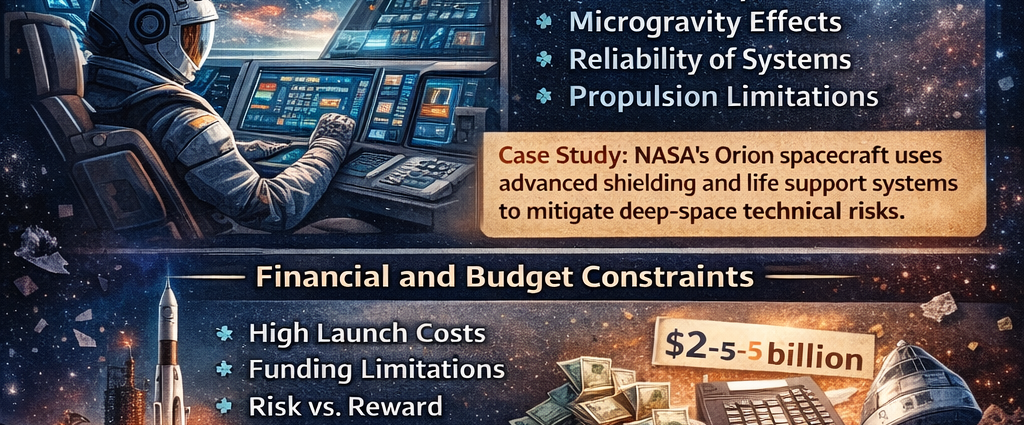
- Radiation Exposure: Cosmic rays and solar radiation pose risks to both human health and electronic systems. Advanced shielding and radiation-hardened electronics are essential.
- Microgravity Effects: Long-duration exposure to microgravity affects human muscles, bones, and cardiovascular systems, requiring specialized exercise and life support systems.
- Reliability of Systems: Spacecraft, satellites, and rovers must function autonomously in conditions where repairs are difficult or impossible.
- Propulsion Limitations: Current propulsion methods limit speed and mission duration for interplanetary travel. Innovations in nuclear, ion, and hybrid propulsion are still experimental.
Case Study: NASA’s Orion spacecraft incorporates advanced shielding, life support, and redundant systems to mitigate these technical risks for deep-space missions.
Financial and Budget Constraints
The costs associated with space technology developments are enormous, limiting the scope of exploration and innovation:
- High Launch Costs: Despite reusable rockets, sending payloads into orbit or beyond still costs millions of dollars.
- Funding Limitations: Many space agencies rely on government budgets, which fluctuate with political priorities.
- Risk vs. Reward: High-risk, long-term projects such as Mars colonization require sustained investment before any commercial or scientific returns are realized.
Statistic: A single mission to Mars can cost $2–5 billion, depending on technology, payload, and duration, illustrating the significant financial commitment required.
Regulatory and Ethical Considerations
Legal and ethical challenges also affect the pace and direction of space technology developments:
- Space Debris: Increasing numbers of satellites and launch vehicles contribute to orbital debris, posing collision risks for spacecraft and satellites.
- Ownership of Resources: Questions surrounding the mining of asteroids or lunar resources remain unresolved under current international space law.
- Compliance and Liability: Countries and companies must adhere to international treaties, like the Outer Space Treaty, while avoiding conflicts over territorial or economic claims.
Insight: The United Nations Office for Outer Space Affairs (UNOOSA) is actively developing guidelines for sustainable space activities, including debris mitigation and resource utilization.
Comments are closed, but trackbacks and pingbacks are open.