The Internet of Things (IoT) is no longer just a futuristic concept—it has become a vital part of our daily lives. From smart homes to industrial automation, IoT is transforming how we live, work, and interact with technology. At its core, IoT refers to the network of physical devices, vehicles, appliances, and other objects embedded with sensors, software, and connectivity that allow them to collect and exchange data.
Imagine a world where your refrigerator can notify you when groceries are running low, your wearable tracks your health metrics in real-time, and your factory machines automatically adjust their operations for optimal efficiency. This is the power of IoT devices and IoT technology working seamlessly to enhance convenience, productivity, and decision-making.
According to Statista, the number of IoT-connected devices worldwide is expected to reach over 30 billion by 2030, showing the massive growth and potential of this technology. This rapid expansion is not limited to consumer products; industries such as healthcare, agriculture, manufacturing, and transportation are leveraging IoT to reduce costs, improve safety, and drive innovation.
In this comprehensive guide, we will explore the Internet of Things (IoT) in depth: what it is, how it works, its components, applications across industries, benefits, challenges, and the future of this transformative technology. By the end, you’ll have a thorough understanding of IoT and how it can impact both personal and business environments.
Understanding the Basics of IoT
To truly appreciate the Internet of Things (IoT), it’s important to understand its core concepts and how it operates in everyday life.
Definition of IoT
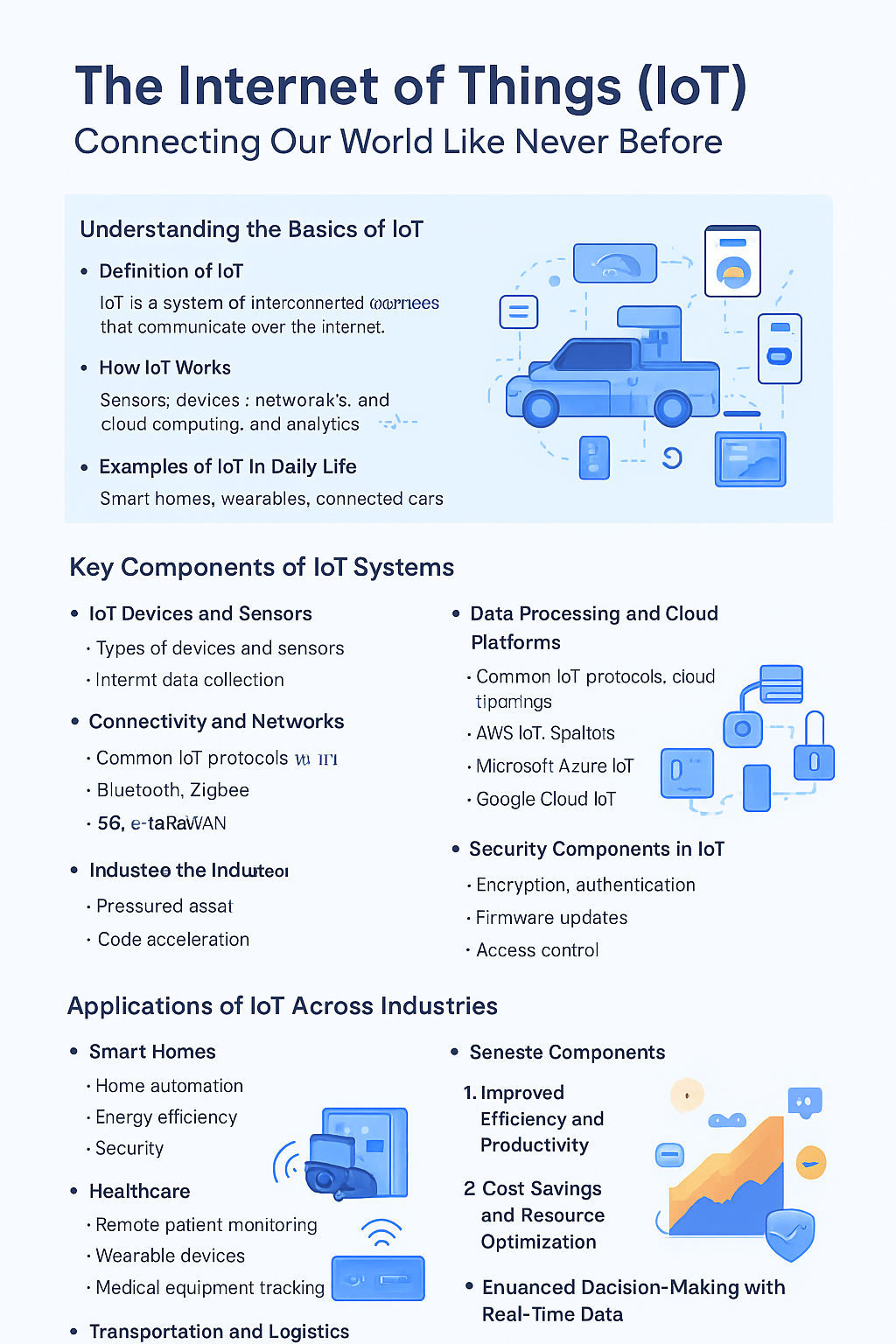
The Internet of Things (IoT) is a system of interconnected devices that communicate with each other over the internet. These devices, often embedded with sensors, software, and network connectivity, can collect, exchange, and analyze data without human intervention. While IoT is often associated with smart homes or wearable devices, it extends far beyond consumer products. In industrial settings, it’s referred to as Industrial IoT (IIoT), enabling factories, supply chains, and infrastructure systems to operate more efficiently.
In simpler terms, IoT transforms ordinary objects into “smart” devices that can sense, act, and respond. For example, a smart thermostat can learn your routine, adjust the temperature automatically, and even send notifications to your smartphone.
How IoT Works
At the heart of IoT technology is the flow of data. A typical IoT system involves:
- Sensors & Devices – Devices collect real-time data, such as temperature, motion, or location.
- Connectivity – Devices communicate through networks like Wi-Fi, Bluetooth, Zigbee, 5G, or LoRaWAN.
- Data Processing – Collected data is analyzed using cloud or edge computing systems.
- Action/Automation – Based on analysis, devices take action automatically, or insights are provided to humans for decision-making.
For example, in a smart farm, soil sensors collect moisture data, send it to a cloud platform for analysis, and trigger irrigation systems only when necessary. This automation not only saves water but also improves crop yield.
Examples of IoT in Daily Life
IoT is no longer confined to tech labs—it’s a part of everyday life:
- Smart Homes: Devices like smart lights, thermostats, and security cameras create a more convenient, energy-efficient, and secure living environment.
- Wearables: Fitness trackers, smartwatches, and health monitors provide real-time insights into your physical activity, sleep, and heart rate.
- Connected Vehicles: Cars can now offer navigation updates, predictive maintenance alerts, and even autonomous driving features.
- Healthcare: IoT devices monitor patients remotely, track vital signs, and enable telemedicine, reducing hospital visits and improving patient care.
Case Study:
In 2023, Philips Healthcare implemented IoT-enabled patient monitoring systems in over 200 hospitals worldwide. These systems reduced patient complications by 20% and cut emergency response times by 30%, demonstrating how IoT can save lives and improve operational efficiency.
Key Components of IoT Systems
Understanding the key components of IoT systems is essential to grasp how the Internet of Things (IoT) functions effectively across devices, networks, and applications. Every IoT system relies on several interconnected elements working together to collect, transmit, and analyze data.
IoT Devices and Sensors
At the heart of IoT are devices and sensors. These can range from simple temperature sensors to complex industrial machinery embedded with multiple monitoring systems. Sensors detect changes in the environment—such as motion, temperature, humidity, or light—and convert them into digital signals that can be transmitted for analysis.
Types of IoT Devices:
- Wearables: Smartwatches, fitness trackers, and health monitors.
- Smart Home Devices: Thermostats, security cameras, lighting systems.
- Industrial Sensors: Machines, robotic arms, and environmental monitors in factories.
- Connected Vehicles: Cars equipped with GPS, collision detection, and maintenance monitoring.
Example: A smart fridge can monitor food levels and temperature, sending alerts to your phone if items are running low or if the temperature rises above a safe level.
Connectivity and Networks
For IoT to work, devices need to communicate through networks. Connectivity is a crucial component because it allows sensors and devices to transmit data to other devices or cloud platforms.
Common IoT Connectivity Protocols:
- Wi-Fi: Widely used for home devices; suitable for high-bandwidth applications.
- Bluetooth & BLE (Bluetooth Low Energy): Ideal for short-range, low-power devices like wearables.
- Zigbee & Z-Wave: Popular in smart home automation for mesh networking.
- 5G: High-speed, low-latency networks for autonomous vehicles, smart cities, and industrial IoT.
- LoRaWAN: Long-range, low-power connectivity for agriculture and remote monitoring.
Each protocol has its own benefits depending on the application, range, and power requirements. Choosing the right network is critical for IoT system performance.
Data Processing and Cloud Platforms
IoT generates massive amounts of data, which must be processed and analyzed to generate actionable insights. This is where cloud computing and edge computing come into play.
- Cloud Computing: Data from IoT devices is sent to centralized cloud servers, where it is stored, processed, and analyzed. Platforms like AWS IoT, Microsoft Azure IoT, and Google Cloud IoT provide scalable solutions for device management, data analytics, and security.
- Edge Computing: Data processing happens closer to the devices, reducing latency and improving real-time decision-making. This is critical for applications like autonomous vehicles or industrial automation, where milliseconds matter.
Fact: According to IDC, by 2025, over 75% of IoT data will be processed at the edge rather than in centralized cloud systems, highlighting the importance of fast, localized computation.
Security Components in IoT
Security is one of the biggest challenges in IoT systems, as connected devices can be vulnerable to hacking and unauthorized access. Effective IoT security requires a multi-layered approach:
- Encryption: Protects data transmitted between devices and cloud platforms.
- Authentication: Ensures that only authorized devices and users can access the system.
- Firmware Updates: Regular updates prevent vulnerabilities from being exploited.
- Access Control: Limits user permissions to safeguard sensitive information.
Case Study: In 2022, a major IoT botnet attack affected over 1.5 million devices worldwide, emphasizing the critical need for strong IoT security practices.
Summary:
The Internet of Things (IoT) relies on four main components: devices and sensors, connectivity networks, data processing platforms, and security mechanisms. These elements work together to create a seamless, automated ecosystem capable of transforming both consumer and industrial applications.
Applications of IoT Across Industries
The Internet of Things (IoT) is no longer just a theoretical concept; it has become a transformative force across multiple industries. From everyday household conveniences to large-scale industrial operations, IoT is reshaping the way businesses operate and how people interact with technology.
IoT in Smart Homes
Smart home technology is one of the most visible applications of IoT in daily life. Devices connected to a home network communicate with each other and users to provide convenience, efficiency, and security.
Examples of IoT in Smart Homes:
- Smart Thermostats: Automatically adjust temperature based on your routine, saving energy and reducing bills.
- Smart Lighting Systems: Lights turn on/off automatically or can be controlled remotely via apps.
- Home Security: Smart locks, cameras, and motion sensors provide real-time alerts and monitoring.
Fact: According to Statista, the smart home market is projected to reach $137 billion by 2026, largely driven by IoT devices that enhance comfort and energy efficiency.
IoT in Healthcare
Healthcare has seen one of the most significant impacts from IoT, with devices improving patient monitoring, diagnosis, and treatment.
Key IoT Applications in Healthcare:
- Remote Patient Monitoring: Devices track vital signs such as heart rate, blood pressure, and glucose levels, sending data directly to healthcare providers.
- Wearable Health Devices: Smartwatches and fitness bands help track activity levels, sleep patterns, and other health metrics.
- Medical Equipment Tracking: Hospitals use IoT sensors to monitor the location and condition of critical equipment.
Case Study: Philips Healthcare implemented IoT-enabled patient monitoring systems in hospitals, reducing emergency response times by 30% and complications by 20%, proving the life-saving potential of IoT in medicine.
IoT in Industrial and Manufacturing (IIoT)
Industrial IoT (IIoT) leverages sensors, connected machinery, and analytics to improve productivity, efficiency, and safety in manufacturing and industrial operations.
Key Applications:
- Predictive Maintenance: Machines equipped with sensors detect potential failures before they occur, reducing downtime.
- Supply Chain Monitoring: Real-time tracking of inventory, shipments, and logistics enhances efficiency.
- Automation and Robotics: IoT-enabled robots can adapt to changing conditions without manual intervention.
Fact: According to McKinsey, implementing IIoT can improve manufacturing productivity by up to 25%, while reducing operational costs by 10–15%.
IoT in Transportation and Logistics
Transportation and logistics industries use IoT to streamline operations, improve safety, and enhance customer experience.
Applications Include:
- Fleet Tracking: GPS-enabled vehicles provide real-time location, route optimization, and fuel usage data.
- Smart Traffic Management: IoT sensors monitor traffic flow, reducing congestion in cities.
- Autonomous Vehicles: IoT, combined with AI, enables self-driving cars to navigate safely and efficiently.
Example: UPS uses IoT-enabled sensors on delivery vehicles to monitor fuel consumption, engine performance, and driver behavior, resulting in significant cost savings and operational improvements.
IoT in Agriculture
IoT is revolutionizing agriculture by enabling precision farming, where real-time data informs decisions to maximize yield and minimize waste.
Applications Include:
- Soil Sensors: Monitor moisture, temperature, and nutrient levels to optimize irrigation and fertilization.
- Livestock Monitoring: Track animal health and location with wearable IoT devices.
- Smart Irrigation Systems: Automatically water crops based on soil data, weather conditions, and crop requirements.
Fact: The global smart agriculture market is expected to reach $22.5 billion by 2025, driven by IoT adoption in farming practices.
IoT in Retail
Retailers use IoT to enhance customer experience, streamline operations, and optimize inventory management.
Applications Include:
- Inventory Tracking: Smart shelves and RFID tags monitor stock levels in real-time.
- Personalized Shopping: IoT-enabled apps provide personalized recommendations and promotions.
- Supply Chain Optimization: Real-time data improves delivery efficiency and reduces losses.
Example: Walmart uses IoT sensors in refrigeration units to monitor temperatures, ensuring food safety while minimizing energy consumption.
Summary:
From homes to hospitals, factories to farms, and stores to cities, the Internet of Things (IoT) is creating smarter, more connected environments. Each industry leverages IoT differently, but the core goal remains the same: improving efficiency, reducing costs, and enhancing experiences through connected technology.
Benefits of Internet of Things (IoT)
The Internet of Things (IoT) offers a wide range of benefits for individuals, businesses, and industries. By connecting devices and systems, IoT enables smarter decision-making, operational efficiency, and enhanced convenience. Here’s a closer look at the key advantages:
1. Improved Efficiency and Productivity
IoT allows real-time monitoring and automation, which leads to increased efficiency and productivity across industries. Devices and systems can operate autonomously or provide actionable insights to humans, reducing manual labor and minimizing errors.
Examples:
- Smart factories use IoT sensors to optimize assembly lines, resulting in faster production.
- Office buildings with IoT-enabled lighting and HVAC systems automatically adjust energy usage based on occupancy.
Fact: According to a PwC report, IoT adoption can increase operational efficiency by up to 30% in manufacturing and logistics.
2. Cost Savings and Resource Optimization
By providing detailed insights and automating processes, IoT helps reduce costs and optimize the use of resources.
Applications:
- Smart energy meters and thermostats reduce electricity and water consumption.
- Predictive maintenance in industrial equipment prevents costly downtime and repairs.
- IoT-enabled fleet management reduces fuel consumption and maintenance costs.
Example: DHL reported a 10–15% reduction in operational costs by using IoT sensors for real-time tracking and route optimization.
3. Enhanced Decision-Making with Real-Time Data
IoT generates massive amounts of data that can be analyzed for actionable insights. Businesses and individuals can make informed decisions based on accurate, real-time information rather than assumptions.
Examples:
- Retailers analyze customer behavior through IoT-enabled sensors to improve sales strategies.
- Farmers adjust irrigation schedules based on soil sensor data to increase crop yields.
- Hospitals monitor patients remotely and make timely interventions using wearable IoT devices.
4. Better Safety and Security
IoT devices enhance safety and security by monitoring environments, detecting anomalies, and triggering alerts automatically.
Applications:
- Smart home security systems detect intrusions and alert homeowners immediately.
- Industrial IoT systems monitor machinery conditions to prevent accidents.
- IoT-enabled vehicles use sensors to avoid collisions and monitor driver behavior.
Case Study: A smart city initiative in Barcelona deployed IoT-based street lighting and traffic monitoring systems, improving pedestrian safety while reducing energy consumption by 30%.
5. New Business Models and Revenue Streams
IoT enables businesses to create new products, services, and revenue streams by leveraging connected technologies.
Examples:
- Subscription-based smart home services (e.g., security or energy management).
- Predictive maintenance services for industrial equipment.
- Data monetization opportunities from IoT-generated analytics.
Fact: According to Gartner, IoT-enabled business models are expected to contribute over $1.9 trillion in global business value by 2025.
Summary:
The Internet of Things (IoT) provides efficiency, cost savings, real-time insights, enhanced safety, and new business opportunities. Its value extends from personal convenience in smart homes to transformative impacts in industries, healthcare, agriculture, and urban infrastructure.
Comments are closed, but trackbacks and pingbacks are open.