
Emerging Tech Ecosystems – Shaping the Future of Technology
Emerging tech ecosystems are rapidly becoming the backbone of global innovation, transforming industries, economies, and societies at an unprecedented pace. At their core, these ecosystems are dynamic networks of startups, corporations, research institutions, investors, and talent, all working together to accelerate technological advancement. Unlike traditional technology industries, which often focus on linear growth and isolated developments, emerging tech ecosystems thrive on collaboration, experimentation, and rapid iteration.
These ecosystems are not limited to one specific region or industry; they span across artificial intelligence, blockchain, Internet of Things (IoT), virtual reality (VR), robotics, and many other high-tech domains. By connecting innovators with resources, mentorship, and funding opportunities, emerging tech ecosystems empower startups to bring breakthrough technologies to market faster and more efficiently.http://futuretechfrontier.com
The importance of understanding these ecosystems goes beyond just entrepreneurs and tech enthusiasts. Governments, investors, and educational institutions are increasingly recognizing that participating in or supporting a tech ecosystem can drive regional economic growth, enhance talent development, and position countries at the forefront of global technological leadership.
Key points to understand about emerging tech ecosystems:
- They are interconnected networks of technology, talent, and capital.
- They drive innovation and disruptive growth across multiple industries.
- They provide opportunities for startups and professionals to scale rapidly.
- They shape the future of technology and global economies.
Case Study: Silicon Valley, California, is the most famous example of a thriving tech ecosystem. With its combination of venture capital, top-tier universities like Stanford, and a dense network of technology startups, it has produced some of the world’s most innovative companies, including Apple, Google, and Tesla. This demonstrates how an ecosystem can amplify innovation beyond what any single company could achieve alone.
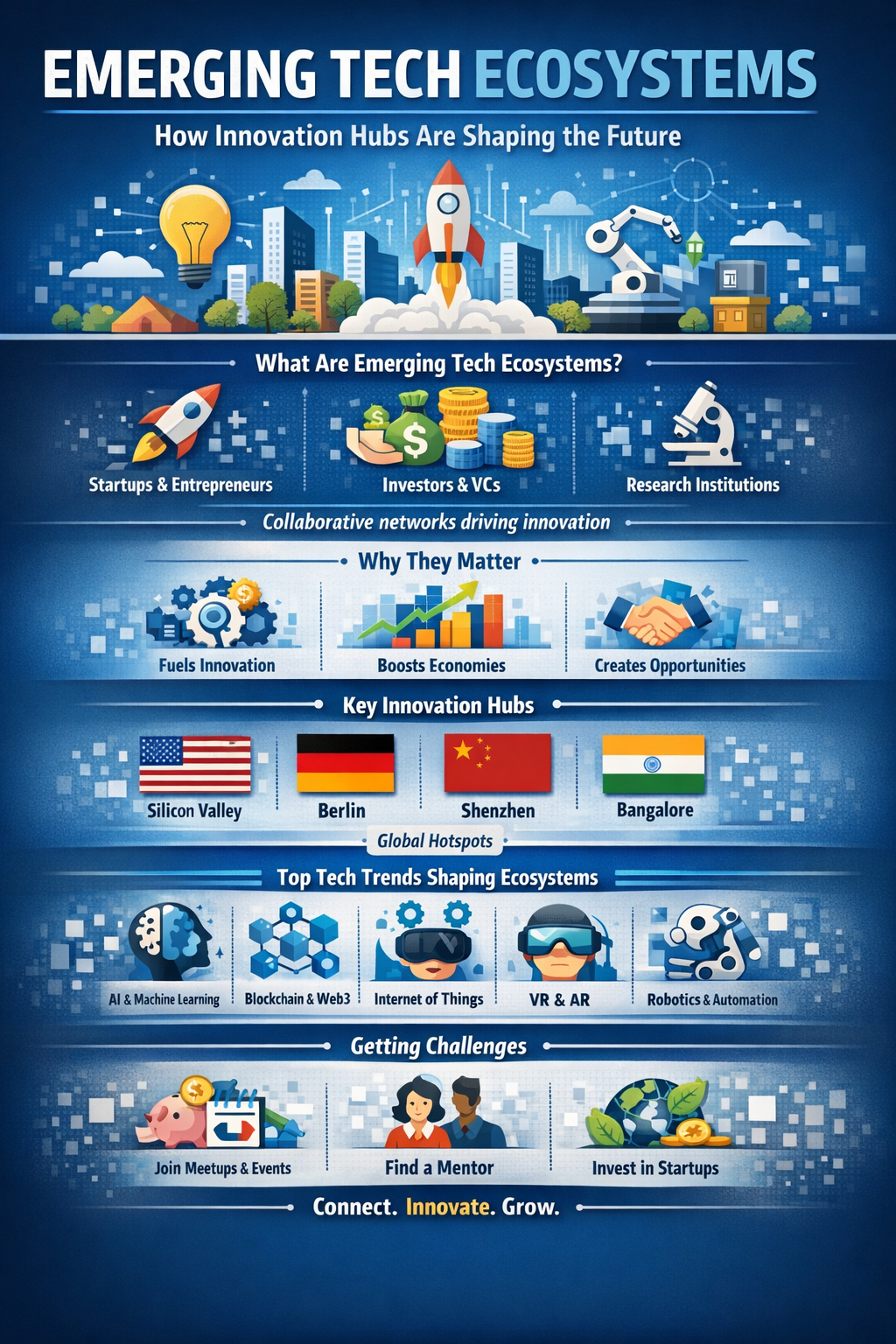
What Are Emerging Tech Ecosystems?
Emerging tech ecosystems are complex, interconnected networks where innovation, technology, investment, and talent converge. They are not merely collections of startups or tech companies—they are dynamic environments where multiple stakeholders collaborate to accelerate technological development, share knowledge, and create new business opportunities. Understanding what constitutes a tech ecosystem is essential for entrepreneurs, investors, and policymakers who want to leverage these networks for growth and innovation.
Definition and Core Components
A tech ecosystem can be defined as a synergistic network of entities that collectively foster innovation and technological advancement. The main components include:
- Startups and Entrepreneurs – Small, agile companies that drive innovation through experimentation and disruptive ideas.
- Established Corporations – Larger organizations that provide market access, mentorship, and partnerships to emerging innovators.
- Investors and Venture Capitalists – Entities that provide the funding necessary to scale new technologies and bring products to market.
- Universities and Research Institutions – Academic bodies that contribute research, talent, and intellectual property to the ecosystem.
- Government and Policy Makers – Regulators and facilitators that create favorable environments through funding, policy support, and infrastructure.
- Talent Pool – Skilled professionals, engineers, and innovators who form the backbone of technological progress.
- Supporting Services – Legal, marketing, and operational services that help startups navigate growth challenges.
By integrating these components, emerging tech ecosystems create highly efficient innovation loops, where ideas move from research to funding to commercialization faster than in isolated industries.
Examples of Emerging Technology Ecosystems
Emerging tech ecosystems exist across multiple domains, reflecting the evolving priorities of global innovation. Some key examples include:
- Artificial Intelligence (AI) Ecosystems – Networks of AI startups, cloud computing platforms, research labs, and investors focused on machine learning, deep learning, and natural language processing technologies.
- Blockchain and Decentralized Finance (DeFi) Ecosystems – Platforms, developers, and institutions collaborating to advance blockchain technologies, smart contracts, and digital finance solutions.
- Internet of Things (IoT) Ecosystems – Connected device manufacturers, software developers, and telecom providers creating integrated smart systems for homes, cities, and industries.
- Virtual Reality (VR) and Augmented Reality (AR) Ecosystems – Developers, hardware manufacturers, and content creators advancing immersive technologies for entertainment, education, and professional applications.
- Robotics and Automation Ecosystems – Industrial and consumer robotics companies working with AI and manufacturing solutions to enhance productivity and efficiency.
Data Insight: According to CB Insights, global AI startups raised $35 billion in 2023 alone, highlighting the rapid growth and investment activity within AI-focused tech ecosystems.
How They Differ From Traditional Tech Industries
While traditional tech industries often operate in siloed environments with slow adoption cycles, emerging tech ecosystems are characterized by:
- Collaborative Innovation: Entities work together instead of competing in isolation, leading to faster problem-solving and innovation.
- Rapid Experimentation: Startups can test and pivot ideas quickly due to shared resources and support networks.
- Global Reach: Digital infrastructure allows ecosystems to collaborate internationally, attracting talent and investors from around the world.
- Interdisciplinary Integration: Multiple technologies—AI, IoT, robotics, VR—converge to create solutions that span industries.
In essence, emerging tech ecosystems accelerate growth and adoption by leveraging collaboration, digital connectivity, and interdisciplinary innovation, setting them apart from conventional tech sectors.
Why Emerging Tech Ecosystems Matter
Emerging tech ecosystems are not just a trend—they are powerful engines driving global innovation, economic growth, and social progress. Understanding their significance helps entrepreneurs, investors, policymakers, and professionals recognize why engaging with these ecosystems can create long-term value.
Driving Innovation and Disruption
At the core of every thriving tech ecosystem is innovation. Emerging tech ecosystems provide a structured environment where startups, established companies, research institutions, and investors collaborate to develop breakthrough technologies.
- Rapid Prototyping and Experimentation: Startups in these ecosystems can test ideas quickly with access to shared resources, mentors, and funding.
- Disruptive Technologies: Emerging ecosystems accelerate the adoption of technologies that challenge traditional business models, such as AI, blockchain, and autonomous systems.
- Knowledge Sharing: Open collaboration and networking within ecosystems ensure innovations spread rapidly across industries.
Example: The AI ecosystem in Toronto combines universities, startups, and government funding to accelerate AI research and commercialization. Companies like Layer 6 AI and DarwinAI emerged from this ecosystem, showcasing its innovation-driven impact.
Economic and Social Impact
Emerging tech ecosystems contribute significantly to both regional economies and societal development:
- Job Creation: Startups and tech companies generate employment opportunities in high-skill sectors like AI, robotics, and cybersecurity.
- Regional Growth: Cities with strong tech ecosystems—like Silicon Valley, Berlin, and Shenzhen—experience higher GDP growth and increased foreign investment.
- Education and Skills Development: Universities and research institutions within ecosystems provide advanced training, preparing the workforce for the technologies of the future.
Data Insight: According to a report by Startup Genome, cities with strong tech ecosystems see up to 30% higher startup survival rates, emphasizing the economic benefits of supportive networks.
Advantages for Startups and Entrepreneurs
Emerging tech ecosystems are particularly beneficial for startups and entrepreneurs because they provide a fertile environment for growth:
- Access to Capital: Venture capitalists, angel investors, and government grants make it easier to secure funding for innovative ideas.
- Mentorship and Guidance: Experienced professionals and corporate partners provide strategic advice, helping startups scale efficiently.
- Networking Opportunities: Ecosystem hubs offer access to industry events, conferences, and collaborative projects that expand business reach.
- Reduced Time-to-Market: By leveraging shared infrastructure and partnerships, startups can bring products and services to market faster than in isolated settings.
Quote: Marc Andreessen, co-founder of Andreessen Horowitz, once said: “In a startup ecosystem, the network effect matters more than anything else. Connections, mentorship, and access to capital often determine success more than the idea itself.”
Strategic Importance for Corporates and Governments
Emerging tech ecosystems also matter for large corporations and governments:
- Corporate Innovation: Big companies engage with startups to adopt cutting-edge technologies faster than internal R&D allows.
- Policy and Infrastructure: Governments can drive economic development by investing in tech hubs, creating favorable regulations, and supporting talent development programs.
- Global Competitiveness: Countries that foster strong tech ecosystems gain leadership in high-tech industries, attracting foreign investment and talent.
In summary, emerging tech ecosystems matter because they fuel innovation, drive economic growth, and create opportunities for startups, professionals, and governments alike. They are not just networks of technology—they are strategic engines shaping the future of global industries.
Key Emerging Tech Ecosystems Around the World
Emerging tech ecosystems are not limited to one country or region—they are global phenomena, with hubs in North America, Europe, Asia-Pacific, and beyond. Each ecosystem has its own strengths, focus areas, and innovation drivers, shaped by local talent, investment, infrastructure, and government support. Understanding these hubs provides insights into where innovation is thriving and why certain regions are leading the future of technology.
North America
Silicon Valley, USA
- Known as the world’s most iconic tech ecosystem, Silicon Valley is home to companies like Apple, Google, Tesla, and hundreds of AI and blockchain startups.
- Strengths: Venture capital abundance, world-class universities (Stanford, Berkeley), and a culture of risk-taking and entrepreneurship.
- Focus Areas: AI, autonomous vehicles, software, cloud computing, and deep tech.
Toronto & Vancouver, Canada
- Toronto’s AI ecosystem is one of the fastest-growing globally, powered by research from the University of Toronto and the Vector Institute.
- Vancouver focuses on gaming, software, and smart city solutions.
- Strengths: Government grants, skilled workforce, proximity to U.S. tech markets.
Fact: Toronto AI startups raised over $1 billion in funding in 2023, reflecting the ecosystem’s growing influence.
Europe
Berlin, Germany
- Berlin has emerged as a startup hub with a thriving ecosystem for IoT, AI, and software innovation.
- Strengths: Affordable living, access to EU funding programs, diverse talent pool.
- Focus Areas: IoT, AI, SaaS, cleantech, and smart mobility.
London, UK
- London’s ecosystem is a global leader in fintech and blockchain technology.
- Strengths: Financial infrastructure, regulatory support for fintech innovation, strong venture capital presence.
- Focus Areas: Fintech, blockchain, AI applications in finance, cybersecurity.
Asia-Pacific
Shenzhen & Beijing, China
- Shenzhen is known as China’s hardware capital, producing robotics, IoT devices, and consumer electronics.
- Beijing focuses on AI, deep tech, and research-driven innovation.
- Strengths: Government investment, manufacturing infrastructure, large domestic market.
Bangalore, India
- Known as the “Silicon Valley of India,” Bangalore is a hotspot for software development, AI, and cloud computing startups.
- Strengths: Large pool of tech talent, lower operational costs, and a growing startup culture.
Middle East & Africa
Dubai, UAE
- Dubai is building a smart city and blockchain ecosystem, attracting startups from fintech, logistics, and IoT sectors.
- Strengths: Government-backed initiatives, strategic location between Asia and Europe, and tax incentives.
Nairobi, Kenya
- Known for mobile tech innovations and fintech, Nairobi has become a hub for African startups.
- Strengths: Mobile-first infrastructure, vibrant entrepreneur community, and government support for innovation.
Key Takeaways from Global Ecosystems
| Region | Leading Cities | Strengths | Focus Areas |
|---|---|---|---|
| North America | Silicon Valley, Toronto | Venture capital, universities | AI, cloud, software, autonomous tech |
| Europe | Berlin, London | EU funding, diverse talent | IoT, fintech, AI, SaaS |
| Asia-Pacific | Shenzhen, Beijing, Bangalore | Manufacturing, R&D, talent | Robotics, AI, IoT, software |
| Middle East & Africa | Dubai, Nairobi | Government support, mobile tech | Blockchain, fintech, smart city solutions |
Insight: While each ecosystem has unique strengths, all successful ecosystems share common elements: access to talent, investment, infrastructure, and collaboration networks.
Core Elements That Make a Tech Ecosystem Thrive
A thriving emerging tech ecosystem is not accidental—it requires a deliberate combination of talent, infrastructure, funding, and collaboration. While each ecosystem has unique characteristics, certain core elements consistently determine its success. Understanding these factors can help startups, investors, and policymakers strengthen or participate effectively in tech ecosystems.
Innovation Hubs and Research Centers
Innovation hubs—universities, research institutions, and labs—are the heartbeat of any tech ecosystem. They provide:
- Cutting-Edge Research: Universities and labs conduct foundational research that startups and corporates can commercialize.
- Talent Pipeline: Graduate students, PhDs, and researchers feed the ecosystem with skilled professionals.
- Collaboration Opportunities: Labs often partner with startups for pilot programs, prototypes, and knowledge sharing.
Example: The MIT Media Lab in Boston has produced numerous AI, robotics, and IoT startups, demonstrating how research institutions drive ecosystem innovation.
Investment and Funding Opportunities
Capital is the lifeblood of emerging tech ecosystems. Access to venture capital, angel investors, corporate funds, and government grants allows startups to scale rapidly:
- Venture Capital (VC): Provides high-risk, high-reward funding for early-stage startups.
- Angel Investors: Individual investors who offer mentorship and seed funding.
- Government Grants & Incentives: Programs that lower financial barriers for innovative projects.
Fact: According to Crunchbase, global startup funding in AI reached $35 billion in 2023, highlighting the critical role of financial backing in ecosystem growth.
Talent and Human Capital
An ecosystem without skilled talent cannot thrive. Human capital includes engineers, data scientists, designers, and innovators who drive technological advancement:
- Education & Training: Coding bootcamps, online courses, and university programs equip talent with relevant skills.
- Global Talent Attraction: Successful ecosystems attract international professionals, enriching diversity and expertise.
- Knowledge Sharing: Meetups, hackathons, and mentorship programs foster collaboration and skill growth.
Quote: Satya Nadella, CEO of Microsoft, emphasizes, “Talent is the core driver of innovation. An ecosystem grows only when the best minds are engaged and connected.”
Infrastructure and Digital Tools
Robust infrastructure enables ecosystems to function efficiently:
- Physical Infrastructure: Offices, labs, co-working spaces, and manufacturing facilities.
- Digital Infrastructure: Cloud computing, high-speed internet, collaborative platforms, and data storage solutions.
- Support Services: Legal, marketing, logistics, and operational services that help startups navigate challenges.
Example: Singapore’s Smart Nation initiative provides high-speed internet, IoT infrastructure, and government-backed digital platforms, creating a fertile environment for tech startups.
Culture and Collaboration
Culture is often an underestimated element:
- Entrepreneurial Mindset: Risk-taking and experimentation are encouraged.
- Networking and Collaboration: Knowledge and resources flow freely, accelerating innovation.
- Open Innovation: Companies and startups co-develop solutions instead of competing in isolation.
Insight: Ecosystems with collaborative cultures, like Berlin and Silicon Valley, tend to produce more breakthrough startups and faster technological adoption.
Summary of Core Elements
| Core Element | Role in Ecosystem | Example |
|---|---|---|
| Innovation Hubs | Research & talent pipeline | MIT Media Lab, Vector Institute |
| Investment & Funding | Financial growth & scaling | Silicon Valley VC networks |
| Talent & Human Capital | Skilled workforce & innovation | Coding bootcamps, universities |
| Infrastructure & Digital Tools | Operational & technological support | Singapore Smart Nation |
| Culture & Collaboration | Encourages experimentation & networking | Silicon Valley, Berlin |
Emerging Technology Trends Shaping Tech Ecosystems
Emerging tech ecosystems are constantly evolving, driven by innovations that disrupt traditional industries and create new opportunities. Staying informed about these technology trends is critical for entrepreneurs, investors, and professionals who want to participate effectively in these ecosystems. Below are the most influential trends shaping global tech ecosystems today.
Artificial Intelligence & Machine Learning
AI and machine learning are at the core of many emerging tech ecosystems, powering applications from healthcare to finance:
- Impact on Ecosystems: AI startups attract substantial investment and collaboration with universities and corporates.
- Applications: Predictive analytics, autonomous systems, natural language processing (NLP), computer vision.
- Example Hubs: Toronto, Beijing, and Silicon Valley are major AI ecosystem centers.
Data Insight: AI startups worldwide raised $35 billion in 2023, making it the fastest-growing sector within tech ecosystems.
Blockchain & Web3
Blockchain is transforming how ecosystems operate by enabling decentralized networks and secure, transparent transactions:
- Impact on Ecosystems: Creates opportunities for startups, investors, and developers in fintech, supply chain, and digital identity solutions.
- Applications: Smart contracts, decentralized finance (DeFi), NFTs, and digital governance.
- Example Hubs: London, Singapore, and Dubai are prominent blockchain innovation centers.
Case Study: Ethereum’s development hub in Switzerland’s “Crypto Valley” illustrates how blockchain ecosystems can foster startups, attract talent, and drive global adoption.
Internet of Things (IoT)
IoT connects devices, data, and services, creating interconnected ecosystems in smart homes, cities, and industries:
- Impact on Ecosystems: Drives collaboration between hardware manufacturers, software developers, telecom providers, and governments.
- Applications: Smart cities, industrial IoT, healthcare monitoring, and logistics automation.
- Example Hubs: Shenzhen, Berlin, and Singapore.
Fact: The global IoT market is projected to reach $1.6 trillion by 2026, emphasizing its central role in tech ecosystems.
Virtual Reality (VR) & Augmented Reality (AR)
VR and AR are revolutionizing experiences in education, gaming, healthcare, and industrial applications:
- Impact on Ecosystems: Encourages the creation of new content, hardware, and software startups.
- Applications: VR training simulations, AR-enhanced retail, immersive education, and medical applications.
- Example Hubs: Los Angeles, Tokyo, and London have thriving VR/AR innovation ecosystems.
Example: Oculus (acquired by Meta) grew within the U.S. VR ecosystem, demonstrating how immersive technology hubs foster rapid startup growth.
Robotics and Automation
Robotics and automation are transforming industries, from manufacturing to healthcare:
- Impact on Ecosystems: Requires collaboration between hardware engineers, AI developers, and industrial companies.
- Applications: Industrial robots, autonomous vehicles, drones, surgical robotics, and warehouse automation.
- Example Hubs: Japan, Germany, and California are leading robotics ecosystems.
Insight: The global robotics market is expected to grow to $74 billion by 2026, highlighting its pivotal role in tech ecosystems.
Summary of Key Trends
| Technology Trend | Ecosystem Impact | Leading Hubs |
|---|---|---|
| AI & ML | Drives research, investment, and startups | Toronto, Beijing, Silicon Valley |
| Blockchain & Web3 | Enables decentralized solutions and fintech | London, Dubai, Singapore |
| IoT | Connects devices, data, and services | Shenzhen, Berlin, Singapore |
| VR & AR | Creates immersive experiences and content | Los Angeles, Tokyo, London |
| Robotics & Automation | Transforms industries and operations | Japan, Germany, California |
Challenges in Emerging Tech Ecosystems
While emerging tech ecosystems are powerful engines of innovation, they also face several challenges that can hinder growth. Startups, investors, and policymakers must understand these hurdles to navigate the ecosystem effectively and create strategies for long-term sustainability.
Funding and Resource Limitations
Although ecosystems provide access to investors, many startups still struggle to secure sufficient funding, especially in early stages or in regions with less-developed investment networks.
- Seed Stage Challenges: Early-stage startups often find it difficult to raise initial capital, which can limit innovation and slow product development.
- Regional Disparities: Ecosystems in emerging markets may lack venture capital density compared to hubs like Silicon Valley or London.
- Resource Allocation: Limited access to advanced labs, cloud computing, and specialized software can restrict growth.
Example: A 2023 Startup Genome report noted that only 1 in 10 startups in Africa secures significant venture capital, highlighting disparities in global ecosystems.
Regulatory and Legal Issues
Emerging technologies such as AI, blockchain, and autonomous vehicles often operate in uncertain regulatory environments:
- Compliance Complexity: Startups must navigate data privacy laws, intellectual property rights, and international regulations.
- Slower Innovation: Overly strict regulations may delay product launches or prevent ecosystem growth.
- Cross-Border Challenges: Global collaboration is often hampered by differing legal standards in various countries.
Case Study: European GDPR regulations have required startups across AI and IoT ecosystems to rethink data handling practices, which, while ensuring privacy, adds operational complexity.
Talent Shortages
High-tech ecosystems rely on skilled human capital, but many regions face talent gaps:
- Specialized Skills: AI, robotics, blockchain, and cybersecurity require highly trained professionals, who are often scarce.
- Brain Drain: Skilled talent may move from developing ecosystems to established hubs, weakening local innovation capacity.
- Upskilling Needs: Rapid technology changes require ongoing training and professional development.
Insight: According to LinkedIn’s 2023 Emerging Jobs Report, AI specialists, data scientists, and blockchain developers are among the most in-demand roles, reflecting the critical talent gap in ecosystems.
Sustainability and Ethical Concerns
Emerging tech ecosystems must also address ethical, environmental, and social challenges:
- Responsible AI: Ensuring AI systems are fair, transparent, and unbiased is critical.
- Green Tech & Sustainability: Startups must consider energy consumption and environmental impact, especially in IoT and cloud computing sectors.
- Ethical Practices: Blockchain, VR, and AR ecosystems face challenges regarding privacy, consent, and data security.
Quote: Satya Nadella emphasizes, “The future of technology must be grounded in ethical responsibility. Ecosystems that ignore ethics will face long-term setbacks.”
Summary of Challenges
| Challenge | Impact on Ecosystem | Example |
|---|---|---|
| Funding & Resource Limitations | Slows innovation and scaling | African startups struggle to secure VC |
| Regulatory & Legal Issues | Delays adoption, compliance hurdles | GDPR impact on AI/IoT startups |
| Talent Shortages | Limits innovation and growth | High demand for AI & blockchain developers |
| Sustainability & Ethics | Risks long-term viability | Responsible AI and green tech initiatives |
Comments are closed, but trackbacks and pingbacks are open.