
Introduction: Exploring Virtual Reality (VR) Technology
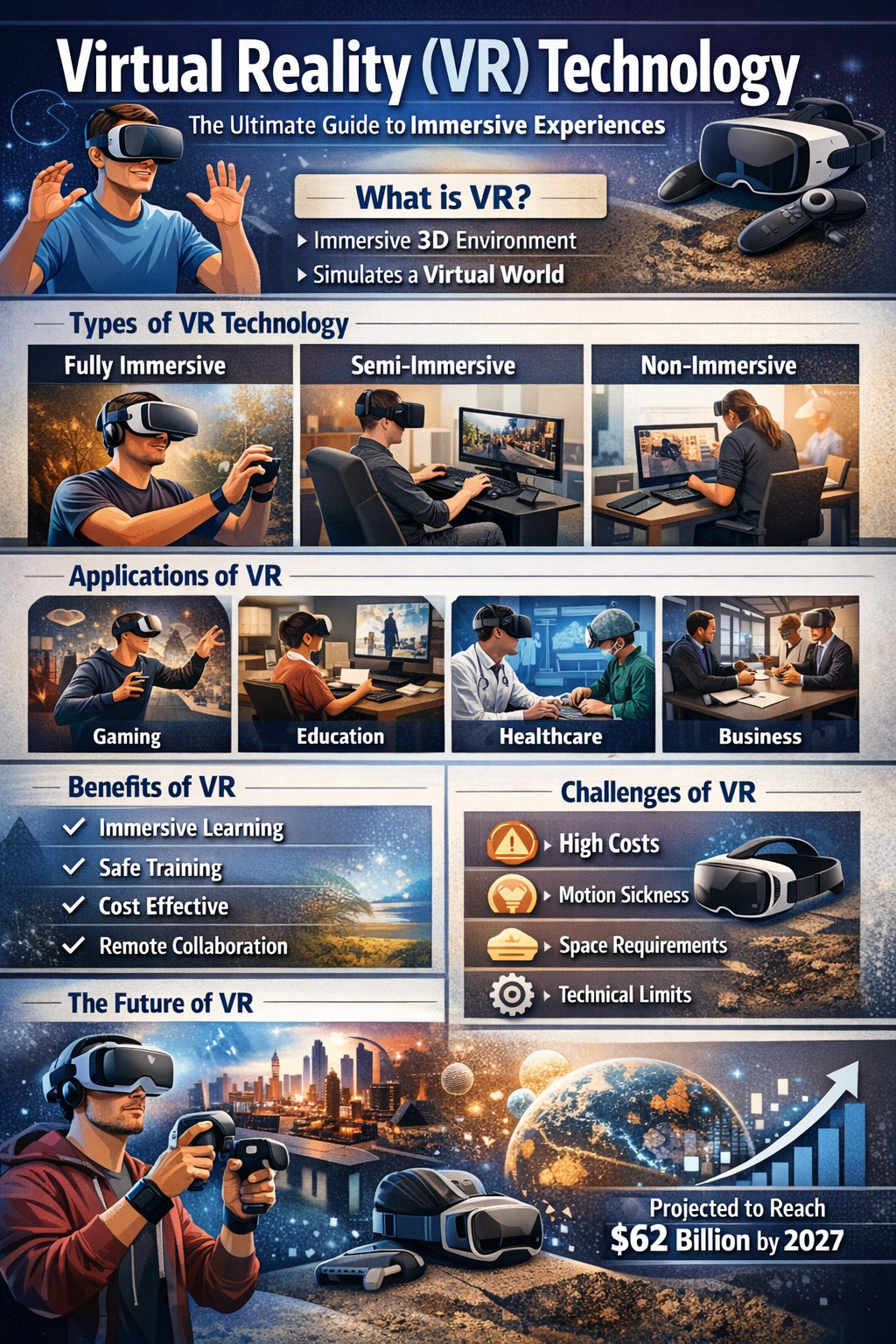
Virtual Reality (VR) technology has rapidly transformed the way we interact with digital content, bridging the gap between imagination and reality. At its core, VR is an immersive technology that allows users to experience and interact with a computer-generated environment as if it were real. Unlike traditional screens or devices, VR puts users inside a fully simulated world, offering experiences that are highly interactive, engaging, and realistic.
The impact of VR technology goes beyond entertainment. Today, it is revolutionizing industries such as education, healthcare, business, and even remote collaboration. For example, medical students can practice surgeries in a risk-free VR environment, while businesses can conduct virtual meetings and product demos without geographical limitations.http://futuretechfrontier.com
This article is a comprehensive guide to virtual reality (VR) technology. You will learn how VR works, the different types of VR systems, its applications across industries, key benefits and limitations, as well as future trends shaping this immersive technology. Whether you are a tech enthusiast, business professional, or someone curious about the latest innovations, this guide will provide valuable insights into the world of VR.
By the end of this guide, you’ll not only understand how VR technology works but also how it is shaping the future of immersive digital experiences.
What is Virtual Reality (VR) Technology?
Virtual Reality (VR) technology is a computer-generated simulation that immerses users in a 3D environment where they can interact with objects, people, and surroundings as if they were physically present. Unlike traditional media, which only allows observation, VR allows active participation, creating experiences that feel lifelike and interactive. This immersion is achieved through specialized hardware like VR headsets, controllers, and motion sensors, combined with sophisticated software that renders realistic environments in real time.
VR technology has grown beyond its early experimental stages and is now a mainstream tool across multiple industries. From VR gaming and virtual classrooms to medical simulations and corporate training, the technology is enabling experiences that were once impossible outside of imagination.
VR vs AR vs MR – Understanding the Differences
While VR creates a fully virtual world, Augmented Reality (AR) overlays digital elements onto the real world. For example, AR apps can display furniture in your living room through your smartphone camera, blending real and digital worlds. Mixed Reality (MR), on the other hand, merges real and virtual environments interactively, allowing objects to coexist and interact in real-time.
| Technology | Description | Example Use Case |
|---|---|---|
| VR (Virtual Reality) | Fully immersive digital environment | VR gaming, surgical simulations |
| AR (Augmented Reality) | Digital elements overlaying the real world | Pokémon GO, AR interior design apps |
| MR (Mixed Reality) | Interactive combination of real and virtual worlds | Microsoft HoloLens for engineering and training |
Understanding these differences is crucial because while all three fall under immersive technology, the applications and user experiences vary widely.
How Does VR Technology Work?
The functionality of VR technology depends on three main components: hardware, software, and tracking systems.
- VR Hardware:
- Headsets: Devices like the Oculus Quest, HTC Vive, and PlayStation VR are worn on the head and display the immersive virtual environment.
- Controllers: Handheld devices allow users to interact with the virtual world, enabling gestures, selections, and movements.
- Sensors & Cameras: These track the user’s movement and adjust the environment in real time for a seamless experience.
- VR Software:
- VR applications and games render 3D environments that respond to user actions.
- Specialized VR engines, such as Unity or Unreal Engine, are used to develop realistic simulations.
- Tracking Systems:
- Advanced VR systems use motion sensors, gyroscopes, and depth cameras to track head and hand movements.
- The system recalculates the visuals continuously to match the user’s perspective, making the experience feel lifelike.
A well-designed VR system creates a sense of presence, making users feel as though they are truly inside the virtual world, not just viewing it through a screen. This is the core advantage of VR technology over other forms of digital media.
Types of Virtual Reality (VR) Technology
Virtual Reality (VR) technology comes in different forms, each offering unique experiences and levels of immersion. Understanding the types of VR is essential for consumers, developers, and businesses to choose the right system for their needs. Broadly, VR can be classified into fully immersive, semi-immersive, and non-immersive VR.
Fully Immersive VR
Fully immersive VR provides the most realistic and engaging experience, placing users entirely inside a virtual world. Users wear VR headsets equipped with high-resolution displays and use motion-tracking controllers to interact with objects and environments.
Key Features:
- 360-degree virtual environments
- Real-time motion tracking
- Interactive objects and realistic simulations
- Often paired with haptic feedback for tactile sensations
Use Cases:
- VR gaming with lifelike graphics and motion interaction
- Flight or driving simulators for professional training
- Medical surgery simulations for hands-on learning
Fully immersive VR is ideal for applications where complete presence and engagement are necessary.
Semi-Immersive VR
Semi-immersive VR combines elements of VR with real-world interaction. While it doesn’t fully enclose the user in a virtual environment, it enhances experiences with partial immersion.
Key Features:
- Use of large screens or projections to display virtual content
- Limited motion tracking, usually via controllers or limited sensors
- Combination of digital and real-world inputs
Use Cases:
- Educational simulations in classrooms
- Architectural walkthroughs and virtual tours
- Training for industrial or technical skills
Semi-immersive VR is often more accessible and affordable than fully immersive systems.
Non-Immersive VR
Non-immersive VR is the least immersive form and typically involves interaction with a virtual environment using a computer or console screen without wearing a headset.
Key Features:
- Limited interaction, usually through a mouse, keyboard, or touchscreen
- No full sensory immersion
- Lower cost and easier setup
Use Cases:
- Desktop VR games
- Virtual design software
- VR simulations for learning basic concepts
While non-immersive VR doesn’t offer the same “presence” as other types, it is still useful for introductory experiences and applications where full immersion isn’t required.
VR Devices and Headsets
VR devices are the gateway to immersive experiences. The choice of a VR headset depends on the type of VR you want, your budget, and the applications you plan to use.
Popular VR Headsets in 2026:
| Device | Type | Key Features | Price Range |
|---|---|---|---|
| Oculus Quest 3 | Standalone, Fully Immersive | Wireless, hand tracking, high-res display | $399–$499 |
| HTC Vive Pro 2 | PC-based, Fully Immersive | Ultra HD graphics, room-scale tracking | $799–$999 |
| PlayStation VR2 | Console-based, Fully Immersive | Haptic feedback, eye tracking | $549 |
| HP Reverb G2 | PC-based, Semi-Immersive | High-res visuals, comfortable fit | $599 |
| Google Cardboard | Non-Immersive | Budget-friendly, mobile VR | $15–$30 |
Tips for Choosing a VR Headset:
- Purpose: Gaming, education, professional training, or casual use
- Hardware compatibility: PC, console, or standalone
- Comfort and ergonomics: Lightweight and adjustable headsets reduce fatigue
- Content availability: Check app stores and VR software support
VR Software and Applications
VR software drives the immersive experience, providing interactive worlds, realistic simulations, and engaging content. The software ecosystem includes games, training simulations, educational applications, and professional tools.
Popular VR Software Platforms:
- SteamVR: Extensive library of games and experiences
- Viveport: VR apps for entertainment, education, and business
- Unity & Unreal Engine: Tools for developing VR experiences
- Tilt Brush & Gravity Sketch: Creative VR apps for artists and designers
Applications Across Industries:
- Gaming: Fully interactive VR games like Half-Life: Alyx
- Education: Virtual classrooms and historical recreations
- Healthcare: Surgical simulations and therapy sessions
- Business: Virtual meetings, training, and marketing demos
Applications of Virtual Reality (VR) Technology
Virtual Reality (VR) technology has evolved from a niche gaming tool into a versatile technology that transforms multiple industries. Its ability to create immersive, interactive, and realistic simulations makes it highly valuable across entertainment, education, healthcare, and business. Here’s a detailed look at its key applications:
VR in Gaming and Entertainment
The gaming and entertainment industry was the first to widely adopt VR technology. VR has redefined how players experience digital worlds by immersing them directly in the action.
Popular VR Games:
- Half-Life: Alyx – A fully immersive first-person shooter
- Beat Saber – Music-based rhythm game with interactive lightsabers
- The Walking Dead: Saints & Sinners – Survival horror with realistic physics
Entertainment Beyond Gaming:
- VR concerts and virtual music festivals let fans attend live events from home.
- Virtual cinemas allow movie-goers to watch films in simulated theaters.
Case Study: Walt Disney Imagineering uses VR to design rides and attractions, allowing engineers to test concepts before building physical prototypes. This reduces cost and improves creativity.
VR in Education and Training
Virtual Reality is revolutionizing education by providing interactive learning experiences that are more engaging than traditional methods.
Applications in Education:
- Virtual classrooms for remote learning
- Historical recreations where students can explore ancient civilizations
- Interactive science labs without real-world risks
Professional Training Applications:
- Medical students practice surgeries in VR simulators, improving skills without endangering patients
- Industrial workers learn machinery operation safely
- Pilots use flight simulators to train in realistic scenarios
Case Study: Stanford University developed a VR biology lab where students can dissect virtual animals, allowing repeated practice without ethical concerns.
VR in Healthcare and Therapy
Healthcare is one of the most promising areas for VR adoption. The technology is used for training, therapy, and patient care.
Medical Training:
- Surgeons practice complex procedures in a VR simulation
- VR anatomy lessons allow detailed exploration of the human body
Therapy and Rehabilitation:
- VR therapy for PTSD helps patients gradually confront traumatic memories in controlled environments
- Physical rehabilitation uses VR exercises to motivate patients and track progress
- Pain management through immersive VR environments has shown measurable reduction in discomfort during procedures
Case Study: Cedars-Sinai Medical Center uses VR to help patients manage pain and anxiety before surgeries, reporting reduced opioid usage and improved patient outcomes.
VR in Business and Remote Collaboration
Businesses are leveraging VR for productivity, marketing, and collaboration. VR provides virtual spaces where teams can meet, collaborate, and interact with digital products.
Applications in Business:
- Virtual meetings and conferences: Employees can interact in lifelike 3D spaces, improving engagement over traditional video calls
- Product demonstrations and marketing: Companies showcase products virtually to global audiences
- Employee training: VR simulations prepare staff for complex operations without real-world risks
Case Study: Ford Motor Company uses VR to design cars and test ergonomics before production, reducing prototyping costs and speeding up design cycles.
Other Emerging Applications
VR is also making strides in other fields:
- Real Estate: Virtual property tours allow potential buyers to explore homes remotely
- Tourism: VR travel experiences let users explore destinations before visiting
- Fitness: VR workouts gamify exercise, increasing engagement and motivation
Advantages of Virtual Reality (VR) Technology
Virtual Reality (VR) technology offers a wide range of benefits that make it a transformative tool across multiple domains. From immersive entertainment to professional training, VR provides experiences that traditional media or methods cannot replicate. Below, we explore the key advantages of VR technology:
1. Immersive and Engaging Experiences
One of the primary benefits of VR is its ability to create fully immersive environments. Unlike flat screens or videos, VR places users directly inside a 3D world, engaging multiple senses simultaneously.
Benefits:
- Enhanced focus and attention due to high interactivity
- Deep emotional engagement in games, storytelling, and simulations
- Realistic experiences that feel lifelike, increasing memory retention in learning
Example: In VR education simulations, students retain up to 75% more information compared to traditional classroom learning due to immersive engagement.
2. Safe Learning and Training Environments
VR provides risk-free environments for training and skill development. Users can practice complex or dangerous tasks without real-world consequences.
Applications:
- Surgeons can practice high-risk operations without endangering patients
- Pilots use VR flight simulators to train for emergencies
- Industrial workers learn heavy machinery operation safely
Case Study: Boeing reported that using VR to train technicians reduced wiring assembly time by 25% while improving accuracy and safety.
3. Cost Efficiency
While VR hardware can have an upfront cost, it often reduces long-term expenses in training, prototyping, and operations.
Examples:
- Car manufacturers like Ford use VR for virtual prototypes, reducing the need for multiple physical models
- Corporate training programs using VR eliminate travel, lodging, and instructor costs
- VR therapy reduces long-term mental health treatment costs by providing scalable solutions
4. Personalized and Adaptive Experiences
VR allows for customized experiences that adapt to the user’s behavior, preferences, and learning style.
Benefits:
- Tailored learning paths in VR education applications
- Personalized therapy sessions for mental health patients
- Gamified VR workouts that adapt difficulty based on performance
Data Point: VR-based learning platforms have been shown to improve learning efficiency by up to 60% compared to traditional methods due to adaptive interactivity.
5. Accessibility and Remote Collaboration
VR technology can connect users across geographies, creating shared spaces for collaboration, education, and social experiences.
Applications:
- Virtual offices for global teams
- Remote students attending VR classrooms
- Virtual events and conferences reducing travel requirements
Example: Spatial VR platform allows teams to collaborate in a shared 3D workspace, improving communication and decision-making despite physical distance.
6. Creativity and Innovation
VR opens new avenues for creativity, enabling users to design, experiment, and innovate in ways that were previously impossible.
Examples:
- Artists using Tilt Brush to create 3D digital art in immersive spaces
- Architects creating virtual walkthroughs for clients before construction
- Game designers testing interactive environments without physical constraints
Challenges and Limitations of Virtual Reality (VR) Technology
While Virtual Reality (VR) technology offers immense potential, it also faces several challenges that can limit adoption, usability, and long-term effectiveness. Understanding these limitations helps businesses, educators, and consumers make informed decisions.
1. High Cost of VR Hardware and Software
One of the most significant barriers to widespread VR adoption is cost. Fully immersive VR headsets, high-end PCs, and specialized controllers can be expensive. Additionally, professional-grade VR software for training, design, or healthcare adds to the investment.
Cost Examples:
- Oculus Quest 3: $399–$499 (consumer-level)
- HTC Vive Pro 2: $799–$999 (professional VR setup)
- VR software licenses: $200–$1000 depending on application and industry
Impact: High costs can limit accessibility, especially for schools, small businesses, or casual users looking to explore VR technology.
2. Motion Sickness and Physical Discomfort
Many users experience VR motion sickness, also called “cybersickness,” due to mismatched sensory signals between vision and inner ear balance.
Symptoms:
- Dizziness and nausea
- Eye strain and headaches
- Fatigue after prolonged use
Mitigation Techniques:
- Use high-refresh-rate VR headsets (90Hz or higher)
- Take regular breaks during VR sessions
- Gradually increase exposure time to allow adaptation
Data Point: Studies indicate that 20–40% of VR users experience some form of motion sickness, particularly during fast-paced simulations or poorly optimized VR environments.
3. Technical Limitations
VR technology still faces hardware and software constraints that impact the user experience.
Challenges include:
- Graphics and processing power: High-quality VR requires powerful GPUs, which can be costly
- Limited field of view: Some headsets still provide a narrower visual perspective than human vision
- Latency issues: Delays between user movement and display response can disrupt immersion
- Content availability: Not all applications or experiences are optimized for every VR headset
Impact: These limitations can reduce realism, comfort, and engagement, especially for professional simulations requiring precision.
4. Accessibility and Space Requirements
Fully immersive VR often requires adequate physical space for safe movement, which may not be available in small homes or offices. Additionally, VR can be less accessible for people with disabilities if applications aren’t designed inclusively.
Solutions:
- Use stationary VR setups for limited space
- Incorporate accessibility features like voice commands and adjustable controls
5. Adoption and User Learning Curve
VR technology is still relatively new for many users. Learning to navigate VR interfaces, interact with controllers, and adapt to immersive environments can pose a steep learning curve, particularly for older users or non-gamers.
Impact: Slow adoption rates in certain industries, especially education and healthcare, where traditional methods are deeply entrenched.
The Future of Virtual Reality Technology
Virtual Reality (VR) technology is evolving at an unprecedented pace. From early experimental systems to mainstream consumer and professional applications, VR continues to expand its influence across gaming, healthcare, education, business, and beyond. The future of VR promises more immersive, accessible, and intelligent experiences powered by advancements in hardware, software, and integration with other technologies.
VR Trends to Watch in the Next 5–10 Years
- Standalone and Wireless VR Headsets
- The next generation of VR headsets will increasingly be wireless, eliminating the need for tethered PCs or consoles.
- Lightweight, standalone headsets will improve mobility and comfort, enabling casual and professional users to enjoy VR more easily.
- High-Fidelity Graphics and Realistic Immersion
- Advances in GPU performance, rendering algorithms, and display technology will create ultra-realistic visuals.
- Users will experience VR environments nearly indistinguishable from the real world, enhancing training, gaming, and virtual tourism.
- Haptic Feedback and Tactile VR Experiences
- Haptic suits and gloves will provide realistic touch sensations, simulating textures, resistance, and pressure in virtual environments.
- This will improve applications in gaming, design, and medical training, offering a more hands-on immersive experience.
- Integration with Artificial Intelligence (AI)
- AI-powered VR experiences will become more personalized and adaptive.
- Examples include intelligent virtual instructors, dynamic gaming worlds that respond to player behavior, and AI-driven VR simulations in healthcare.
- Expansion into the Metaverse
- VR will be a key technology for the growing Metaverse, creating persistent digital worlds where people can socialize, work, and play.
- Companies are investing in virtual spaces for commerce, entertainment, and education, driving widespread adoption.
Emerging VR Technologies
| Technology | Description | Potential Impact |
|---|---|---|
| Eye Tracking VR | Monitors where users look to optimize rendering and interactivity | Reduces motion sickness, improves immersion |
| AR-VR Hybrid Systems | Combines augmented and virtual reality for interactive environments | Blends real-world and virtual elements for professional use |
| Cloud-Based VR | Streaming VR content from servers instead of local hardware | Makes VR more accessible without expensive PCs |
| Social VR Platforms | Enables multi-user interaction in virtual spaces | Facilitates collaboration, education, and socialization |
Predictions for Consumer VR Adoption
- Market Growth: The global VR market is projected to reach $62 billion by 2027, driven by gaming, education, and enterprise applications.
- Mainstream Accessibility: Wireless, standalone headsets and mobile VR will make VR more accessible to casual users.
- Cross-Industry Expansion: VR will continue to grow in healthcare, training, real estate, and business collaboration.
Potential Social and Economic Impacts
- Remote Work and Collaboration: VR will redefine workplaces by creating virtual offices, reducing travel costs, and improving global team interactions.
- Education: VR classrooms will enable immersive learning experiences, expanding access to quality education worldwide.
- Healthcare: VR therapy and surgical simulations will improve patient outcomes while reducing costs.
- Entertainment and Tourism: Virtual concerts, tourism experiences, and gaming will redefine how people spend leisure time.
Quote:
“Virtual Reality is not just a technology—it’s a new way to experience the world.” – John Carmack, VR Pioneer
Comments are closed, but trackbacks and pingbacks are open.