
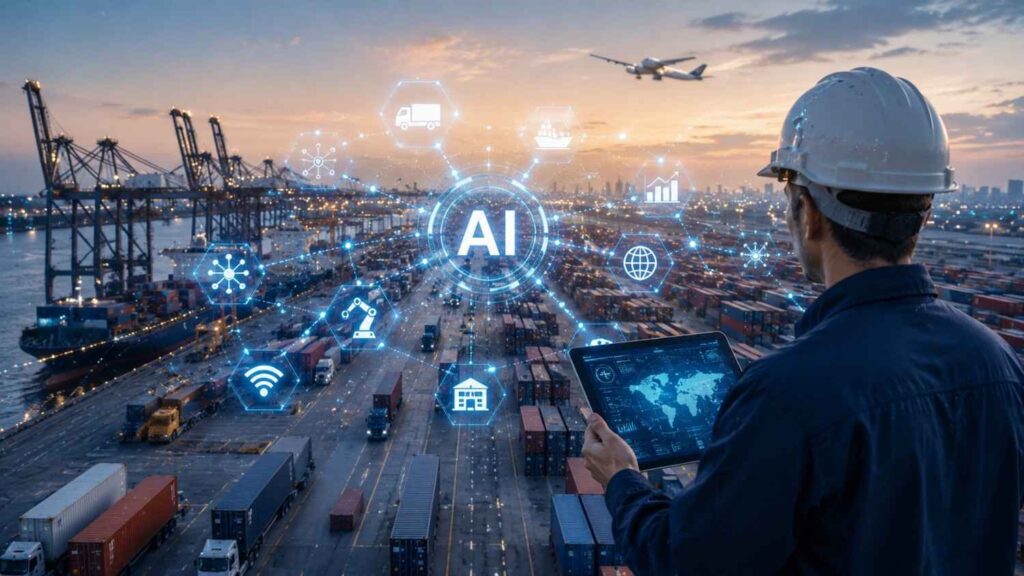
The Impact of Agentic AI on Supply Chain Management
Supply chain management has always depended on timely decisions. Organizations must continuously determine how much inventory to hold, when to replenish materials, which suppliers to use, how to schedule production, and how to respond when shipments are delayed. Traditional supply chain platforms help teams collect data and identify problems, but many decisions still require employees to review alerts, compare alternatives, communicate with stakeholders, and manually update several systems.
Agentic artificial intelligence changes this operating model. Instead of simply displaying information or generating a recommendation, an AI agent can work toward a defined business objective. It can monitor changing conditions, interpret data from multiple sources, evaluate possible responses, communicate with connected applications, and take approved actions within established limits.
For example, a conventional system may notify a planner that a component will arrive late. An agentic system may identify the products affected by the delay, review available inventory, compare alternative suppliers, calculate the cost of expedited transportation, and prepare a recommended response. Depending on its authority, the agent may also contact a supplier, create a proposed purchase order, or update a planning workflow for human approval.
The impact of agentic AI on supply chain management is therefore not limited to faster analytics. It involves reducing the distance between identifying a problem, making a decision, and executing the response. When implemented responsibly, AI agents can improve planning speed, operational coordination, supply chain visibility, and resilience.
However, companies should not treat agentic AI as a replacement for professional judgment. Effective adoption requires reliable data, secure system integrations, transparent decision rules, clearly defined permissions, and human oversight for sensitive or high-value actions. The most successful supply chains will combine the speed and analytical capacity of AI agents with the experience, accountability, and commercial understanding of human professionals.
Quick Answer About the Impact of Agentic AI on Supply Chain Management
The impact of agentic AI on supply chain management is the transition from systems that only analyze or recommend to systems that can also coordinate and execute multistep actions. Agentic AI allows organizations to create software agents that monitor supply chain conditions, interpret disruptions, compare response options, and use approved business applications to complete tasks.
These agents can support demand forecasting, inventory optimization, procurement, supplier communication, production planning, warehouse operations, logistics coordination, and risk management. For example, an inventory agent may detect a possible stockout, assess available inventory across several facilities, calculate transfer costs, and recommend moving stock before customer orders are affected. A procurement agent may identify an overdue supplier response, send a follow-up message, and escalate the issue when it exceeds a defined risk threshold.
The main advantage is faster and more coordinated decision-making. Instead of waiting for information to move through separate departments, AI agents can connect data and workflows across enterprise resource planning, warehouse management, transportation management, and supplier platforms.
Agentic AI does not mean that the entire supply chain operates without people. Organizations still need human approval for strategic, financial, contractual, safety-related, or unusual decisions. Companies must also control agent permissions, validate data quality, monitor outputs, and maintain complete audit records.
In practical terms, agentic AI gives supply chain teams a digital workforce that can handle routine analysis and coordination while employees focus on exceptions, relationships, strategy, and high-impact decisions.
What Does Agentic AI Mean for Modern Supply Chains?
Agentic AI refers to artificial intelligence systems designed to pursue goals and complete tasks with a degree of operational independence. In a supply chain environment, an agent may be assigned an objective such as maintaining product availability, reducing avoidable logistics costs, improving supplier response times, or identifying disruption risks before they affect customers.
This differs from traditional business intelligence. A dashboard can show that inventory is below target, while a predictive model can estimate when a stockout may occur. An agentic system can take the next step by investigating why the shortage exists, identifying possible responses, evaluating the consequences of each option, and initiating an approved workflow.
Modern AI agents typically combine several capabilities. They may use machine learning models, large language models, optimization engines, business rules, application programming interfaces, retrieval systems, and workflow automation. These components allow an agent to understand instructions, obtain relevant information, use connected tools, and determine whether its action achieved the intended result.
In supply chain management, this capability is especially valuable because decisions are rarely isolated. A change in customer demand can affect purchasing, inventory, production, warehousing, transportation, cash flow, and supplier capacity. Agentic AI can help organizations evaluate these relationships more quickly than disconnected functional systems.
However, an agent is only as effective as the environment around it. Poor data, conflicting objectives, weak system access controls, and unclear approval rules can produce unreliable results. Organizations must therefore design AI agents around well-defined processes, measurable goals, trusted data, and explicit operating boundaries.
How Agentic AI Differs From Traditional Automation
Traditional automation is highly effective when a process follows predictable rules. A company may automatically create a replenishment request when inventory reaches a fixed minimum, send a reminder when a supplier misses a deadline, or generate a report at the end of each week. These workflows save time, but they usually cannot adjust when the situation becomes more complex than the original rule.
Agentic AI can evaluate context before choosing an action. If inventory falls below target, an AI agent may consider pending purchase orders, supplier lead times, warehouse capacity, customer priority, seasonal demand, transportation costs, and available stock at other locations. It can then compare replenishment, transfer, substitution, or allocation options.
The main difference is flexibility. Traditional automation executes a predefined sequence, while an agentic system can determine which sequence is appropriate for the current situation. It can also revise its plan when new information appears.
This does not make rules unnecessary. Strong agentic systems still operate within policies, approval thresholds, and technical restrictions. The difference is that the rules define the boundaries of acceptable action rather than every individual step. This allows the agent to handle variation without giving it unrestricted authority.
How an AI Agent Makes Supply Chain Decisions
A supply chain AI agent generally follows a continuous cycle of observation, analysis, action, and evaluation. It begins by gathering information from approved sources. These may include ERP records, warehouse systems, transportation platforms, supplier portals, customer orders, production schedules, IoT sensors, contracts, emails, and external disruption feeds.
The agent then compares current conditions with its assigned objective. For instance, an agent responsible for customer service levels may determine that a delayed material could affect several priority orders. It may calculate the likely shortage, review substitute materials, identify alternative suppliers, and compare transportation options.
After selecting a suitable response, the agent uses connected tools to complete or prepare the next action. It may draft a supplier message, create a stock-transfer request, update a risk record, or request approval from a planner.
The final stage is evaluation. The agent checks whether the supplier responded, inventory arrived, or customer risk declined. If the outcome remains unresolved, it can revise its plan or escalate the issue.
In advanced multi-agent environments, specialized agents collaborate. A demand agent, inventory agent, procurement agent, and logistics agent may each analyze part of the problem, while an orchestration layer coordinates the final recommendation.
Where Does Agentic AI Create the Most Supply Chain Value?
Agentic AI creates the greatest value in supply chain activities that involve frequent decisions, large amounts of data, multiple possible responses, and significant coordination across teams. These are often the areas where employees spend considerable time collecting information, updating spreadsheets, checking systems, contacting suppliers, and resolving routine exceptions.
The technology is particularly useful when a decision must be revisited as conditions change. Demand plans, inventory requirements, supplier commitments, production schedules, and transportation routes rarely remain fixed. An AI agent can monitor these areas continuously rather than waiting for the next formal review cycle.
However, companies should avoid applying agentic AI simply because a process involves repetitive work. Conventional automation may remain the better option for stable, rule-based tasks. Agentic AI is more appropriate when the system must understand context, compare alternatives, or adapt its workflow.
Organizations should also prioritize use cases where the business outcome can be measured. Examples include reducing purchase-order follow-up time, improving inventory availability, lowering manual planning effort, shortening disruption-response time, or reducing unnecessary expedited freight.
A valuable use case also needs suitable data and controllable risk. An agent that recommends inventory transfers is easier to pilot than one that independently changes strategic suppliers or commits large financial amounts. This is why many organizations begin with recommendation-only or human-approved workflows.
The most promising areas include demand planning, inventory optimization, procurement administration, supplier monitoring, production scheduling, warehouse exception management, logistics coordination, and supply chain risk analysis.
Demand Planning, Inventory, and Production
Demand-planning agents can strengthen forecasting by continuously evaluating information that may not be fully reflected in historical sales data. This may include current orders, promotions, pricing changes, regional trends, customer behavior, product launches, and supply constraints. Instead of replacing formal planning, the agent can identify meaningful deviations and direct planners toward the forecasts that require attention.
Inventory agents can monitor stock levels across warehouses, stores, production sites, and distribution centers. When they identify a likely shortage or surplus, they can compare several responses. These may include changing replenishment quantities, transferring stock, prioritizing certain customers, adjusting safety stock, or delaying a lower-priority allocation.
Production-planning agents can assess demand, material availability, equipment capacity, labor schedules, maintenance requirements, and order priorities. When a disruption occurs, the agent can model different production sequences and explain the trade-offs involved.
These capabilities help organizations move from periodic planning toward more responsive planning. The goal is not to change every plan whenever new data appears. Instead, the agent should distinguish between minor variations and changes that materially affect cost, capacity, customer service, or risk. Human planners can then focus on the most important exceptions.
Procurement, Warehousing, and Logistics
Procurement contains many coordination-heavy activities that are suitable for AI agents. An agent can monitor purchase orders, identify missing confirmations, send routine supplier follow-ups, summarize vendor responses, and escalate issues that threaten production or customer delivery. It can also compare supplier lead times, performance history, capacity, and risk indicators when an alternative source may be required.
In warehousing, agents can support inventory consolidation, slotting recommendations, cycle-count priorities, labor allocation, and exception handling. For example, an agent may detect that fast-moving inventory is stored in an inefficient location and recommend a change based on order patterns and handling effort.
Logistics agents can monitor shipments, delivery appointments, carrier performance, route conditions, and transportation costs. When a delay develops, the agent can identify affected orders, compare rerouting options, and recommend whether to expedite, change carriers, or communicate a revised delivery date.
| Supply Chain Function | Possible Agent Action | Recommended Human Control |
|---|---|---|
| Demand planning | Identify forecast exceptions and recommend revisions | Approve major forecast overrides |
| Procurement | Follow up with suppliers and compare alternatives | Approve contract and supplier changes |
| Inventory | Recommend transfers and replenishment | Set value and quantity thresholds |
| Production | Recalculate schedules after disruptions | Approve safety or customer trade-offs |
| Warehousing | Prioritize tasks and investigate exceptions | Validate layout and labor changes |
| Logistics | Compare routing and carrier options | Approve high-cost service changes |
| Risk management | Identify disruptions and rank responses | Confirm strategic mitigation actions |
How Does Agentic AI Improve Resilience and Decision Speed?
Supply chain resilience depends on how quickly an organization can detect a disruption, understand its possible impact, decide on a response, and coordinate that response across the business. Many companies have invested in visibility platforms, control towers, and predictive analytics. These technologies improve awareness, but awareness alone does not guarantee a fast response.
A common problem is the time required to move from an alert to an operational decision. A planner may need to identify affected materials, contact procurement, review warehouse inventory, speak with production, compare transportation alternatives, and obtain management approval. By the time these steps are completed, the disruption may have become more difficult or expensive to manage.
Agentic AI can compress this decision cycle. An agent can gather information from connected systems, determine which orders or facilities are exposed, compare response options, and prepare a coordinated action plan. It can also assign tasks, request approvals, and monitor whether the selected response is working.
This capability supports resilience because it improves both speed and consistency. The organization is less dependent on one employee manually identifying every relationship between a disruption and the wider network.
Still, faster action is not automatically better action. Agents must understand operational priorities, customer commitments, regulatory requirements, and risk tolerances. They also need rules for handling incomplete or conflicting data. Resilience improves when speed is combined with disciplined governance, clear escalation procedures, and professional review of high-impact decisions.
Continuous Disruption Monitoring and Scenario Analysis
Supply chain disruptions can arise from supplier failures, labor shortages, severe weather, transport congestion, material scarcity, equipment breakdowns, cyber incidents, demand spikes, or geopolitical events. Traditional monitoring may identify these threats, but employees still need to connect the event to specific products, suppliers, routes, customers, and production plans.
An AI agent can continuously monitor both internal and external signals. When it detects a material risk, it can map the disruption to the relevant supply chain network. It may determine which purchase orders are affected, how much inventory is available, which customer orders are exposed, and when the impact is likely to occur.
The agent can then create alternative scenarios. It may compare changing suppliers, splitting an order, using a substitute material, transferring inventory, rescheduling production, or selecting a faster transport mode. Each option can be evaluated against cost, service, lead time, capacity, and risk.
This structured scenario analysis gives decision-makers more than a general warning. It provides a ranked set of actions with clear consequences. Human leaders can review the assumptions, consider relationship or strategic factors, and select the response that best supports the organization’s priorities.
Coordinating Decisions Across Business Functions
Supply chains often struggle because each department optimizes a different objective. Procurement may focus on purchase price, production may focus on equipment utilization, logistics may focus on transport cost, and sales may focus on customer delivery. A decision that improves one metric can unintentionally create a problem elsewhere.
Agentic AI can support cross-functional coordination by evaluating a decision from several perspectives. For example, purchasing from a lower-cost supplier may increase lead time and require more safety stock. Using expedited transport may protect an important customer order but reduce the profitability of the sale. Increasing production volume may improve unit cost while creating excess inventory.
An agent can bring these trade-offs into one decision process. It may compare revenue exposure, service levels, inventory cost, production capacity, supplier risk, and transportation expense before recommending an action.
This does not eliminate negotiation between departments. Instead, it gives teams a shared evidence base and reduces the time spent collecting conflicting reports. The agent can document the data, assumptions, constraints, and expected outcome behind each scenario.
Cross-functional coordination is one of the most important benefits of agentic AI because supply chain performance depends on the overall network, not on the independent efficiency of one function.
What Business Benefits Can Agentic AI Deliver?
Agentic AI can create business value by improving decision quality, reducing administrative effort, accelerating execution, and increasing the number of scenarios an organization can evaluate. Its benefits may appear across cost, service, inventory, productivity, resilience, and employee experience.
The size of the benefit depends on the quality of implementation. A well-designed agent working with trusted data and a clearly defined process may remove significant manual effort. The same technology applied to a poorly documented workflow may automate confusion and create additional risk.
Organizations should therefore avoid treating agentic AI as a universal solution. Every use case needs a clear baseline, measurable outcome, and realistic understanding of what the agent will change. For example, a supplier-communication agent may reduce the time buyers spend chasing confirmations, but it cannot solve an underlying supplier-capacity problem. An inventory agent may recommend better stock positioning, but it cannot compensate for inaccurate inventory records.
The business case should consider direct and indirect benefits. Direct benefits may include lower expediting costs, shorter planning cycles, reduced inventory, or fewer manual transactions. Indirect benefits may include earlier risk detection, improved employee focus, more consistent decisions, and better documentation.
Companies should also measure the cost of operating the agent. This includes integration, data preparation, software usage, model monitoring, governance, cybersecurity, employee training, and process redesign. A credible business case evaluates sustainable net value rather than focusing only on technical capabilities.
| KPI | Before Agentic AI | With Agentic AI | Business Impact |
|---|---|---|---|
| Forecast Accuracy | Periodic manual updates | Continuous AI-driven forecasting | Better demand planning |
| Inventory Levels | Overstock or stockouts | Optimized inventory balancing | Lower carrying costs |
| Order Processing Time | Manual coordination | Automated workflow execution | Faster fulfillment |
| Supplier Response Time | Email and phone follow-ups | AI-driven supplier communication | Improved procurement efficiency |
| Logistics Planning | Static route selection | Real-time route optimization | Reduced transportation costs |
| Exception Resolution | Manual investigation | Automated detection and prioritization | Faster decision-making |
Cost, Service, and Working-Capital Improvements
Agentic AI can help reduce costs by identifying inefficient decisions before they become expensive. For example, an agent may detect that a purchase order is likely to arrive late and recommend a low-cost inventory transfer before emergency air freight becomes necessary. It may also identify excess stock, repeated supplier delays, inefficient transportation patterns, or avoidable production changes.
Customer service can improve when agents identify order risks earlier and coordinate responses more quickly. Instead of discovering a shortage close to the delivery date, the company may have enough time to reallocate inventory, adjust production, or communicate alternatives to the customer.
Working capital may improve through better inventory positioning. An agent can help distinguish between inventory that protects service and inventory that remains unused because of inaccurate assumptions, slow-moving products, or duplicated safety buffers.
However, benefits should be measured against business-specific baselines. Useful metrics include forecast accuracy, fill rate, inventory turns, days of inventory, perfect-order performance, expedite cost, supplier response time, production schedule adherence, and planning cycle time.
Management should also monitor whether an improvement in one metric creates a negative effect elsewhere. Lower inventory, for example, is not beneficial if it produces more stockouts or unstable production.
A Shift From Routine Work to Exception Management
Supply chain employees often spend a large part of their day gathering information rather than making decisions. They may copy data between systems, check order status, send reminder emails, update spreadsheets, compare reports, and prepare routine summaries. These activities are necessary, but they do not always make the best use of professional expertise.
AI agents can perform more of this administrative and analytical work. They can monitor transactions, collect relevant records, summarize changes, initiate standard communications, and direct employees toward the exceptions that require judgment.
This changes the role of the planner, buyer, warehouse manager, or logistics professional. Instead of manually reviewing every transaction, employees can supervise groups of decisions, investigate unusual recommendations, manage important relationships, and address strategic risks.
The shift also creates new responsibilities. Employees must understand how agents reach decisions, when to override them, and how to report poor performance. Managers must define decision rights and ensure that people remain accountable for critical outcomes.
Agentic AI should therefore be positioned as workforce augmentation rather than simple headcount reduction. The strongest value comes when technology reduces repetitive coordination and allows experienced employees to focus on complex, commercial, and customer-sensitive work.
What Are the Risks and Limitations of Agentic Supply Chains?
Agentic AI introduces operational benefits, but it also creates risks that are more serious than those associated with a conventional reporting tool. A dashboard may display an incorrect number, but an AI agent could use incorrect information to place an order, change a schedule, send a supplier message, or update a customer commitment.
The level of risk depends on the agent’s authority. A recommendation-only agent presents less operational exposure than an agent allowed to complete transactions without review. Organizations should therefore increase governance requirements as the level of autonomy increases.
One major limitation is that AI agents do not possess perfect business understanding. They may process policies, historical decisions, and operational data, but they can still misinterpret unusual situations. They may also struggle when objectives conflict or when the correct decision depends on relationship history, ethics, negotiation strategy, or information that is not stored in a system.
Another concern is interconnected behavior. Several agents optimizing different goals could create instability if they do not share consistent data and policies. A purchasing agent may order additional material while an inventory agent recommends reducing stock. A production agent may increase output while a demand agent lowers the forecast.
For these reasons, companies need centralized governance, shared objectives, technical controls, auditability, and clear human ownership. The goal is not to remove risk completely. It is to make risk visible, measurable, and manageable before agents receive meaningful operational authority.
Data, Integration, and Reliability Risks
AI agents depend on timely, accurate, and well-structured information. If inventory records are wrong, supplier lead times are outdated, or production capacity is overstated, the agent may make a logical decision based on an incorrect picture of reality.
Data consistency is equally important. Different systems may use separate product codes, supplier names, units of measurement, or location structures. Unless these differences are reconciled, the agent may connect unrelated records or fail to identify important relationships.
Integration creates another layer of risk. Agents need secure access to ERP, WMS, TMS, procurement, planning, and communication tools. A failed connection may leave a workflow incomplete, while a poorly designed integration may allow duplicated or unauthorized transactions.
Reliability must also be tested across unusual situations. An agent may perform well during normal operations but respond poorly to extreme demand, widespread shortages, or incomplete information. Companies should test normal scenarios, edge cases, conflicting instructions, system failures, and malicious inputs.
Human overrides and agent errors should be recorded and analyzed. This allows teams to identify patterns, improve policies, and determine whether the agent is ready for more authority. Reliability should be demonstrated through evidence rather than assumed from a successful demonstration.
Governance, Security, and Accountability
Every supply chain agent should have a clearly documented purpose, owner, permission level, data access scope, and escalation process. Employees should know what the agent is allowed to recommend, what it may execute, and which actions always require human approval.
High-impact decisions should receive stronger controls. These may include changing suppliers, signing contracts, committing large purchases, modifying regulated production, overriding safety requirements, or altering customer commitments. Approval thresholds can be based on financial value, risk level, product category, customer priority, or operational consequence.
Security teams should treat agents as active system users. Each agent needs a unique identity, least-privilege access, authentication controls, activity monitoring, and regular permission reviews. Sensitive data should only be available when it is required for the assigned task.
Accountability must remain with named employees and business functions. An organization should not attribute a failed decision to “the AI” without identifying who designed the workflow, approved the permissions, monitored the system, and accepted the operating risk.
Complete audit logs are essential. Records should show the information used, the reasoning or rules applied, the action taken, the approval received, and the resulting outcome. This supports investigation, compliance, improvement, and management oversight.
How to Implement the Impact of Agentic AI on Supply Chain Management
Implementing agentic AI is not simply a matter of purchasing software and connecting it to an ERP platform. It requires the organization to redesign how decisions are made, approved, executed, and reviewed. Companies should treat the initiative as a combination of technology implementation, process improvement, data management, risk governance, and workforce change.
The first priority is selecting the right problem. Broad goals such as “automate the supply chain” are too vague. A useful project begins with a specific operational issue, such as slow supplier confirmations, excess planning effort, delayed logistics escalation, or poor inventory balancing across locations.
The current process must then be mapped in detail. Teams should document which systems contain the necessary information, which employees make decisions, what business rules apply, where approvals occur, and what typically causes delays or errors.
Data readiness should be evaluated before model selection. An advanced agent cannot produce reliable results if the underlying inventory, supplier, cost, capacity, or lead-time information is inaccurate.
Organizations must also decide how much authority the agent should receive. Most early projects should begin with observation, recommendation, or draft creation. Transactional authority can be added gradually after performance has been validated.
Successful implementation also requires employee involvement. Supply chain professionals should help design scenarios, test recommendations, define escalation rules, and identify exceptions. Their participation improves accuracy and builds trust because the system reflects real operating knowledge rather than theoretical workflows.
| Implementation Stage | Primary Objective | Key Activities | Expected Outcome |
|---|---|---|---|
| Assessment | Identify suitable AI opportunities | Analyze workflows, data quality, and business challenges | Clear implementation roadmap |
| Pilot Deployment | Test AI in a controlled environment | Run AI in shadow mode, monitor recommendations | Validate performance with minimal risk |
| Controlled Automation | Automate low-risk decisions | Set approval thresholds and monitor results | Faster operations with human oversight |
| Enterprise Scaling | Expand AI across supply chain functions | Integrate ERP, WMS, TMS, and supplier systems | Organization-wide efficiency improvements |
| Continuous Optimization | Improve long-term performance | Track KPIs, retrain models, refine workflows | Higher resilience and operational excellence |
A Practical Step-by-Step Implementation Process
A structured implementation process reduces risk and helps the organization demonstrate value before expanding autonomy.
- Define the operational problem. Select a measurable issue with a clear owner and business outcome.
- Map the current workflow. Document data sources, systems, decisions, approvals, delays, and failure points.
- Assess data readiness. Confirm that critical information is accurate, accessible, consistent, and regularly updated.
- Define the agent’s objective. Specify what the agent should optimize and which constraints it must respect.
- Set decision boundaries. Clarify what the agent may recommend, draft, execute, escalate, or never perform.
- Build and test integrations. Use controlled access to relevant enterprise and communication systems.
- Run in shadow mode. Allow the agent to generate recommendations without acting on them.
- Compare outcomes. Review recommendations against decisions made by experienced employees.
- Launch a limited pilot. Restrict the agent to one location, category, supplier group, or transaction type.
- Monitor and improve. Track errors, overrides, escalations, business results, and user feedback.
- Expand gradually. Add new actions or use cases only after the existing workflow demonstrates reliable performance.
This phased approach gives the organization time to improve policies, data, and employee confidence.
Selecting KPIs and a Suitable First Use Case
A strong first use case should be frequent enough to generate meaningful learning but limited enough to control risk. It should use accessible data, follow a reasonably consistent process, and produce an outcome that can be measured.
Suitable examples include supplier follow-up, purchase-order confirmation monitoring, shipment-delay triage, inventory-transfer recommendations, warehouse exception summaries, or routine demand-planning alerts. These processes involve real operational value without immediately giving the agent authority over major financial or strategic decisions.
The organization should establish baseline performance before the pilot begins. If the project targets supplier communication, baseline measures might include response time, number of manual follow-ups, overdue confirmations, and buyer hours spent on administration.
Business KPIs should be combined with agent-performance metrics. These may include recommendation accuracy, task-completion rate, escalation frequency, human override rate, unsupported statements, integration failures, policy violations, and average time to resolution.
User feedback also matters. An agent may technically complete a task but create additional review work or produce recommendations that are difficult to understand. Teams should evaluate whether the agent improves the complete workflow rather than one isolated step.
The best pilot is not necessarily the most impressive use case. It is the use case that allows the company to learn safely, demonstrate measurable value, and build a foundation for broader adoption.
What Is the Future of Agentic AI in Supply Chain Management?
The future of agentic AI in supply chain management is likely to involve networks of specialized agents rather than one system independently controlling every operation. Supply chains are too complex, diverse, and commercially sensitive to be managed effectively by a single unrestricted agent.
Specialized agents can focus on defined responsibilities. A demand agent may monitor forecast changes, an inventory agent may balance stock, a procurement agent may coordinate suppliers, and a logistics agent may assess shipment risks. An orchestration layer can then combine their findings and resolve conflicts according to shared business priorities.
This model could make supply chains more adaptive. Instead of relying only on fixed monthly or weekly planning cycles, organizations may continuously review demand, inventory, capacity, supplier status, logistics conditions, and financial impact. Plans could be adjusted when material changes occur rather than according to an arbitrary calendar.
The future will also depend on improved interoperability. Agents must communicate across ERP, planning, warehouse, transportation, procurement, customer, and supplier systems. They will need consistent data definitions, shared policies, and reliable mechanisms for confirming that actions were completed.
Governance will remain central as systems become more capable. Organizations will need formal standards for agent identity, permissions, testing, monitoring, and retirement. Human employees will continue to define strategy, manage relationships, approve consequential decisions, and take responsibility for results.
The companies that benefit most will not simply deploy more agents. They will build a disciplined operating environment in which agents can collaborate safely, transparently, and effectively.
Multi-Agent Orchestration and Connected Operations
Multi-agent orchestration allows several specialized AI agents to contribute to one supply chain decision. Consider a sudden increase in demand for a product. A demand agent may identify the increase and estimate future requirements. An inventory agent may calculate available stock and expected shortages. A procurement agent may review material availability and supplier lead times, while a production agent evaluates capacity.
A logistics agent can then determine how quickly materials or finished goods can be moved. The orchestration system combines these findings and recommends a coordinated plan rather than several disconnected actions.
This approach is valuable because supply chain decisions involve competing objectives. The lowest-cost sourcing option may increase lead time. The fastest transportation option may reduce profitability. A production change may protect one customer while delaying another.
Orchestration helps ensure that agents use shared priorities and do not optimize their own function in isolation. It can also manage dependencies, such as preventing a logistics booking before procurement confirms material availability.
For multi-agent systems to work, organizations need common data, consistent terminology, clear decision rights, and mechanisms for resolving conflicting recommendations. Without these foundations, adding more agents may increase complexity instead of improving coordination.
Why Human Supply Chain Expertise Will Remain Important
Supply chain professionals understand factors that may be difficult to represent completely in software. These include supplier relationships, negotiation history, customer expectations, product-quality concerns, organizational politics, ethical considerations, and long-term strategy.
An AI agent may identify the lowest-cost supplier, but an experienced buyer may know that the supplier is already operating near capacity. A logistics agent may recommend delaying a low-value shipment, while a customer manager may understand that the order is important to a strategic relationship.
Human expertise is also required when objectives conflict. Cost, service, resilience, sustainability, cash flow, and risk cannot always be reduced to one universally correct answer. Leaders must determine which trade-offs are acceptable in the current business context.
The human role will increasingly involve setting objectives, approving policies, supervising agent behavior, reviewing exceptions, and challenging assumptions. Employees will need enough understanding of the system to know when a recommendation is reliable and when additional investigation is necessary.
The strongest future model is therefore human-agent collaboration. Agents provide speed, analytical capacity, continuous monitoring, and workflow execution. People provide judgment, accountability, relationship management, strategic direction, and ethical oversight. Neither side delivers the best result in isolation.
Frequently Asked Questions
Organizations exploring agentic AI often have questions about autonomy, implementation, business value, employment, and operational risk. These questions are important because agentic AI is not simply another reporting technology. It can interact with business systems, communicate with suppliers, recommend actions, and potentially execute decisions.
The most important distinction is that agentic AI exists on a spectrum. Some agents only monitor data and provide summaries. Others generate recommendations or prepare draft transactions for approval. More advanced agents may complete approved actions independently when the transaction falls within clearly defined limits.
Companies do not need to begin with the highest level of autonomy. In most cases, a gradual approach produces better results. Employees can first review agent recommendations, compare them with real decisions, identify weaknesses, and improve the operating rules. Authority can then be increased only when the system demonstrates consistent performance.
It is also important to separate realistic capabilities from exaggerated expectations. Agentic AI can reduce routine coordination, improve decision speed, and help teams manage more information. It cannot guarantee perfect forecasts, eliminate disruptions, or replace the need for strong supplier relationships and professional management.
The following questions address the issues business leaders, supply chain managers, technology teams, and operational employees most commonly consider when evaluating AI agents.
What is agentic AI in supply chain management?
Agentic AI in supply chain management refers to goal-directed artificial intelligence systems that can monitor conditions, analyze information, plan actions, use approved tools, and evaluate results. These systems are designed to complete defined supply chain tasks with a controlled level of independence.
For example, an agent may monitor overdue purchase orders, check supplier responses, identify materials at risk, and prepare follow-up communications. Another agent may analyze inventory across several warehouses and recommend transfers to prevent shortages.
Agentic AI differs from a standard chatbot because it does not only answer questions. It can interact with ERP, warehouse, transportation, procurement, and communication systems to complete a multistep workflow.
However, the agent should operate within explicit limits. Organizations must determine what information it can access, what actions it can take, and when human approval is required. Agentic AI is therefore best understood as a digital operational assistant or supervised digital worker rather than an independent replacement for supply chain management.
How does agentic AI improve supply chain efficiency?
Agentic AI improves efficiency by reducing the manual effort required to collect information, identify problems, compare options, communicate with stakeholders, and update systems. It connects steps that are often handled separately by planners, buyers, warehouse teams, and logistics employees.
For example, when a shipment is delayed, an agent can identify affected orders, review available inventory, calculate alternative routes, prepare customer-impact summaries, and escalate the issue to the appropriate employee. This reduces the time between detection and response.
Efficiency also improves because agents can monitor operations continuously. Employees do not need to review every transaction or report manually. Instead, the system can direct their attention toward exceptions that exceed defined cost, service, or risk thresholds.
The benefit should not be measured only by the number of automated tasks. Organizations should evaluate whether the agent improves the complete process. A useful implementation should reduce cycle time, lower errors, improve decision consistency, or release employees for higher-value work without creating excessive review effort.
Can agentic AI manage inventory automatically?
Agentic AI can support many inventory-management activities. It can monitor stock levels, demand changes, supplier lead times, open orders, safety-stock policies, warehouse capacity, and inventory imbalances across locations. It can then recommend replenishment, allocation, stock transfers, or order adjustments.
Limited actions may also be automated. For example, an agent may create a transfer request when the quantity and value fall below approved thresholds. It may automatically notify a planner when a high-value, regulated, or unusual item requires review.
Full automation is not appropriate for every inventory decision. New products, extreme demand changes, strategic customers, uncertain supplier conditions, or inaccurate records may require professional judgment. Organizations should also prevent the agent from repeatedly reacting to temporary changes and creating unnecessary inventory movement.
The most practical model combines automatic monitoring with controlled execution. Routine, low-risk inventory decisions can be processed quickly, while exceptions are escalated to experienced employees. This delivers operational speed without removing accountability from the business.
Will AI agents replace supply chain planners?
AI agents are more likely to change the responsibilities of supply chain planners than eliminate the role completely. Many planners currently spend significant time collecting data, checking order status, updating spreadsheets, preparing reports, and coordinating routine follow-ups. Agentic AI can reduce this administrative workload.
Planners can then spend more time evaluating strategic scenarios, managing exceptions, improving parameters, working with suppliers, and aligning decisions with commercial priorities. Their role becomes more focused on supervision, judgment, and continuous improvement.
The change will require new skills. Planners must understand how agents use data, which assumptions influence recommendations, and when a decision should be challenged. They may also help define policies, test new workflows, and review patterns in agent errors or overrides.
Some highly repetitive tasks may require fewer manual hours, but supply chain environments remain uncertain and relationship-driven. Human professionals are still needed to interpret unusual conditions, balance competing objectives, manage sensitive stakeholders, and accept responsibility for consequential decisions.
What are the biggest risks of autonomous supply chains?
The biggest risks include inaccurate data, unreliable recommendations, excessive agent permissions, weak system integration, cybersecurity incidents, duplicated actions, policy violations, and unclear accountability. These risks become more serious when an agent is allowed to execute transactions rather than provide recommendations.
Another concern is objective misalignment. An agent instructed to reduce cost may make decisions that negatively affect service, resilience, quality, or supplier relationships unless those considerations are included in its operating rules.
Several agents can also create conflicting actions. A procurement agent may increase orders while an inventory agent attempts to reduce stock. Shared policies and orchestration are necessary to prevent this behavior.
Organizations should control these risks through phased implementation, role-based access, approval thresholds, audit logs, human oversight, scenario testing, and continuous performance monitoring. High-value, strategic, contractual, safety-related, or regulated decisions should remain under direct human authority until the organization has strong evidence that greater autonomy is appropriate.
What is a good first agentic AI use case?
A good first use case is specific, frequent, measurable, and operationally contained. It should solve a real problem without giving the agent authority over major financial, contractual, or safety-sensitive decisions.
Examples include monitoring supplier confirmations, preparing purchase-order follow-ups, summarizing shipment delays, identifying inventory-transfer opportunities, prioritizing warehouse exceptions, or creating demand-planning alerts.
The required data should already be available and reasonably reliable. The process should also have a knowledgeable business owner who can evaluate the agent’s recommendations and identify mistakes.
Many companies should begin in shadow mode. In this stage, the agent produces recommendations but does not take action. Employees compare the recommendations with actual decisions and record where the agent performed well or poorly.
Once performance is consistent, the company may allow the agent to create drafts, initiate approval workflows, or execute low-risk actions within fixed thresholds. This approach produces practical learning, protects operations, and builds employee trust before the organization expands the agent’s authority.
Conclusion
The impact of agentic AI on supply chain management extends far beyond faster reporting or improved forecasting. Agentic systems can connect data analysis, decision-making, communication, and workflow execution across demand planning, procurement, inventory, production, warehousing, logistics, and risk management.
This capability can help organizations respond more quickly to disruptions, reduce repetitive administrative work, improve inventory positioning, strengthen supplier coordination, and make cross-functional decisions more consistent. It can also give employees more time to focus on strategic planning, customer priorities, supplier relationships, and complex exceptions.
However, value does not come from autonomy alone. An agent working with inaccurate data, weak permissions, or unclear objectives may increase operational risk. Companies need strong data foundations, secure system integrations, defined decision boundaries, approval thresholds, audit logs, and named human owners.
A phased implementation approach offers the safest path. Organizations should begin with a focused, measurable use case, run the agent in recommendation or shadow mode, compare its performance with experienced employees, and increase its authority only when evidence supports the change.
In the long term, agentic AI may enable more adaptive and connected supply chain networks. Specialist agents could continuously coordinate demand, inventory, capacity, sourcing, and transportation decisions. Human expertise will still remain central because strategy, accountability, relationships, and ethical judgment cannot be delegated completely.
The most successful organizations will not ask whether people or AI should control the supply chain. They will design a responsible working relationship in which AI agents provide speed and analytical scale while professionals provide judgment, governance, and strategic direction.
Comments are closed, but trackbacks and pingbacks are open.