
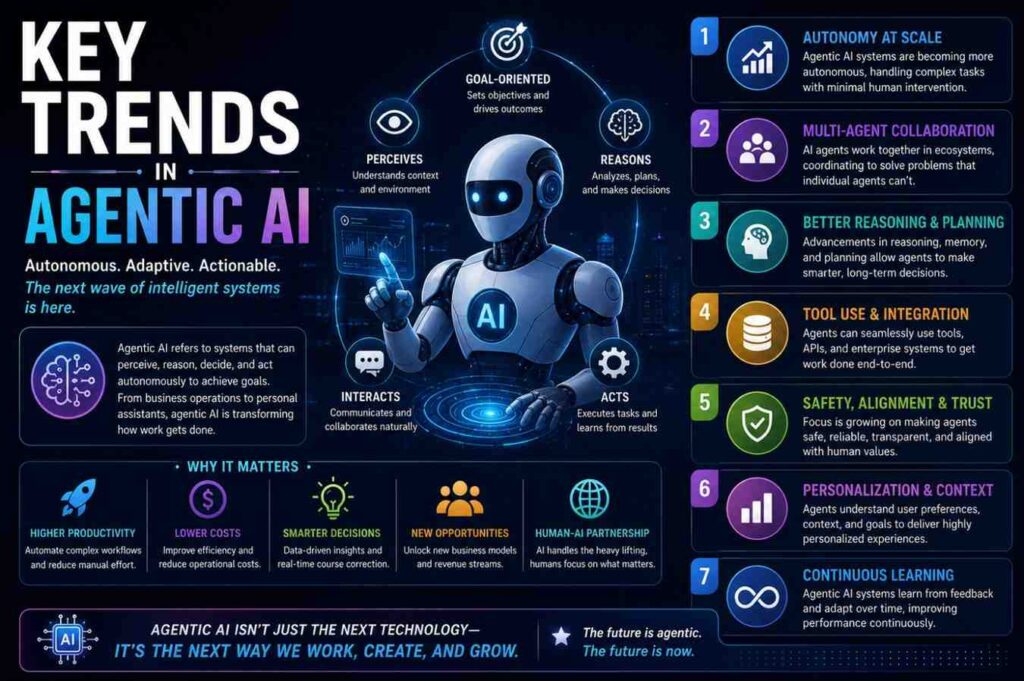
Key Trends in Agentic AI: The Future of Autonomous Intelligence
Agentic AI is rapidly reshaping how digital systems think, plan, and act in increasingly autonomous ways. Unlike traditional AI models that primarily respond to prompts, agentic systems are designed to understand goals, break them into structured steps, and execute tasks with minimal human intervention. This shift is transforming automation, enterprise workflows, and human–machine collaboration at a fundamental level.
As these systems continue to evolve, they are becoming more capable of handling complex, multi-step reasoning and long-term planning. This allows them to move beyond simple task execution and into more advanced roles such as decision support, workflow orchestration, and adaptive problem-solving across different environments. As a result, agentic AI is increasingly seen as a foundation for the next generation of intelligent systems.
At the same time, research and industry adoption are accelerating, with organizations exploring how agentic AI can improve productivity, reduce manual effort, and streamline operations. From business automation to scientific research, these systems are being integrated into real-world applications where autonomy and adaptability are essential.
Overall, the key trends in agentic AI highlight a clear shift toward more independent, goal-driven systems that can operate with greater context awareness and flexibility. This evolution is expected to significantly redefine how humans interact with technology in the coming years.
Key Trends in Agentic AI: The Future of Autonomous Intelligence
Agentic AI is rapidly reshaping how digital systems think, plan, and act in increasingly autonomous ways. Unlike traditional AI models that primarily respond to prompts, agentic systems are designed to understand goals, break them into structured steps, and execute tasks with minimal human intervention. This shift is transforming automation, enterprise workflows, and human–machine collaboration at a fundamental level.
As these systems continue to evolve, they are becoming more capable of handling complex, multi-step reasoning and long-term planning. This allows them to move beyond simple task execution and into more advanced roles such as decision support, workflow orchestration, and adaptive problem-solving across different environments. As a result, agentic AI is increasingly seen as a foundation for the next generation of intelligent systems.
A major trend driving this evolution is the integration of memory, reasoning, and tool-use capabilities into unified agent frameworks. Instead of operating in isolation, modern agentic systems can interact with external applications, APIs, and databases to complete real-world tasks. This makes them significantly more practical for enterprise use cases such as automation pipelines, customer support systems, and data analysis workflows.
| Trend Category | Description | Real-World Application | Key Benefit |
|---|---|---|---|
| Autonomous AI Agents | AI systems that independently plan and execute tasks without continuous human input | Scheduling, research automation, customer service workflows | Reduces manual workload and increases efficiency |
| Multi-Agent Collaboration | Multiple AI agents working together with specialized roles | Finance analysis systems, software development pipelines | Improves accuracy and scalability through division of labor |
| Tool & API Integration | AI systems connected with external tools, APIs, and software platforms | Data fetching, workflow automation, system updates | Enables real-world actions beyond text generation |
| Enterprise Automation | AI-driven automation across business operations | Reporting, HR workflows, data processing | Improves productivity and reduces operational costs |
| Reasoning-Based AI Systems | AI that evaluates multiple possible actions before deciding | Decision support systems, strategic planning tools | Enhances decision accuracy and reliability |
| Cloud-Enabled AI Deployment | Use of cloud infrastructure for scaling AI agents | SaaS platforms, enterprise AI systems | Provides scalability and high-performance execution |
What Makes AI “Agentic”
Agentic AI becomes “agentic” when it can operate with autonomy and structured reasoning. This means it is not just reacting to inputs but actively deciding what to do next based on a defined goal. These systems typically include components like memory, planning modules, and tool usage capabilities.
For example, an agent might be tasked with “researching market trends.” Instead of simply summarizing information, it can break the task into sub-steps such as gathering data, filtering sources, comparing insights, and producing a structured report. This ability to self-direct actions makes agentic AI fundamentally different from earlier models.
Difference Between Generative AI and Agentic AI
Generative AI focuses on producing outputs such as text, images, or code in response to prompts. Agentic AI, on the other hand, focuses on completing tasks end-to-end. The key difference lies in action versus generation.
For instance, generative AI might write an email draft, while agentic AI could write the email, decide the optimal send time, schedule it, and follow up if no response is received. This workflow-based capability is what makes agentic systems more powerful in real-world applications.
Core Technologies Behind Agentic AI
Agentic AI is built on several advanced technologies, including large language models (LLMs), reinforcement learning, and memory systems. Companies like OpenAI and Google DeepMind have played a major role in advancing these foundations.
Additionally, tool integration frameworks allow AI systems to interact with APIs, databases, and external software. This combination of reasoning, memory, and tool usage enables agentic systems to function more like autonomous digital workers than traditional models.
Evolution of Agentic AI Models
The evolution of agentic AI has been rapid, moving from simple scripted bots to highly capable reasoning systems. Early AI systems were limited to rule-based responses, where they could only follow predefined instructions without understanding context or adapting to new situations. These systems were useful for basic automation tasks, but they lacked flexibility and could not handle complex decision-making.
With advancements in machine learning and natural language processing, AI systems began to evolve beyond static rules. Models became capable of recognizing patterns in data, improving their responses based on training, and handling more dynamic interactions. This shift marked the beginning of more intelligent systems that could simulate aspects of understanding rather than simply executing fixed commands.
Modern agentic AI architectures now go a step further by incorporating planning, memory, and tool-use capabilities. These systems can break down complex goals into smaller steps, adjust their actions based on feedback, and interact with external tools or APIs to complete tasks. This enables them to function more like autonomous agents rather than passive models.
From Chatbots to Autonomous Agents
The earliest chatbots were rigid and relied on predefined scripts. They could answer only limited questions and failed when faced with complex queries. Over time, machine learning improved their flexibility, allowing them to handle more natural language inputs.
Today’s autonomous agents go far beyond conversation. They can manage workflows, interact with software tools, and even collaborate with other agents. This transformation has been driven by advances in transformer-based models and contextual learning systems.
Role of LLMs in AI Evolution
Large language models (LLMs) have become the backbone of modern agentic systems. Companies like Microsoft and Anthropic have contributed significantly to improving reasoning, alignment, and context retention.
LLMs enable agents to interpret instructions, maintain multi-step reasoning chains, and generate structured outputs. When integrated with external tools, these models can perform tasks that previously required human intervention, such as analyzing data or managing workflows.
Emergence of Reasoning-Based Systems
Recent advancements have introduced reasoning-focused architectures where AI systems evaluate multiple possible actions before choosing the best one. These systems simulate planning processes similar to human decision-making.
This includes evaluating task outcomes, revising strategies, and learning from feedback loops. As a result, agentic AI is becoming more reliable in complex environments like finance, healthcare, and logistics.
Key Trends in Agentic AI
The key trends in agentic AI highlight the most important directions shaping the future of autonomous systems. These trends reflect a shift toward greater independence, collaboration, and integration with real-world environments. As the technology matures, agentic systems are moving beyond experimental models and becoming practical tools used in industries such as business automation, software development, research, and digital services.
One major trend is the growing emphasis on autonomous decision-making, where AI systems are no longer limited to responding to prompts but can independently plan, execute, and refine multi-step tasks. This shift allows agentic systems to operate with higher levels of efficiency, making them suitable for complex workflows that previously required continuous human supervision.
Another important direction is the rise of multi-agent collaboration, where multiple AI agents work together to solve problems by dividing tasks, sharing information, and coordinating actions. This approach improves scalability and performance, enabling systems to handle more complex and large-scale challenges than single-model architectures.
Rise of Autonomous AI Agents
One of the most significant trends is the rise of fully autonomous AI agents capable of completing tasks without continuous human supervision. These agents can manage scheduling, research, communication, and even decision-making processes.
Businesses are increasingly adopting these systems to reduce manual workloads and improve efficiency. Instead of acting as assistants, AI agents are becoming digital operators that handle entire workflows from start to finish.
Expansion of Multi-Agent Collaboration
Multi-agent systems are becoming increasingly important in complex environments. Instead of relying on a single AI model, multiple specialized agents work together to solve problems.
For example, one agent might collect data, another analyzes it, and a third generates insights. This division of labor improves accuracy, scalability, and performance in large-scale applications.
Integration with Real-World Tools
Modern agentic systems are tightly integrated with external tools such as APIs, enterprise software, and cloud platforms like Amazon Web Services. This allows AI systems to perform real-world actions instead of just generating text.
Hardware acceleration from companies like NVIDIA further enhances performance, enabling faster processing and more complex workflows across industries.
Multi-Agent Systems and Collaboration
Multi-agent systems represent a powerful shift in how AI handles complex tasks. Instead of relying on one model to do everything, responsibilities are distributed across multiple intelligent agents that communicate, coordinate, and work together toward a shared goal. This structure allows each agent to specialize in a specific function, improving efficiency, accuracy, and scalability in problem-solving.
In these systems, different agents may take on roles such as planning, data analysis, execution, or evaluation. By dividing tasks in this way, multi-agent frameworks can manage more complex workflows than a single AI system. This collaborative structure also reduces errors, as agents can cross-check each other’s outputs and refine results through iterative interaction.
Another key advantage of multi-agent collaboration is adaptability. Since agents operate semi-independently, the system can dynamically adjust when conditions change or when new information becomes available. This makes multi-agent systems particularly useful in environments that require real-time decision-making, such as logistics, finance, and large-scale automation.
How Multi-Agent Systems Work
In a multi-agent setup, each agent has a specialized role. One agent may focus on research, another on planning, and another on execution. These agents communicate through structured protocols to ensure task completion.
This architecture improves efficiency because each agent can focus on its strengths. It also reduces errors by allowing cross-verification between agents.
Benefits of Collaboration Between Agents
Collaboration between agents leads to improved performance and scalability. When tasks are divided, systems can process information faster and more accurately.
Additionally, multi-agent systems can self-correct. If one agent produces incorrect output, another can identify and adjust it.
Use Cases in Real Applications
Multi-agent systems are already being used in various industries. In finance, they assist with risk modeling and portfolio optimization. In software development, they help automate coding, testing, and deployment pipelines.
They are also used in customer service, where different agents handle queries, escalate issues, and provide solutions.
Tool Use, APIs, and Real-World Integration
A defining feature of agentic AI is its ability to interact with external systems, tools, and digital environments. This capability transforms AI from a passive system that only generates responses into an active participant in real-world workflows. Instead of simply providing information, agentic systems can execute tasks, retrieve live data, and connect directly with external applications.
This level of integration makes AI significantly more practical for real-world use cases such as automation, business operations, and digital services. By combining reasoning with action, agentic systems can bridge the gap between decision-making and execution, allowing them to operate more like intelligent assistants within complex ecosystems.
| Component | Function in Agentic AI System | Example Use Case | Importance in Workflow |
|---|---|---|---|
| LLM Core Engine | Understands instructions and generates reasoning output | Interpreting complex user goals | Acts as the “brain” of the system |
| Planning Module | Breaks down goals into structured steps | “Research market trends” → sub-tasks creation | Ensures structured execution |
| Memory System | Stores past interactions and contextual knowledge | Remembering previous tasks or user preferences | Enables continuity and personalization |
| Tool Integration Layer | Connects AI with external tools like APIs and apps | Fetching data, sending emails, updating databases | Bridges AI with real-world systems |
| Execution Agent | Performs actual task execution steps | Running code, generating reports, sending outputs | Converts decisions into real actions |
| Feedback Loop System | Evaluates results and improves next actions | Correcting errors or refining outputs | Improves accuracy over time |
API-Driven Intelligence
APIs are a fundamental component of agentic AI because they enable communication between AI systems and external platforms. Through APIs, agents can access real-time data, update records, send messages, or trigger automated workflows across different software systems. This connectivity allows AI to function dynamically rather than relying on static information.
With API-driven intelligence, organizations can automate entire processes that previously required manual input. For example, an AI agent can analyze incoming data, generate insights, and then automatically update dashboards or execute business actions, significantly improving efficiency and reducing operational workload.
Tool-Using AI Models
Tool-using AI models extend beyond traditional language generation by actively using external tools to complete tasks. These tools may include search engines, code execution environments, analytics platforms, or specialized software systems. This allows the AI to perform actions instead of only providing suggestions or explanations.
By selecting and using the appropriate tools for each task, agentic systems become more accurate and capable in real-world scenarios. They can verify information, process complex datasets, and execute functions in real time, making them far more reliable and versatile than traditional AI models.
Cloud and Infrastructure Dependency
Cloud infrastructure is essential for running agentic AI systems at scale, as it provides the computing power and storage needed for complex operations. Platforms such as Amazon Web Services, Google Cloud, and Microsoft Azure support the deployment and management of AI agents across large environments.
These cloud systems also enable scalability and reliability by allowing multiple agents to operate simultaneously while handling high volumes of data. As agentic AI continues to grow, cloud integration will remain a critical foundation for ensuring performance, accessibility, and seamless global deployment.
Enterprise Automation and Business Transformation
Agentic AI is significantly transforming enterprise operations by automating complex workflows and improving decision-making processes. Unlike traditional automation tools that follow rigid rules, agentic systems can adapt to changing conditions, understand goals, and execute multi-step tasks with minimal human intervention. This makes them highly valuable in modern business environments where speed and accuracy are essential.
As organizations continue to adopt agentic AI, they are restructuring workflows to become more intelligent and self-operating. This shift reduces manual effort, improves consistency, and allows teams to focus on higher-level strategic work rather than repetitive operational tasks. The result is a more efficient and scalable business ecosystem.
Workflow Optimization in Enterprises
Organizations are increasingly using agentic AI to optimize workflows by automating repetitive and time-consuming tasks such as reporting, scheduling, customer support, and data entry. These systems can handle structured processes with speed and accuracy, reducing the need for constant human oversight.
Beyond simple automation, agentic systems can also adapt workflows based on real-time data. This means processes can be dynamically adjusted to improve efficiency, reduce delays, and ensure better resource allocation across departments, leading to smoother overall operations.
AI-Powered Decision Support
Agentic AI plays an important role in decision support by analyzing large volumes of data and generating actionable insights. Instead of relying solely on human interpretation, these systems can identify patterns, predict outcomes, and suggest optimal strategies based on available information.
This enhances decision-making speed and accuracy in business environments. Managers and executives can use AI-generated insights to make more informed choices, reduce uncertainty, and respond quickly to changing market conditions, improving overall organizational performance.
Productivity Gains and Efficiency
Enterprises that adopt agentic AI often experience significant productivity improvements due to reduced manual workload and faster task execution. By automating repetitive processes, employees can focus on more creative and strategic responsibilities that add greater value to the organization.
In addition to saving time, agentic systems also reduce operational errors and improve consistency across workflows. This combination of efficiency, accuracy, and scalability makes agentic AI a powerful driver of digital transformation in modern businesses.
Safety, Alignment, and Governance in Agentic AI
As AI systems become more autonomous, ensuring safety, alignment, and proper governance becomes increasingly important. Agentic AI can make decisions and execute actions independently, which introduces both powerful capabilities and potential risks. Because of this, researchers and organizations are focusing heavily on building safeguards that ensure these systems remain reliable, transparent, and under meaningful human control.
At the core of responsible agentic AI development is the idea that autonomy must be balanced with accountability. While these systems can improve efficiency and reduce human workload, they must also operate within clearly defined ethical, technical, and organizational boundaries to prevent unintended or harmful outcomes.
Importance of AI Alignment
AI alignment ensures that systems behave in accordance with human intentions, values, and ethical standards. In agentic AI, this is especially critical because systems are not just generating outputs but also taking actions in real environments. Misalignment in such systems can lead to incorrect decisions or unintended consequences.
To address this, researchers are developing techniques that guide AI behavior through training methods, feedback loops, and human oversight. The goal is to ensure that even as systems become more autonomous, they remain consistent with user goals and broader societal expectations.
Governance Frameworks
Governance frameworks are being developed to regulate how agentic AI systems are designed, deployed, and monitored. These frameworks define rules for accountability, transparency, and responsibility, ensuring that AI actions can be traced and evaluated when necessary.
Organizations and governments are also working on policies that define acceptable use cases and risk levels for autonomous systems. This helps create a structured environment where innovation can continue while maintaining control over potential misuse or unintended behavior.
Risk Management in Autonomous Systems
Agentic AI introduces several risks that must be carefully managed, including unauthorized actions, hallucinated outputs, and data privacy concerns. Since these systems can interact with external tools and environments, even small errors can lead to significant consequences.
To mitigate these risks, developers implement monitoring systems, permission controls, and validation mechanisms. Human oversight remains a key component of risk management, ensuring that autonomous actions can be reviewed, corrected, or stopped when necessary.
Future Outlook of Agentic AI
The future of agentic AI is centered on full autonomy, deeper integration, and more advanced human–AI collaboration. As these systems continue to evolve, they are expected to move beyond task-based assistance and become highly capable digital entities that can operate within complex environments. This progression will significantly reshape how work is performed across both digital and physical systems.
At the same time, the development of agentic AI is likely to remain closely tied to safety, governance, and alignment research. While autonomy will increase, the focus will also shift toward ensuring these systems remain reliable, controllable, and aligned with human goals. This balance between capability and control will define the next phase of AI evolution.
Toward Fully Autonomous Digital Workers
One of the most anticipated developments in agentic AI is the emergence of fully autonomous digital workers. These AI agents could potentially handle entire job roles, managing end-to-end workflows such as customer service, data analysis, scheduling, and operational decision-making with minimal human intervention.
Such systems would function as persistent digital employees that operate continuously, adapt to new information, and optimize their performance over time. This could significantly transform workplace structures by reducing repetitive workloads and allowing human employees to focus on strategic, creative, and supervisory responsibilities.
Human-AI Collaboration Models
Despite increasing autonomy, human oversight will continue to play a critical role in agentic AI systems. Rather than replacing humans entirely, these systems are expected to work alongside people, enhancing decision-making and improving productivity through collaboration.
In these models, humans will guide objectives, set constraints, and review outcomes while AI agents handle execution and optimization. This collaborative approach ensures that AI remains a supportive tool while still benefiting from human judgment, creativity, and ethical reasoning.
Industry-Wide Transformation
Agentic AI is expected to drive major transformation across industries such as healthcare, finance, logistics, and education. In healthcare, it could assist with diagnostics and patient management; in finance, it could optimize trading strategies and risk analysis; and in logistics, it could streamline supply chain operations.
These changes will not only improve efficiency but also redefine how services are delivered and managed. As adoption grows, industries will likely shift toward more automated, data-driven, and intelligent systems, fundamentally changing traditional operational models.
Frequently Asked Questions
What is agentic AI in simple terms?
Agentic AI refers to AI systems that can independently plan and execute tasks instead of just responding to prompts. Unlike traditional AI that only reacts to user input, agentic systems can break down goals into steps, make decisions, and carry out actions with minimal supervision.
These systems are designed to function more like autonomous assistants. They can analyze a situation, choose a strategy, and complete tasks in a structured way, making them useful for complex workflows that require reasoning and execution.
What are the key trends in agentic AI today?
The major trends in agentic AI include autonomous agents, multi-agent collaboration, tool integration, and enterprise automation. These developments are pushing AI systems beyond simple text generation toward real-world problem-solving and action-based intelligence.
Another important trend is the integration of AI with external tools and APIs, allowing systems to interact with software, databases, and digital environments. This makes agentic AI more practical and widely applicable across industries.
How is agentic AI used in business?
Businesses use agentic AI for workflow automation, customer support, data analysis, and decision-making. These systems help reduce manual effort by handling repetitive or time-consuming tasks more efficiently and accurately.
They are also used to generate insights from large datasets and support strategic decisions. By combining automation with intelligence, agentic AI improves productivity and operational efficiency in organizations.
What industries benefit most from agentic AI?
Industries such as finance, healthcare, logistics, and technology benefit significantly from agentic AI. In finance, it helps with risk analysis and automation; in healthcare, it supports diagnostics and patient management; and in logistics, it improves supply chain efficiency.
Technology-driven industries also use agentic systems for software development, testing, and automation. These applications help reduce costs and increase speed across complex operations.
Is agentic AI replacing human jobs?
Agentic AI is not fully replacing human roles. Instead, it primarily automates repetitive and structured tasks, allowing humans to focus on more creative, strategic, and decision-making responsibilities.
In most cases, it acts as a support system rather than a replacement. Human oversight remains essential, especially in areas that require judgment, ethics, and accountability.
What companies are leading agentic AI development?
Key leaders in agentic AI development include OpenAI, Google DeepMind, Microsoft, and Anthropic. These organizations are actively building advanced AI systems capable of reasoning, planning, and tool use.
They are also investing heavily in safety, alignment, and real-world integration to ensure that agentic AI systems are both powerful and reliable in practical applications.
Conclusion
The key trends in agentic AI clearly show a shift toward more autonomous, intelligent, and collaborative systems. As these technologies continue to advance, AI is moving beyond simple assistance tools and becoming capable of planning, decision-making, and executing complex tasks across a wide range of environments. This evolution is redefining how humans interact with digital systems and how work is structured in modern organizations.
As adoption continues to grow, organizations must balance innovation with safety, alignment, and governance to fully benefit from these systems. While agentic AI offers significant improvements in efficiency and productivity, it also introduces new challenges related to control, accountability, and responsible use. Addressing these challenges will be essential for sustainable and ethical deployment.
Overall, agentic AI is likely to become one of the most transformative forces in the next decade, reshaping both digital and physical workflows. Its ability to combine reasoning, autonomy, and real-world action will continue to drive major changes across industries, making it a foundational technology for the future of intelligent systems.
Comments are closed, but trackbacks and pingbacks are open.