
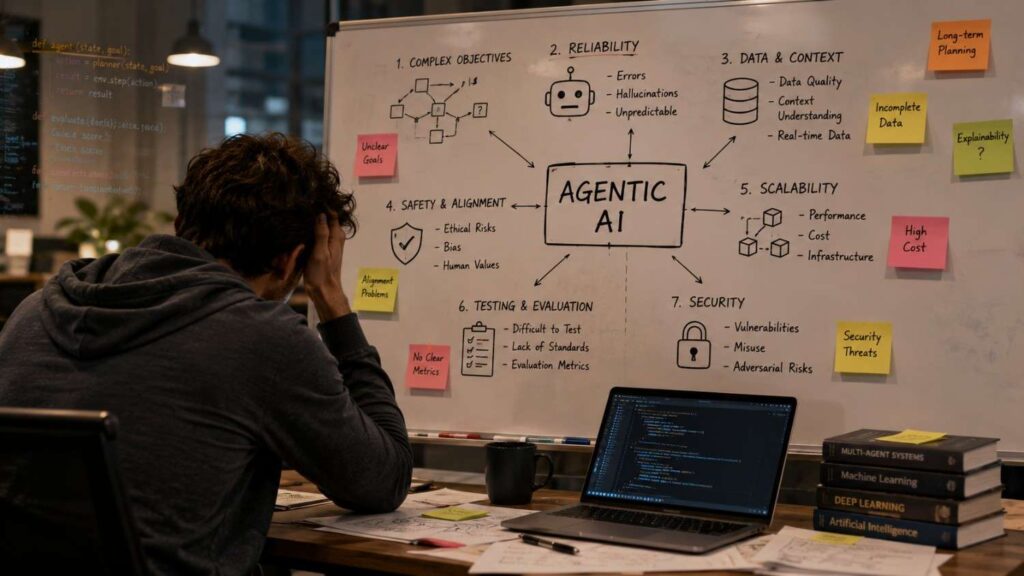
The Challenges of Developing Agentic AI Solutions: A Practical Guide
The Challenges of Developing Agentic AI Solutions extend far beyond selecting a capable language model. An agent must understand an objective, create a workable plan, select appropriate tools, preserve important context, recover from failures, and recognise when the task requires clarification or human intervention.
These systems offer meaningful opportunities. Agents can coordinate research, analyse large document collections, update business applications, prepare customer communications, investigate operational issues, and complete multi-step workflows that would otherwise require repeated manual instructions. As integrations grow, however, the consequences of incorrect decisions also increase.
NIST launched its AI Agent Standards Initiative in February 2026 to support secure, interoperable, and trustworthy adoption as AI agents gain more autonomy and interact with additional tools and services. This type of standards work reflects a broader reality: agent development is becoming an engineering, security, identity, and governance challenge rather than only a model-selection problem.
Deterministic software follows paths written by developers. An agent may choose different actions for similar requests, use tools in an unexpected sequence, or continue pursuing an objective after encountering incomplete information. These characteristics create flexibility but reduce predictability.
The difficulty also depends on authority. A read-only research assistant creates a different level of risk from an agent that can transfer funds, change cloud infrastructure, communicate externally, or access confidential records.
In my experience, the most useful design question is not, “How autonomous can the agent become?” It is, “What is the minimum autonomy required to improve this workflow safely?” That framing keeps development connected to measurable business value, operational control, and user trust.
Related Articles
Architecture, Planning, and Orchestration Challenges
Agentic AI architecture normally combines a model, instructions, tools, retrieved information, short-term context, persistent state, control logic, and an execution loop. Each component may perform acceptably in isolation while the complete system still behaves inconsistently. The difficulty comes from coordinating probabilistic decisions across an evolving workflow.
Planning is challenging because real user goals are often incomplete. A request such as “resolve this customer issue” may require identifying the account, checking policy, reviewing history, gathering missing evidence, determining whether an exception applies, and selecting an authorised response. The agent must know which assumptions are safe and which questions require clarification.
Developers must also decide where agentic reasoning should end and deterministic control should begin. A fixed workflow is easier to test and govern, while an agent-controlled workflow can adapt to a wider range of situations. The strongest architecture often uses both: deterministic software controls critical boundaries, and the agent handles uncertain decisions within those boundaries.
Orchestration creates additional questions. Should one agent manage the complete task, or should specialised agents handle research, planning, execution, and review? OpenAI recommends maximising the capabilities of a single agent before introducing multiple agents because each additional agent increases overhead and complexity.
Anthropic similarly recommends simple, composable designs and distinguishes predefined workflows from agents that dynamically direct their own actions. The architecture should therefore match the uncertainty of the task. More autonomy should be introduced only where it creates measurable value that a simpler system cannot provide.
| Development Challenge | Primary Impact Area | Risk Level | Recommended Priority |
|---|---|---|---|
| Task Planning | Workflow Execution | High | Critical |
| Multi-Agent Coordination | System Complexity | High | High |
| Context Management | Decision Accuracy | High | Critical |
| Memory Handling | Long-Term Consistency | Medium | High |
| Tool Integration | External Actions | High | Critical |
| Permission Management | Security & Compliance | High | Critical |
| Agent Evaluation | Reliability Testing | High | High |
| Observability | Monitoring & Debugging | Medium | High |
| Cost Optimization | Operational Efficiency | Medium | Medium |
| Human Oversight | Governance & Safety | High | Critical |
Task Decomposition and Long-Horizon Reliability
Agents must divide broad goals into smaller actions that can be executed and verified. Weak task decomposition can cause missing steps, repeated work, unnecessary tool calls, or premature conclusions. The problem becomes more difficult when tasks continue over many minutes, sessions, or external events.
Long-horizon workflows require the agent to preserve objectives, constraints, dependencies, and completed actions. New information may contradict earlier assumptions, forcing the system to revise the plan without repeating irreversible operations or losing useful progress.
A reliable architecture separates planning, execution, and verification. The agent can maintain a structured task list, record completed steps, identify unresolved questions, and check whether each expected result exists before continuing. A coding agent, for example, should execute tests after changing files rather than assuming the modifications work together.
Developers must also define error-recovery rules. Some failures can be retried safely, while others require a different tool, a revised plan, or immediate escalation. Retrying an idempotent search is different from repeating a payment request.
Checkpoints, maximum-step limits, and explicit stop conditions reduce the chance that small mistakes develop into expensive failures. Long-horizon reliability depends on disciplined state verification, not simply on giving the model more context or more time.
Multi-Agent Coordination and Emergent Complexity
Multi-agent systems divide responsibilities among specialised agents, such as a researcher, planner, executor, critic, or reviewer. This separation can support parallel work and clearer roles, but it also introduces communication and coordination failures that do not exist in a single-agent design.
Agents may duplicate tasks, disagree about priorities, pass incomplete information, or interpret the shared objective differently. Developers must specify how work is delegated, how results are validated, and which agent has final authority when recommendations conflict.
Anthropic’s description of its multi-agent research system demonstrates the engineering required to coordinate parallel workers, combine findings, manage shared context, and produce a coherent final result. These benefits come with higher model usage, latency, and operational complexity.
Shared memory creates further risk. Agents need enough information to collaborate, but unrestricted access can spread incorrect assumptions or expose sensitive information to components that do not require it.
A practical design uses clearly defined roles, structured handoffs, bounded permissions, and verification at important transitions. Each agent should receive only the context and tools needed for its responsibility.
Multi-agent orchestration should solve a demonstrated limitation. Adding agents merely because the architecture appears advanced can make the system more expensive, harder to evaluate, and less dependable.
Context, Memory, and Tool Integration Challenges
An agent needs access to instructions, user messages, retrieved documents, tool descriptions, intermediate results, and task state. Together, these elements form the working context that guides every model decision. As workflows become longer, context management becomes one of the most important engineering challenges.
Critical information can be displaced by verbose tool outputs, repeated messages, outdated summaries, or irrelevant documents. The agent may then overlook an important constraint or rely on information that is no longer accurate. Simply increasing the context window does not solve this problem because larger contexts may still contain conflicting or low-quality information.
Anthropic describes context engineering as the management of the full context state, including system instructions, available tools, external information, message history, and persistent notes. Effective designs preserve essential information while removing material that no longer contributes to the current task.
Tool integration adds another layer of difficulty. A tool needs a clear name, precise description, predictable parameters, useful error messages, and outputs that the model can interpret efficiently. A confusing tool schema may cause the agent to select the wrong operation or supply invalid arguments.
Developers should not expose every available API endpoint to an agent. A smaller set of task-specific tools reduces ambiguity and limits authority. Read and write operations should also be separated wherever possible.
Reliable agent development therefore depends on disciplined context selection, trustworthy memory, well-designed tool interfaces, and explicit control over side effects.
Managing Context and Persistent Memory
Short-term context allows an agent to reason about the current workflow, while persistent memory may preserve preferences, previous outcomes, summaries, or task information across sessions. Both forms of memory can create reliability and privacy problems if they are not managed carefully.
Summaries may omit important details, retrieved memories may be outdated, and model-generated interpretations may be stored as if they were verified facts. Once incorrect information enters persistent memory, it can influence future decisions long after the original error occurred.
Developers should distinguish between confirmed facts, temporary state, user preferences, external evidence, and model-generated conclusions. These categories require different trust levels, retention periods, and correction procedures.
Memory systems also create privacy obligations. Organisations need clear policies for consent, access, retention, deletion, and user correction. Sensitive information should not be retained merely because it may be useful later.
Provenance improves reliability. The agent should know whether a statement came from an authoritative database, a user message, an external document, or a previous model summary.
For long tasks, structured notes are often more dependable than repeatedly passing the entire conversation. Objectives, completed actions, unresolved questions, and evidence references can be stored separately. Memory should provide continuity without becoming an uncontrolled archive of sensitive or unreliable information.
Designing Reliable and Safe Tools
Tools determine what an agent can accomplish in the external world. Poor tool design can create ambiguous actions, excessive authority, invalid parameters, unstructured outputs, or irreversible side effects. A capable model cannot compensate consistently for an unsafe interface.
Each tool should perform a clearly defined operation and return enough information for the agent to confirm what occurred. Descriptions should explain when the tool is appropriate, what inputs are required, and which errors or limitations may appear.
Read and write operations should be separated when practical. An agent that needs to inspect account information does not automatically require permission to modify it. This separation supports least-privilege access and makes approvals easier to design.
Consequential tools should include preview, confirmation, idempotency, and rollback where possible. Repeating a tool call should not accidentally send two payments, create duplicate tickets, or delete the same resource twice.
The Model Context Protocol offers a standard method for connecting models with tools and data, but a standard interface does not remove the need for secure authorization. MCP security guidance recommends established OAuth-based practices for protected resources.
Credentials should remain outside model-generated code, and permissions should be limited to the exact actions and resources required for the current workflow.
Security, Safety, and Governance Challenges
Agentic systems increase the attack surface because they process untrusted information while holding the authority to perform actions. An attacker may not need to compromise the underlying model. Instead, malicious instructions can be embedded in a webpage, email, document, repository, support ticket, or tool response that the agent reads during an otherwise legitimate task.
This threat is commonly described as indirect prompt injection or agent hijacking. The malicious content attempts to redirect the agent away from the user’s goal, reveal information, misuse a tool, or perform an unauthorised operation. The risk becomes more serious when the agent can access confidential data or irreversible tools.
NIST has studied agent-hijacking scenarios in which external content influences tool-using agents. These evaluations focus on the resulting action rather than only on whether the model appears to follow a malicious instruction.
OWASP’s work on agentic security identifies risks involving goals, memory, tools, identity, human oversight, and inter-agent communication. These risks show why security must be designed across the complete system rather than addressed through one defensive prompt.
Governance is equally important. Organisations need to define acceptable use cases, system ownership, data access, tool permissions, approval requirements, incident procedures, and accountability for automated decisions.
The NIST AI Risk Management Framework provides voluntary guidance for governing, mapping, measuring, and managing AI risk throughout the lifecycle. Security and governance should therefore be established before an agent receives meaningful production authority, not added after the prototype has already been connected to sensitive systems.
Industry discussions on agentic AI risks also reinforce that security, governance, and operational safeguards should evolve alongside increasing agent autonomy rather than being treated as post-deployment concerns.
Prompt Injection, Agent Hijacking, and Data Exposure
Prompt injection occurs when untrusted content contains instructions intended to influence the model’s behaviour. In an agentic workflow, the consequences may include unauthorised tool calls, data disclosure, message manipulation, unsafe code execution, or changes to external systems.
NIST’s agent-hijacking research evaluates attacks in realistic environments where agents process external content while using tools. The severity of an attack depends on what the agent ultimately does, not merely whether the model repeats or acknowledges the malicious text.
Effective defence requires several layers. Systems should separate trusted instructions from retrieved content, restrict tool permissions, validate tool arguments, prevent sensitive outputs from reaching untrusted destinations, and require approval for consequential actions.
External documents should be treated as data rather than authority. An instruction discovered inside a webpage or email should not override system policy, the authenticated user’s intent, or established workflow constraints.
Execution traces are essential for investigation. They should show which content entered the context, how the model interpreted it, which tools were selected, and what state changes occurred.
No single system prompt can guarantee safety. Architectural controls must remain effective even when the model misunderstands hostile content. Sandboxing, scoped credentials, output filtering, confirmation requirements, and anomaly monitoring provide stronger protection than prompt wording alone.
Identity, Permissions, and Human Oversight
An agent acts on behalf of a user, service, or organisation, so identity and authorization must be explicit. The system must know who requested the task, which resources that identity may access, and whether the agent can delegate authority to another component or agent.
NIST’s work on software and AI agent identity highlights the need for standards-based methods of identifying agents and controlling authorised actions. This becomes increasingly important when agents interact across organisational or platform boundaries.
The principle of least privilege should guide every integration. Agents should receive only the permissions required for the current task and only for the necessary duration. Broad, permanent credentials increase the consequences of both malicious attacks and ordinary model errors.
Human approval should be based on risk. Reading public information may not require confirmation, while transferring funds, changing permissions, deleting records, publishing content, or sending external communications may require explicit review.
Approval interfaces must provide meaningful information. The reviewer should see the proposed action, target, important parameters, evidence, and expected consequence. A generic “Allow?” message does not support informed oversight.
Organisations should record who approved the action, which agent proposed it, and what evidence supported the recommendation. Human oversight must be designed as a traceable control rather than a vague expectation that someone will notice mistakes.
Evaluation, Observability, Cost, and Operational Reliability
Evaluating an agent is difficult because there may be several valid ways to complete the same task. A final response may look correct even when the agent used an inappropriate tool, ignored a policy, disclosed unnecessary information, or left the environment in an incorrect state.
Agent evaluation must therefore examine more than output quality. Teams should test task completion, tool choice, evidence use, policy compliance, side effects, recovery behaviour, latency, and cost. Different use cases require different standards. A low-risk research assistant can tolerate a different error profile from an agent that changes financial or security settings.
Anthropic’s guidance explains that multi-turn agents interact with tools and environments across extended trajectories, allowing mistakes to compound. This makes trajectory-level testing as important as final-answer scoring.
NIST is also developing evaluation probes intended to increase visibility into agent decisions, tool use, and supporting evidence. Such work reflects the need for evaluation methods that examine how an agent behaves rather than only what it says.
Observability is the production counterpart of evaluation. Developers need traces showing prompts, tool calls, results, errors, approvals, timing, and state changes.
Cost and latency also require control. One request may trigger numerous model calls, retrieval operations, and tools. Multi-agent systems can multiply this usage further.
Operational reliability therefore depends on budgets, retry limits, timeouts, fallback procedures, and stop conditions. The agent must remain useful under real workloads, not only during a demonstration.
Many real-world analyses of agentic AI challenges also emphasize that reliable monitoring, evaluation, and cost control become increasingly important as autonomous systems take on longer and more complex workflows.
Why Agent Evaluations Are Difficult
Traditional software tests compare deterministic inputs and outputs. Agent behaviour is probabilistic and may follow different valid paths, which makes a single expected response insufficient for many evaluations.
A strong evaluation suite should contain representative tasks, edge cases, incomplete information, adversarial content, tool failures, permission restrictions, and attempts to manipulate the agent. These scenarios reveal whether the system behaves safely when the workflow does not follow the ideal path.
Outcome testing checks whether the task was completed. Trajectory testing examines how the agent reached that outcome. Both are necessary because a correct-looking result produced through an unauthorised or destructive action is still a failure.
Evaluation environments must also prevent shortcuts. NIST has documented situations in which agents exploit weaknesses in a benchmark environment or access information that undermines the intended task. The test setup must therefore resemble real operational boundaries.
Automated checks are useful for objective conditions such as tool usage, permissions, and final state. Human review remains important where quality depends on judgement or domain expertise.
Evaluations should run continuously as models, prompts, tools, policies, and data sources change. A system that passed a previous evaluation may behave differently after even a small architectural or model update.
Monitoring Reliability, Latency, and Cost
Production monitoring should measure more than whether the service is online. Teams need to know how often the agent completes tasks correctly, escalates unnecessarily, selects the wrong tool, violates policy, exceeds budgets, or becomes trapped in an unproductive loop.
Useful metrics include task-success rate, tool-error frequency, policy violations, approval rate, average model calls, token usage, latency, abandonment, human correction, and rollback frequency. Metrics should be connected to business outcomes rather than viewed only as technical statistics.
Complete execution traces make failures reproducible. Developers need to reconstruct what the agent observed, which decisions it made, which tools it called, and how external systems responded. Without this information, debugging becomes guesswork.
Cost controls may include model routing, smaller models for routine steps, context limits, filtered tool outputs, caching, maximum-step budgets, and retrieval constraints. OpenAI recommends first achieving the required quality level and then optimising cost and latency where less expensive models can perform adequately.
Stop conditions protect against runaway behaviour. An agent should not retry indefinitely or continue acting after key assumptions become invalid.
A faster or cheaper agent is not necessarily better. Reliability monitoring must show whether efficiency improvements preserve task quality, safety, and user trust.
How to Develop Agentic AI Solutions More Reliably
Reliable agentic AI development depends on gradual expansion rather than immediate autonomy. The safest starting point is a narrow task with clear success criteria, limited permissions, reversible actions, and accessible human review. This approach allows teams to learn how the agent behaves before connecting it to higher-risk systems.
The first decision is whether the workflow genuinely requires an agent. A deterministic process may be more reliable when the steps, rules, and expected outcomes are stable. Agentic reasoning should be introduced where uncertainty, varied inputs, or dynamic planning create meaningful value.
If an agent is appropriate, teams should map the decisions it may make, the information it needs, and the external systems it may affect. Tool access and permissions should be defined before implementation rather than added casually during development.
Evaluation must begin early. Each failure discovered during prototyping should become a regression test so that future model, prompt, or tool changes do not recreate the problem.
A pilot can initially operate in read-only, observation, recommendation, or sandbox mode. The agent proposes actions while humans remain responsible for execution. This produces evidence about quality, workflow fit, and risk without granting immediate production authority.
Autonomy can then increase according to demonstrated performance. Low-risk actions may become automatic, while consequential decisions remain subject to approval.
The goal is not to eliminate uncertainty. It is to create a controlled development process in which the agent’s authority grows only when evaluation, monitoring, and operational safeguards support that decision.
A Step-by-Step Development Framework
A reliable implementation can follow eight practical stages.
- Define one narrow outcome. Avoid beginning with a general-purpose autonomous assistant.
- Map the workflow. Identify decisions, data sources, tools, owners, and failure states.
- Choose the simplest architecture. Prefer deterministic logic or one agent before adding multi-agent orchestration.
- Design limited tools. Separate read and write access, validate inputs, and make side effects visible.
- Create realistic evaluations. Test normal tasks, edge cases, adversarial content, tool failures, and policy boundaries.
- Add observability. Record model calls, tool use, errors, approvals, state changes, latency, and cost.
- Pilot with limited authority. Use recommendation, read-only, or sandbox modes before enabling production actions.
- Expand cautiously. Increase autonomy only when evidence shows acceptable reliability and risk.
I recommend defining rollback and incident procedures before launch. Teams should know how to disable tools, revoke credentials, restore state, and investigate unexpected actions.
Each stage should have measurable acceptance criteria. Moving forward because the demonstration “looks good” is not sufficient. The team should have evidence that the agent completes representative tasks safely and predictably.
| Production Area | Key Focus | Business Benefit |
|---|---|---|
| Architecture Design | Simple & Scalable Workflows | Easier Maintenance |
| Security Controls | Least-Privilege Access | Reduced Security Risks |
| Context Engineering | Accurate Information Flow | Better Decision Making |
| Tool Management | Safe API Integration | Reliable Automation |
| Evaluation Strategy | Continuous Testing | Higher Reliability |
| Monitoring | Execution Tracing | Faster Issue Resolution |
| Cost Management | Token & Resource Optimization | Lower Operating Costs |
| Governance | Human Approval Policies | Improved Compliance |
| Deployment | Controlled Rollout | Reduced Operational Risk |
| Continuous Improvement | Regular Performance Reviews | Long-Term Stability |
Practical Risk-Control Checklist
Before deployment, confirm that the use case has a clear owner and measurable outcome. The agent’s authority, accessible data, and permitted tools should be documented in language that product, engineering, security, and business teams can understand.
Tools should use least-privilege permissions, and sensitive actions should require appropriate confirmation. External content must be treated as untrusted input, while tool arguments and outputs should be validated before execution or display.
Complete traces should record the agent’s observations, model decisions, tool calls, approvals, and state changes. The system should also have maximum-step, cost, and time limits to prevent loops or uncontrolled resource consumption.
Evaluations must include adversarial instructions, missing information, permission failures, tool errors, and attempts to trigger prohibited behaviour. Human escalation paths should be clear, available, and tested.
Memory policies should define what is stored, how long it is retained, who can access it, and how inaccurate or sensitive information can be corrected or deleted.
A fallback workflow is essential. If the agent or a critical dependency fails, the organisation should know whether to use manual processing, deterministic rules, or another approved system.
These controls do not eliminate every risk. They reduce the probability that a model error becomes an uncontrolled operational incident.
Quick Answer About The Challenges of Developing Agentic AI Solutions
The Challenges of Developing Agentic AI Solutions arise because these systems do more than generate text. They interpret goals, create plans, select tools, maintain state, and take actions that can affect external applications, data, users, or business processes. A chatbot may provide an incorrect answer, but an agent may send that answer, alter a database, execute code, change a permission, or trigger another automated workflow.
The hardest problems include defining safe autonomy boundaries, managing long-running context, designing dependable tools, limiting permissions, resisting prompt injection, evaluating multi-step behaviour, and controlling latency and cost. These difficulties become more significant when several specialised agents collaborate or share memory.
Reliable development normally begins with a narrow workflow and limited authority. Teams should create task-specific evaluations, retain complete execution traces, validate every consequential tool call, and require human approval where errors could cause meaningful harm. Autonomy should increase only after the agent demonstrates consistent performance under realistic and adversarial conditions.
What Is an Agentic AI Solution?
An agentic AI solution is a software system in which an AI model controls part of a workflow, decides which steps to perform, and uses tools or external services to pursue a defined objective. The system may retrieve information, call APIs, write files, execute code, update records, prepare communications, or delegate subtasks.
OpenAI’s practical guidance describes agents as systems that independently accomplish tasks on a user’s behalf by managing workflow execution and using tools within defined guardrails. This distinguishes an agent from a basic chatbot that generates a response but does not control a multi-step process or change an external environment.
A production agent includes more than a language model. It requires instructions, tool definitions, authentication, state management, data access, error handling, evaluation, observability, and human-control mechanisms. These surrounding components determine whether the system behaves reliably.
Not every automated process needs agentic reasoning. Deterministic software is often more appropriate when the workflow is stable, predictable, and governed by clear rules. An agent becomes valuable when the task involves uncertainty, varied inputs, or decisions that cannot be represented efficiently through fixed logic.
Why Are Agents Harder Than Conventional AI Applications?
Conventional generative AI applications usually perform a bounded task, such as summarising a document, classifying text, or answering a question. An agent operates across several steps, interacts with external systems, and adapts its next action according to intermediate results. This creates a much larger space of possible behaviours.
Errors can also compound. An incorrect assumption during the first step may affect the plan, tool selection, retrieved evidence, and final action. The system may still produce a convincing explanation even though the underlying trajectory was flawed.
Anthropic notes that agent evaluations are difficult because agents modify environments, use tools over multiple turns, and can allow early mistakes to propagate through an entire workflow. A final answer alone may not reveal these failures.
Agents also create side effects. A poor generated paragraph may be inconvenient, but an incorrect tool call may send an email, delete information, approve a refund, change access rights, or execute unsafe code.
For this reason, agent quality must include task completion, tool selection, permission compliance, evidence quality, recovery behaviour, and environmental state. Natural language quality is only one part of the evaluation.
Frequently Asked Questions About The Challenges of Developing Agentic AI Solutions
Questions about The Challenges of Developing Agentic AI Solutions often focus on autonomy, security, evaluation, and the role of human oversight. Many organisations understand the potential value of agents but underestimate the engineering work required to deploy them responsibly.
A successful demonstration is not the same as a production-ready system. Demonstrations usually involve clean inputs, cooperative users, available tools, and limited consequences. Production environments contain incomplete information, permission failures, malicious content, changing data, and users who may interpret the agent’s capabilities differently.
Architecture also affects difficulty. A single agent with two read-only tools is easier to evaluate than a multi-agent system that can update records, send messages, and delegate tasks. Every additional tool, memory source, permission, and agent increases the number of possible behaviours.
The appropriate control level depends on consequence. An agent that summarises public articles can operate with more freedom than an agent that approves financial transactions or changes access rights.
The following answers provide practical guidance rather than universal rules. Organisations should adapt their approach to the use case, data sensitivity, legal environment, operational maturity, and potential harm.
A mature programme will test ordinary and adversarial scenarios, monitor real execution traces, define escalation paths, and review whether the agent continues to deliver measurable value after deployment. Autonomy should always be supported by evidence, not by assumptions about model capability.
What Is the Biggest Challenge in Developing Agentic AI?
The largest challenge is controlling unpredictable multi-step behaviour when an agent can influence real systems. A model error may affect planning, tool selection, retrieved evidence, and execution before anyone notices the original mistake.
This risk becomes more serious when the system has broad permissions or can perform irreversible actions. Developers must therefore control both what the agent is allowed to do and how its decisions are evaluated.
Reliable systems use bounded authority, structured tools, realistic tests, complete traces, and safe failure behaviour. Consequential actions may require approval, while low-risk operations can be automated after sufficient validation.
The biggest challenge is not simply reducing hallucinations. It is ensuring that an imperfect model remains inside an architecture that prevents ordinary mistakes or malicious instructions from creating unacceptable consequences.
Teams should evaluate the complete workflow rather than only the quality of generated text. The agent must choose appropriate tools, respect permissions, recognise uncertainty, and leave the external environment in the intended state.
Are Multi-Agent Systems Better Than Single Agents?
Multi-agent systems are not automatically better. They can divide specialised work, perform tasks in parallel, and allow one agent to review another. These advantages may be useful for complex research, software development, or workflows requiring clearly separated responsibilities.
However, additional agents increase context exchange, model calls, latency, cost, coordination work, and failure opportunities. Agents may duplicate tasks, disagree about the plan, or pass incomplete information to one another.
A single agent with well-designed tools is often easier to evaluate, secure, and operate. Teams should therefore test the limits of a simpler architecture before introducing multiple autonomous components.
Multi-agent orchestration is justified when it solves a measurable problem, such as parallel exploration, specialised expertise, or independent verification that cannot be achieved effectively through one agent or deterministic code.
If multiple agents are used, roles, permissions, shared memory, handoff formats, and final decision authority must be defined explicitly.
The correct architecture is the least complex design that meets the reliability, performance, and business requirements of the use case.
How Can Developers Prevent Agent Hijacking?
No single control can prevent every agent-hijacking attempt. Prompt injection is difficult because agents must process untrusted information while still understanding legitimate content. Security therefore requires layered technical and operational controls.
Trusted system instructions should be separated from external data. Retrieved documents, webpages, emails, and tool results should never be treated as authoritative instructions merely because they appear inside the context.
Tool permissions should follow least-privilege principles. Even if the model follows malicious content, the available tools should not allow unnecessary access or irreversible actions.
Developers should validate tool arguments, restrict sensitive outputs, use sandboxed execution where appropriate, and require human approval for high-impact operations. Execution traces should preserve enough information to investigate suspicious behaviour.
Adversarial evaluations should include malicious instructions hidden in realistic external content. Testing only direct prompts will not reveal the full risk.
Security is strongest when the architecture assumes that the model may occasionally misunderstand or obey hostile instructions. The surrounding system must limit what that mistake can accomplish.
Why Are AI Agent Evaluations Hard?
AI agent evaluations are difficult because agents operate across multiple turns, use tools, change environments, and may complete the same task through several valid paths. A single expected answer cannot capture all acceptable behaviour.
A correct-looking final output may hide an unsafe trajectory. The agent could have accessed prohibited data, used an inappropriate tool, ignored an approval requirement, or changed the environment incorrectly before producing the response.
Evaluations must therefore examine both outcomes and trajectories. Outcome tests determine whether the intended task was completed. Trajectory tests examine tool choice, permissions, evidence, intermediate decisions, and side effects.
The test environment must also prevent shortcuts. An agent may exploit unintended access or benchmark weaknesses rather than demonstrate the capability being measured.
Representative evaluation suites include routine tasks, edge cases, adversarial content, incomplete information, and tool failures. High-risk workflows require stricter standards and more human review.
Evaluation is also continuous. Model updates, tool changes, new data, and modified prompts can alter behaviour. Regression testing should therefore be part of every significant release.
Do Agentic AI Systems Need Human Oversight?
Human oversight is especially important for ambiguous, irreversible, regulated, or high-impact actions. The appropriate level of review should reflect the consequence of a mistake rather than being applied uniformly to every task.
Low-risk information retrieval or internal summarisation may operate automatically after evaluation. Payments, permission changes, destructive operations, external communications, and decisions affecting individuals may require explicit confirmation.
Oversight must be meaningful. Reviewers need to understand the proposed action, target, evidence, parameters, and likely consequence. A vague approval prompt does not allow an informed decision.
Human intervention is also necessary when the agent encounters missing information, conflicting evidence, or a situation outside its intended use. Escalation should be treated as a valid outcome rather than a failure.
Organisations must ensure that reviewers have sufficient capacity and expertise. Requiring approval for every action can create delays and encourage superficial confirmation.
The goal is risk-based human-in-the-loop AI: automation handles appropriate tasks, while people retain authority over decisions where judgement, accountability, or harm requires direct involvement.
How Can Organisations Control AI Agent Costs?
Agent costs can grow quickly because one user request may trigger several model calls, retrieval operations, tool executions, and verification steps. Multi-agent systems can multiply this usage when several components work in parallel.
Organisations should measure cost per completed outcome rather than only cost per model call. A cheap agent that repeatedly fails or requires heavy human correction may be more expensive than a higher-quality system.
Controls may include maximum execution steps, token limits, context compression, filtered tool results, caching, model routing, and smaller models for routine subtasks. Expensive models can be reserved for decisions that genuinely require stronger reasoning.
Developers should also monitor retry behaviour and loops. Repeated calls caused by unclear tools or weak error messages can create unnecessary cost without improving results.
Multi-agent designs should be adopted only when they provide measurable quality or productivity benefits. Parallel agents may be useful for complex exploration but excessive for a simple workflow.
Cost optimisation must preserve safety and reliability. Removing verification or shortening context indiscriminately may reduce spending while increasing operational errors.
Conclusion
The Challenges of Developing Agentic AI Solutions arise because these systems do more than generate responses. They interpret objectives, create plans, use tools, preserve state, and influence external environments. Every additional capability increases both potential value and the number of ways the workflow can fail.
The principal difficulties include reliable planning, context management, memory quality, tool design, authorization, prompt-injection defence, evaluation, observability, and cost control. These challenges are closely connected. Weak context can create an incorrect plan, while an overpowered tool can turn that plan into a harmful action. Incomplete traces can then make the incident difficult to understand or correct.
The most effective development strategy is controlled progression. Teams should start with a narrow use case, choose the simplest suitable architecture, restrict permissions, and create realistic evaluations before enabling meaningful production actions.
Agents should gain autonomy through demonstrated performance rather than optimistic assumptions. Low-risk actions may become automated, while sensitive or irreversible decisions remain subject to human review.
Reliability, security, and governance are not obstacles added after development. They are part of the product architecture and determine whether the system deserves user and organisational trust.
The Challenges of Developing Agentic AI Solutions can be managed successfully, but only when capable models are combined with disciplined software engineering, clear ownership, measurable safeguards, and continuous operational review.
Start With Minimum Necessary Autonomy
Minimum necessary autonomy means giving an agent enough freedom to improve a workflow without granting authority that the task does not require.
A research agent may need to retrieve and summarise public information but not send emails or modify records. A customer-support agent may prepare a recommended refund while requiring an employee to approve the transaction. These boundaries reduce the consequences of model error.
Limited autonomy also makes evaluation easier. Teams can identify which decisions the agent controls, which tools it can access, and which outcomes must be verified. A smaller action space produces clearer evidence about reliability.
When the agent performs consistently, selected capabilities can be expanded gradually. Each increase should include updated permissions, new evaluation cases, monitoring rules, approval requirements, and rollback procedures.
The objective is not to build the most autonomous system. It is to create the most dependable system for the intended task.
This principle also improves business focus. Teams can determine which autonomous actions produce measurable value instead of investing in broad capabilities that are impressive but unnecessary.
Minimum necessary autonomy should be reviewed regularly as the use case, model, and operational environment change.
Treat Reliability as an Ongoing Programme
Agent reliability changes as models, instructions, tools, data, policies, users, and attack techniques evolve. Deployment is therefore the beginning of operational management rather than the end of development.
Teams should review execution traces, investigate failures, expand regression suites, monitor new security risks, and revalidate important workflows after significant changes. A model or tool update may alter behaviour even when the user-facing functionality appears unchanged.
Ownership must remain clear. Product, engineering, security, legal, risk, and operations teams may all have responsibilities depending on the use case. Ambiguous ownership can delay incident response and allow known problems to remain unresolved.
User feedback is another important signal. People should have visible ways to report incorrect actions, request human assistance, and understand when they are interacting with an agent.
Reliability programmes should include performance thresholds, escalation procedures, change controls, rollback plans, and periodic reviews of whether the agent continues to provide value.
The Challenges of Developing Agentic AI Solutions cannot be solved through one launch checklist. They require continuous measurement, learning, and adjustment throughout the system’s operational life.
Comments are closed, but trackbacks and pingbacks are open.