
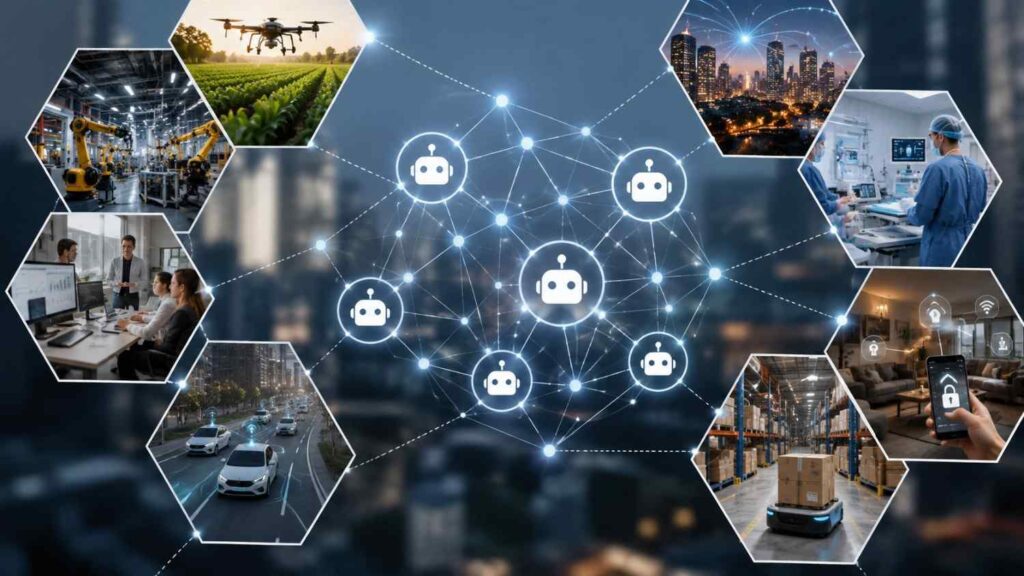
Real-World Applications of Multiagent Systems: Uses, Benefits, and Examples
The real-world applications of multiagent systems extend far beyond teams of chatbots. They include physical robots coordinating routes in crowded facilities, software agents dividing complex business processes, and distributed controllers balancing energy supply with changing demand. The shared principle is straightforward: instead of expecting one system to perceive, plan, decide, and act across an entire problem, a multi-agent architecture divides responsibility among specialized participants.
Each participant may have its own goals, tools, permissions, memory, and view of the environment. The agents then communicate through structured messages or shared state so that local decisions support a broader objective. This approach can improve speed, modularity, resilience, and accountability when the underlying work genuinely benefits from distribution.
This guide explains how multiagent systems work, where they create practical value, and which agent orchestration patterns are commonly used. It also examines implementation steps, business benefits, technical limitations, governance requirements, and the situations in which a simpler single-agent design remains the better option. Importantly, the discussion distinguishes operational deployments from controlled pilots, research projects, and technology demonstrations. That distinction matters because a compelling prototype may still require extensive evaluation, security engineering, and human oversight before it is suitable for unsupervised production use.
What Are Multiagent Systems and How Do They Work?
A multiagent system is a collection of interacting agents that operate within a shared environment or workflow. An agent may be a physical robot, a software service, a decision model, a sensor-driven controller, or an LLM-powered assistant. Although implementations vary, each agent observes relevant information, makes decisions within a defined scope, and performs actions that contribute to an individual or collective goal. IBM describes a multi-agent system as multiple AI agents working collectively to complete tasks for a user or another system.
The defining feature is not simply the use of several AI models. A genuine multi-agent architecture includes meaningful coordination between components. Agents may delegate tasks, negotiate priorities, share status updates, request information, review one another’s outputs, or transfer control when a specialist is better suited to continue. Communication may occur directly, through an orchestrator, through shared memory, or through an event-driven system that records changes in state.
The operating environment strongly influences system behavior. In robotics, it includes physical space, obstacles, equipment, and other machines. In a business workflow, it may include databases, policies, customer records, and external tools. Reliable operation therefore depends on more than reasoning quality. It requires clear roles, communication rules, state management, permission boundaries, error handling, and completion conditions. These foundations determine whether a group of capable agents behaves as a coordinated system or as disconnected components producing inconsistent actions. They also make performance measurable, failures traceable, and future changes easier to manage safely.
Core Components of a Multi-Agent Architecture
A practical multi-agent architecture usually includes specialized agents, an operating environment, communication mechanisms, memory, tools, and a coordination layer. Each agent should have a narrow responsibility so that its instructions, model, data access, and permissions match a specific task. A research agent may retrieve evidence, for example, while a calculation agent handles numerical work and a review agent checks whether the final output meets policy and formatting requirements.
The environment provides the context in which agents act. For warehouse robots, it includes maps, obstacles, charging stations, and the positions of other machines. For an LLM workflow, it may include conversation history, customer records, knowledge bases, and application programming interfaces. Coordination connects these elements through an orchestrator, shared state, or direct handoffs. OpenAI’s Agents SDK describes manager-style orchestration and handoffs as distinct patterns. Regardless of the framework, dependable systems need structured messages, explicit completion criteria, trace logs, and safeguards that keep every agent within its approved scope.
Centralized, Decentralized, and Hybrid Coordination
A centralized multi-agent design uses an orchestrator, supervisor, or manager agent to control the workflow. The central component receives a request, divides it into tasks, assigns work to specialists, tracks progress, and combines the results. This structure is relatively easy to understand and audit because decisions follow a visible hierarchy. It often suits business processes, customer support, and research pipelines with clear stages and one expected outcome.
A decentralized design distributes authority across participating agents. Agents respond to local conditions, exchange messages, negotiate priorities, or follow coordination protocols without waiting for one manager. This is useful in robot fleets, sensor networks, and traffic systems where rapid local action matters. Hybrid designs combine both approaches: local agents make time-sensitive decisions while a central layer enforces global constraints or resolves conflicts. Microsoft Agent Framework documents sequential, concurrent, handoff, group-chat, and manager-led patterns, showing that “multi-agent” describes a family of architectures rather than one fixed workflow.
Related Articles
- Agentic AI in Financial Services: Improving Efficiency
- The Ethical Implications of Autonomous AI Systems
- Agentic AI in Healthcare: Improving Patient Outcomes
Key Real-World Applications of Multiagent Systems
The strongest real-world applications of multiagent systems involve distributed resources, changing conditions, specialist roles, or parallel tasks. One component may struggle to maintain a global view while also making timely local decisions. Multiple agents can divide the problem, exchange relevant information, and adapt when routes, priorities, demand, or resources change.
Application maturity varies. Warehouse fleets and specialist software workflows already operate in production, while many healthcare and energy examples remain in pilots or research. Space robotics often progresses through demonstrations showing that machines can coordinate without continuous human direction. Distinguishing deployments from experiments prevents readers from treating every published result as production-ready.
The table below summarizes common sectors, participating agents, coordinated tasks, and typical maturity. It is a practical orientation rather than a rigid classification because one industry can contain mature deployments and early experiments at the same time. The key questions are whether the system has been validated under realistic conditions, whether failure modes are understood, and whether people can intervene when agents encounter situations beyond their approved scope.
| Sector | Typical Agents | Coordinated Task | Current Maturity |
|---|---|---|---|
| Warehousing | Mobile robots, route planners, allocation agents | Movement, collision avoidance, package sorting | Operational systems plus ongoing optimization research |
| Transportation | Traffic lights, vehicles, dispatch agents | Flow control, routing, emergency priority | Pilots, simulations, and selected deployments |
| Energy | Building, HVAC, battery, and grid agents | Demand response and resource balancing | Research, demonstrations, and specialized control systems |
| Healthcare | Retrieval, diagnostic, scheduling, and review agents | Evidence synthesis and care workflow support | Early-stage research and controlled pilots |
| Customer service | Triage, account, billing, and refund agents | Request routing and case resolution | Production-ready workflow pattern |
| Space robotics | Rovers, base stations, planning agents | Cooperative mapping and exploration | Technology demonstration |
Robotics, Warehousing, and Logistics
Warehouse automation is a clear example of multi-agent robotics because many machines must share the same physical environment while completing different assignments. A robot may receive a task, calculate a route, avoid people and equipment, respond to obstructions, and reach a station on time. At the same time, scheduling and allocation agents must distribute work across the fleet without creating congestion or overloading particular workstations.
The challenge extends beyond finding the shortest path. Routes interact, charging capacity is limited, and delays in one area can disrupt the wider facility. Effective coordination therefore combines local safety controls with fleet-level planning. Amazon Science has published research on persistent multi-agent path finding for warehouse robots and multi-agent reinforcement learning for resource allocation in robotic sortation centers. These examples show why coordination quality can be as important as the capability of an individual robot. The same principles apply to ports, factories, delivery fleets, and fulfillment networks where autonomous machines and software planners must operate as one system.
Transportation, Energy, and Smart Infrastructure
In intelligent transportation systems, agents can represent intersections, traffic signals, vehicles, transit routes, emergency services, or control centers. Each agent observes part of the network and shares information that helps nearby components respond to congestion, incidents, weather, or changing demand. A traffic-signal agent may adjust timing based on current queues, while a regional coordinator prevents one intersection from improving its own flow at the expense of surrounding roads.
Energy systems use a similar structure because supply, demand, storage, and equipment constraints are distributed across many locations. Building agents can manage heating and cooling, battery agents can decide when to charge or discharge, and grid agents can balance local actions against system-wide reliability. The National Renewable Energy Laboratory has described a hierarchical multi-agent approach tested on a Southern California microgrid containing 413 buildings. The example shows how local controllers can pursue comfort or efficiency goals while higher-level agents coordinate broader energy objectives. Safe deployment still requires dependable communication, fallback behavior, and strict operating limits.
Healthcare, Customer Service, and Space Exploration
Healthcare researchers are exploring multi-agent systems for evidence retrieval, diagnostic discussion, scheduling, documentation, and care coordination. A retrieval agent may collect relevant literature, a reasoning agent may compare possible explanations, and a review agent may check whether conclusions are supported. Clinical use remains high risk, however, and requires rigorous validation, privacy protection, bias assessment, accountability, and human approval. Several coordinated agents can still repeat or amplify the same incorrect assumption.
Customer service offers a more mature software pattern. A triage agent can route requests to billing, technical-support, account-security, or refund specialists. Each agent can receive only the tools and data needed for its role, improving auditability and permission control. NASA’s CADRE project provides a physical example of AI agent collaboration in space exploration. Small rovers are designed to communicate and work together autonomously on the Moon, where delayed and limited communication with Earth makes continuous human control impractical and operationally inefficient.
| Industry | Primary Agents | Main Objective | Business Benefit |
|---|---|---|---|
| Warehousing & Logistics | Mobile robots, route planners, allocation agents | Inventory movement and package sorting | Faster fulfillment, reduced congestion, improved efficiency |
| Transportation | Traffic control agents, vehicle agents, dispatch systems | Traffic optimization and route coordination | Reduced delays and improved traffic flow |
| Energy | Grid controllers, HVAC agents, battery management agents | Resource balancing and demand response | Lower energy costs and better grid stability |
| Healthcare | Research agents, diagnostic assistants, scheduling agents | Clinical support and workflow automation | Faster information retrieval and operational efficiency |
| Customer Service | Triage agents, billing agents, support agents | Automated request handling | Faster response times and consistent customer support |
| Space Exploration | Rover agents, planning agents, communication agents | Autonomous exploration and mapping | Improved mission coordination and resilience |
How Do Multi-Agent Workflows Improve Business and Technical Operations?
Multi-agent workflows improve business and technical operations when dividing work creates a specific, measurable advantage. The most common gains come from specialization, parallel execution, clearer permissions, independent verification, and fault isolation. A single general-purpose agent might otherwise research a topic, access sensitive systems, calculate results, draft a response, and approve its own work. A multi-agent design can separate these responsibilities so each component has a narrower scope and fewer opportunities to make an unchecked error.
This structure also supports more deliberate workflow management. Teams can define which agent owns each stage, what information it receives, which tools it can use, and what evidence it must provide before the next stage begins. The resulting system can resemble a well-designed human operating model with specialists, reviewers, escalation paths, and approval gates. It can also improve observability because actions are associated with explicit roles rather than hidden inside one long reasoning process.
However, assigning every minor step to a separate agent is not effective architecture. Excessive decomposition increases handoffs, cost, latency, and the number of possible failure points. A sound design process begins by mapping the current workflow. Teams should identify where tasks can proceed independently, where specialist knowledge is required, where access must be restricted, and where human judgment remains essential. Agents should be introduced only when these boundaries improve performance, safety, resilience, or accountability. Documenting the expected advantage before development gives teams a practical standard for deciding whether the architecture is succeeding.
Specialist Agents for Complex Business Processes
Complex business processes often combine research, data retrieval, calculation, compliance, drafting, and review. Assigning these responsibilities to specialist agents can make the workflow easier to control because each agent receives focused instructions and a limited set of tools. A procurement workflow, for example, could use one agent to extract vendor information, another to compare contract terms, a third to check policy requirements, and a final agent to prepare a summary for human approval.
Customer service provides a simpler illustration. A triage agent classifies the request, an account agent retrieves approved information, and a policy agent determines which remedies are permitted. A resolution agent can then prepare the response without receiving unrestricted access to every system. This separation supports least-privilege access and clearer audit trails. Microsoft’s multi-agent workflow reference architecture describes specialized agents collaborating through an orchestrator. The broader lesson is that roles should reflect genuine differences in knowledge, tools, permissions, or evaluation criteria; otherwise, combining similar agents may reduce complexity without sacrificing capability.
Parallel Work, Review, and Human Approval
Multi-agent workflows can reduce completion time when independent subtasks run concurrently. Several research agents may examine different sources, regions, datasets, or technical perspectives while a synthesis agent compares their findings. In software operations, one agent might inspect logs while another checks deployment history and a third reviews configuration changes. Parallel processing is valuable only when the tasks are sufficiently independent and the system has a reliable method for reconciling contradictory results.
Independent review is another useful pattern. A reviewer agent can verify citations, test calculations, check policy requirements, or confirm that an output follows a required schema. This creates separation between generation and evaluation, although the reviewer should not be treated as infallible. High-impact actions still require deterministic validation or human approval, particularly in financial, medical, legal, employment, and safety-critical settings. Microsoft documents workflow checkpoints and approval mechanisms, while the NIST AI Risk Management Framework provides broader guidance for governing AI risk. Effective approval design gives people the evidence needed to make an informed decision.
What Are the Benefits, Limitations, and Risks?
A well-designed agent team can be modular, scalable, resilient, and easier to govern than one unrestricted system. A poorly designed team can become expensive, slow, unpredictable, and difficult to debug. The central question is not how many agents can be added, but which boundaries make the system safer, faster, or more effective. Every additional component should have a defensible purpose connected to the workflow’s technical or operational requirements.
Benefits and risks often emerge from the same design choice. Specialization can improve focus, but it may fragment context. Parallel work can reduce turnaround time, but it can increase model calls and produce contradictory outputs. Decentralized decision-making can improve responsiveness, but it can make system-wide behavior harder to predict. Independent review can catch mistakes, but reviewers may share the same flawed assumptions as the agents they evaluate.
Organizations should assess multi-agent systems as distributed software rather than as collections of prompts. Testing should cover communication failures, partial outages, malformed messages, permission errors, duplicate actions, timeouts, and recovery behavior. Teams should measure quality, latency, cost, and failure rates against a simpler baseline. Governance must cover the complete workflow, including external tools, shared memory, logs, user data, and escalation paths. With these controls, multi-agent systems can provide substantial value without concealing their operational complexity. Risk assessments should be revisited whenever agents receive new tools, data sources, permissions, or decision authority. Regular red-team exercises and incident reviews can reveal weaknesses that routine accuracy tests may overlook.
Main Benefits of Multi-Agent Systems
The main benefits of multi-agent systems include specialization, parallel processing, distributed decision-making, modular development, fault isolation, permission separation, and independent review. Specialization allows each agent to use the instructions, models, tools, and data best suited to one responsibility. A numerical agent can focus on calculations, for example, while a policy agent interprets rules and a communication agent prepares clear user-facing language.
Modularity can simplify development and maintenance because teams can test agents independently, replace one component without rebuilding the entire workflow, and scale only the services under heavy demand. In physical environments, local agents may continue making safe decisions when a central service is unavailable. Permission separation is also valuable when workflows touch customer records, payments, or production systems. Open standards such as the Agent2Agent Protocol aim to improve interoperability among agents built with different frameworks or operated by different vendors. Interoperability can reduce platform dependence, but it does not remove the need for authentication, authorization, message validation, and trust policies.
Coordination, Cost, and Reliability Challenges
Every handoff creates another point where context can be lost, instructions can conflict, or execution can fail. An agent may omit a critical detail, misunderstand the receiving agent’s schema, or transfer a task before its own work is complete. As workflows become longer, small errors can compound. Debugging is also harder because the final result may depend on several nondeterministic decisions made across different services.
Cost and latency can rise quickly because additional agents often require more model calls, retrieval operations, tool invocations, logs, and evaluation steps. Teams need budgets, token limits, caching, timeouts, and clear stop conditions to prevent repeated delegation or circular discussions. A June 2026 preprint reported that automatically generated multi-agent architectures underperformed a strong single-agent baseline on several evaluated tasks while costing substantially more. Expert-designed systems performed better on tasks suited to decomposition and parallelism. The finding is a caution, not a universal verdict, and reinforces the need to benchmark every proposed architecture against a simpler alternative.
Governance and Security Controls
Each agent should be treated as a software identity with clearly defined permissions, responsibilities, and accountability. Least-privilege access is the foundation: an agent should receive only the data and tools required for its role. Sensitive actions should use allowlisted operations, validated parameters, and approval gates rather than unrestricted natural-language commands. These controls limit the damage that can result from faulty reasoning, prompt injection, or compromised context.
Structured communication is equally important. Message schemas should define required fields, accepted values, provenance, confidence, and error states. Trace logs should record which agent made each decision, which tools it used, and how the workflow changed. Timeouts, spending limits, token limits, and circuit breakers can stop runaway behavior. Organizations also need automated evaluation, rollback paths, and recovery procedures so one incorrect agent does not silently contaminate downstream decisions. NIST recommends managing AI risk through governance, mapping, measurement, and management practices aligned with the organization’s use case and risk tolerance.
How Should You Implement a Multiagent System?
A successful implementation begins with a measurable problem rather than a fashionable framework. The best first project usually has clear task boundaries, accessible data, reversible actions, and a knowledgeable person who can judge output quality. Teams should define success before deciding how many agents are required. Useful measures may include accuracy, completion time, cost per task, escalation rate, policy compliance, user satisfaction, or the number of human corrections.
The next step is to map the existing process in detail. Identify which activities are sequential, which can run in parallel, which require specialist knowledge, and which involve sensitive permissions. This analysis reveals whether a multi-agent design offers a real advantage or merely divides a simple task into unnecessary pieces. Whenever possible, create a single-agent or conventional software baseline so the value of added complexity can be evaluated objectively.
Implementation should proceed gradually. Start with low-risk cases, narrow tool access, strong observability, and human approval for consequential actions. Test normal operation as well as missing data, unavailable services, conflicting outputs, duplicate requests, malformed messages, and timeouts. Expand autonomy only after the system demonstrates consistent value under realistic conditions. This incremental approach makes weak coordination rules easier to identify and prevents agent sprawl from becoming embedded in the production architecture. It also gives users, operators, security teams, and reviewers time to understand how the workflow behaves before its scope expands. Documenting lessons from each pilot creates reusable standards for later deployments across the organization.
| Architecture Type | Best Use Case | Advantages | Considerations |
|---|---|---|---|
| Centralized | Business workflows and enterprise automation | Easier monitoring, centralized decision-making | Single orchestration point may become a bottleneck |
| Decentralized | Robotics, IoT, and distributed environments | Faster local decisions and higher fault tolerance | More complex coordination between agents |
| Hybrid | Large-scale enterprise AI systems | Balances centralized control with autonomous execution | Requires careful workflow and communication design |
| Manager-Based Orchestration | Customer support, document processing | Clear task delegation and easier governance | Increased orchestration overhead |
| Peer-to-Peer Collaboration | Collaborative robotics and research systems | Flexible communication and distributed intelligence | Harder to monitor and debug |
Step-by-Step Implementation Process
Begin by defining the outcome, including the intended user, expected result, operating constraints, and measurable success criteria. Next, map the workflow and identify tasks that are genuinely independent, require different expertise, or need separate permission boundaries. Assign each agent one clear responsibility, a limited tool set, and explicit input and output requirements. Avoid vague roles such as “general helper,” because they make behavior difficult to test and govern.
Choose a coordination model that matches the task, then define message schemas, shared state, handoff conditions, retry rules, timeouts, and stop conditions. Add safeguards such as validation, human approval, observability, budget limits, and recovery paths before granting significant autonomy. Create a single-agent or conventional software baseline and compare quality, latency, cost, and failure rates. Pilot the multi-agent workflow on low-risk cases, review traces, and expand only when specialization, parallel work, permission separation, or resilience produces a measurable improvement. This process prevents additional agents from increasing complexity without improving outcomes.
Frameworks, Protocols, and Interoperability
Framework selection should follow operational requirements rather than popularity. Current options include Microsoft Agent Framework for graph-based workflows and OpenAI Agents SDK for manager patterns, agents-as-tools, and handoffs. Frameworks can simplify routing, tool use, state management, tracing, and error handling, but they do not replace sound architecture. Teams still need to define agent roles, data boundaries, evaluation methods, and recovery behavior.
Important selection criteria include durable workflow support, deployment environment, model choice, security controls, observability, human approvals, and integration with existing systems. The A2A Protocol focuses on communication between agents across frameworks and vendors. Such standards may help agents discover capabilities, exchange structured information, and coordinate tasks without requiring one platform. However, interoperability is not only a messaging problem. Organizations still need authentication, authorization, encryption, data-governance rules, version compatibility, and trust decisions about remote agents. A protocol can standardize interaction, but every participant must still prove that it is permitted and safe to perform the requested action.
When a Single Agent Is the Better Choice
A single agent is often the better choice when a task is narrow, sequential, easy to evaluate, and safely handled with a small tool set. Examples include summarizing one document, extracting fields from a standard form, answering questions from a controlled knowledge base, or completing a straightforward calculation. In these situations, additional agents may create more handoffs, cost, and latency without improving the result.
The comparison between a multi-agent vs single-agent system should be evidence-based. Multiple agents become more attractive when work can run in parallel, permissions must be separated, distinct specialist knowledge is required, distributed physical control is unavoidable, independent verification adds value, or failures need to be isolated. Even then, some responsibilities may be better implemented as deterministic software services rather than autonomous agents. Teams should test both approaches using the same data and success criteria. A multi-agent system should earn its complexity through measurable gains in accuracy, speed, resilience, or control. When the difference is small, the simpler architecture is usually easier to maintain, audit, and secure.
Quick Answer About Real-World Applications of Multiagent Systems
The real-world applications of multiagent systems include warehouse robotics, traffic coordination, smart energy management, customer service, healthcare research, software operations, and autonomous space exploration. In each case, several autonomous or semi-autonomous agents work toward a shared objective while handling different responsibilities. One agent may plan routes, another may allocate resources, and another may monitor safety or validate results. The agents exchange information through structured messages, shared state, or an orchestration layer so their individual actions contribute to one coordinated outcome.
This model is most useful when work is naturally distributed. A warehouse may contain hundreds of robots that need to move simultaneously without blocking one another. A customer-service platform may route billing, technical, and account-security issues to different specialists. An energy network may coordinate buildings, batteries, renewable generation, and grid resources as demand changes. These problems combine local decisions with system-wide constraints, making them difficult for one component to manage effectively in real time.
However, a multi-agent design is not automatically superior to a single-agent system. Additional agents introduce communication overhead, more service or model calls, greater security exposure, and more complicated testing. Organizations must define permissions, preserve context during handoffs, control costs, and maintain human oversight for consequential decisions. The best applications are those in which specialization, parallel processing, distributed control, independent review, or fault isolation creates a measurable benefit that clearly outweighs the added architectural complexity. That benefit should be demonstrated with realistic tests rather than assumed from the design.
Frequently Asked Questions
The following questions address common informational, comparative, and implementation-focused concerns about the real-world applications of multiagent systems. They are intended for readers who understand the basic concept but need practical guidance on where these architectures fit, how they differ from single-agent systems, and what risks should be considered before deployment. The answers focus on decision-making rather than assuming that a more complex design is automatically more advanced.
A recurring theme is that multi-agent technology is broader than generative AI. The field includes robotics, distributed control, simulations, sensor networks, and software services. Large language models have made agent orchestration more accessible because they can interpret natural language, use tools, and transfer tasks flexibly. However, the same architectural principles still apply: agents need defined goals, observations, actions, communication mechanisms, boundaries, and a way to resolve conflicts.
Another important theme is proportionality. Organizations should not adopt several agents merely because the design appears innovative. The architecture is most valuable when the workflow contains genuine distribution, specialization, permission separation, or parallelism. In high-risk domains, technical capability must be matched by governance, validation, human oversight, and clear accountability. The answers below provide direct explanations while preserving the distinctions needed for responsible evaluation, procurement, and implementation. They also clarify where current examples represent mature operational patterns and where claims should be interpreted as research or early-stage experimentation. Readers should carefully evaluate each example according to its operating environment, evidence quality, and level of human supervision involved.
What is a real-life example of a multiagent system?
A robotic warehouse is a strong real-life example of a multiagent system. Multiple mobile robots operate on the same floor, receive assignments, plan routes, avoid collisions, and adjust when congestion, equipment failures, or unexpected obstacles appear. They do not act as isolated machines. They exchange status information with scheduling, routing, and fleet-management services so individual movements support the facility’s wider objectives.
A typical workflow begins when an allocation agent assigns a pickup or transport task. A route-planning component identifies a path, while local safety systems monitor nearby people and machines. If an aisle becomes blocked, the robot may stop or reroute, and the fleet manager can update other routes to prevent a larger bottleneck. Charging agents may also schedule battery replenishment without removing too many robots from service. The value comes from coordination rather than any one robot’s intelligence. Similar patterns appear in ports, factories, delivery networks, and autonomous vehicle fleets where many agents must share limited resources and respond to changing conditions.
Are multi-agent systems only used with large language models?
No. Multi-agent systems existed long before modern large language models. Traditional examples include robot teams, traffic-control agents, distributed sensors, market simulations, telecommunications networks, energy controllers, and autonomous vehicles. In these systems, an agent may follow rules, optimize a mathematical objective, respond to sensor data, or use reinforcement learning. Natural-language generation is not required.
LLM-based agents extend the field by adding flexible language understanding, reasoning, tool selection, and conversational interaction. A language-model agent can interpret an unstructured request, decide which specialist should handle it, call external systems, and explain the result to a user. These capabilities make multi-agent workflows attractive for customer support, research, document processing, and business automation.
However, the underlying concepts remain broader than LLMs. Agents still need defined goals, observations, actions, communication mechanisms, and coordination rules. Many effective systems combine different technologies: deterministic services for calculations, machine-learning models for prediction, LLMs for language tasks, and human reviewers for judgment. Choosing the right component for each role is more important than making every agent conversational or generative.
What industries benefit most from multi-agent AI?
Industries with distributed assets, complex workflows, or rapidly changing operating conditions are strong candidates for multi-agent AI. Logistics and warehousing benefit because robots, orders, routes, workstations, and inventory must be coordinated continuously. Transportation systems can use agents to represent traffic signals, vehicles, dispatchers, and regional controllers. Energy organizations can coordinate buildings, batteries, renewable generation, and grid constraints through distributed control.
Software-intensive sectors also benefit when work requires specialist roles. Customer support can route requests among account, billing, security, and policy agents. Software engineering workflows may divide planning, code analysis, testing, security review, and deployment checks. Scientific research can use parallel agents to examine different sources or hypotheses before a synthesis stage.
Healthcare may benefit from evidence retrieval, administrative coordination, scheduling, and controlled decision support, but the risk level demands rigorous validation and human oversight. Ultimately, suitability depends less on the industry label than on workflow structure, data quality, operational risk, and coordination requirements. A business should consider multiple agents when specialization, parallelism, permission separation, or distributed control creates a clear advantage over a simpler design.
What is the difference between a single agent and a multi-agent system?
A single agent owns the complete task and uses its available tools directly. It may retrieve information, reason about the request, perform calculations, and produce a final answer without transferring responsibility to another autonomous component. This architecture is often easier to build, test, monitor, and secure because it contains fewer handoffs and possible failure paths.
A multi-agent system divides work among agents that specialize, collaborate, review one another, or hand off control. One agent may classify the request, another may retrieve data, a third may perform an action, and a reviewer may validate the result. This can improve modularity, parallel processing, permission control, and fault isolation when the task contains genuinely distinct responsibilities. The trade-off is additional coordination overhead: agents need communication rules, state management, conflict resolution, identity controls, logging, and recovery procedures. The best choice depends on measurable performance. A multi-agent design is justified when its benefits exceed the complexity it introduces; otherwise, a capable single agent or conventional workflow is usually more reliable.
What are the biggest risks of multi-agent systems?
The biggest risks include incorrect delegation, conflicting goals, context loss, excessive model calls, cascading errors, unauthorized tool use, weak accountability, and difficult-to-reproduce behavior. A routing agent may send a task to the wrong specialist, or one agent may pass incomplete information to the next. When several agents rely on the same flawed assumption, the mistake can spread through the workflow and appear more credible after repeated processing.
Security exposure also increases because each agent may access tools, data, memory, or external services. Prompt injection or malicious content can influence one component and then affect others through shared context. Risk reduction requires least-privilege permissions, structured messages, validated tool inputs, trace logs, token and spending limits, automated evaluations, and human approval for irreversible actions. Recovery procedures should isolate failed agents and prevent contaminated state from spreading. Clear ownership is also essential so people remain accountable for system design, monitoring, incident response, and final outcomes.
Can multi-agent systems work across different vendors?
Yes, multi-agent systems can work across different vendors, but interoperability requires more than the ability to exchange text. Agents need agreed methods for discovering capabilities, sending requests, representing task status, returning results, and reporting errors. The Agent2Agent Protocol is an open standard designed to support communication and coordination among agents built with different frameworks or operated by different organizations.
A shared protocol can reduce custom integration, but it does not automatically establish trust. Each organization must authenticate the remote agent, determine which actions it may request, and decide what information can be shared. Messages should be validated against expected schemas, and sensitive data should be protected during transmission and storage. Teams also need audit logs, service-level expectations, version controls, failure handling, and policies for revoking access. Interoperability can reduce vendor lock-in and support flexible ecosystems, but safe cross-vendor collaboration still depends on identity, authorization, data governance, technical compatibility, and clearly assigned responsibility between participants.
Conclusion
The real-world applications of multiagent systems are strongest where work is naturally distributed across people, machines, software services, data sources, or physical locations. Robot fleets, infrastructure control, specialist business processes, scientific exploration, and complex research workflows all demonstrate situations in which coordinated agents may outperform one component attempting to manage every responsibility. Their value comes from purposeful division of work rather than from adding AI elements for their own sake.
Organizations should evaluate these systems with the same discipline applied to other distributed architectures. Clear roles, communication schemas, permission boundaries, observability, testing, recovery procedures, and human escalation must be designed from the beginning. A successful prototype is not sufficient evidence for production deployment, especially when agents can access sensitive data, influence decisions, or perform consequential actions. Teams need realistic tests that expose coordination failures as well as model-level errors.
The most reliable path is incremental. Begin with a bounded workflow, establish a simpler baseline, and add agents only where specialization, parallel execution, resilience, permission control, or independent verification produces measurable improvement. This keeps the architecture understandable while allowing genuine multi-agent advantages to emerge. The final decision should be based on quality, cost, latency, security, and operational reliability rather than on the perceived sophistication of the design. Ongoing monitoring should confirm that these benefits continue after models, tools, data, or operating conditions change. Periodic comparison with the original baseline helps determine whether the architecture remains justified as the workflow continuously evolves.
Key Takeaway
The central takeaway is that multiagent systems create value when a problem already contains meaningful divisions of responsibility. In a warehouse, robots, route planners, and allocation services coordinate physical movement. In a customer-support workflow, triage, account, policy, and resolution agents handle different parts of the case. In an energy network, local controllers respond to building conditions while higher-level agents balance broader grid requirements. The architecture mirrors the structure of the problem.
Success therefore depends on choosing the right agent boundaries. Each agent should have a clear purpose, limited permissions, defined inputs and outputs, and measurable performance criteria. Communication should be structured, and failures should be visible rather than silently passed downstream. Where decisions carry significant consequences, human approval and deterministic validation remain essential.
Multi-agent architecture is not a shortcut to intelligence. It is a method for organizing distributed decision-making and action. When used appropriately, it can improve modularity, speed, resilience, and accountability. When used without a clear need, it can increase cost and uncertainty. The strongest implementations are deliberately designed, carefully evaluated, and continuously monitored against simpler alternatives.
Recommended Next Step
The recommended next step is to select one bounded workflow with clear inputs, outputs, and evaluation criteria. Good candidates include research synthesis, customer-request triage, document review, software incident analysis, or another process in which tasks can be separated without exposing the organization to unacceptable risk. Document the current workflow before introducing agents so that bottlenecks, permission boundaries, and human decision points are visible.
Build a single-agent or conventional automation baseline first. Measure accuracy, completion time, cost, escalation rate, and the number of corrections required. Then introduce one additional specialist only where there is a defensible reason, such as independent review, parallel data collection, or restricted access to a sensitive tool. Compare the results using the same test cases.
Governance, evaluation, observability, and human oversight should be part of the architecture from the beginning. Review traces, test failure scenarios, and confirm that the workflow can stop safely when information is missing or systems are unavailable. Expand gradually only after the evidence shows meaningful improvement. This disciplined process converts multi-agent experimentation into an operational decision based on measurable value.
Comments are closed, but trackbacks and pingbacks are open.