
Introduction
The rise of Agentic AI is transforming the way businesses operate, innovate, and compete in the digital economy. Unlike traditional artificial intelligence systems that only follow predefined instructions, Agentic AI can make decisions, plan tasks, learn from interactions, and execute workflows with minimal human intervention. These intelligent systems act like digital agents capable of handling complex business processes autonomously.
From customer service automation to cybersecurity management, Agentic AI is revolutionizing industries worldwide. Organizations are increasingly investing in AI-driven agents to improve productivity, reduce operational costs, and enhance customer experiences.
In this comprehensive guide, we will explore the top 10 use cases for Agentic AI in business, understand how it works, and examine why it is becoming a critical technology for future-ready enterprises.
What Is Agentic AI?
Understanding Agentic AI
Agentic AI refers to autonomous AI systems designed to independently pursue goals, make decisions, and complete tasks without continuous human supervision. These systems combine technologies such as:
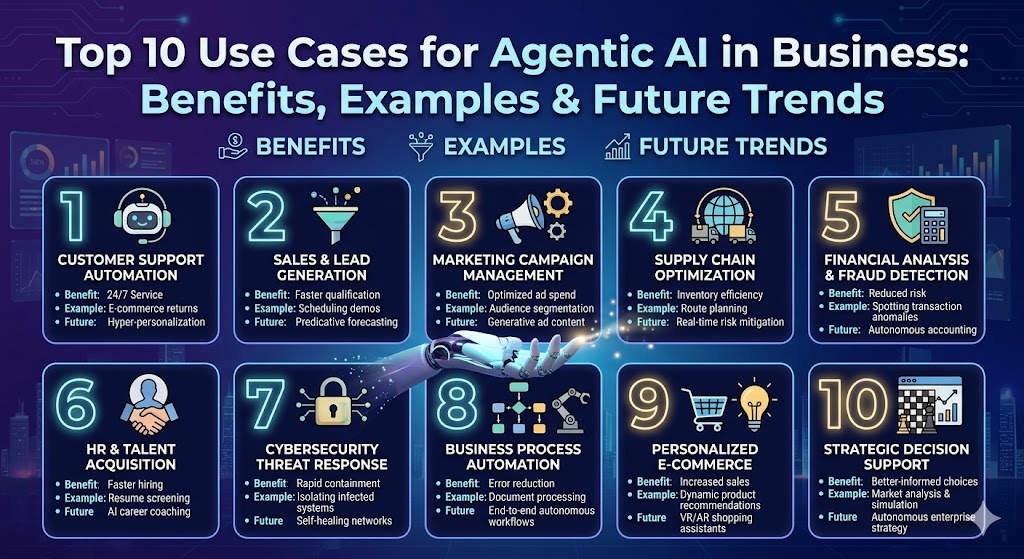
- Machine learning
- Natural language processing
- Large language models
- Reinforcement learning
- Automation frameworks
Unlike standard AI chatbots or automation tools, Agentic AI systems can:
- Analyze situations
- Create strategies
- Adapt to changing conditions
- Collaborate with humans and software
- Perform multi-step reasoning
Key Features of Agentic AI
Autonomous Decision-Making
Agentic AI can independently evaluate scenarios and determine the best course of action.
Goal-Oriented Behavior
These AI systems are designed to achieve specific objectives rather than simply responding to prompts.
Continuous Learning
Agentic AI improves over time by learning from data, interactions, and outcomes.
Workflow Automation
It can execute end-to-end workflows across multiple systems and platforms.
Why Businesses Are Adopting Agentic AI
Businesses are rapidly embracing Agentic AI because it offers several competitive advantages.
Increased Efficiency
AI agents can handle repetitive tasks much faster than humans.
Cost Reduction
Organizations can reduce labor costs and minimize operational inefficiencies.
Better Decision-Making
AI-driven insights help companies make more informed strategic decisions.
Scalability
Agentic AI systems can manage thousands of tasks simultaneously without performance degradation.
Enhanced Customer Experience
Businesses can deliver personalized and real-time customer interactions.
Top 10 Use Cases for Agentic AI in Business
1. Intelligent Customer Support Automation
Revolutionizing Customer Service
Customer support is one of the most impactful applications of Agentic AI. AI-powered agents can autonomously manage customer interactions across multiple channels.
Key Functions
Automated Ticket Resolution
AI agents can analyze customer issues and provide solutions instantly.
Personalized Responses
They can tailor replies based on customer history and preferences.
Multi-Language Support
Agentic AI can communicate in various languages for global businesses.
Benefits for Businesses
- Reduced response times
- Lower support costs
- 24/7 customer service
- Improved customer satisfaction
Example
E-commerce companies use Agentic AI to manage returns, refunds, and order tracking without human involvement.
2. AI-Powered Sales and Lead Generation
Transforming Sales Processes
Sales teams are increasingly leveraging Agentic AI to automate prospecting and lead nurturing.
How It Works
Lead Qualification
AI agents analyze customer data to identify high-quality leads.
Automated Outreach
They send personalized emails and follow-up messages.
Sales Forecasting
AI predicts future sales trends using historical data.
Business Advantages
- Increased conversion rates
- Faster lead response times
- Better sales pipeline management
Real-World Example
Software companies use AI sales agents to schedule demos and qualify prospects automatically.
3. Autonomous Marketing Campaign Management
Smarter Marketing with AI Agents
Agentic AI enables businesses to automate complex digital marketing campaigns.
Key Marketing Tasks
Audience Segmentation
AI identifies target audiences based on behavioral patterns.
Content Personalization
It generates personalized advertisements and email campaigns.
Campaign Optimization
AI continuously monitors campaign performance and adjusts strategies.
Benefits
- Higher ROI
- Better customer targeting
- Reduced manual workload
Example
Retail brands use AI agents to dynamically optimize Facebook and Google ad campaigns.
4. Supply Chain and Logistics Optimization
Enhancing Operational Efficiency
Supply chain management becomes significantly more efficient with Agentic AI.
Core Capabilities
Inventory Management
AI predicts demand and automatically restocks inventory.
Route Optimization
Delivery routes are optimized for speed and cost savings.
Risk Management
AI identifies potential disruptions in the supply chain.
Business Impact
- Reduced shipping costs
- Improved inventory accuracy
- Faster deliveries
Industry Example
Logistics companies use AI agents to manage fleet operations in real time.
5. Financial Analysis and Fraud Detection
Smarter Financial Operations
Financial institutions are among the biggest adopters of Agentic AI.
AI Functions in Finance
Fraud Detection
AI agents monitor transactions for suspicious activities.
Financial Forecasting
They analyze market trends and business performance.
Expense Management
AI automates invoice processing and expense tracking.
Benefits
- Reduced financial risks
- Faster financial reporting
- Improved regulatory compliance
Example
Banks use AI agents to detect fraudulent credit card transactions instantly.
6. Human Resources and Talent Acquisition
Modernizing HR Operations
Agentic AI is transforming recruitment and employee management.
HR Applications
Resume Screening
AI scans resumes and identifies top candidates.
Interview Scheduling
Agents automatically coordinate interviews.
Employee Onboarding
AI guides new employees through onboarding processes.
Business Benefits
- Faster hiring processes
- Reduced HR workload
- Better candidate matching
Example
Large enterprises use AI recruiters to manage thousands of job applications efficiently.
7. Cybersecurity Threat Detection and Response
Strengthening Business Security
Cybersecurity threats are increasing rapidly, making Agentic AI essential for modern businesses.
AI Security Functions
Threat Monitoring
AI agents continuously monitor networks for anomalies.
Incident Response
They can isolate infected systems automatically.
Vulnerability Assessment
AI identifies security weaknesses before attackers exploit them.
Benefits
- Faster threat detection
- Reduced downtime
- Enhanced data protection
Example
Technology companies deploy AI security agents to prevent ransomware attacks.
8. Business Process Automation
Streamlining Repetitive Tasks
Businesses use Agentic AI to automate routine workflows and improve productivity.
Automated Processes
Data Entry
AI extracts and processes information automatically.
Document Management
Agents organize and categorize business documents.
Workflow Coordination
AI manages approvals, notifications, and reporting tasks.
Advantages
- Reduced human errors
- Increased operational efficiency
- Faster task completion
Example
Insurance companies automate claims processing using AI agents.
9. Personalized E-Commerce Experiences
Improving Online Shopping
E-commerce businesses use Agentic AI to create highly personalized customer experiences.
AI-Powered Features
Product Recommendations
AI suggests products based on browsing behavior.
Dynamic Pricing
Prices are adjusted based on demand and market trends.
Virtual Shopping Assistants
AI agents guide customers through the purchasing process.
Business Benefits
- Increased sales
- Higher customer engagement
- Improved retention rates
Example
Online marketplaces use AI agents to optimize customer journeys and upselling opportunities.
10. Strategic Business Decision Support
Executives use Agentic AI for strategic planning and business intelligence.
Key Capabilities
Market Analysis
AI analyzes competitors, trends, and customer behavior.
Predictive Analytics
Agents forecast business opportunities and risks.
Scenario Simulation
AI models different business strategies and outcomes.
Benefits
- Better strategic decisions
- Faster access to insights
- Reduced uncertainty
Example
Global corporations use AI-powered dashboards for executive decision-making.
Benefits of Agentic AI Across Industries
AI agents can perform tasks continuously without fatigue.
Improved Accuracy
Automation reduces human errors in critical processes.
Faster Innovation
Businesses can develop and launch products more quickly.
Enhanced Customer Engagement
AI enables personalized experiences at scale.
Competitive Advantage
Organizations adopting Agentic AI gain operational superiority.
Challenges of Implementing Agentic AI
Data Privacy Concerns
Businesses must protect sensitive customer and company data.
Ethical Considerations
AI decision-making raises ethical and accountability questions.
Integration Complexity
Implementing AI across existing systems can be challenging.
Workforce Adaptation
Employees may require training to work alongside AI agents.
Future of Agentic AI in Business
Hyperautomation
Businesses will increasingly combine AI with robotic process automation.
AI Collaboration
Human-AI collaboration will become standard across industries.
Autonomous Enterprises
Future organizations may rely heavily on AI-driven operations.
Industry Expansion
Agentic AI adoption will grow across healthcare, education, finance, manufacturing, and retail sectors.
Best Practices for Adopting Agentic AI
Start with Clear Objectives
Define specific business goals before implementation.
Focus on High-Impact Areas
Begin with processes that deliver measurable ROI.
Ensure Data Quality
High-quality data improves AI performance significantly.
Prioritize Security
Protect AI systems against cyber threats and misuse.
Train Employees
Educate teams about working effectively with AI systems.
How Small Businesses Can Use Agentic AI
Affordable Automation
Small businesses can automate customer support and marketing tasks.
Improved Productivity
AI tools help smaller teams achieve more with fewer resources.
Better Customer Service
AI chatbots can provide instant support around the clock.
Competitive Growth
Small companies can compete with larger organizations using AI-powered efficiency.
Industries Most Impacted by Agentic AI
Healthcare
AI assists with diagnostics, patient management, and administrative tasks.
Finance
Banks and fintech firms use AI for fraud prevention and investment analysis.
Retail
Retailers personalize shopping experiences using AI agents.
Manufacturing
Factories optimize production lines with autonomous systems.
Logistics
Transportation companies improve route planning and delivery efficiency.
Conclusion
Agentic AI is rapidly becoming one of the most transformative technologies in modern business. Its ability to autonomously plan, execute, and optimize tasks enables organizations to improve efficiency, reduce costs, and deliver exceptional customer experiences.
From customer support and marketing automation to cybersecurity and strategic decision-making, the use cases for Agentic AI continue to expand across industries. Businesses that embrace this technology early will gain a significant competitive advantage in the evolving digital landscape.
As AI technology advances, Agentic AI will play an even greater role in shaping the future of work, innovation, and enterprise automation.
For more insights into artificial intelligence and business technology trends, visit OpenAI
Frequently Asked Questions (FAQs)
What is Agentic AI in simple terms?
Agentic AI refers to intelligent systems that can independently make decisions, perform tasks, and achieve goals with minimal human intervention.
How is Agentic AI different from traditional AI?
Traditional AI typically follows predefined instructions, while Agentic AI can autonomously plan, adapt, and execute complex workflows.
Which industries benefit most from Agentic AI?
Industries such as finance, healthcare, retail, manufacturing, logistics, and customer service benefit significantly from Agentic AI.
Is Agentic AI expensive to implement?
Implementation costs vary depending on the complexity of the system, but many cloud-based AI tools are becoming more affordable for businesses of all sizes.
Can small businesses use Agentic AI?
Yes, small businesses can use AI-powered chatbots, marketing automation tools, and workflow automation systems to improve productivity and customer service.
What are the risks of Agentic AI?
Potential risks include data privacy concerns, cybersecurity vulnerabilities, ethical issues, and overreliance on automation.
Will Agentic AI replace human workers?
Agentic AI is more likely to augment human work rather than completely replace employees. It helps automate repetitive tasks while humans focus on strategic and creative responsibilities.
How can businesses start using Agentic AI?
Businesses should begin by identifying repetitive processes, choosing suitable AI tools, ensuring data quality, and training employees for AI collaboration.
What technologies power Agentic AI?
Agentic AI uses technologies such as machine learning, natural language processing, large language models, and reinforcement learning.
What is the future of Agentic AI?
The future includes autonomous enterprises, advanced automation, human-AI collaboration, and widespread adoption across industries worldwide.
Comments are closed, but trackbacks and pingbacks are open.