
Artificial Intelligence has evolved rapidly over the last decade, transforming industries, businesses, and everyday life. From chatbots and recommendation systems to self-driving cars and predictive analytics, AI technologies are becoming increasingly advanced and capable. One of the most exciting developments in the world of artificial intelligence is the emergence of Agentic AI.
Agentic AI represents a major shift in how AI systems operate. Unlike traditional AI models that simply respond to commands or analyze data, Agentic AI systems can make decisions, plan actions, adapt to changing environments, and pursue goals with a higher degree of autonomy. These systems are designed to act more like intelligent agents rather than passive tools.
As businesses and organizations seek smarter automation and more capable AI systems, understanding Agentic AI has become increasingly important. This article explores what Agentic AI is, how it works, its key characteristics, applications, benefits, challenges, ethical concerns, and what the future may hold.
What Is Agentic AI?
Agentic AI refers to artificial intelligence systems that can independently take actions to achieve specific goals. These systems are capable of reasoning, planning, decision-making, learning, and adapting with limited human intervention.
The word “agentic” comes from the concept of an “agent,” which refers to an entity capable of perceiving its environment and taking actions to achieve objectives.
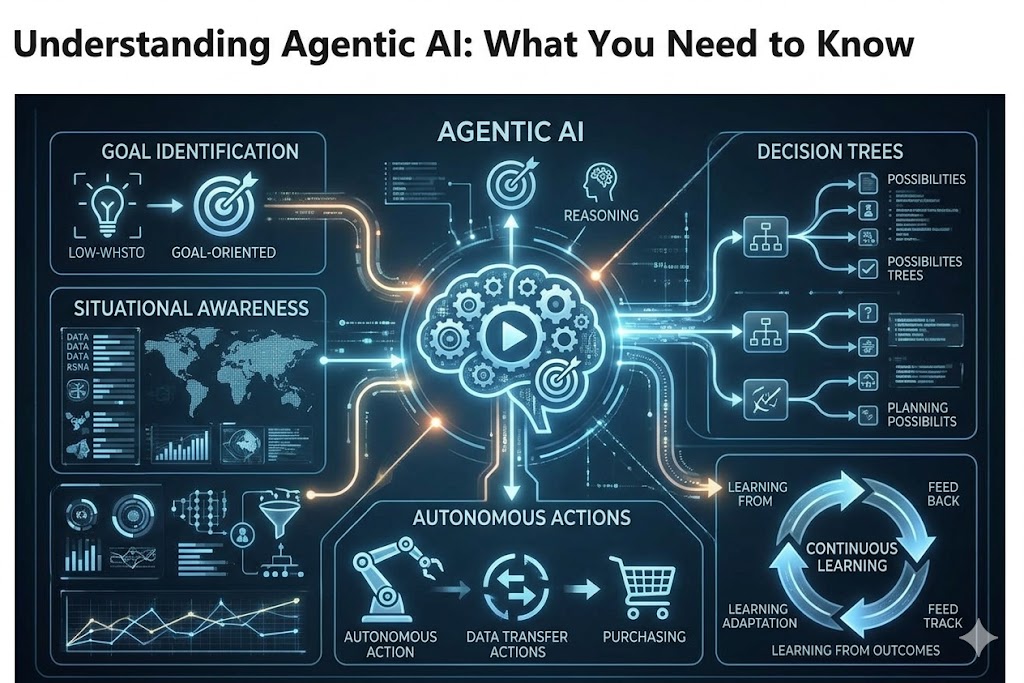
Traditional AI systems typically perform narrow tasks based on user instructions. Agentic AI goes further by:
- Understanding goals
- Planning steps
- Making decisions
- Executing actions
- Adapting to feedback
- Learning from outcomes
In simple terms, Agentic AI behaves more like an autonomous assistant capable of completing complex tasks on its own.
How Agentic AI Differs from Traditional AI
Traditional AI systems are reactive. They wait for commands and respond accordingly. Agentic AI systems are proactive and goal-driven.
Traditional AI
Examples include:
- Chatbots
- Recommendation engines
- Image recognition tools
- Spam filters
These systems:
- Perform predefined tasks
- Require human prompts
- Operate within narrow boundaries
- Do not independently pursue objectives
Agentic AI
Agentic AI systems:
- Operate autonomously
- Make decisions independently
- Plan multi-step tasks
- Adapt to changing conditions
- Learn continuously
- Pursue long-term goals
For example, a traditional AI assistant may answer travel questions, while an Agentic AI assistant could:
- Research destinations
- Compare flight prices
- Book tickets
- Schedule accommodations
- Adjust plans automatically
All with minimal user involvement.
Core Characteristics of Agentic AI
Agentic AI systems possess several defining features that separate them from conventional AI systems.
1. Autonomy
Autonomy is one of the most important characteristics of Agentic AI. These systems can operate without constant human supervision.
They can:
- Make independent decisions
- Execute tasks
- Monitor outcomes
- Adjust actions automatically
Autonomy allows AI agents to handle complex workflows efficiently.
2. Goal-Oriented Behavior
Agentic AI systems work toward achieving defined goals rather than simply responding to instructions.
For example:
- Maximizing business efficiency
- Optimizing logistics
- Managing investments
- Solving customer problems
The system continuously evaluates actions based on whether they move closer to the desired outcome.
3. Planning and Reasoning
Agentic AI can break large tasks into smaller steps and create strategic plans.
This includes:
- Evaluating alternatives
- Predicting outcomes
- Prioritizing actions
- Allocating resources
Planning capabilities make Agentic AI useful for complex operations.
4. Learning and Adaptation
These systems improve over time by learning from:
- Data
- Feedback
- Experience
- Environmental changes
Adaptability enables AI agents to function effectively in dynamic environments.
5. Decision-Making
Agentic AI systems evaluate available information and select actions based on objectives, risks, and predicted results.
Advanced decision-making allows AI to handle situations with uncertainty and complexity.
Technologies Behind Agentic AI
Several advanced technologies work together to enable Agentic AI.
1. Machine Learning
Machine learning helps AI systems identify patterns and improve performance through experience.
2. Natural Language Processing (NLP)
NLP enables AI agents to understand and communicate using human language.
3. Reinforcement Learning
Reinforcement learning allows AI systems to learn through rewards and penalties.
This helps agents optimize behavior over time.
4. Large Language Models (LLMs)
LLMs provide advanced reasoning, conversation, and content generation capabilities.
5. Knowledge Graphs
Knowledge graphs help AI systems organize and connect information logically.
6. Robotic Process Automation (RPA)
RPA allows AI agents to automate repetitive digital tasks.
How Agentic AI Works
Agentic AI systems generally follow a cycle of perception, reasoning, action, and learning.
Step 1: Perception
The AI agent gathers information from:
- Databases
- APIs
- Sensors
- User input
- Online sources
Step 2: Goal Interpretation
The system identifies objectives and desired outcomes.
Step 3: Planning
The AI develops a strategy and determines the sequence of actions required.
Step 4: Execution
The agent performs actions independently.
Step 5: Monitoring
The AI evaluates results and tracks progress.
Step 6: Learning and Adjustment
The system learns from feedback and modifies future behavior.
Real-World Applications of Agentic AI
Agentic AI has applications across many industries.
Agentic AI in Healthcare
Healthcare organizations are increasingly exploring AI-powered systems.
Applications
- Patient monitoring
- Personalized treatment plans
- Medical diagnosis assistance
- Drug discovery
- Administrative automation
Agentic AI can continuously monitor patient data and recommend actions based on changing conditions.
Agentic AI in Finance
Financial institutions use AI agents for:
- Fraud detection
- Investment analysis
- Automated trading
- Risk management
- Customer support
AI agents can analyze financial markets and execute trades autonomously.
Agentic AI in Customer Service
Advanced AI agents provide intelligent customer support by:
- Resolving issues independently
- Understanding customer emotions
- Managing conversations
- Escalating complex cases when necessary
Agentic AI in Supply Chain Management
AI agents optimize logistics by:
- Predicting demand
- Managing inventory
- Tracking shipments
- Optimizing routes
- Reducing operational costs
Agentic AI in Manufacturing
Manufacturing companies use AI agents for:
- Predictive maintenance
- Quality control
- Production optimization
- Robotics coordination
Agentic AI in Education
Educational AI agents can:
- Personalize learning experiences
- Track student progress
- Recommend study materials
- Automate grading
Agentic AI in Cybersecurity
Cybersecurity systems powered by Agentic AI can:
- Detect threats
- Respond to attacks
- Monitor networks
- Identify vulnerabilities
These systems operate continuously to protect digital infrastructure.
Benefits of Agentic AI
Agentic AI offers significant advantages across industries.
1. Increased Productivity
AI agents automate complex workflows and reduce manual effort.
2. Faster Decision-Making
Agentic AI analyzes data quickly and responds in real time.
3. Improved Efficiency
Organizations can optimize operations and reduce delays.
4. Scalability
AI agents can manage large volumes of tasks simultaneously.
5. Reduced Costs
Automation lowers operational expenses and resource requirements.
6. Continuous Operation
AI systems can work 24/7 without fatigue.
7. Personalized Experiences
AI agents can tailor services to individual users.
Challenges of Agentic AI
Despite its advantages, Agentic AI also introduces challenges.
1. Ethical Concerns
Autonomous systems raise questions about accountability and fairness.
2. Data Privacy
AI agents often require access to sensitive information.
3. Security Risks
Autonomous systems may become targets for cyberattacks.
4. Lack of Transparency
Complex AI models may be difficult to interpret.
5. Bias and Discrimination
Biased training data can produce unfair decisions.
6. Job Displacement
Automation may replace certain human roles.
Ethical Issues in Agentic AI
Ethics play a critical role in AI development.
Accountability
Who is responsible when an AI agent makes a harmful decision?
Transparency
Users should understand how AI systems operate.
Human Oversight
Humans must maintain control over critical decisions.
Fairness
AI systems should avoid discrimination and bias.
Agentic AI vs Generative AI
People often confuse Agentic AI with Generative AI, but they are different.
Generative AI
Generative AI creates content such as:
- Text
- Images
- Music
- Videos
- Code
Examples include chatbots and image generators.
Agentic AI
Agentic AI focuses on:
- Goal achievement
- Decision-making
- Task execution
- Autonomous actions
Generative AI can be part of Agentic AI systems, but Agentic AI has broader capabilities.
The Future of Agentic AI
The future of Agentic AI is expected to be transformative.
Smarter Digital Assistants
Future AI assistants may manage entire workflows independently.
Autonomous Business Operations
Businesses may rely on AI agents for operations, strategy, and optimization.
Human-AI Collaboration
AI agents will increasingly work alongside humans rather than replacing them completely.
Multi-Agent Systems
Multiple AI agents may collaborate to solve complex problems.
Advanced Robotics
Agentic AI could power intelligent robots capable of autonomous behavior.
Risks of Over-Reliance on Agentic AI
While Agentic AI is powerful, excessive dependence can create risks.
Potential concerns include:
- Reduced human oversight
- Loss of critical thinking
- System failures
- Ethical misuse
- Unintended consequences
Organizations must balance automation with human control.
Industries Most Likely to Be Transformed by Agentic AI
Several sectors are expected to experience major changes.
Key Industries
- Healthcare
- Finance
- Retail
- Logistics
- Manufacturing
- Education
- Cybersecurity
- Marketing
- Transportation
Agentic AI may become a central part of digital transformation strategies.
How Businesses Can Prepare for Agentic AI
Organizations should take strategic steps before implementing Agentic AI.
Recommendations
1. Build Strong Data Infrastructure
High-quality data is essential for AI performance.
2. Invest in AI Talent
Companies need skilled professionals to develop and manage AI systems.
3. Focus on Ethics and Governance
Responsible AI practices are critical.
4. Start with Pilot Projects
Testing smaller AI implementations reduces risks.
5. Maintain Human Oversight
Human supervision remains important for accountability and trust.
Why Agentic AI Matters
Agentic AI represents the next stage in artificial intelligence evolution. It moves beyond passive assistance toward autonomous problem-solving and intelligent action.
Its ability to:
- Understand goals
- Make decisions
- Learn continuously
- Operate independently
makes it one of the most powerful technological developments of the modern era.
Organizations that understand and adopt Agentic AI responsibly may gain significant competitive advantages.
Conclusion
Agentic AI is transforming how artificial intelligence operates by enabling systems to act autonomously, pursue goals, make decisions, and adapt to changing environments. Unlike traditional AI models that simply respond to instructions, Agentic AI behaves more like an intelligent digital agent capable of managing complex tasks independently.
From healthcare and finance to manufacturing and customer service, Agentic AI has the potential to revolutionize industries by improving efficiency, reducing costs, enhancing personalization, and accelerating decision-making.
However, this technology also introduces important challenges related to ethics, transparency, security, and accountability. Responsible development and human oversight will be essential to ensure that Agentic AI benefits society safely and fairly.
As AI technology continues to evolve, Agentic AI is expected to play a major role in shaping the future of work, business, and digital transformation worldwide.
FAQs
1. What is Agentic AI?
Agentic AI refers to artificial intelligence systems capable of acting autonomously to achieve goals through planning, reasoning, decision-making, and learning.
2. How is Agentic AI different from traditional AI?
Traditional AI mainly responds to commands, while Agentic AI independently plans and executes actions to accomplish objectives.
3. What industries use Agentic AI?
Industries including healthcare, finance, manufacturing, logistics, education, and cybersecurity use Agentic AI technologies.
4. Is Agentic AI the same as Generative AI?
No. Generative AI creates content, while Agentic AI focuses on autonomous decision-making and task execution.
5. What are the benefits of Agentic AI?
Benefits include automation, improved efficiency, faster decision-making, scalability, cost reduction, and personalized experiences.
6. What are the risks of Agentic AI?
Risks include ethical concerns, data privacy issues, cybersecurity threats, bias, and reduced human oversight.
7. Can Agentic AI replace humans?
Agentic AI can automate many tasks, but human expertise, creativity, ethics, and strategic thinking remain important.
8. How does Agentic AI learn?
Agentic AI learns through machine learning, reinforcement learning, data analysis, and feedback from interactions.
9. What role does human oversight play in Agentic AI?
Human oversight ensures accountability, ethical decision-making, safety, and transparency.
10. What is the future of Agentic AI?
The future includes smarter digital assistants, autonomous operations, collaborative AI systems, and advanced robotics powered by Agentic AI.

Comments are closed, but trackbacks and pingbacks are open.