
Introduction
Artificial Intelligence (AI) has rapidly evolved from a futuristic concept to an integral part of our daily lives. From the moment we wake up to the time we go to sleep, AI quietly powers many tools and services that make life more convenient, efficient, and personalized. Artificial intelligence in everyday life is no longer limited to high-tech labs or sci-fi movies; it has become a practical reality that touches nearly every aspect of our routines.
For instance, when you ask your smartphone assistant for the weather, AI interprets your request and provides an accurate answer in seconds. When you browse online shopping platforms, AI algorithms analyze your preferences and suggest products tailored just for you. Even in healthcare, AI helps doctors detect diseases faster and more accurately, improving patient care. These are just a few examples of how AI seamlessly integrates into our daily activities, often without us even noticing.
Understanding the role of AI in everyday life is crucial, not just for tech enthusiasts but for anyone who interacts with digital tools and services. This article will explore the many applications of artificial intelligence in daily life, its benefits, challenges, and what the future holds for AI as it becomes an even more essential part of our routines.
Understanding Artificial Intelligence
To fully appreciate the impact of artificial intelligence in everyday life, it’s important to understand what AI is, how it works, and the types of AI we encounter daily. This knowledge helps us grasp why AI is becoming such a transformative force in society.
What is Artificial Intelligence?
Artificial Intelligence refers to the ability of machines or computer systems to perform tasks that typically require human intelligence. These tasks include learning from experience, understanding natural language, recognizing patterns, problem-solving, and making decisions. Unlike traditional software that follows explicit instructions, AI can analyze data, adapt to new information, and improve over time.
In simple terms, AI is like teaching a computer to “think” and “learn” from data, enabling it to make decisions that improve its performance. In everyday life, this could range from your phone predicting the next word you type to an AI-powered recommendation engine suggesting your favorite shows on a streaming platform.
How AI Works in Simple Terms
At its core, AI uses algorithms—sets of rules and calculations—to analyze data and perform tasks. Machine learning, a popular AI technique, allows systems to improve automatically as they process more data. Deep learning, a subset of machine learning, uses artificial neural networks modeled after the human brain to identify complex patterns, such as recognizing faces in photos or understanding spoken language.
For example, when you use voice assistants like Siri or Google Assistant, AI algorithms process your speech, interpret its meaning, and generate a response almost instantly. Similarly, AI in email services can detect spam messages by learning patterns in emails flagged as unwanted, protecting your inbox effectively.
Types of AI Commonly Used Today
AI comes in several forms, but the types most commonly experienced in daily life include:
- Narrow AI (Weak AI):
Designed for specific tasks, such as virtual assistants, chatbots, or recommendation systems. Narrow AI excels at performing one function efficiently but cannot operate outside its designated task. - General AI (Strong AI):
Still largely theoretical, general AI would be capable of performing any intellectual task that a human can do. While we don’t see it in everyday life yet, research continues in this area. - AI in Everyday Devices:
- Smartphones and tablets with predictive keyboards and smart assistants
- Home devices like smart thermostats, cameras, and robotic vacuum cleaners
- AI-powered navigation and traffic apps
By understanding how AI works and the types of AI, we can better appreciate its influence on our routines, productivity, and even our decision-making processes.
Applications of Artificial Intelligence in Everyday Life
AI has become an invisible yet indispensable part of our daily routines. Understanding how artificial intelligence in everyday life manifests can help us leverage its benefits while staying aware of its influence. Here are the major areas where AI plays a significant role:
AI in Smartphones and Personal Devices
Smartphones are among the most common AI-powered devices we use daily. AI enhances usability, personalization, and efficiency. Some key applications include:
- Virtual Assistants: Siri, Google Assistant, and Alexa interpret voice commands, answer questions, set reminders, and even control smart home devices.
- Predictive Text and Autocorrect: AI predicts what you are about to type based on context and past behavior, making typing faster and more accurate.
- Smart Cameras: AI algorithms optimize lighting, detect faces, and even suggest the best photo composition.
Case Study: According to a 2024 report by Statista, 87% of smartphone users utilize AI-driven features like voice assistants and predictive text daily, highlighting how AI integrates seamlessly into personal tech.
AI in Home Automation
Smart homes are increasingly equipped with AI technology that automates daily tasks:
- Smart Thermostats: Devices like Nest learn your schedule and temperature preferences to optimize energy use.
- Security Cameras: AI detects unusual activity and can notify homeowners in real-time.
- Robot Vacuums: Products like Roomba use AI to map your home and clean efficiently without supervision.
Fact: A 2023 survey found that households using AI-powered smart devices reported a 20% increase in energy efficiency and time savings.
AI in Transportation
Transportation has been transformed by AI, enhancing safety, convenience, and efficiency:
- Navigation Apps: Google Maps and Waze use AI to analyze traffic in real-time and suggest the fastest routes.
- Ride-Sharing Algorithms: Uber and Lyft rely on AI to match drivers and riders, calculate fares, and optimize routes.
- Self-Driving Cars: Companies like Tesla and Waymo are using AI to develop autonomous vehicles capable of navigating complex traffic scenarios.
AI in Healthcare
Healthcare is one of the most impactful areas of AI in everyday life:
- Personalized Medicine: AI analyzes patient data to recommend tailored treatments.
- Diagnostics: AI-powered imaging tools detect diseases such as cancer at early stages with high accuracy.
- Wearable Health Tech: Devices like smartwatches track heart rate, sleep patterns, and physical activity using AI algorithms.
Data Point: A 2023 study published in Nature Medicine showed that AI diagnostic tools can detect certain cancers with 95% accuracy, outperforming traditional methods.
AI in Shopping and E-Commerce
AI has revolutionized the way we shop online:
- Product Recommendations: Amazon and eBay use AI to suggest products based on past purchases and browsing history.
- Chatbots for Customer Support: AI-driven chatbots handle queries instantly, improving user experience.
- Dynamic Pricing: AI algorithms adjust prices based on demand, competition, and customer behavior.
AI in Entertainment
From streaming services to gaming, AI enriches leisure and entertainment:
- Streaming Recommendations: Netflix and Spotify use AI to suggest shows, movies, and music tailored to individual preferences.
- AI-Generated Content: Emerging AI tools can create music, artwork, and even short videos, expanding creative possibilities.
Fact: According to a 2024 Deloitte report, AI-driven content recommendations increase user engagement by an average of 30%, showing how personalization enhances user satisfaction.
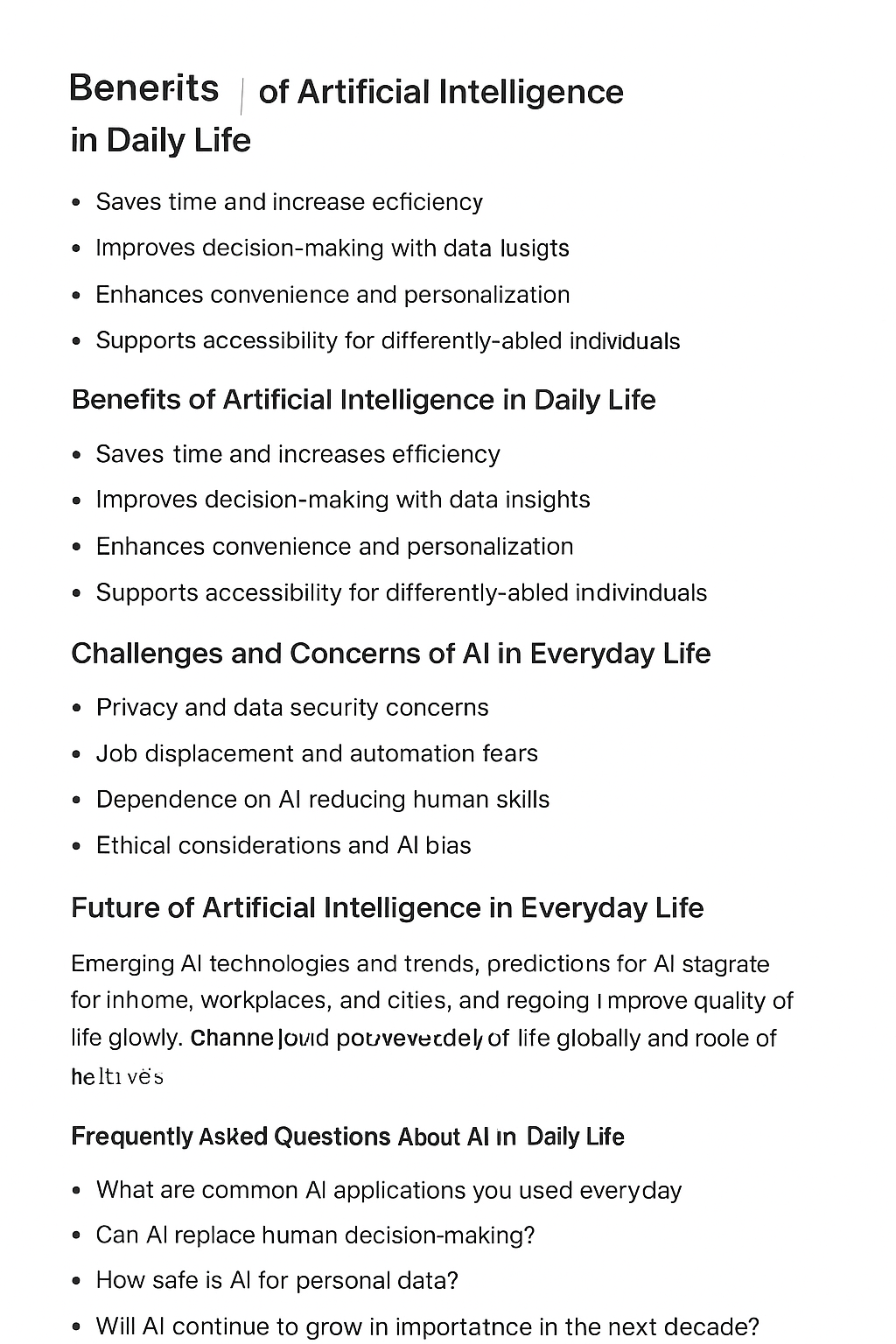
Benefits of Artificial Intelligence in Daily Life
The integration of artificial intelligence in everyday life offers numerous benefits that enhance convenience, productivity, and overall quality of life. By understanding these advantages, we can see why AI has become such a transformative force across industries and households alike.
1. Saves Time and Increases Efficiency
One of the most noticeable benefits of AI is its ability to automate routine tasks, allowing us to focus on higher-value activities. For instance:
- AI-powered email sorting and spam detection save hours of manual filtering.
- Smart home devices, like robotic vacuums and AI lighting systems, automate household chores.
- Virtual assistants handle reminders, schedules, and simple tasks instantly.
Fact: According to McKinsey, businesses using AI for automation report an average 20–30% increase in operational efficiency. On a personal level, AI saves users significant time daily through automated processes and predictive tools.
2. Improves Decision-Making with Data Insights
AI excels at analyzing massive amounts of data and identifying patterns that humans may miss. This capability supports better decision-making in various areas:
- Health: AI recommends personalized treatments based on medical history and predictive analytics.
- Finance: AI tools analyze spending habits and provide investment recommendations.
- Shopping: E-commerce platforms suggest products you’re likely to need, based on past behavior.
Example: Healthcare AI algorithms can predict patient deterioration in hospitals hours before symptoms appear, allowing timely intervention.
3. Enhances Convenience and Personalization
AI makes everyday life more comfortable and personalized by learning user preferences:
- Streaming platforms recommend movies, music, or shows tailored to individual tastes.
- Smart thermostats adjust temperatures automatically based on habits and preferences.
- AI-powered apps customize news feeds, social media content, and shopping experiences.
Quote: Satya Nadella, CEO of Microsoft, says: “AI is the defining technology of our time, and its impact on daily life will be profound in ways that enhance human productivity and creativity.”
4. Supports Accessibility for Differently-Abled Individuals
AI technologies also play a vital role in making life more accessible:
- Voice recognition software helps visually impaired individuals navigate digital devices.
- AI-powered hearing aids adapt sound based on the environment.
- Smart home automation enables people with mobility challenges to control appliances effortlessly.
Case Study: Google’s AI-driven Project Euphonia helps individuals with speech impairments communicate more effectively by recognizing diverse speech patterns and translating them into understandable text.
Challenges and Concerns of AI in Everyday Life
While artificial intelligence in everyday life offers numerous benefits, it also comes with challenges and potential risks that users and society must consider. Being aware of these concerns ensures responsible and informed use of AI technologies.
1. Privacy and Data Security Concerns
AI systems rely heavily on data to function effectively. This often involves collecting personal information, which can raise privacy issues:
- Smart devices track user habits, locations, and preferences.
- E-commerce platforms analyze purchase history to predict consumer behavior.
- Social media algorithms store and process large amounts of personal data.
Fact: According to a 2024 survey by Pew Research Center, 79% of adults worry about how their personal data is used by AI-powered systems. Strong privacy regulations and secure data handling practices are essential to address these concerns.
2. Job Displacement and Automation Fears
AI automation has transformed industries, but it also brings concerns about workforce displacement:
- Repetitive jobs in manufacturing, customer service, and logistics are increasingly handled by AI.
- AI-powered chatbots and virtual assistants reduce the need for human operators in some sectors.
Statistic: The World Economic Forum predicts that by 2030, AI and automation could displace 85 million jobs globally, but also create 97 million new roles in tech, management, and AI-related fields.
3. Dependence on AI Reducing Human Skills
Overreliance on AI can lead to decreased problem-solving and critical thinking skills:
- Navigation apps may reduce people’s ability to read maps or remember routes.
- Automated recommendations can limit independent decision-making in shopping, entertainment, and even health choices.
4. Ethical Considerations and AI Bias
AI systems reflect the data they are trained on. If the data contains bias, the AI can produce unfair or harmful outcomes:
- Facial recognition software has been shown to misidentify individuals from certain ethnic backgrounds.
- Loan approval algorithms may inadvertently favor certain demographics over others.
Quote: Fei-Fei Li, AI researcher, emphasizes: “AI is only as unbiased as the data it learns from. Ethical AI requires diverse and representative data.”
Key Takeaway: Addressing these challenges requires ethical AI development, transparency, and responsible usage. Users should stay informed and critically evaluate AI tools they interact with.
Comments are closed, but trackbacks and pingbacks are open.