
Multiagent Systems Enhance Decision-Making Processes
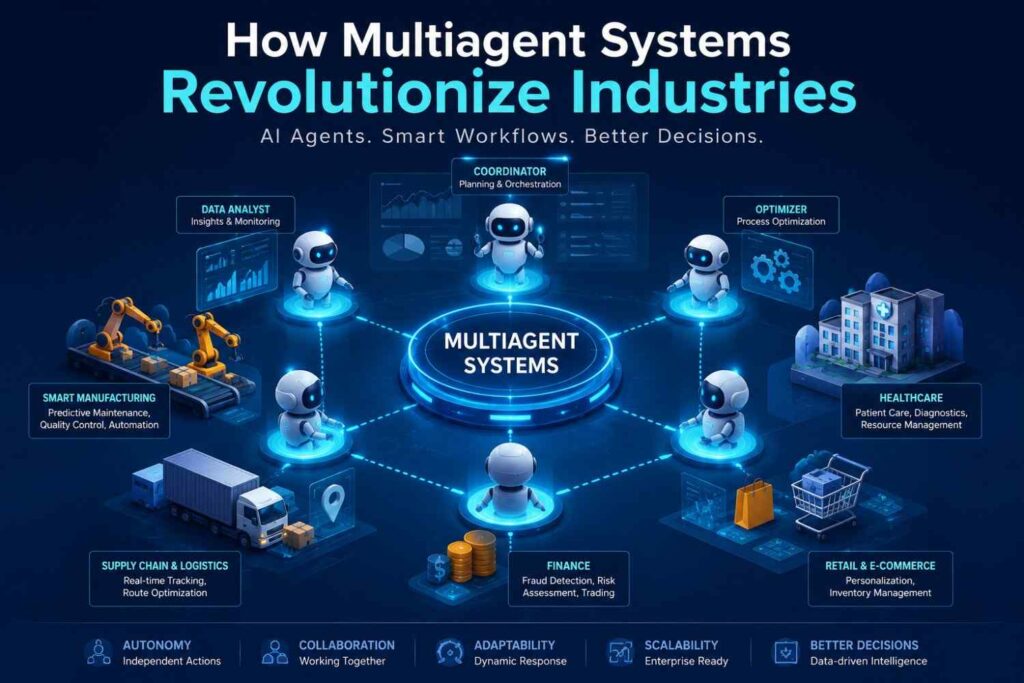
Business decisions are becoming more complex. Leaders now deal with large data sets, fast-changing markets, customer expectations, supply chain risks, cybersecurity threats, and competitive pressure. A single person or one AI model cannot always review every signal, compare every option, and respond quickly enough. This is where multiagent systems become valuable.
How Multiagent Systems Enhance Decision-Making Processes is an important topic because modern AI is moving from single assistants to teams of specialized AI agents. In a multiagent system, different agents can collect information, analyze data, test options, challenge assumptions, and recommend actions. Instead of relying on one source of intelligence, a business can use distributed intelligence.
I see multiagent systems as a practical way to improve decision quality. One agent may focus on customer data. Another may review financial risk. Another may monitor operations. Another may check compliance. When these agents work together, decision-makers get a more complete view before acting.
This does not mean humans disappear from the process. In strong business systems, humans still define goals, approve major decisions, review risks, and take responsibility for outcomes. Multiagent systems help leaders make better, faster, and more informed decisions.
What Are Multiagent Systems in Decision-Making?
Multiagent systems are AI systems made of multiple intelligent agents that work together toward a goal. Each agent may have a specific role, data source, skill, or responsibility. Together, they can solve problems that are too complex for one agent or one human team to handle efficiently.
Multiagent Systems Explained in Simple Terms
A multiagent system works like a team. Each agent has a job. One agent may gather data, another may analyze it, another may check risk, and another may summarize the final recommendation.
For example, in a business pricing decision, one agent can review competitor prices, another can analyze profit margins, another can study customer demand, and another can check inventory levels. The system then combines these findings into a decision-ready recommendation.
This is useful because business decisions rarely depend on one factor. Good decisions usually require different viewpoints, evidence, and trade-offs.
How Multiagent Systems Differ from Single AI Models
A single AI model gives one response from one reasoning path. A multiagent system creates a structured process where different agents contribute specialized input. This reduces blind spots and improves decision coverage.
| Feature | Single AI Model | Multiagent System |
|---|---|---|
| Structure | One model or assistant | Multiple specialized agents |
| Decision Input | Single response | Multiple viewpoints |
| Best For | Simple questions and drafts | Complex workflows and decisions |
| Risk Control | Limited review path | More checks and validation |
| Business Value | Speed and convenience | Better analysis and coordination |
This difference matters when decisions involve risk, money, customers, compliance, or operations.
AEO Answer: What Is a Multiagent System?
A multiagent system is a group of AI agents that work together to complete tasks or support decisions. Each agent can perform a specific function, such as research, analysis, risk review, planning, or reporting. In business, multiagent systems help improve decision-making by combining different sources of intelligence into one coordinated workflow.
How Multiagent Systems Enhance Decision-Making Processes
How Multiagent Systems Enhance Decision-Making Processes can be understood through three main benefits: better information gathering, stronger analysis, and faster action. These systems help teams move from scattered information to structured decision support.
They Collect and Compare More Information
Business decisions often fail because leaders work with incomplete information. Multiagent systems reduce this problem by assigning agents to different sources and viewpoints.
For example:
- A market agent can study industry trends.
- A finance agent can review cost and revenue impact.
- A customer agent can analyze reviews and feedback.
- A risk agent can identify threats and compliance issues.
- An operations agent can check capacity and delivery limits.
This gives decision-makers a wider and more balanced picture. It also reduces the time teams spend manually collecting data from different departments.
They Improve Analysis Through Agent Collaboration
Multiagent systems do not only collect data. They can compare, challenge, and refine insights. One agent may suggest an option, while another agent checks the risks. A third agent may compare the option with business goals.
This collaborative structure improves decision quality because it creates a built-in review process. Instead of accepting the first answer, the system can evaluate multiple options.
Decision analysis table:
| Agent Role | Decision Contribution |
|---|---|
| Research Agent | Finds market, customer, or competitor data |
| Finance Agent | Estimates cost, revenue, and ROI |
| Risk Agent | Reviews legal, security, and compliance risk |
| Operations Agent | Checks feasibility and resource capacity |
| Strategy Agent | Aligns the decision with business goals |
| Summary Agent | Creates final recommendation for humans |
This structure makes AI decision support more reliable and practical.
They Speed Up Time-Sensitive Decisions
Some decisions must happen quickly. Customer escalations, fraud alerts, supply chain delays, cybersecurity threats, and inventory shortages require fast action. Multiagent systems can monitor signals and prepare recommendations in real time.
For example, in logistics, one agent can track shipment delays, another can check warehouse stock, another can calculate cost impact, and another can recommend a backup supplier. A manager can then review the recommendation and act faster.
Speed matters, but it must be balanced with accuracy. That is why human approval remains important for high-impact decisions.
Business Use Cases for Multiagent Decision Support
Multiagent systems can support many business areas. They are especially useful where decisions require multiple data sources, repeated judgment, and cross-functional input.
Customer Service and Experience Decisions
Customer support teams make decisions every day. They decide which tickets are urgent, which customers need escalation, what compensation is appropriate, and how to reduce repeat issues.
A multiagent system can help by:
- Classifying tickets by urgency
- Summarizing customer history
- Checking policy rules
- Recommending response options
- Identifying repeat complaint patterns
- Escalating sensitive cases to humans
This improves customer experience because teams respond faster and with more context.
Finance, Risk, and Compliance Decisions
Finance and compliance teams often need accurate, well-documented decisions. Multiagent systems can help review invoices, detect unusual transactions, compare policy rules, summarize risk reports, and prepare approval notes.
For example, a finance decision workflow may include:
- An invoice agent checking invoice details
- A vendor agent reviewing supplier history
- A risk agent flagging unusual amounts
- A compliance agent checking approval rules
- A summary agent preparing the final recommendation
This does not replace finance experts. It gives them cleaner information and stronger decision support.
Operations, Supply Chain, and Resource Planning
Operations teams deal with constant change. They need to manage inventory, staffing, suppliers, production, delivery timelines, and customer demand. Multiagent systems can help teams compare scenarios before making decisions.
| Business Area | Multiagent Decision Support |
|---|---|
| Supply Chain | Supplier comparison and delay response |
| Inventory | Demand forecasting and stock alerts |
| Manufacturing | Production planning and quality checks |
| Logistics | Route planning and delivery risk review |
| Workforce Planning | Staffing needs and scheduling support |
This type of AI-powered decision-making helps companies react faster and plan better.
Why Multiagent Systems Improve Decision Quality
The real value of multiagent systems is not only automation. It is better decision quality. They help reduce bias, improve validation, and make decision logic more transparent when designed properly.
They Reduce Single-Point Failure
When one person, one department, or one AI model makes a decision alone, blind spots can appear. A multiagent system reduces this risk by using multiple agents with different roles.
For example, a sales team may want to approve a discount to close a deal. A finance agent may calculate margin impact. A customer success agent may review long-term account value. A compliance agent may check approval rules. The final decision becomes more balanced.
This makes multiagent systems useful for decisions where one viewpoint is not enough.
They Create Better Scenario Planning
Scenario planning helps leaders compare possible outcomes before choosing a path. Multiagent systems can generate and evaluate different scenarios quickly.
For example, before launching a new product, agents can compare:
- Best-case revenue
- Worst-case demand
- Competitor response
- Supply chain risk
- Marketing cost
- Customer adoption
- Operational readiness
This gives leaders a clearer view of trade-offs. It also helps teams avoid emotional or rushed decisions.
They Support Explainable Decision Workflows
Decision-making improves when people can understand how a recommendation was created. A well-designed multiagent system can show which agents contributed, what data they used, what risks they found, and why a recommendation was made.
This is important for governance, trust, and accountability. Businesses should avoid black-box decisions, especially in finance, HR, healthcare, legal, insurance, and regulated industries.
Implementation Framework for Multiagent Decision-Making
Businesses should not implement multiagent systems randomly. They need a structured approach that starts with a clear decision problem and ends with measurable results.
Step 1: Identify the Decision Problem
Start by choosing one decision process that is important, repetitive, and measurable. Do not begin with the most sensitive or complex decision in the company.
Good first use cases include:
- Support ticket prioritization
- Sales lead scoring
- Weekly business reporting
- Supplier comparison
- Inventory alerts
- Marketing campaign recommendations
- Internal knowledge routing
Ask these questions:
- What decision takes too long?
- What data is needed?
- Who approves the final decision?
- What mistakes happen often?
- What does success look like?
Step 2: Assign Agent Roles Clearly
Every agent should have a clear role. If roles are unclear, agents may duplicate work or produce confusing outputs.
Example agent structure:
| Agent | Role |
|---|---|
| Data Agent | Collects approved information |
| Analysis Agent | Finds patterns and insights |
| Risk Agent | Flags issues and limitations |
| Policy Agent | Checks rules and compliance |
| Recommendation Agent | Suggests next steps |
| Human Reviewer | Approves or rejects the decision |
This structure keeps the decision process organized and easier to evaluate.
Step 3: Add Human-in-the-Loop Review
Human-in-the-loop review means humans stay involved at important decision points. This is essential for high-value, sensitive, or regulated decisions.
Human approval should be required for:
- Financial approvals
- Legal interpretations
- Hiring decisions
- Medical or health-related decisions
- Customer compensation
- Security actions
- Contract decisions
- Public communication
Multiagent systems should support humans, not remove accountability.
Risks, Challenges, and Best Practices
Multiagent systems can improve decision-making, but they also create risks if businesses deploy them without planning. More agents can mean more complexity, more data movement, and more points of failure.
Common Risks in Multiagent Systems
Common risks include inaccurate outputs, poor coordination, data privacy issues, weak governance, biased recommendations, unclear accountability, and overreliance on automation.
Risk table:
| Risk | Why It Matters | Best Practice |
|---|---|---|
| Wrong output | Can lead to poor decisions | Add validation agents and human review |
| Data leakage | Sensitive data may be exposed | Limit access and use secure tools |
| Poor coordination | Agents may conflict | Define roles and orchestration rules |
| Bias | Recommendations may be unfair | Test outputs and review data sources |
| Lack of accountability | No one owns the final decision | Assign human decision owners |
Good design reduces these risks.
Governance Makes Multiagent Systems Safer
Governance is the difference between useful AI and risky AI. Businesses should define what agents can access, what actions they can take, which outputs need approval, and how decisions are logged.
A strong governance framework should include:
- Access controls
- Audit trails
- Human approval rules
- Testing and evaluation
- Data protection policies
- Performance monitoring
- Escalation paths
- Regular review cycles
The NIST AI Risk Management Framework is a useful reference for managing AI-related risks in organizations.
Best Practices for Business Leaders
Business leaders should start small, measure outcomes, and scale carefully. A multiagent system should not be introduced only because it sounds advanced. It should solve a real decision problem.
Best practices include:
- Start with one decision workflow
- Use approved data sources
- Define each agent’s role
- Keep humans responsible for final decisions
- Measure time saved and decision quality
- Review errors regularly
- Train employees on AI literacy
- Improve the workflow over time
This practical approach creates better results and lowers risk.
Frequently Asked Questions About How Multiagent Systems Enhance Decision-Making Processes
What is a multiagent system in AI?
A multiagent system is an AI setup where multiple agents work together to complete tasks or support decisions. Each agent may have a different role, such as data collection, analysis, risk review, or recommendation. Together, they help solve complex problems more effectively than one model working alone.
How do multiagent systems improve decision-making?
Multiagent systems improve decision-making by combining multiple viewpoints, checking different data sources, comparing options, and identifying risks. They help leaders make faster and more informed decisions because each agent contributes a specific type of intelligence to the process.
What are examples of multiagent systems in business?
Business examples include customer support triage, sales lead scoring, finance risk review, supply chain planning, IT incident response, fraud detection, marketing campaign analysis, and executive reporting. These workflows often need several agents because decisions depend on many data points and business rules.
Are multiagent systems better than single AI models?
Multiagent systems are better for complex decisions that need multiple roles, checks, and data sources. A single AI model may be enough for simple writing, summarizing, or question answering. Multiagent systems are more useful when businesses need coordination, validation, and decision support across workflows.
Do multiagent systems replace human decision-makers?
No, multiagent systems should not fully replace human decision-makers in important business decisions. They support humans by collecting data, analyzing options, and recommending actions. Humans should still approve sensitive, financial, legal, strategic, HR, or customer-impacting decisions.
What industries use multiagent decision support?
Industries that can use multiagent decision support include finance, healthcare administration, logistics, manufacturing, ecommerce, insurance, education, cybersecurity, real estate, retail, and enterprise software. Any industry with complex workflows and data-heavy decisions can benefit from this approach.
What are the risks of multiagent systems?
The main risks include wrong recommendations, poor coordination between agents, data privacy issues, bias, security problems, unclear accountability, and over-automation. Businesses can reduce these risks with clear governance, human review, access controls, audit trails, and regular system testing.
How should a business start with multiagent systems?
A business should start with one low-risk, high-value decision workflow. It should define the decision problem, assign agent roles, use approved data, add human review, measure outcomes, and improve the workflow before scaling to more complex processes.
Conclusion
How Multiagent Systems Enhance Decision-Making Processes is a powerful topic because businesses need better ways to handle complexity. Modern decisions require more data, faster analysis, stronger risk review, and better coordination. Multiagent systems help by dividing decision work among specialized AI agents that collect information, analyze options, check risks, and prepare recommendations.
The biggest benefit is not just speed. It is better decision quality. Multiagent systems can reduce blind spots, support scenario planning, improve collaboration, and make decision workflows more structured. They are useful in customer service, finance, compliance, operations, supply chain, sales, marketing, and executive reporting.
However, businesses must implement them carefully. Human oversight, clear agent roles, secure data access, governance rules, and measurable KPIs are essential. The best results come when multiagent systems support human decision-makers rather than replacing them.
In my view, companies that learn how to combine human judgment with multiagent intelligence will make faster, smarter, and more reliable decisions in the future.
Comments are closed, but trackbacks and pingbacks are open.