
Agentic AI in Healthcare: Improving Patient Outcomes Through Smarter Decisions
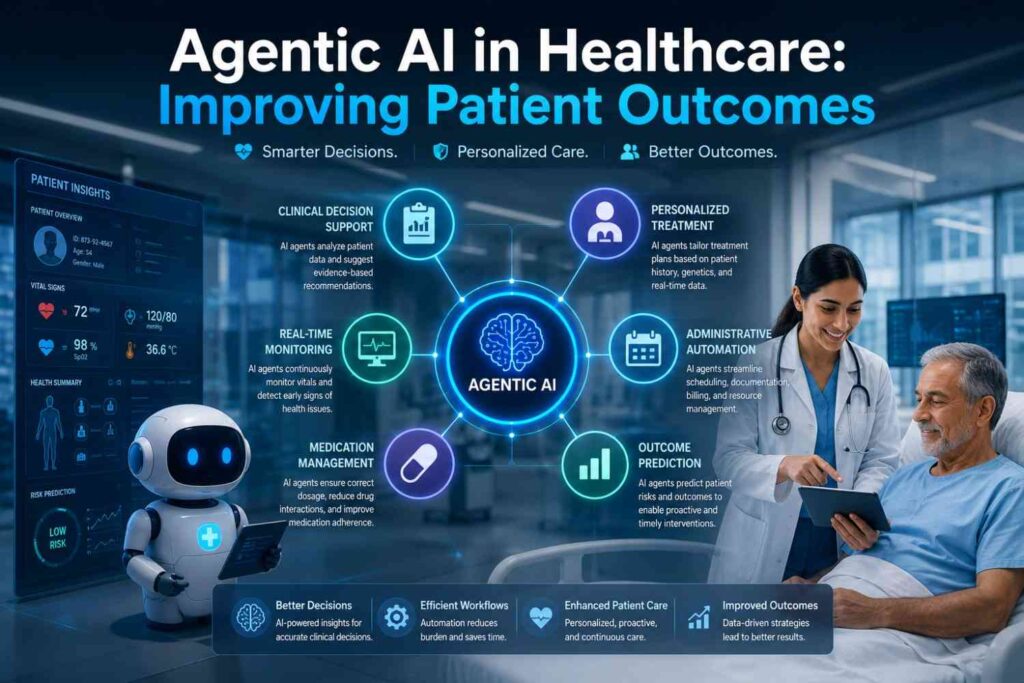
Agentic AI in Healthcare: Improving Patient Outcomes is becoming one of the most important topics in digital health. Healthcare systems are under pressure because of rising patient demand, staff burnout, complex data, and slow administrative workflows. In this environment, agentic AI can help doctors, nurses, hospitals, and patients work more efficiently.
In simple words, agentic AI refers to AI systems that can understand a goal, plan steps, use tools, complete tasks, and learn from feedback. Unlike a normal chatbot that only answers questions, an AI agent can support multi-step healthcare workflows. For example, it can summarize patient records, prepare a visit note, track follow-ups, check care gaps, and remind patients about medication or appointments.
I believe the main value of agentic AI is not replacing healthcare professionals. Its real purpose is to support them. When used responsibly, AI agents in healthcare can reduce workload, improve care coordination, support clinical decision-making, and help patients receive more timely and personalized care.
What Is Agentic AI in Healthcare?
Agentic AI in healthcare means using AI systems that can act with a certain level of independence while still working under human supervision. These systems are designed to complete healthcare-related tasks by following goals, accessing approved data, using connected tools, and giving useful outputs to clinicians or patients. This makes agentic AI different from simple automation because it can handle more complex and connected workflows.
For healthcare, this is important because patient care is rarely one simple task. A single patient journey may include symptoms, medical history, lab results, imaging reports, medication lists, referrals, insurance steps, and follow-up visits. Agentic AI can help organize these steps so care teams can make better and faster decisions.
Agentic AI Is More Than a Basic Chatbot
A basic chatbot usually responds to one question at a time. It may answer FAQs, explain symptoms, or guide users to a form. Agentic AI can go further because it can plan and perform a sequence of tasks.
For example, a healthcare AI agent may review a patient’s previous appointments, summarize recent lab results, identify missing screenings, and prepare a draft note for the doctor. This type of AI is more workflow-focused. It does not just talk; it helps complete useful healthcare actions.
How AI Agents Work in Clinical Settings
In a clinical setting, AI agents usually work through connected systems such as electronic health records, scheduling platforms, patient portals, clinical guidelines, and secure communication tools. The agent receives a goal, checks approved information, performs the task, and shares the result with a human user.
For example, before a patient appointment, an AI agent may prepare a short clinical summary. It can highlight allergies, current medications, recent test results, and unresolved problems. The doctor can then review this summary instead of spending extra time searching through long records.
Why Agentic AI Matters for Patient Outcomes
Agentic AI matters because patient outcomes depend on speed, accuracy, coordination, and communication. If important information is missed, care can be delayed. If follow-ups are not completed, patients may become worse. If instructions are unclear, patients may not follow treatment correctly.
Agentic AI in Healthcare: Improving Patient Outcomes focuses on solving these real problems. It can help care teams act earlier, communicate better, and reduce avoidable gaps in care.
How Agentic AI in Healthcare Works
Agentic AI in Healthcare: Improving Patient Outcomes works by combining data, automation, reasoning, and human oversight. The system does not simply give a random answer. It follows a structured process: understand the goal, collect relevant information, analyze the situation, complete the assigned task, and present the result for review.
This process is especially useful in healthcare because clinicians often work with large amounts of information. AI agents can help turn scattered data into clear, action-ready insights. The final medical decision should still remain with qualified healthcare professionals.
Collecting and Organizing Patient Data
The first step is collecting and organizing patient data from approved sources. This may include medical history, lab reports, imaging notes, prescriptions, allergies, appointment history, and care plans.
A major challenge in healthcare is that data often exists in different places. AI agents can help bring this information together in a clear format. This supports better decision-making because clinicians can see the most relevant details quickly.
Supporting Clinical Decision-Making
Agentic AI can support clinical decision-making by identifying patterns, comparing symptoms with past data, and highlighting possible risks. For example, an AI agent may alert a clinician if a patient with diabetes has missed follow-up testing or if a medication combination needs review.
This does not mean AI should diagnose patients on its own. It should support doctors by making useful information easier to see. Human judgment remains essential because every patient has a unique context.
Taking Action Through Connected Workflows
The most powerful part of agentic AI is its ability to support action. An AI agent may help schedule a follow-up, draft a patient message, prepare a referral summary, or create a discharge instruction draft.
This is where healthcare automation becomes more meaningful. Instead of only producing information, agentic AI helps move care forward. That can improve patient experience and reduce delays.
Key Use Cases of Agentic AI in Healthcare
Agentic AI has many possible use cases in healthcare, but the best use cases are those that solve real workflow problems. Hospitals and clinics should not adopt AI only because it is trending. They should use AI where it can improve safety, reduce workload, and create measurable value for patients and clinicians.
The most useful applications include clinical documentation, patient monitoring, diagnosis support, care coordination, patient communication, and hospital operations. These areas directly affect patient outcomes because they influence how quickly and accurately care is delivered.
AI Medical Documentation and Ambient Scribes
One of the most practical use cases is medical documentation. Many clinicians spend a large amount of time writing notes, updating records, and completing administrative tasks. AI scribes can listen to clinical conversations with consent and create draft notes for review.
This can help doctors focus more on the patient during the visit. It can also reduce after-hours documentation work. Better documentation can support continuity of care because future clinicians can understand what happened during the visit.
Patient Monitoring and Early Risk Detection
Agentic AI can also support remote patient monitoring. For patients with chronic conditions, AI agents can review data from connected devices, patient portals, or regular check-ins. If the system notices concerning patterns, it can alert the care team.
For example, a patient with heart disease may need monitoring for weight changes, blood pressure changes, or symptoms. An AI agent can help flag risks earlier so clinicians can respond before the condition becomes serious.
Care Coordination and Follow-Up Management
Care coordination is one of the most important areas for Agentic AI in Healthcare: Improving Patient Outcomes. Many patients need referrals, lab tests, imaging, medication changes, and follow-up visits. If one step is missed, the patient may face delays or complications.
AI agents can help track these steps. They can remind staff about pending referrals, alert patients about upcoming appointments, and help ensure that test results are reviewed. This can make the care journey smoother and safer.
Benefits of Agentic AI for Patients and Healthcare Providers
The benefits of agentic AI are not limited to technology teams. Patients, doctors, nurses, hospital administrators, and care coordinators can all benefit when AI is used correctly. The main goal is to improve the quality, speed, and consistency of healthcare services.
For patients, agentic AI can mean clearer communication, faster follow-ups, and more personalized support. For healthcare providers, it can reduce repetitive tasks, improve access to information, and support better decision-making. This creates a better care environment for everyone.
Better Patient Experience
Patients often feel confused after appointments because medical instructions can be complex. AI agents can help create simple summaries, medication reminders, and follow-up instructions in patient-friendly language.
This improves patient engagement. When patients understand their care plan, they are more likely to follow it. Better understanding can lead to better treatment adherence and improved outcomes.
Reduced Clinician Workload
Clinicians face heavy workloads because of documentation, messages, forms, and administrative tasks. Agentic AI can help reduce this burden by automating routine work and preparing draft content for review.
This does not remove the clinician from the process. Instead, it gives them more time for meaningful patient care. In healthcare, time is valuable. Even small workflow improvements can make a major difference.
Faster and More Consistent Care Delivery
Agentic AI can help standardize routine processes. For example, it can check whether a patient received recommended follow-up, whether a discharge summary was completed, or whether a referral is still pending.
This consistency matters because healthcare quality depends on reliable systems. AI agents can reduce human error in repetitive tasks and help care teams stay organized.
Risks and Ethical Challenges of Agentic AI in Healthcare
Agentic AI has strong potential, but healthcare organizations must handle it carefully. Healthcare is a high-risk field because mistakes can affect patient safety. AI tools must be tested, monitored, and governed properly before they are used in clinical workflows.
The biggest risks include privacy issues, bias, inaccurate outputs, overreliance, cybersecurity threats, and unclear accountability. These risks do not mean healthcare should avoid AI completely. They mean AI must be implemented responsibly.
Privacy and Patient Data Protection
Healthcare data is highly sensitive. AI agents may need access to medical records, lab results, medication lists, and personal details. This means organizations must protect patient data through strong privacy and security controls.
AI systems should only access the data they need. They should also use secure storage, access controls, audit logs, and compliance processes. Patient trust depends on responsible data handling.
Bias and Fairness in AI Outputs
AI systems can produce biased results if they are trained or tested on incomplete or unbalanced data. In healthcare, this can be dangerous because different patient groups may experience different levels of accuracy.
For example, an AI model may perform well for one population but poorly for another. Healthcare organizations should test AI tools across age groups, genders, ethnic backgrounds, languages, and medical conditions.
Human Oversight and Accountability
AI agents should not operate without human oversight in important medical decisions. Doctors and care teams must review AI-generated outputs before acting on them.
Clear accountability is also necessary. If an AI recommendation is wrong, organizations need to know who is responsible, how the error happened, and how to prevent it in the future. Responsible AI governance is essential for safe healthcare adoption.
Best Practices for Implementing Agentic AI in Healthcare
Implementing agentic AI in healthcare requires planning, testing, governance, and training. A healthcare organization should not launch AI agents without understanding the workflow, risks, users, and expected outcomes.
The best approach is to start small. Clinics and hospitals should begin with low-risk, high-value use cases such as documentation support, appointment reminders, care summaries, or referral tracking. Once the system proves useful and safe, it can be expanded carefully.
Start With Low-Risk Workflows
The safest starting point is usually administrative or support work. Examples include summarizing visits, preparing draft notes, sending reminders, or organizing patient records.
These workflows can create quick value without giving AI full control over diagnosis or treatment. Starting small also helps teams build trust and learn how the system performs in real practice.
Build a Strong AI Governance Framework
A strong governance framework should define how AI tools are selected, tested, approved, monitored, and updated. It should include clinical leaders, compliance teams, IT teams, data security experts, and patient safety experts.
The framework should cover privacy, bias testing, performance monitoring, audit logs, human review, incident reporting, and vendor accountability. This protects both patients and healthcare providers.
Train Clinicians and Staff
Even the best AI system can fail if users do not understand how to use it. Healthcare staff should be trained on what the AI can do, what it cannot do, and when human judgment is required.
Training should also explain how to report errors, review AI outputs, and avoid overreliance. Good training helps AI become a helpful assistant instead of a risky shortcut.
Facts and Data Table: Agentic AI in Healthcare
| Area | Agentic AI Role | Possible Benefit | Required Safety Control |
|---|---|---|---|
| Clinical documentation | Drafts visit notes and summaries | Less admin burden for clinicians | Clinician review before saving |
| Care coordination | Tracks referrals and follow-ups | Fewer missed care steps | Audit logs and escalation rules |
| Patient communication | Sends reminders and education | Better patient engagement | Approved content and privacy checks |
| Risk detection | Flags concerning patterns | Earlier intervention | Clinical validation and monitoring |
| Hospital operations | Supports scheduling and resource planning | Improved workflow efficiency | Human oversight and performance review |
| Medical decision support | Organizes clinical data | Better-informed decisions | Final decision by licensed clinician |
Frequently Asked Questions About Agentic AI in Healthcare
What is agentic AI in healthcare?
Agentic AI in healthcare refers to AI systems that can plan, use tools, complete tasks, and support healthcare workflows with human supervision. These systems can help summarize records, draft notes, track follow-ups, and support patient communication. They are designed to assist healthcare professionals, not replace them.
How does agentic AI improve patient outcomes?
Agentic AI can improve patient outcomes by helping clinicians access information faster, reducing missed follow-ups, improving care coordination, and supporting earlier risk detection. It can also help patients understand instructions better through reminders, summaries, and personalized communication.
Can agentic AI replace doctors and nurses?
No, agentic AI should not replace doctors or nurses. It should work as a support tool. Medical care requires clinical judgment, empathy, patient context, and accountability. AI agents can help organize information and automate routine work, but final medical decisions should remain with licensed professionals.
What are examples of AI agents in healthcare?
Examples include AI documentation assistants, patient follow-up agents, appointment reminder agents, remote monitoring agents, referral tracking agents, and clinical summary agents. These tools can support hospitals, clinics, and care teams by reducing repetitive tasks and improving workflow efficiency.
Is agentic AI safe for healthcare?
Agentic AI can be safe when it is properly tested, monitored, and governed. Safety depends on data quality, privacy protection, clinical validation, bias testing, cybersecurity, and human oversight. Healthcare organizations should never deploy AI tools without a clear risk management process.
What are the biggest challenges of agentic AI in healthcare?
The biggest challenges include privacy risks, biased outputs, inaccurate recommendations, weak governance, poor integration with existing systems, and overreliance on AI. These challenges can be managed through strong policies, training, monitoring, and clinical review.
What is the future of agentic AI in healthcare?
The future of agentic AI in healthcare will likely include more personalized care support, smarter clinical workflows, better patient monitoring, and improved hospital operations. However, successful adoption will depend on trust, regulation, safety testing, and responsible use.
Conclusion
Agentic AI in Healthcare: Improving Patient Outcomes is not just about advanced technology. It is about making healthcare more coordinated, efficient, and patient-centered. AI agents can help doctors and care teams manage information, reduce administrative burden, support decision-making, and keep patients engaged in their care journey.
The best use cases include documentation support, care coordination, patient monitoring, follow-up management, and patient communication. These areas directly affect the quality of care because they reduce delays and improve consistency.
However, agentic AI must be implemented responsibly. Healthcare organizations need strong privacy controls, bias testing, human oversight, governance frameworks, and continuous monitoring. AI should support clinical teams, not replace them.
When used safely, agentic AI can help healthcare systems deliver better care with more speed, clarity, and confidence.
Comments are closed, but trackbacks and pingbacks are open.