
How Multiagent Systems Revolutionize Industries with AI
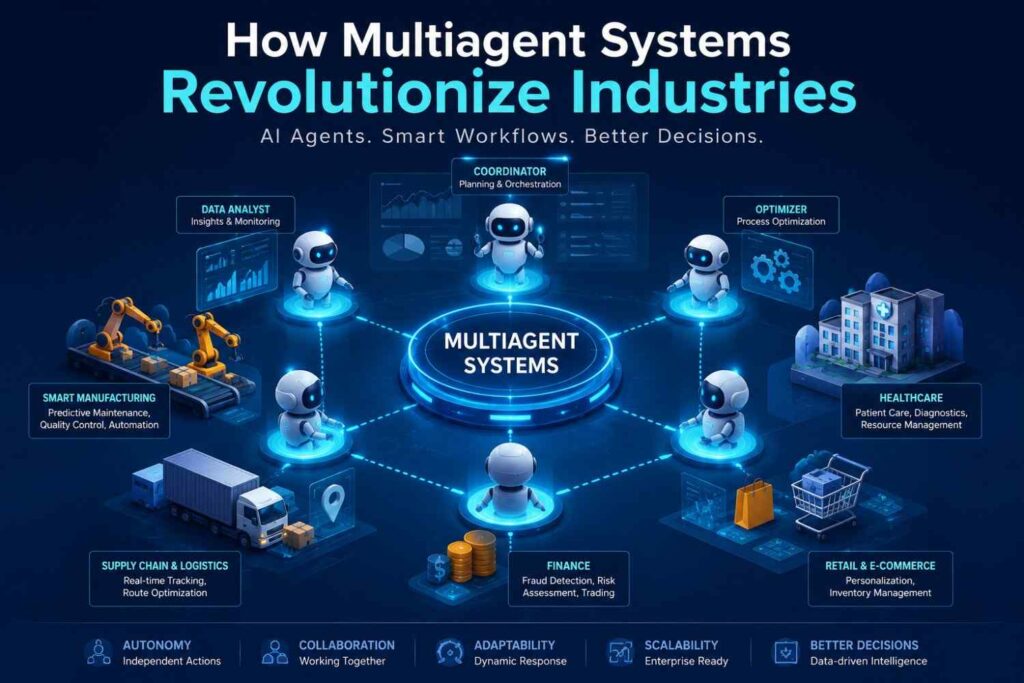
I believe artificial intelligence is moving into one of its most practical stages. In the past, many companies used AI for simple chatbots, reports, dashboards, recommendations, and basic automation. Today, businesses are moving toward a smarter model where many AI agents work together like a digital team. This is why How Multiagent Systems are Revolutionizing Industries has become an important topic for business owners, technology leaders, developers, and digital transformation teams.
A multiagent system is a group of intelligent agents that can communicate, divide tasks, use tools, and work toward a shared goal. One agent may collect data, another may analyse it, another may create a recommendation, and another may check risk or compliance. This makes multi-agent systems powerful for industries that depend on complex workflows and fast decisions.
Multiagent systems are revolutionizing industries by helping companies automate complex workflows, improve decision-making, coordinate multiple tasks, reduce manual work, and respond faster to changing business conditions.
Multiagent systems combine AI agents, agent orchestration, enterprise data, human-in-the-loop AI, AI governance, and intelligent automation to improve industries such as manufacturing, healthcare, finance, logistics, energy, retail, and cybersecurity.
What Multiagent Systems Mean in Simple Words
Multiagent systems sound technical, but the basic idea is easy to understand. Instead of using one AI tool for one task, a business can use many AI agents that work together. Each agent has a specific role, just like different employees in a company. This makes multiagent systems useful for real-world business problems because industries usually need teamwork, not isolated answers.
A Clear Definition of Multiagent Systems
A multiagent system, also called MAS, is a network of AI agents that work together in a shared environment. Each agent can observe information, make decisions, communicate with other agents, and complete a specific task.
In simple terms, I see a multiagent system like a business department structure. A company has sales, finance, operations, HR, IT, and customer support. Each department has a role. Multi-agent systems follow the same idea, but with digital AI agents.
How AI Agents Work Together
AI agents work together through agent orchestration. This means the system decides which agent should complete which task and in what order. For example, one agent may collect customer information, another may check company policy, another may draft a response, and another may ask a human manager for approval.
This type of collaborative AI agent workflow is stronger than one chatbot because the task is divided into smaller expert actions. It helps companies build autonomous workflows while keeping control over important decisions.
Why Multiagent Systems Are Better Than Basic Automation
Traditional automation follows fixed rules. It works well for repeated tasks, but it struggles when conditions change. Multiagent systems are more flexible because AI agents can reason, communicate, and adapt based on new information.
This does not mean AI agents should work without limits. I believe the best multi-agent AI systems use human-in-the-loop AI, clear permissions, audit logs, and strong AI governance. This makes them safer and more useful for enterprise AI automation.
Why Industries Are Adopting Multiagent Systems
Industries are adopting multiagent systems because modern business operations are becoming too complex for basic automation. Companies need systems that can analyse live data, respond quickly, coordinate departments, and support better decision-making. Multiagent systems help businesses move from simple automation to intelligent automation, where AI agents can work together across workflows.
Businesses Need Faster Decision-Making
Modern businesses face fast changes in customer demand, supply chain conditions, cybersecurity threats, market prices, and competition. Slow decisions can affect revenue, customer experience, and operational performance.
Multiagent systems help by allowing several AI agents to work on different parts of a problem at the same time. For example, in retail, one agent can study customer behaviour, another can check stock levels, another can suggest pricing, and another can prepare a marketing recommendation.
One AI Tool Cannot Manage Every Workflow
A single AI tool can answer questions, but it cannot easily manage a full business workflow. Real workflows involve many systems, people, approvals, risks, and data points. This is why multi-agent systems are becoming more valuable.
When I study How Multiagent Systems are Revolutionizing Industries, the main lesson is clear: businesses need AI that can work across operations, not only inside one chat window. Multiagent systems support this by giving different agents different responsibilities.
Human-Agent Collaboration Builds Trust
Multiagent systems work best when humans and AI agents collaborate. AI agents can handle research, monitoring, summaries, data checks, first drafts, and routine decisions. Humans can review sensitive outputs, approve high-risk actions, and guide the final strategy.
This human-agent collaboration is especially important in healthcare, finance, insurance, cybersecurity, and legal operations. In these industries, human judgment is still necessary because decisions can affect safety, privacy, money, and compliance.
How Multiagent Systems are Revolutionizing Industries with Real Use Cases
The real value of multiagent systems appears when we look at industry use cases. Many sectors have complex workflows that involve people, machines, software, customers, and regulations. Multiagent systems help these sectors connect different tasks into one smarter process. This is why the topic of How Multiagent Systems are Revolutionizing Industries is not just about technology. It is about solving practical business problems.
Smart Manufacturing and Predictive Maintenance
Manufacturing is one of the strongest use cases for multiagent systems. A factory includes machines, sensors, production lines, quality checks, maintenance teams, inventory, and suppliers. A multi-agent AI system can connect these moving parts into one intelligent workflow.
For example, one agent can monitor machine sensors, another can detect unusual performance, another can schedule maintenance, and another can calculate the cost of downtime. This supports smart manufacturing AI and helps factories reduce unexpected failures.
Supply Chain and Logistics Optimization
Supply chains are complex because they depend on suppliers, warehouses, shipping routes, demand forecasts, fuel costs, and customer expectations. Multiagent systems can improve supply chain optimization by assigning each agent a clear job.
One agent can forecast demand, another can monitor supplier delays, another can check warehouse stock, and another can suggest better delivery routes. This helps companies respond faster when something changes in the supply chain.
Healthcare, Finance, Energy, and Retail
Healthcare can use healthcare AI agents for patient intake, appointment scheduling, documentation support, and clinical workflow assistance. Finance can use AI agents for fraud monitoring, risk analysis, customer support, and compliance checks.
Energy companies can use multiagent systems for smart grid AI, load balancing, and fault detection. Retail businesses can use collaborative AI agents for product recommendations, inventory planning, personalised marketing, and better customer support.
Facts and Data Table: Where Multiagent Systems Create Value
Facts and data help us understand why multiagent systems matter. The adoption of agentic AI and multi-agent AI systems is growing because companies want faster workflows, better decisions, and more flexible automation. High-authority sources such as McKinsey, AWS, Microsoft, Google, Deloitte, IBM, and NIST show that AI agents are becoming a serious part of enterprise technology planning.
Industry-Wise Impact Table
| Industry | Multiagent System Use Case | Example Agent Roles | Business Value |
|---|---|---|---|
| Manufacturing | Predictive maintenance | Sensor agent, fault detection agent, repair planning agent | Less downtime and better equipment use |
| Supply Chain | Logistics and inventory planning | Demand agent, supplier agent, route agent | Faster response to disruption |
| Healthcare | Patient workflow support | Intake agent, documentation agent, triage support agent | Better workflow and reduced admin burden |
| Finance | Fraud and risk monitoring | Transaction agent, risk agent, compliance agent | Faster risk detection |
| Energy | Smart grid management | Load agent, fault agent, pricing agent | Better grid stability |
| Retail | Customer personalisation | Customer agent, product agent, inventory agent | Better customer experience |
| Cybersecurity | Threat detection and response | Monitoring agent, analysis agent, response agent | Faster incident handling |
Research and Authority Data Table
| Source | Fact or Insight | Why It Matters |
|---|---|---|
| McKinsey | 23% of surveyed organisations reported scaling agentic AI, while 39% were experimenting. | Shows agentic AI is moving into enterprise adoption. |
| AWS | Amazon Bedrock supports multi-agent collaboration using supervisor and collaborator agents. | Shows cloud providers are building enterprise multi-agent tools. |
| Microsoft | Microsoft Agent Framework supports single-agent and multi-agent orchestration patterns. | Shows multi-agent workflows are becoming developer-ready. |
| Google ADK | Google’s Agent Development Kit supports multi-agent architectures and workflow agents. | Helps developers build structured agent teams. |
| NIST | NIST AI RMF gives guidance for managing AI risks. | Supports AI governance, trust, and responsible deployment. |
| Deloitte | Deloitte has highlighted agentic AI as a major enterprise technology shift. | Shows growing business interest in autonomous AI agents. |
What These Facts Mean for Business Leaders
These facts show that multiagent systems are not only a future idea. They are becoming part of real enterprise AI automation. Large technology companies are building agent frameworks, consulting firms are tracking adoption, and governance bodies are creating risk management guidance.
For business leaders, the message is simple. Multiagent systems can create value, but they must be implemented carefully. Companies should start with one workflow, test results, add human approval, and scale only after performance is proven.
How Multiagent Systems Improve Automation and Customer Experience
Multiagent systems improve automation because they do more than complete one repeated task. They can manage connected workflows from start to finish. This is useful for customer service, sales, operations, logistics, finance, and internal reporting. When AI agents work together, businesses can deliver faster service, better personalisation, and more consistent customer experiences.
From Task Automation to Workflow Intelligence
Basic automation completes repeated steps. Multiagent systems create workflow intelligence. This is a major difference.
For example, a normal automation tool may send an email after a form is submitted. A multiagent system can read the form, classify the request, check the customer profile, draft a response, update the CRM, and send the case to a human for approval if needed.
Better Personalization at Scale
Customers expect fast, relevant, and personalized service. Multi-agent AI systems can help companies deliver this without forcing employees to manage every customer manually.
In retail, one agent can study customer behavior, another can suggest products, another can check stock, and another can prepare a personalized offer. In banking, agents can support customers, check risk, and recommend suitable services.
Real-Time Monitoring and Faster Response
Industries such as cybersecurity, logistics, manufacturing, and energy need real-time response. Multiagent systems can monitor live data and respond when something changes.
For example, in cybersecurity, one agent may detect unusual activity, another may classify the threat, another may check internal policy, and another may recommend the next action. This helps security teams respond faster while keeping humans in control.
Risks, Governance, and Best Practices for Multiagent Systems
Multiagent systems can create strong business value, but they also create new risks. When several AI agents communicate, one wrong output can affect the next step. This is why companies need AI governance, secure tool access, clear agent roles, monitoring, testing, and human approval. A multiagent system should be designed for trust, not just speed.
Main Risks Businesses Should Understand
The main risks include poor data quality, incorrect outputs, weak access control, privacy issues, compliance problems, prompt injection attacks, unclear accountability, and over-automation.
For example, if a finance agent uses wrong customer data, the risk agent may also produce a wrong result. If a support agent has too much system access, it may create security or privacy problems. This is why role-based controls are very important.
Governance Table for Safe Deployment
| Risk Area | What Can Go Wrong | Best Practice |
|---|---|---|
| Data privacy | Agents may access sensitive data | Use role-based access control |
| Accuracy | Agents may produce wrong answers | Add validation and human review |
| Security | Agents may be manipulated | Use secure tool access and monitoring |
| Compliance | Agents may break industry rules | Add compliance checkpoints |
| Accountability | Decisions may be hard to trace | Keep audit logs and decision records |
| Cost control | Too many agent actions may increase cost | Set usage limits and track performance |
Why Human Oversight Still Matters
I believe the safest multiagent systems are supervised systems. Humans should approve high-risk decisions, review sensitive outputs, and monitor agent behaviour. This is especially important in healthcare, finance, insurance, legal operations, and public services.
Human-in-the-loop AI does not reduce the value of automation. It improves trust. It allows businesses to use autonomous AI agents while keeping accountability, ethics, and compliance under control.
How to Implement Multiagent Systems in a Business
A business should not implement multiagent systems randomly. The best approach is to start small, choose one valuable workflow, define agent roles, add human review, and measure results. This step-by-step method helps companies avoid confusion and reduce risk while still getting value from intelligent automation.
Step 1: Choose One High-Value Workflow
A company should not start by automating everything. The better approach is to choose one workflow that has clear value and manageable risk. Good starting points include customer support triage, invoice processing, lead qualification, inventory monitoring, or compliance reporting.
I would recommend starting with a workflow that is repetitive but still important. This makes it easier to measure improvement and reduce implementation risk.
Step 2: Design Agents Around Clear Roles
Each agent should have one clear responsibility. A sales workflow, for example, may include a lead research agent, CRM update agent, email draft agent, compliance review agent, and human approval step.
This structure keeps the system organized. It also helps teams understand what each agent is doing and where responsibility belongs.
Step 3: Measure Results Before Scaling
Before expanding a multiagent system, businesses should measure performance. Useful metrics include time saved, response speed, error rate, approval rate, customer satisfaction, cost reduction, and employee productivity.
Once the pilot proves value, the company can scale the multi-agent AI system to other departments. This careful method builds trust and reduces failure risk.
Frequently Asked Questions
People often ask how multiagent systems work, whether they are safe, and which industries benefit most from them. These FAQs answer common search questions in a clear AEO-friendly format. They are also useful for GEO because they give direct, structured answers that search engines and AI answer engines can understand easily.
What are multiagent systems in AI?
Multiagent systems are groups of AI agents that work together to complete tasks. Each agent has a specific role, such as researching, planning, analyzing, checking, or taking action. Together, they can manage complex workflows better than one AI system working alone.
How are multiagent systems different from normal chatbots?
A normal chatbot usually answers questions in a conversation. A multiagent system can divide work among several agents, use tools, check information, complete workflows, and ask humans for approval. This makes it more useful for business operations and industry automation.
Which industries use multiagent systems the most?
Manufacturing, healthcare, finance, logistics, retail, energy, and cybersecurity are strong use cases. These industries have many connected decisions, large data sets, and complex workflows where multiple AI agents can improve speed, monitoring, and coordination.
Are multiagent systems safe for companies?
Multiagent systems can be safe when companies use strong governance. They need access controls, human review, audit logs, testing, monitoring, and clear agent roles. Without these controls, they may create privacy, accuracy, compliance, and accountability risks.
Do multiagent systems replace employees?
In most cases, multiagent systems support employees rather than fully replace them. Agents can handle research, monitoring, repetitive tasks, and first drafts. Humans still manage judgment, relationships, strategy, ethics, and final approval.
Why are multiagent systems important for the future of AI?
Multiagent systems are important because future business workflows need more than one AI model. They allow specialized agents to collaborate, use tools, solve multi-step problems, and support autonomous workflows with human oversight.
Conclusion
Multiagent systems are changing the way industries use artificial intelligence. Instead of relying on one AI tool for one task, companies can now build teams of AI agents that communicate, divide work, use tools, and support smarter decisions. This makes multiagent systems useful for manufacturing, supply chains, healthcare, finance, energy, retail, and cybersecurity.
Final Summary
Multiagent Systems are Revolutionizing Industries is more than a technology trend. It shows the next stage of AI adoption. Companies are moving from basic automation to intelligent automation, where AI agents can support workflows across departments.
Multiagent systems can improve smart manufacturing AI, supply chain optimization, healthcare AI agents, AI in finance, smart grid AI, customer service, cybersecurity, and enterprise AI automation.
Final Recommendation
In my view, businesses should adopt multiagent systems step by step. Start with one high-value workflow, define clear agent roles, add human oversight, measure results, and scale carefully.
When used responsibly, multi-agent AI systems can become a strong foundation for the future of autonomous workflows, intelligent automation, and industry transformation.
Comments are closed, but trackbacks and pingbacks are open.