
Introduction to Agentic AI in Smart Cities
Smart cities are rapidly evolving through the integration of advanced technologies such as artificial intelligence, Internet of Things (IoT), cloud computing, and big data analytics. Among these innovations, Agentic AI is emerging as one of the most transformative technologies shaping the future of urban development.
Agentic AI refers to intelligent AI systems capable of autonomous decision-making, problem-solving, and task execution with minimal human intervention. In smart cities, these AI agents work collaboratively to optimize transportation, energy management, public safety, healthcare, waste management, and urban planning.
As urban populations continue to grow, governments and city planners are increasingly adopting Agentic AI to improve efficiency, sustainability, and quality of life for citizens. From intelligent traffic systems to automated public services, Agentic AI is revolutionizing how cities operate.
This comprehensive guide explores the role of Agentic AI in smart cities, its key applications, benefits, challenges, future trends, and how it is transforming urban environments worldwide.
What Is Agentic AI?
Understanding Agentic AI
Agentic AI is a form of artificial intelligence designed to act autonomously, make decisions, learn from environments, and achieve predefined goals without continuous human supervision.
Unlike traditional AI systems that simply respond to commands, Agentic AI can:
- Analyze complex situations
- Make strategic decisions
- Coordinate tasks
- Adapt to changing conditions
- Collaborate with other systems
Key Features of Agentic AI
Autonomous Decision-Making
AI agents can independently evaluate situations and determine appropriate actions.
Real-Time Adaptability
The systems continuously adapt to dynamic urban conditions.
Collaboration Between Agents
Multiple AI agents communicate and work together to improve city operations.
Data-Driven Intelligence
Agentic AI uses large volumes of urban data to optimize performance.
What Are Smart Cities?
Definition of Smart Cities
Smart cities use digital technologies and connected systems to improve infrastructure, public services, sustainability, and citizen experiences.
Core Components of Smart Cities
Internet of Things (IoT)
Connected devices collect and share real-time urban data.
Artificial Intelligence
AI analyzes data and automates decision-making processes.
Cloud Computing
Cloud infrastructure supports large-scale data storage and processing.
Smart Infrastructure
Cities deploy intelligent systems for transportation, energy, healthcare, and public services.
How Agentic AI Powers Smart Cities
Agentic AI acts as the intelligence layer behind many smart city technologies. It enables autonomous management of urban systems and improves operational efficiency.
Real-Time Urban Monitoring
AI agents monitor traffic, pollution, energy usage, and public safety continuously.
Automated Decision-Making
The systems make instant decisions to optimize city operations.
Resource Optimization
Agentic AI ensures efficient allocation of resources such as electricity, water, and transportation services.
Predictive Analytics
AI predicts future trends, demands, and risks based on historical and real-time data.
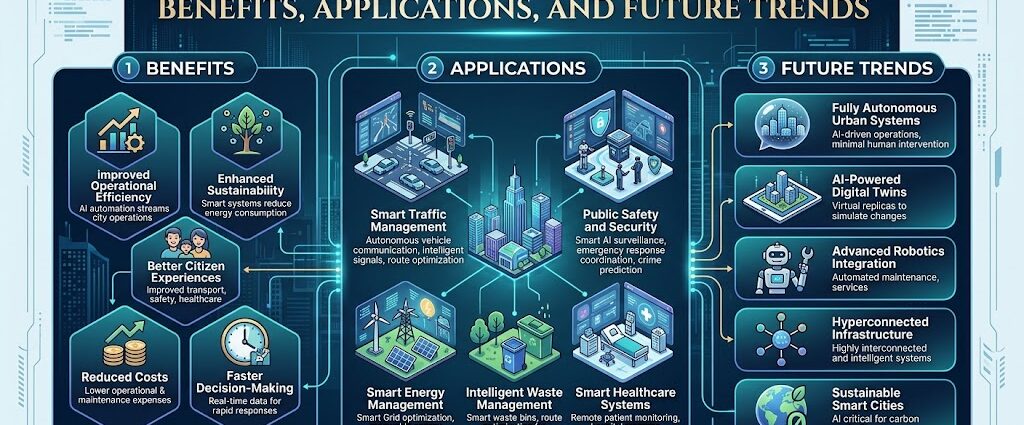
Key Applications of Agentic AI in Smart Cities
Smart Traffic Management
Traffic congestion is one of the biggest challenges in modern cities. Agentic AI helps optimize transportation systems and reduce traffic-related issues.
Intelligent Traffic Signals
AI agents adjust traffic lights based on real-time traffic flow.
Autonomous Vehicles
Self-driving cars communicate with AI infrastructure to improve road safety.
Route Optimization
AI systems recommend the fastest and most efficient travel routes.
Benefits of Smart Traffic Systems
- Reduced congestion
- Lower fuel consumption
- Faster emergency response
- Improved road safety
Public Safety and Security
Agentic AI significantly enhances urban security and emergency management.
AI Surveillance Systems
Smart cameras use AI to detect suspicious activities and threats.
Emergency Response Coordination
AI agents coordinate police, ambulance, and fire services efficiently.
Crime Prediction
Predictive analytics identify high-risk areas and prevent criminal activities.
Benefits for Public Safety
- Faster emergency response
- Reduced crime rates
- Improved urban monitoring
- Enhanced citizen security
Smart Energy Management
Energy efficiency is a major priority for sustainable smart cities.
Smart Grid Optimization
AI agents balance electricity supply and demand in real time.
Renewable Energy Integration
Agentic AI manages solar, wind, and renewable energy systems.
Predictive Maintenance
AI predicts failures in power infrastructure before outages occur.
Benefits of AI Energy Systems
- Reduced energy waste
- Lower operational costs
- Improved sustainability
- Better renewable energy utilization
Intelligent Waste Management
Smart cities are using Agentic AI to improve waste collection and recycling systems.
Smart Waste Bins
IoT-enabled bins notify AI systems when they need emptying.
Route Optimization for Waste Collection
AI determines the most efficient collection routes.
Recycling Automation
AI-powered systems improve waste sorting and recycling efficiency.
Waste Management Benefits
- Reduced operational costs
- Cleaner urban environments
- Lower fuel consumption
- Increased recycling rates
Smart Healthcare Systems
Healthcare services become more efficient and accessible with Agentic AI.
Remote Patient Monitoring
AI monitors patient health through connected medical devices.
Hospital Resource Management
AI agents optimize staffing, equipment, and appointment scheduling.
Disease Prediction and Prevention
AI analyzes health trends to predict outbreaks and health risks.
Healthcare Benefits
- Improved patient care
- Faster medical responses
- Reduced healthcare costs
- Better healthcare accessibility
Water Management Systems
Water conservation is essential for growing urban populations.
Smart Water Distribution
AI agents monitor water supply networks and detect leaks.
Water Usage Optimization
Systems analyze consumption patterns to reduce wastage.
Flood Prediction
AI predicts flooding risks using environmental and weather data.
Benefits of Smart Water Systems
- Reduced water waste
- Improved infrastructure efficiency
- Better disaster management
- Enhanced sustainability
Urban Planning and Infrastructure Development
City planners use Agentic AI to design more efficient urban environments.
Data-Driven Urban Planning
AI analyzes population growth, transportation needs, and infrastructure demands.
Smart Construction Management
AI optimizes construction schedules and resource allocation.
Environmental Monitoring
AI tracks pollution levels and environmental conditions.
Benefits for Urban Development
- Improved city planning
- Better infrastructure management
- Reduced construction costs
- Increased sustainability
Smart Public Transportation
Public transportation systems are becoming more intelligent through Agentic AI.
Real-Time Transit Optimization
AI adjusts bus and train schedules based on passenger demand.
Predictive Maintenance
AI monitors transportation infrastructure for maintenance needs.
Passenger Experience Enhancement
AI provides real-time updates and travel recommendations.
Transportation Benefits
- Reduced waiting times
- Improved passenger satisfaction
- Lower operational costs
- Enhanced mobility
Benefits of Agentic AI in Smart Cities
Improved Operational Efficiency
AI automation streamlines city operations and reduces inefficiencies.
Enhanced Sustainability
Smart systems reduce energy consumption and environmental impact.
Better Citizen Experiences
Residents enjoy improved transportation, safety, healthcare, and public services.
Reduced Costs
Automation lowers operational and maintenance expenses.
Faster Decision-Making
Real-time data analysis enables rapid responses to urban challenges.
Challenges of Implementing Agentic AI in Smart Cities
Data Privacy Concerns
Smart cities collect massive amounts of citizen data, raising privacy issues.
Cybersecurity Risks
Connected systems may become targets for cyberattacks.
High Implementation Costs
Building AI-powered urban infrastructure requires significant investment.
Ethical and Regulatory Issues
Governments must establish ethical frameworks for AI decision-making.
Integration Complexity
Combining multiple smart systems can be technically challenging.
Technologies Supporting Agentic AI in Smart Cities
Internet of Things (IoT)
IoT devices provide real-time data from urban environments.
Cloud Computing
Cloud infrastructure supports data storage and processing.
Edge Computing
Edge computing enables faster local data analysis.
Machine Learning
Machine learning improves AI accuracy and adaptability.
5G Connectivity
High-speed networks enable real-time communication between systems.
Future Trends of Agentic AI in Smart Cities
Fully Autonomous Urban Systems
Future cities may rely heavily on AI-driven operations with minimal human intervention.
AI-Powered Digital Twins
Cities will use virtual replicas to simulate urban planning and infrastructure changes.
Advanced Robotics Integration
Robotic systems will automate maintenance, transportation, and public services.
Hyperconnected Infrastructure
Urban systems will become more interconnected and intelligent.
Sustainable Smart Cities
AI will play a critical role in achieving carbon neutrality and environmental sustainability.
How Governments Can Successfully Implement Agentic AI
Develop Clear AI Strategies
Governments should define long-term smart city goals and AI policies.
Prioritize Cybersecurity
Strong security measures are essential for protecting urban systems.
Encourage Public-Private Partnerships
Collaboration with technology companies accelerates innovation.
Invest in Digital Infrastructure
Reliable connectivity and cloud infrastructure are critical for AI systems.
Promote Ethical AI Usage
Governments must ensure transparency and accountability in AI deployment.
The Economic Impact of Agentic AI in Smart Cities
Agentic AI is expected to generate significant economic benefits through increased productivity, reduced costs, and new business opportunities.
Job Creation
AI-driven industries will create new roles in technology, cybersecurity, and data analysis.
Increased Investment Opportunities
Smart city technologies attract investments from governments and private companies.
Improved Business Environments
Efficient urban systems support economic growth and innovation.
Conclusion
Agentic AI is revolutionizing smart cities by enabling intelligent automation, real-time decision-making, and efficient urban management. From traffic optimization and public safety to energy management and healthcare, AI-powered systems are transforming how cities operate and serve their citizens.
As urban populations continue to grow, the adoption of Agentic AI will become increasingly important for building sustainable, efficient, and connected cities. Although challenges such as cybersecurity, privacy, and infrastructure costs remain, the long-term benefits of smart city innovation are substantial.
Cities that embrace Agentic AI today will lead the future of digital transformation, sustainability, and urban intelligence.
FAQs
What is Agentic AI in smart cities?
Agentic AI refers to autonomous artificial intelligence systems that help manage and optimize smart city operations such as transportation, energy, healthcare, and public safety.
How does Agentic AI improve smart cities?
It improves efficiency, automates decision-making, reduces operational costs, and enhances citizen experiences through intelligent urban management.
What industries benefit from Agentic AI in smart cities?
Industries including transportation, healthcare, energy, construction, public safety, and waste management benefit significantly from Agentic AI.
What technologies support smart cities?
Technologies include IoT, cloud computing, machine learning, edge computing, 5G networks, and artificial intelligence.
What are the challenges of implementing Agentic AI in cities?
Challenges include cybersecurity risks, high infrastructure costs, data privacy concerns, and regulatory complexities.
How does Agentic AI help traffic management?
AI optimizes traffic signals, supports autonomous vehicles, and improves route planning to reduce congestion.
Can Agentic AI improve environmental sustainability?
Yes, it helps reduce energy consumption, optimize waste management, and support renewable energy integration.
What is the future of Agentic AI in smart cities?
The future includes fully autonomous urban systems, AI-powered infrastructure, advanced robotics, and sustainable smart city ecosystems.
Comments are closed, but trackbacks and pingbacks are open.