
The Growing Role of Agentic AI in Smart Cities
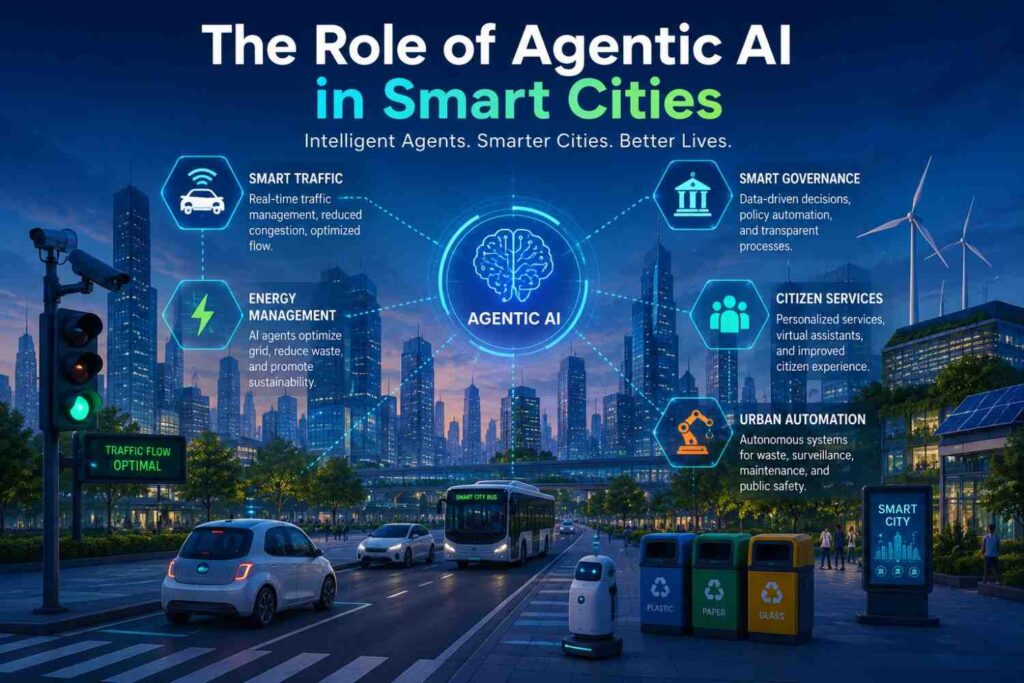
Smart cities are no longer only about sensors, mobile apps, CCTV systems, or digital dashboards. The next stage of urban innovation is about intelligent systems that can understand goals, study live data, recommend actions, and sometimes complete approved tasks automatically. This is where the Role of Agentic AI in Smart Cities becomes very important.
In simple terms, agentic AI means AI systems that can act like goal-driven digital agents. They can observe information, reason through options, use tools, connect with systems, and support decisions with less manual input. In a city, this can help manage traffic, energy, public safety, water networks, waste collection, emergency response, and citizen services.
In my view, agentic AI does not replace city officials, planners, engineers, or public service teams. Instead, it helps them respond faster, reduce manual workload, and make better decisions based on real-time data. When used responsibly, agentic AI can make cities more efficient, safer, cleaner, and more citizen-focused.
What Agentic AI Means in Smart Cities
Agentic AI in smart cities refers to AI systems that can work toward a specific urban goal by using data, reasoning, memory, and approved actions. Unlike basic automation, these systems do not only follow fixed rules. They can analyze changing conditions and support better decisions across connected city departments.
Agentic AI is more than simple automation
Traditional automation works on fixed instructions. For example, a traffic signal may change after a set number of seconds. Agentic AI can go further by checking live traffic flow, road incidents, weather conditions, and public transport movement before suggesting a better signal pattern.
This makes agentic AI useful for complex city environments where conditions change quickly. It can help city systems move from simple monitoring to intelligent action, while still keeping human teams in control.
AI agents connect city data with city action
Smart cities already collect data from many places, including IoT sensors, cameras, GPS systems, utility meters, transport networks, and citizen service portals. The problem is that this data often sits in separate systems.
AI agents can connect these systems and help city teams understand what is happening. For example, if a flood sensor detects rising water, an AI agent can check weather forecasts, drainage maps, traffic routes, and emergency resources before recommending a response plan.
The Role of Agentic AI in Smart Cities is to help urban systems move from passive data collection to active, goal-based decision support. It can assist with transport, energy, safety, maintenance, climate response, and citizen services by using AI agents that observe, reason, plan, and act within approved limits.
Why Smart Cities Need Agentic AI Now
Modern cities are growing quickly, and public systems are becoming harder to manage manually. Urban leaders need faster ways to understand problems, predict risks, and improve daily services. Agentic AI gives smart cities a practical way to manage complexity by turning live data into timely action.
Urban growth is creating pressure on city services
UN DESA’s World Urbanization Prospects 2025 tracks city, town, and rural population data for 237 countries or areas, with projections to 2050. This shows how important urban planning has become for governments, infrastructure teams, and public service providers.
As more people live in cities, pressure increases on roads, housing, energy, water, waste systems, hospitals, and emergency services. Agentic AI in smart cities can help city teams detect issues earlier and respond before small problems become major service failures.
Smart city systems need faster decisions
Many smart cities already use sensors, dashboards, apps, and public data systems. But dashboards alone do not solve problems. They show information, while humans still need to review it, understand it, and decide what to do.
Agentic AI can shorten this gap. It can monitor patterns, compare options, and recommend actions. In low-risk cases, it can also complete approved tasks, such as creating a repair ticket, updating a service record, or sending a public alert.
Facts and data table
| Fact or Framework | Why It Matters for Smart Cities |
|---|---|
| UN DESA provides urban population estimates and projections | Helps cities plan for future infrastructure and services |
| ITU defines smart sustainable cities around ICT, quality of life, efficiency, and sustainability | Shows that smart cities need both technology and public value |
| World Bank supports data-driven smart city planning and service delivery | Confirms the role of data in better urban management |
| NIST AI Risk Management Framework helps manage AI risks | Supports safer and more accountable AI adoption |
| OECD AI Principles promote trustworthy, human-centered AI | Helps cities align AI with rights, fairness, and public trust |
Key Use Cases of Agentic AI in Smart Cities
Agentic AI can support many smart city functions because cities are made of connected systems. Transport affects air quality, energy affects sustainability, public safety affects mobility, and infrastructure affects daily life. AI agents can help coordinate these areas instead of treating them as separate problems.
Intelligent traffic and mobility management
Traffic management is one of the most useful areas for smart city automation. AI agents can analyze live road data, traffic cameras, public transport schedules, ride-sharing demand, accidents, weather conditions, and event traffic.
Based on this data, they can suggest signal changes, recommend route diversions, prioritize emergency vehicles, and send travel alerts to citizens. This can help reduce congestion, improve road safety, and make public transport more reliable.
Energy optimization and smart buildings
Cities use large amounts of energy for buildings, streetlights, public transport, water systems, and public facilities. Agentic AI can help city teams understand energy demand and reduce waste.
For example, AI agents can adjust lighting based on movement, identify buildings with unusual energy use, recommend maintenance for heating or cooling systems, and support renewable energy planning. This is important for cities that want to lower costs and improve sustainability.
Predictive maintenance for infrastructure
Infrastructure problems often become expensive because cities discover them too late. Agentic AI can support predictive maintenance by analyzing sensor data, repair history, weather impact, vibration readings, water pressure, and public complaints.
If an AI agent detects unusual patterns in a water pipe network or bridge sensor, it can alert maintenance teams before a breakdown happens. This helps cities reduce emergency repairs, improve safety, and use maintenance budgets more wisely.
How Agentic AI Improves Citizen Services
Citizen services are one of the most practical areas where The Role of Agentic AI in Smart Cities becomes visible. Residents want faster responses, clearer communication, and easier access to government services. AI agents can help cities deliver better support without making citizens wait through slow manual processes.
Faster complaint handling and service requests
Many cities receive thousands of complaints about streetlights, roads, garbage, water leaks, traffic, noise, and public facilities. Without automation, these requests can be delayed or sent to the wrong department.
Agentic AI can read a complaint, identify the issue, check the location, compare it with similar reports, assign it to the correct department, and update the citizen. This makes the service process faster, more organised, and easier to track.
Personalized and timely public alerts
Agentic AI can also help cities communicate with citizens at the right time. For example, if a road is closed, a public transport route is delayed, or a flood warning is active, AI agents can send relevant alerts to affected areas.
This is better than sending the same message to everyone. Location-aware and context-aware alerts can help citizens make safer and smarter decisions during daily travel or emergency situations.
Better accessibility and inclusion
Smart cities should serve everyone, including older adults, people with disabilities, low-income communities, and people who speak different languages. AI agents can support voice-based services, multilingual chat, simple digital forms, and accessibility-focused navigation.
However, inclusion must be planned carefully. City teams should test AI services across different communities to make sure the system does not favor only digitally active or high-income residents.
Governance and Risks of Agentic AI in Smart Cities
Agentic AI can improve smart cities, but it also creates serious responsibilities. Cities deal with public safety, personal data, transport access, policing, housing, utilities, and emergency response. Because these areas affect real people, AI systems must be transparent, secure, fair, and properly supervised.
Human oversight must remain central
Autonomous AI systems should not make high-impact public decisions without human review. For example, decisions linked to policing, welfare, housing, surveillance, or emergency response must include clear accountability.
A practical approach is to create different action levels. Low-risk tasks, such as creating a maintenance ticket, may be automated. Medium-risk tasks may need staff review. High-risk tasks should require human approval before any action is taken.
Privacy and data protection are critical
Smart cities collect sensitive information through cameras, sensors, apps, service requests, public Wi-Fi, and connected infrastructure. If agentic AI uses this data without proper controls, it can create privacy problems.
Cities should collect only the data they need, define retention periods, secure databases, limit access, and explain how AI systems use public information. Citizens should know when AI is involved and how their data is protected.
Governance checklist for responsible use
| Governance Area | What City Leaders Should Do |
|---|---|
| Human oversight | Define which actions need staff approval |
| Privacy | Use only necessary data and protect personal information |
| Bias testing | Test AI outputs across different communities |
| Cybersecurity | Secure sensors, APIs, models, and city platforms |
| Transparency | Explain where AI is used in public services |
| Audit logs | Record AI recommendations, actions, and human overrides |
| Accountability | Assign responsibility for AI decisions and failures |
How Cities Can Implement Agentic AI Step by Step
Cities should not adopt agentic AI only because it is a trending technology. The best approach is to start with a clear problem, test a small pilot, measure results, and then scale carefully. This reduces risk and helps public teams build trust in the system.
Start with one clear city problem
The first step is to choose one practical use case. This could be traffic congestion, waste collection delays, water leak detection, slow complaint handling, energy waste, or emergency alert management.
A clear use case helps city teams define success. For example, if the problem is complaint handling, success may mean faster response times, fewer duplicate tickets, and higher citizen satisfaction.
Build a safe data and integration layer
Agentic AI needs access to city systems, but this access must be controlled. City teams should connect only the data sources needed for the pilot, such as GIS maps, sensor data, service records, traffic feeds, or weather data.
Role-based permissions, API security, data quality checks, and audit logs should be added before AI agents are allowed to recommend or complete actions. This protects public systems from misuse and errors.
Pilot, measure, review, and scale
After the data layer is ready, cities should run a limited pilot. The pilot should include technical testing, staff training, citizen feedback, privacy review, and performance measurement.
| Step | Implementation Action |
|---|---|
| Step 1 | Choose one high-value urban problem |
| Step 2 | Identify required data sources |
| Step 3 | Define what the AI agent can and cannot do |
| Step 4 | Add human approval for sensitive actions |
| Step 5 | Run a small pilot in one department or district |
| Step 6 | Measure accuracy, speed, cost, and citizen impact |
| Step 7 | Review risks before scaling citywide |
Future of Agentic AI in Smart Cities
The future of smart cities will depend on how well governments combine technology with public trust. Agentic AI can make cities more responsive, but only if it is used with clear goals, strong governance, and human responsibility. The future is not about replacing city workers; it is about giving them better tools.
Digital twins and agentic AI will work together
Digital twins are virtual models of real-world systems. In smart cities, they can represent roads, buildings, utilities, transport systems, or entire districts. When combined with agentic AI, digital twins can help cities test actions before applying them in real life.
For example, a city may simulate a traffic diversion, flood response, or energy-saving plan before making changes. AI agents can study the simulation and suggest safer or more efficient options.
Multi-agent systems will coordinate city departments
In the future, cities may use multiple AI agents that specialize in different tasks. One agent may manage traffic, another may monitor energy, another may support public safety, and another may handle citizen service requests.
These agents can work together under a central governance model. This can improve coordination between departments that often operate separately.
Public trust will decide adoption
Technology alone will not make a city smart. Citizens must trust that AI systems are fair, secure, explainable, and used for public benefit. If people feel watched, excluded, or unfairly treated, adoption will fail.
That is why responsible AI in cities must include public communication, clear rules, independent review, and strong accountability. The Role of Agentic AI in Smart Cities will grow only when people believe it serves them.
Frequently Asked Questions
What is agentic AI in smart cities?
Agentic AI in smart cities means AI agents that can observe data, reason through options, plan tasks, and support or perform approved actions. It helps manage transport, energy, safety, maintenance, citizen services, and emergency response more efficiently.
How is agentic AI different from normal AI?
Normal AI often answers questions or analyses information. Agentic AI can work toward a goal, use tools, remember context, make plans, and act within set limits. This makes it more useful for complex city operations.
Can agentic AI help reduce traffic congestion?
Yes, agentic AI can help reduce congestion by analyzing live traffic data, accidents, public transport movement, weather, and road capacity. It can suggest signal changes, route diversions, and alerts for better mobility management.
Is agentic AI safe for public services?
Agentic AI can be safe when cities use strong governance, privacy controls, cybersecurity, human oversight, and audit logs. It becomes risky when used without accountability, especially in sensitive areas like surveillance or emergency decisions.
What data does agentic AI need in a smart city?
It may use traffic feeds, IoT sensor data, GIS maps, service requests, weather alerts, energy data, public transport data, and maintenance records. Cities should use only necessary data and protect personal information.
Will agentic AI replace city workers?
No, agentic AI should support city workers rather than replace them. It can handle repetitive monitoring, routing, and analysis, while humans continue to manage planning, judgement, public communication, and accountability.
Conclusion
The Role of Agentic AI in Smart Cities is to help cities become more responsive, efficient, and citizen-focused. It connects data with action and helps public teams manage traffic, energy, infrastructure, safety, climate risks, and citizen services with better speed and accuracy.
The biggest benefit is not only automation. The real value is smarter coordination. Agentic AI can help city departments work together, predict problems earlier, and improve daily life for residents. But cities must use it responsibly with privacy, fairness, cybersecurity, transparency, and human oversight.
In my view, the smartest cities will not be the ones that automate everything. They will be the ones that use AI agents carefully, explain decisions clearly, protect citizens, and keep humans responsible for public outcomes.
Comments are closed, but trackbacks and pingbacks are open.