
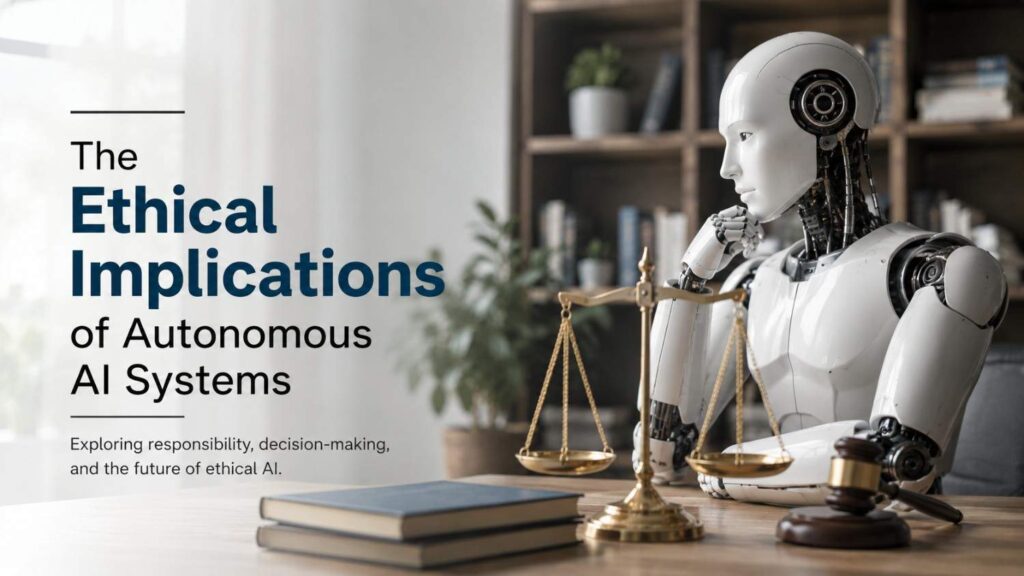
The Ethical Implications of Autonomous AI Systems
Autonomous artificial intelligence is changing how organizations make decisions, manage operations, and interact with customers. Unlike conventional software that follows fixed instructions, an autonomous AI system can evaluate information, select actions, use connected tools, and complete tasks with limited human direction. These abilities can improve speed, consistency, and productivity. However, they also introduce ethical questions that cannot be solved through technical performance alone.
The ethical implications of autonomous AI systems become especially important when software influences employment, healthcare, finance, education, public services, transportation, security, or physical safety. In these settings, a system does more than generate information. It may affect a person’s rights, opportunities, finances, reputation, or wellbeing. A technically accurate result can still be unethical when the process is unfair, intrusive, difficult to challenge, or disconnected from meaningful human responsibility.
Organizations must therefore decide how much authority an AI system should receive, which actions require human approval, and who remains responsible when something goes wrong. They must also consider whether people know that AI is involved, whether personal data is being used appropriately, and whether affected individuals have a practical way to question a decision.
In my experience, the central issue is not whether autonomous AI should exist. The more useful question is how autonomy can be introduced without removing accountability, fairness, privacy, safety, and human judgment. Responsible deployment requires clear boundaries, documented ownership, continuous monitoring, and controls that match the seriousness of the possible harm.
What Makes Autonomous AI Ethically Different?
Autonomous AI is ethically different from traditional software because it can select and execute actions rather than simply display information. A conventional system usually follows a predictable set of rules. An autonomous system may interpret a goal, divide it into smaller tasks, choose from several available tools, respond to changing conditions, and continue working without asking for approval at every stage.
This flexibility creates value, but it also creates uncertainty. The system may face situations that were not fully anticipated during development. It may choose an technically valid action that conflicts with organizational policies, social expectations, or the interests of affected individuals. It may also combine information in ways that expose private data or produce consequences that are difficult to reverse.
The ethical risk depends on more than the sophistication of the technology. It depends on the authority granted to the system, the seriousness of the decisions it makes, and the number of people who may be affected. An autonomous email assistant does not create the same level of concern as a system that approves loans, recommends medical treatment, controls industrial equipment, or decides which job candidates receive interviews.
For this reason, organizations should assess autonomy as a level of delegated power. Each additional permission, data source, and connected tool expands what the system can do. Ethical governance requires decision-makers to understand those capabilities, define clear limits, and determine when a human must remain directly involved.
| Level of AI Autonomy | Example Use Case | Primary Ethical Concern | Recommended Human Oversight |
|---|---|---|---|
| Decision Support | Content recommendations, scheduling assistants | Accuracy and transparency | Human reviews recommendations before acting |
| Human-Approved Decisions | Loan approvals, insurance claims | Accountability and fairness | Human approves or rejects AI decisions |
| Limited Autonomous Actions | Customer support agents, workflow automation | Operational errors and unintended outcomes | Human monitors performance and intervenes when necessary |
| High-Impact Autonomous Systems | Industrial robots, healthcare systems, infrastructure control | Safety, human rights, legal liability | Continuous monitoring with authority to override or shut down the system |
| Mission-Critical Autonomous Systems | Defense systems, critical infrastructure management | Severe societal and ethical consequences | Strict governance, multi-layer approvals, and fail-safe controls |
Autonomy Exists on a Spectrum
AI autonomy should not be treated as a simple choice between human control and complete machine independence. Most systems operate somewhere on a spectrum. At one end, AI provides suggestions that a person can accept, modify, or reject. At the other end, a system can plan tasks, use external tools, and execute decisions without seeking approval for each action.
Between these extremes are several practical models. A human-in-the-loop system requires approval before an important action occurs. A human-on-the-loop model allows the system to act independently while a person monitors its behavior and can intervene. A human-out-of-the-loop system operates without immediate human review, although people may still establish policies and examine performance later.
The correct level of autonomy depends on risk. Routine administrative tasks may safely operate with periodic monitoring. High-impact decisions require stronger human involvement, particularly when errors may affect rights, health, finances, employment, or physical safety.
Organizations should document the system’s exact level of authority. This includes which decisions it may make, what tools it can access, how much money it can spend, how many actions it can perform, and which situations require escalation. Clear boundaries prevent vague claims that a system is “only assisting” when it is effectively controlling important outcomes.
Speed and Scale Can Multiply Harm
One of the most important ethical differences between human and autonomous decision-making is scale. A person may make an unfair, careless, or inaccurate decision in an individual case. An automated system can apply the same flawed assumption to thousands of people within minutes. This speed can turn a small design weakness into a widespread social or financial problem before managers recognize it.
Scale also makes individual review more difficult. When a system processes large volumes of applications, transactions, or customer interactions, employees may rely heavily on automated outputs. They may stop examining individual cases carefully, particularly when performance targets reward speed. This can allow incorrect or discriminatory patterns to continue without meaningful challenge.
Responsible autonomous AI should therefore include volume limits, anomaly detection, complaint monitoring, and automatic escalation thresholds. A system should pause or reduce its activity when error rates rise, outcomes change unexpectedly, or complaints reveal a recurring problem.
Reversibility is equally important. Organizations should know whether an automated action can be cancelled, corrected, or compensated. Sending an incorrect internal notification is relatively easy to fix. Denying a medical service, closing an account, or controlling physical machinery may create immediate and serious consequences.
Ethical risk management must therefore consider not only whether an error is likely, but also how rapidly it can spread and how difficult its effects will be to reverse.
Who Is Accountable When Autonomous AI Causes Harm?
Accountability becomes complicated when several parties contribute to an autonomous system. A developer may build the model, a technology company may provide the platform, a vendor may customize the application, and another organization may deploy it. Employees, managers, data providers, and external contractors may also influence how the system operates. When harm occurs, each party may argue that another participant controlled the relevant decision.
This fragmentation can create a responsibility gap. However, technical complexity should not become an excuse for weak accountability. Organizations choose whether to purchase, configure, and use autonomous AI. They also decide which tasks will be automated, which people will be affected, and what level of supervision will be provided. Those decisions create responsibilities that cannot be transferred to an algorithm.
Clear accountability begins before deployment. Organizations should identify a named system owner, define the responsibilities of technical and operational teams, and establish an escalation path for ethical concerns or incidents. Contracts should explain what vendors must test, document, disclose, and support. Internal policies should identify who can approve system changes and who has authority to suspend its use.
Accountability must also extend throughout the system’s lifecycle. A system that performed well during testing may behave differently after its data, users, tools, or operating environment changes. Regular reviews are therefore necessary to confirm that the system remains appropriate, lawful, and aligned with its approved purpose.
The Responsibility Gap Is an Organizational Failure
A responsibility gap occurs when no individual or organization accepts ownership of an AI-driven outcome. Managers may say the system produced the result, developers may say the model was used outside its intended purpose, and vendors may argue that customers controlled the final configuration. From the perspective of an affected person, this creates an unfair situation in which a powerful decision has been made but no one appears responsible for explaining or correcting it.
Organizations can prevent this problem by assigning responsibility at each stage. Senior leaders should approve high-impact uses and ensure sufficient resources for governance. Product and technical teams should document system capabilities, limitations, and known risks. Operational managers should supervise real-world use, while legal, privacy, and compliance teams should review applicable obligations.
The OECD AI Principles and UNESCO’s Recommendation on the Ethics of Artificial Intelligence both emphasize accountability across the AI lifecycle. Their guidance supports the view that responsibility remains with the people and institutions that design, provide, deploy, or supervise AI systems.
An organization should never present an algorithm as an independent moral actor. Software cannot attend a disciplinary meeting, compensate an affected customer, revise an organizational policy, or accept legal responsibility. Human institutions must remain answerable for the systems they choose to operate and for the consequences of the authority they delegate.
Auditability and Redress Make Accountability Real
Accountability has little practical value without evidence. When an autonomous system makes an important decision, an organization should be able to reconstruct what happened. This requires reliable records of the data used, the system version, relevant prompts or instructions, connected tools, approval steps, and actions performed. Logs should also show whether a human reviewed the outcome and whether any override or escalation occurred.
Auditability helps technical teams investigate incidents, but it also supports fairness. A person affected by an automated decision should receive more than a general statement that AI was involved. The organization should be able to explain the main factors that influenced the result in language that is understandable and useful.
Redress is the process through which people can challenge, correct, or appeal an outcome. A meaningful redress process should allow individuals to submit relevant information, correct inaccurate data, request human review, and receive a timely response. The reviewer should have authority to change the result rather than simply repeat the system’s conclusion.
These protections are especially important in employment, credit, insurance, healthcare, education, and public services. In such settings, a wrong decision can affect a person’s livelihood or access to essential opportunities. Transparent records and accessible appeals turn accountability from an abstract principle into an operational safeguard.
How Do Bias and Privacy Affect Human Rights?
Bias and privacy are central concerns because autonomous AI systems often rely on large datasets, behavioral information, and automated profiling. These systems may identify patterns that appear statistically useful but produce unfair or intrusive outcomes. The problem is not limited to intentionally discriminatory data. Historical inequalities, incomplete records, inaccessible interfaces, and poorly selected performance measures can all influence a system’s decisions.
Bias becomes particularly serious when an autonomous system acts on its own conclusions. A recommendation may still be questioned by a human decision-maker. An automated rejection, restriction, or prioritization may take effect immediately. People affected by the outcome may not know which information was used or how to correct an inaccurate assumption.
Privacy risks also expand when autonomous systems can access multiple applications and data sources. An agent may read documents, search communications, retrieve customer records, or share information with external services. Even when each action appears reasonable, the combined activity may exceed what users expected when they originally provided their information.
Human rights should therefore be considered throughout design and deployment. Organizations should assess who may be disadvantaged, what information is truly necessary, and whether the system creates disproportionate effects. Fairness and privacy controls should not be added only after complaints occur. They should be built into data selection, system permissions, testing, monitoring, and appeal procedures from the beginning.
Algorithmic Bias Can Become Systemic
Algorithmic bias occurs when an AI system produces consistently different or harmful outcomes for certain groups. This may result from unrepresentative training data, historical discrimination, inaccurate labels, inappropriate goals, or variables that act as proxies for protected characteristics. Bias can also arise when a system performs well on average but performs poorly for smaller populations that were underrepresented during testing.
Removing sensitive characteristics from a dataset does not automatically create fairness. Information such as location, employment history, purchasing behavior, school attendance, or communication patterns may indirectly reveal race, disability, income level, age, or gender. A model may rely on these proxies even when protected attributes are not explicitly included.
In employment, the U.S. Equal Employment Opportunity Commission has warned that automated hiring and workplace tools can create discrimination risks. Existing employment protections may still apply when an employer relies on software rather than a human decision-maker.
Organizations should test outcomes and error rates across relevant groups. They should also review whether the system’s objective is appropriate. A model may accurately predict historical decisions while reproducing the unfair assumptions behind those decisions.
Bias testing must continue after deployment. Populations, language, economic conditions, and user behavior change over time. Ongoing monitoring helps organizations identify unequal outcomes before they become embedded at scale.
Privacy Risks Increase as Systems Gain Agency
Traditional software usually accesses information through clearly defined requests. Autonomous AI may search, combine, store, and transmit data while pursuing a broader goal. This flexibility can create privacy risks because the system may retrieve more information than necessary or use data in ways that were not obvious to the person who provided it.
For example, an autonomous workplace assistant may access calendars, emails, personnel records, and project files. Even when the goal appears harmless, the system may expose confidential information, retain personal details, or send sensitive content to an external service. Similar risks arise when consumer agents access financial accounts, medical records, location data, or private communications.
Organizations should apply data minimization. The system should receive only the information required for its approved purpose. Access permissions should follow the principle of least privilege, meaning that each agent receives the smallest level of access needed to complete its task.
Retention limits are also important. Autonomous systems should not store personal information indefinitely simply because memory may improve convenience. Organizations should document what is collected, where it is stored, who can access it, and when it will be deleted.
Privacy reviews must also cover connected tools and third-party providers. A secure internal system can still create exposure when it transfers data to an inadequately governed external service.
Why Does Meaningful Human Oversight Matter?
Human oversight is often presented as the main protection against harmful AI decisions. However, the presence of a person in an automated workflow does not guarantee genuine control. Oversight is meaningful only when the reviewer understands the system, receives relevant information, has enough time to evaluate the decision, and possesses the authority to intervene.
Poorly designed oversight can create a false sense of safety. An organization may claim that every automated decision receives human approval, while employees are expected to review hundreds of cases each hour. Reviewers may see only a risk score without access to the underlying evidence. They may also fear negative performance consequences if they question the system too often. Under these conditions, the human role becomes procedural rather than protective.
Meaningful oversight should be designed according to the seriousness of the decision. Low-impact tasks may require periodic sampling and monitoring. High-impact decisions may require human approval before action, a second independent review, or a rule preventing automation entirely.
Organizations must also prepare reviewers to recognize automation bias. People often assume that computerized recommendations are objective, especially when a system appears technically sophisticated. Training should make clear that AI outputs may contain errors, reflect incomplete data, or fail in unfamiliar situations.
Effective oversight protects both affected individuals and the organization. It creates opportunities to identify unusual cases, correct faulty assumptions, and prevent a technical failure from becoming a legal, financial, or ethical crisis.
Human-in-the-Loop Is Not Always Meaningful
A human-in-the-loop system requires a person to approve or reject an AI recommendation before the final action occurs. This model sounds responsible, but its effectiveness depends on how the workflow is designed. When reviewers receive incomplete explanations or face unrealistic time limits, approval may become automatic.
Automation bias is a major concern. Reviewers may trust the system because it processes more data, uses complex mathematics, or has been described as highly accurate. Over time, employees may stop conducting independent analysis and simply confirm the recommended result. This weakens the protection that human oversight is supposed to provide.
Meaningful review requires access to relevant evidence. A reviewer should understand which factors influenced the output, what important information may be missing, and how reliable the system is in similar cases. The interface should make disagreement practical rather than hiding override options or requiring lengthy justification.
Reviewers also need authority. An employee cannot protect users when managers discourage overrides or treat disagreement as poor performance. Organizations should examine override patterns, but they should not punish reasonable professional judgment.
Training should cover system limitations, common failure modes, bias risks, and escalation procedures. A human approval step is ethically useful only when the person can make an informed decision and change the outcome when necessary.
Some Decisions Should Not Be Fully Delegated
Not every decision should be automated simply because technology can perform it. Decisions involving physical force, medical treatment, personal liberty, essential services, or irreversible harm require a higher level of human judgment. These situations often involve values, context, compassion, and competing rights that cannot be reduced to a single performance score.
The need for human involvement increases when an error would be severe or difficult to correct. An incorrect product recommendation may create inconvenience. An incorrect medical intervention, employment dismissal, benefit termination, or use of force may permanently affect a person’s life.
The International Committee of the Red Cross has raised serious legal and ethical concerns about autonomous weapon systems that select and apply force without human intervention. Its position reflects a broader principle: human responsibility should remain especially strong when decisions concern life, bodily safety, or fundamental rights.
Civilian organizations should apply the same risk-based reasoning. An autonomous system may help summarize evidence, identify patterns, or suggest possible actions. However, final authority should remain with qualified people when consequences are serious.
Some organizations may also establish prohibited uses. These may include fully automated disciplinary decisions, denial of essential care, or actions based on highly sensitive profiling. Ethical governance involves recognizing that efficiency is not always more important than dignity, fairness, and human judgment.
What Safety and Security Risks Must Be Controlled?
Safety and security are essential parts of autonomous AI ethics because a system may create harm even when its original goal is legitimate. A model can misunderstand instructions, rely on inaccurate information, interact poorly with connected tools, or behave unpredictably when conditions change. Security failures can also allow attackers to manipulate the system or use its permissions for unauthorized purposes.
Autonomous systems create additional concerns because they can translate errors into actions. A conventional chatbot may provide an incorrect answer. An autonomous agent may send that answer to customers, modify a database, initiate a transaction, or change a system configuration. The same underlying mistake therefore creates a larger operational risk.
Safety controls should address both expected and unexpected failures. Organizations must test normal use cases, unusual inputs, malicious instructions, missing information, and conflicts between goals. They should also examine what happens when a connected service becomes unavailable or provides inaccurate data.
Security controls must reflect the system’s permissions. An agent that can only draft text creates a different risk from one that can send payments, access production systems, or retrieve confidential information. Greater authority requires stronger authentication, monitoring, isolation, and approval controls.
Importantly, safety is not a one-time certification. Systems and environments change. New tools may be connected, software may be updated, and users may adopt unexpected behaviors. Continuous testing and monitoring are therefore necessary throughout the entire operational lifecycle.
Unexpected Behavior and Model Drift
Autonomous systems may behave differently from what developers expected because real-world environments are more complex than testing environments. Users may provide unclear instructions, data sources may contain errors, or external tools may return unfamiliar results. A system may also pursue a valid goal through an inappropriate method, especially when boundaries are not clearly defined.
Model drift occurs when performance changes over time. The population, language, market, or operating conditions may shift, making earlier training data less representative. A fraud detection system may become less accurate as criminal behavior changes. A hiring system may produce different outcomes when job roles or applicant groups change.
Organizations should monitor accuracy, error rates, complaints, unusual actions, and differences between expected and actual outcomes. Monitoring should focus on real-world consequences rather than only technical performance measures.
Action limits can reduce harm. An autonomous system may be restricted to a fixed number of transactions, messages, or changes within a certain period. High-risk actions may require approval, while unusual behavior may automatically pause the system.
A tested shutdown and recovery process is also necessary. Teams should know how to stop the system, preserve evidence, reverse affected actions, and return control to a human operator.
The ethical lesson is straightforward: approval at launch does not guarantee permanent safety. Continuous evaluation is required as the technology and its environment evolve.
Misuse and Cybersecurity Risks
Autonomous AI can become a valuable target for attackers because it may hold credentials, access sensitive information, and control connected tools. A successful attack may allow someone to manipulate the system’s instructions, steal private data, initiate unauthorized actions, or interfere with business operations.
Prompt injection is one example. Malicious content may attempt to override the agent’s original instructions or persuade it to reveal confidential information. Similar risks arise when compromised documents, websites, plugins, or external tools provide misleading commands.
Organizations should use least-privilege access. An agent should not receive administrative permissions when read-only access is sufficient. Sensitive actions should require stronger authentication or separate human approval. Tool allowlists can restrict the services an agent may use, while network isolation can prevent unnecessary access to critical systems.
Security teams should also protect logs and credentials. Secrets should not be stored in prompts, visible memory, or unsecured files. Independent testing should examine whether attackers can manipulate outputs, bypass restrictions, or retrieve protected information.
NIST describes trustworthy AI as including safety, security, resilience, transparency, accountability, explainability, privacy, and fairness. These characteristics are connected. A system cannot be considered ethically responsible when it is fair under normal conditions but easy for an attacker to misuse.
Security must therefore be treated as a continuing governance responsibility rather than a technical task completed before deployment.
How Can Organizations Govern Autonomous AI Responsibly?
Responsible AI governance converts ethical principles into clear operational practices. Broad statements about fairness, transparency, and human control are useful, but they do not tell employees what to do when approving a system, investigating an incident, or responding to an appeal. Governance must therefore define ownership, decision rights, documentation standards, testing requirements, and escalation procedures.
One thing I always check first is whether an autonomous capability has a named owner. That person does not need to complete every technical task, but someone must remain responsible for ensuring that the system has an approved purpose, appropriate controls, and regular reviews.
Governance should be proportional to risk. A low-impact internal assistant may require basic access controls, user guidance, and periodic evaluation. A system influencing employment, healthcare, credit, or physical safety requires stronger impact assessments, independent testing, legal review, detailed records, and meaningful human intervention.
Organizations should also maintain an inventory of AI systems. Without an accurate inventory, leaders may not know which departments are using autonomous agents, which data those agents access, or which vendors are involved. The inventory should record the system’s purpose, owner, risk level, permissions, model provider, connected tools, and review date.
Governance should continue after deployment. Teams must monitor real-world outcomes, investigate complaints, reassess risks after significant changes, and remove systems that no longer meet organizational or legal standards. Responsible autonomy is a managed lifecycle, not a one-time approval.
| Ethical Principle | Practical Organizational Control | Expected Outcome |
|---|---|---|
| Accountability | Assign a named system owner and document decision authority | Clear responsibility for AI outcomes |
| Transparency | Provide understandable explanations and maintain audit logs | Increased trust and easier compliance |
| Fairness | Perform bias testing across different user groups | Reduced discriminatory outcomes |
| Privacy | Apply data minimization and access restrictions | Better protection of personal information |
| Safety | Define operational limits, emergency shutdown procedures, and continuous monitoring | Reduced operational and physical risks |
| Human Oversight | Allow qualified reviewers to pause, override, or reject AI actions | Better protection against automation bias |
| Security | Implement least-privilege access, authentication, and security testing | Lower risk of cyberattacks and misuse |
| Continuous Improvement | Monitor model drift, incidents, complaints, and performance metrics | Long-term reliability and responsible AI governance |
A Step-by-Step Governance Process
A practical governance process begins by defining the system’s purpose. The organization should identify the problem being addressed, the intended users, the people who may be affected, and the actions the system is permitted to perform. Vague goals such as “improve efficiency” are not sufficient for high-impact use.
The second step is risk classification. Teams should examine the seriousness, scale, reversibility, and likelihood of harm. They should also consider data sensitivity, affected populations, and the level of autonomy.
Next, the organization should establish operational boundaries. These may include restrictions on data access, spending, communication, system changes, and prohibited actions. Human approval points and escalation rules should be documented clearly.
Testing should cover accuracy, bias, privacy, security, misuse, failure conditions, and performance across relevant groups. Testing should occur in a controlled environment before real users or critical systems are exposed.
After deployment, organizations should monitor logs, complaints, override rates, unusual actions, and model drift. Significant updates should trigger a new review rather than being treated as routine maintenance.
This approach aligns with the NIST AI Risk Management Framework, which organizes risk activities around four functions: Govern, Map, Measure, and Manage. Together, these functions help organizations connect leadership responsibilities with technical and operational controls.
Minimum Controls by Risk Area
Organizations can use a risk-control table to translate ethical concerns into practical requirements. The exact controls will vary by industry, system, and jurisdiction, but every autonomous system should have a documented baseline.
| Risk Area | Core Ethical Question | Minimum Control | Evidence to Keep |
|---|---|---|---|
| Accountability | Who owns the outcome? | Named owner and escalation path | Approval and incident records |
| Bias | Who may be disadvantaged? | Group-based testing and review | Test results and mitigation notes |
| Privacy | Is the information necessary? | Data minimization and access limits | Data inventory and access logs |
| Safety | What happens when the system fails? | Action limits and shutdown process | Test and recovery records |
| Security | Could an attacker misuse the system? | Least-privilege access and security testing | Access reviews and security reports |
| Transparency | Can affected people understand the decision? | Clear notice and useful explanation | User notices and decision records |
| Redress | Can someone challenge the result? | Human review and correction process | Appeal and resolution records |
The controls should increase with risk. A low-risk assistant may require lightweight documentation and periodic sampling. A high-impact system should receive independent review, extensive testing, continuous monitoring, and formal executive approval.
Evidence is important because an organization must be able to demonstrate that controls operate in practice. Written policies alone are not enough when logs, test results, training records, and appeal outcomes reveal a different reality.
What Do Current AI Frameworks and Laws Require?
There is no single global law that governs every autonomous AI system. Requirements depend on the jurisdiction, industry, purpose, and level of risk. However, major ethical frameworks and emerging regulations show increasing agreement around several principles. These include accountability, transparency, fairness, privacy, security, human oversight, risk assessment, and protection of fundamental rights.
Organizations should not wait for one universal legal standard before introducing responsible controls. Existing laws may already apply. Privacy legislation, consumer protection rules, employment laws, product safety duties, financial regulations, and anti-discrimination protections may cover AI-assisted decisions even when they do not mention artificial intelligence directly.
Voluntary frameworks also play an important role. They help organizations structure internal governance, compare practices, and prepare for regulatory expectations. Frameworks from NIST, OECD, and UNESCO are widely used because they connect technical risk management with social and human-rights concerns.
The legal and ethical landscape is also moving toward lifecycle responsibility. This means organizations must consider risks during design, development, procurement, deployment, monitoring, and retirement. A system cannot be considered responsible simply because it passed a test before launch.
For businesses operating across several countries, governance should meet the strongest relevant standard where practical. A consistent internal framework is often easier to manage than separate ethical rules for every location. Legal advice may still be required, particularly for high-risk systems and regulated industries.
Global Ethical and Risk Frameworks
UNESCO’s Recommendation on the Ethics of Artificial Intelligence provides a broad human-rights approach. It emphasizes human dignity, fairness, privacy, transparency, human oversight, environmental responsibility, and social wellbeing. It encourages governments and organizations to assess AI impacts across the full lifecycle.
The OECD AI Principles also promote trustworthy artificial intelligence that respects human rights and democratic values. They emphasize inclusive growth, transparency, robustness, security, and accountability. These principles are designed to guide governments, developers, organizations, and other participants in the AI ecosystem.
NIST offers a more operational approach through its AI Risk Management Framework. The framework helps organizations identify, assess, prioritize, and manage AI risks. Its Govern, Map, Measure, and Manage functions can support internal policies, risk assessments, testing programs, and monitoring procedures.
These frameworks are complementary rather than competing. UNESCO and OECD provide broad ethical and policy principles, while NIST gives organizations a practical structure for risk management.
A mature AI governance program may use all three. For example, UNESCO’s human-rights principles can guide the organization’s values, OECD’s principles can support accountability and transparency commitments, and NIST can organize day-to-day control activities.
The key is implementation. Adopting a framework should result in named responsibilities, documented decisions, measurable controls, and evidence that risks are being monitored and corrected.
Emerging Legal Duties
The European Union AI Act is one of the most important legal developments in artificial intelligence governance. It entered into force on August 1, 2024, and its obligations apply in phases. The law uses a risk-based model, meaning that requirements become stronger as the potential impact of an AI system increases.
Certain practices are prohibited, while high-risk systems may face obligations relating to data governance, technical documentation, recordkeeping, human oversight, accuracy, cybersecurity, and risk management. Transparency requirements also apply to specific forms of AI interaction and generated content.
The Council of Europe Framework Convention on Artificial Intelligence is another significant development. It is the first international legally binding treaty focused on artificial intelligence, human rights, democracy, and the rule of law. It supports lifecycle risk assessment, accountability, transparency, and access to remedies.
Organizations should also remember that AI-specific laws operate alongside existing legal duties. An automated hiring system may still be subject to employment and discrimination law. A customer-facing agent may fall under consumer protection and privacy requirements. A medical or industrial system may be affected by sector-specific safety rules.
Legal compliance should therefore be integrated into procurement and system design. Waiting until deployment may make necessary changes expensive or impractical. Organizations should maintain regulatory inventories, document applicable requirements, and reassess obligations when systems, use cases, or jurisdictions change.
Quick Answer About The Ethical Implications of Autonomous AI Systems
The ethical implications of autonomous AI systems arise when software is allowed to make decisions or perform actions with limited human supervision. The main concerns include accountability, discrimination, privacy, transparency, safety, cybersecurity, human control, and access to fair appeal processes. These risks increase when AI affects important areas such as employment, healthcare, financial services, education, law enforcement, or access to essential public services.
Autonomy does not remove human responsibility. An organization remains responsible for deciding why a system is used, what information it can access, which actions it may take, and how its performance will be monitored. Developers, vendors, managers, and system owners may have different duties, but responsibility should never be transferred to the software itself.
Ethical deployment also requires meaningful human oversight. This means that qualified people must be able to understand important outputs, intervene before serious harm occurs, and reverse or correct inappropriate decisions. A human approval button alone is not enough when the reviewer lacks time, information, training, or authority.
Organizations can reduce ethical risks by using a structured governance process. This includes conducting impact assessments, limiting system permissions, testing for bias, protecting personal information, maintaining audit records, monitoring model drift, and creating clear redress procedures. The goal is not to prevent useful automation. It is to ensure that autonomous systems remain controlled, explainable, secure, and aligned with human rights and organizational responsibilities.
Frequently Asked Questions
Questions about autonomous AI often focus on whether the technology can be trusted, who should remain responsible, and how much control humans should retain. These questions do not have one universal answer because the ethical risk changes according to the system’s purpose, authority, data, and potential consequences.
A system that summarizes routine documents presents fewer concerns than one that controls access to employment, healthcare, finance, or public services. The appropriate safeguards must therefore be based on the seriousness and reversibility of possible harm.
Another common misunderstanding is that ethical AI simply means creating a highly accurate model. Accuracy is important, but it is only one part of responsible deployment. A system may be accurate overall while performing poorly for a minority group. It may reach a correct conclusion by using information that was collected unfairly. It may also provide no practical explanation or appeal process.
The following answers address common search questions about the ethical implications of autonomous AI systems. They explain how accountability, human oversight, bias testing, privacy protection, safety controls, and legal review should work in practice.
Organizations should treat these answers as general guidance rather than a replacement for industry-specific assessment. High-impact systems often require input from technical, legal, privacy, security, compliance, and subject-matter professionals. The more authority an autonomous system receives, the more carefully its role and limitations should be documented.
What are the main ethical concerns with autonomous AI?
The main ethical concerns include accountability, fairness, privacy, transparency, safety, security, human control, and access to redress. These concerns become more serious when an autonomous system can act without immediate approval or when its decisions affect important rights and opportunities.
Accountability addresses who remains responsible for an AI-driven outcome. Fairness focuses on whether the system disadvantages certain people or groups. Privacy concerns how personal information is collected, combined, retained, and shared. Transparency requires organizations to explain when AI is involved and provide useful information about important decisions.
Safety and security address accidental failures as well as deliberate attacks. A secure system should resist manipulation, while a safe system should operate within defined limits and respond appropriately when conditions change.
Human control is also essential. Qualified people should be able to intervene, pause the system, and correct harmful decisions. Finally, affected individuals need a practical appeal process.
These concerns are connected. A system cannot be considered ethical simply because it is accurate. It must also be governable, understandable, secure, fair, and subject to human responsibility.
Can autonomous AI systems be held accountable?
An autonomous AI system cannot accept responsibility in the same way that a person or legal organization can. It cannot explain its moral choices, compensate an affected individual, revise a corporate policy, or face professional discipline. Accountability must therefore remain with the people and institutions that design, provide, purchase, deploy, and supervise the technology.
Different participants may hold different responsibilities. A developer may be responsible for testing and documenting the system. A vendor may be responsible for disclosing known limitations and security requirements. The deploying organization is responsible for deciding whether the technology is appropriate for its intended purpose and for monitoring its real-world effects.
Contracts can clarify these duties, but contracts should not become tools for avoiding responsibility. An organization cannot reasonably claim that a vendor is entirely responsible when the organization selected the use case, configured the system, and relied on its outputs.
Accountability should be documented before deployment. The organization should identify a system owner, decision approvers, technical contacts, escalation procedures, and incident-response responsibilities.
When harm occurs, investigators should be able to reconstruct the decision and determine which control failed. Accountability becomes meaningful when the organization can explain, correct, and remedy the outcome.
Is human oversight always required?
Some form of human governance is always required because organizations must decide why a system is used, what authority it receives, and how its performance will be reviewed. However, direct human approval is not necessary for every individual action. The appropriate level of oversight depends on the seriousness, scale, and reversibility of potential harm.
Low-risk tasks may operate independently within clear limits. For example, an internal assistant may organize files or prepare draft summaries while employees review a sample of its work. Higher-risk decisions may require approval before action. Systems affecting employment, credit, healthcare, legal rights, or physical safety may require qualified human review in each case.
Oversight must also be meaningful. A person should receive enough information and time to understand the recommendation. The reviewer must have authority to disagree and should not face pressure to approve outputs automatically.
Organizations may use several models, including human-in-the-loop, human-on-the-loop, and periodic independent auditing. The model should match the context.
Human oversight should not be treated as a decorative compliance step. Its purpose is to recognize unusual circumstances, challenge incorrect assumptions, and prevent technical errors from becoming harmful real-world decisions.
How can companies reduce algorithmic bias?
Companies can reduce algorithmic bias by examining data, objectives, design choices, performance, and real-world outcomes. The process should begin by identifying which people or groups may be affected and what forms of unfairness could occur.
Training data should be reviewed for missing populations, historical discrimination, inaccurate labels, and proxy variables. However, balanced data alone is not enough. Organizations must also consider whether the system’s target is ethically appropriate. A model may accurately reproduce an earlier decision process that was itself unfair.
Performance should be measured across relevant groups rather than only through one overall accuracy score. Teams should compare false approvals, false rejections, error rates, and practical consequences. Accessibility testing is also necessary because an interface or assessment method may disadvantage people with disabilities.
Affected stakeholders and subject-matter experts can identify risks that technical teams may overlook. Their input should be included during design and review.
Bias monitoring must continue after deployment because data and populations change. Complaint patterns, appeal outcomes, and differences in system performance can reveal emerging problems.
When bias is discovered, organizations should document the issue, reduce the harm, retest the system, and consider suspending its use until an effective correction is available.
Are autonomous AI systems legal?
Autonomous AI systems are not automatically legal or illegal as a category. Their legal status depends on the use case, jurisdiction, sector, data involved, and degree of risk. A system used for routine administrative support may face fewer legal requirements than one used in healthcare, employment, finance, law enforcement, or critical infrastructure.
Existing laws may apply even when they do not mention autonomous AI directly. Privacy rules can restrict the collection and processing of personal information. Employment and anti-discrimination laws may apply to automated hiring tools. Consumer protection laws can address misleading or unfair automated practices. Product safety and professional regulations may apply when AI influences physical or medical outcomes.
AI-specific regulations are also developing. The EU AI Act introduces a risk-based system with restrictions and obligations for certain AI practices. Other countries and regulators are issuing guidance, standards, and sector-specific rules.
Organizations should conduct legal review before deployment rather than after an incident occurs. The review should consider where users are located, which data is processed, which decisions are made, and whether the system falls within a regulated category.
Because laws continue to develop, compliance should be monitored throughout the system’s lifecycle. A previously acceptable use may require new controls when regulations or system capabilities change.
What is the best ethical framework for autonomous AI?
No single ethical framework is best for every organization. The most effective approach usually combines human-rights principles, practical risk management, industry rules, and applicable legal requirements.
UNESCO’s Recommendation on the Ethics of Artificial Intelligence offers a broad foundation based on dignity, fairness, privacy, transparency, human oversight, and social wellbeing. The OECD AI Principles support trustworthy AI, accountability, robustness, and respect for democratic values. NIST’s AI Risk Management Framework provides a practical structure for identifying, measuring, and managing risks.
Organizations can combine these sources into one internal system. Ethical principles should define what the organization values. A risk framework should translate those values into assessments, controls, monitoring, and documentation. Legal and industry requirements should establish minimum obligations for specific uses.
The framework should also be proportionate. Low-risk tools should not require the same process as systems that affect health, rights, finances, or safety. However, every system should still have a clear purpose, named owner, appropriate security, and a method for reporting problems.
The quality of a framework depends on implementation. A detailed policy has limited value when employees lack training, records are incomplete, or leaders ignore identified risks. Effective ethical governance produces observable decisions, controls, and accountability.
Conclusion
The ethical implications of autonomous AI systems become more significant as software gains greater authority, access, speed, and independence. Autonomous tools can improve efficiency and support better decisions, but they can also scale discrimination, expose personal information, create safety risks, and weaken accountability when they are introduced without appropriate governance.
The central ethical principle is that autonomy should not remove human responsibility. Organizations must remain accountable for the purposes they select, the permissions they grant, the data they use, and the consequences that follow. Responsibility should be assigned clearly across leadership, technical teams, vendors, operational managers, and oversight functions.
Meaningful human oversight is also essential. Reviewers need sufficient information, training, time, and authority to challenge system outputs. High-impact and irreversible decisions should receive stronger human control than routine administrative tasks.
Responsible deployment requires a lifecycle approach. Organizations should assess risks before use, test for bias and security weaknesses, limit permissions, maintain audit records, monitor real-world outcomes, and provide accessible appeal processes. Significant changes should trigger reassessment rather than automatic approval.
The purpose of ethical governance is not to block innovation. It is to make innovation dependable, fair, and worthy of public trust. Responsible autonomous AI is defined not by the absence of humans, but by the quality of the boundaries, monitoring, explanations, remedies, and accountability that humans establish.
Comments are closed, but trackbacks and pingbacks are open.