
Introduction to Agentic AI in Healthcare
The healthcare industry is undergoing a massive transformation with the rise of artificial intelligence technologies. Among the most advanced innovations, Agentic AI is emerging as a revolutionary force capable of improving patient outcomes, optimizing hospital operations, and enhancing medical decision-making.
Agentic AI refers to intelligent AI systems that can autonomously make decisions, perform tasks, learn from data, and collaborate with humans or other systems with minimal supervision. In healthcare, these intelligent agents help doctors, nurses, hospitals, and healthcare organizations deliver faster, safer, and more personalized care.
From AI-powered diagnostics and remote patient monitoring to predictive analytics and robotic surgeries, Agentic AI is changing how healthcare systems operate worldwide. As patient demands increase and healthcare challenges become more complex, AI-driven healthcare solutions are becoming essential for improving efficiency, reducing costs, and enhancing patient experiences.
This comprehensive guide explores how Agentic AI is improving patient outcomes, its key applications in healthcare, major benefits, challenges, future trends, and why it is becoming one of the most important technologies in modern medicine.
What Is Agentic AI?
Understanding Agentic AI
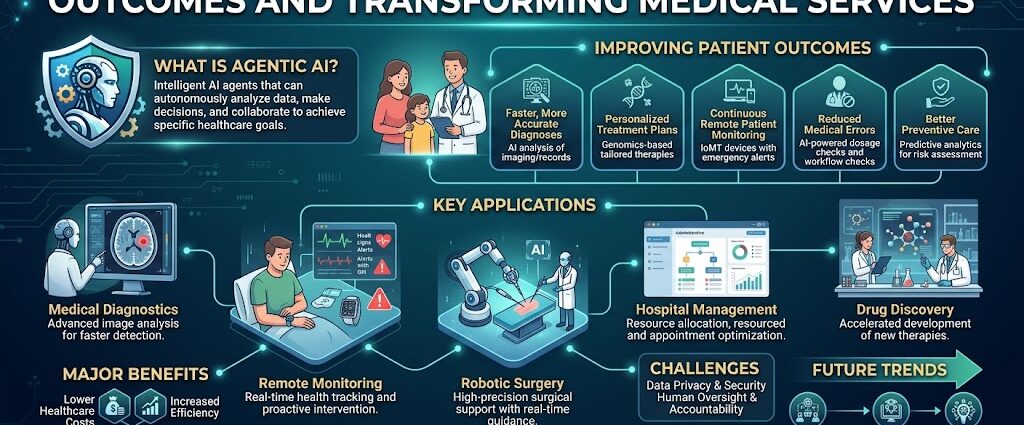
Agentic AI is an advanced form of artificial intelligence capable of acting autonomously to achieve specific goals. Unlike traditional AI systems that simply respond to commands, Agentic AI can analyze information, make decisions, adapt to changing environments, and execute complex workflows independently.
Core Characteristics of Agentic AI
Autonomous Decision-Making
AI agents can independently analyze medical data and suggest appropriate actions.
Continuous Learning
The systems improve over time through machine learning and data analysis.
Real-Time Adaptability
Agentic AI responds quickly to changing patient conditions and healthcare environments.
Collaboration and Coordination
Multiple AI agents can work together with healthcare professionals to improve treatment outcomes.
Why Healthcare Needs Agentic AI
Healthcare systems worldwide face growing challenges, including rising patient populations, staff shortages, increasing operational costs, and the demand for personalized care.
Major Healthcare Challenges
Increasing Patient Volumes
Hospitals and clinics struggle to manage growing patient numbers efficiently.
Administrative Burdens
Healthcare professionals spend significant time on paperwork and administrative tasks.
Rising Healthcare Costs
Medical expenses continue to increase globally.
Delayed Diagnoses
Late diagnosis of diseases often leads to poor patient outcomes.
How Agentic AI Solves These Problems
Agentic AI automates repetitive tasks, analyzes medical data quickly, supports clinical decisions, and improves operational efficiency.
How Agentic AI Improves Patient Outcomes
Faster and More Accurate Diagnoses
AI systems analyze medical records, imaging scans, and lab results rapidly to assist doctors in identifying diseases earlier.
Personalized Treatment Plans
AI agents tailor treatments based on patient history, genetics, lifestyle, and medical conditions.
Continuous Patient Monitoring
Remote monitoring systems track patient health in real time and alert healthcare providers during emergencies.
Reduced Medical Errors
AI-powered systems help minimize diagnostic mistakes and medication errors.
Better Preventive Care
Predictive analytics identify health risks before conditions become severe.
Key Applications of Agentic AI in Healthcare
Medical diagnostics is one of the most impactful applications of Agentic AI.
Medical Imaging Analysis
AI systems analyze X-rays, CT scans, MRIs, and ultrasounds with remarkable accuracy.
Benefits of AI Imaging
- Faster diagnosis
- Improved accuracy
- Early disease detection
- Reduced workload for radiologists
Disease Prediction
AI predicts diseases such as cancer, diabetes, and cardiovascular conditions using patient data.
Clinical Decision Support
AI agents assist physicians by recommending diagnoses and treatment options.
Remote Patient Monitoring
Remote healthcare technologies are becoming increasingly important for modern medical care.
Wearable Health Devices
Smartwatches and sensors collect real-time health data.
Real-Time Health Tracking
AI monitors heart rate, blood pressure, oxygen levels, and glucose levels continuously.
Emergency Alerts
The system notifies healthcare providers if abnormal conditions are detected.
Benefits of Remote Monitoring
Improved Chronic Disease Management
Patients with diabetes or heart disease receive continuous monitoring.
Reduced Hospital Readmissions
Early intervention prevents complications and emergency admissions.
Better Patient Convenience
Patients receive care from home without frequent hospital visits.
Personalized Medicine and Treatment
Agentic AI enables highly personalized healthcare solutions.
Precision Medicine
AI analyzes genetic and medical data to recommend customized treatments.
Drug Recommendations
AI identifies the most effective medications based on patient-specific factors.
Treatment Optimization
The system continuously evaluates treatment effectiveness and suggests adjustments.
Advantages of Personalized Healthcare
Higher Treatment Success Rates
Customized treatments improve patient recovery outcomes.
Reduced Side Effects
AI helps select safer medications and dosages.
Better Patient Satisfaction
Patients receive more individualized care experiences.
AI in Hospital Management
Hospitals use Agentic AI to optimize administrative and operational workflows.
Appointment Scheduling
AI automates patient scheduling and reduces wait times.
Resource Allocation
The system manages beds, equipment, and staff efficiently.
Medical Record Management
AI organizes and retrieves electronic health records quickly.
Benefits for Hospitals
Increased Operational Efficiency
Automation reduces administrative burdens.
Lower Healthcare Costs
Hospitals save resources through optimized operations.
Improved Patient Experiences
Patients receive faster and more organized services.
Robotic Surgery and Automation
Robotic systems powered by Agentic AI are transforming surgical procedures.
AI-Assisted Surgeries
Robotic systems support surgeons with precision-based operations.
Real-Time Surgical Guidance
AI provides insights and recommendations during procedures.
Post-Surgery Monitoring
AI monitors patient recovery and detects complications early.
Benefits of Robotic Surgery
Higher Surgical Precision
AI-assisted systems reduce human errors.
Faster Recovery Times
Minimally invasive procedures improve healing.
Reduced Complications
Better accuracy leads to safer surgeries.
Drug Discovery and Pharmaceutical Research
Agentic AI accelerates medical research and pharmaceutical innovation.
Drug Development
AI identifies potential drug compounds faster than traditional methods.
Clinical Trial Optimization
AI improves patient selection and trial monitoring.
Predictive Modeling
AI predicts drug effectiveness and side effects.
Pharmaceutical Industry Benefits
Faster Drug Development
AI reduces research timelines significantly.
Lower Research Costs
Automation improves efficiency in clinical studies.
Improved Treatment Innovation
Healthcare organizations develop advanced therapies more effectively.
Mental Health Support
Agentic AI is increasingly used in mental healthcare services.
AI-Powered Mental Health Assistants
Virtual agents provide emotional support and mental health guidance.
Behavioral Analysis
AI identifies signs of anxiety, depression, and stress.
Therapy Support
AI tools assist therapists by monitoring patient progress.
Benefits of AI Mental Healthcare
Increased Accessibility
Patients can access support anytime.
Early Mental Health Detection
AI identifies warning signs before conditions worsen.
Reduced Stigma
Virtual support systems encourage more people to seek help.
Predictive Analytics in Healthcare
Predictive analytics is one of the most powerful capabilities of Agentic AI.
Disease Outbreak Prediction
AI analyzes trends to predict infectious disease outbreaks.
Patient Risk Assessment
The system identifies patients at risk of severe complications.
Hospital Demand Forecasting
AI predicts patient volumes and resource requirements.
Benefits of Predictive Healthcare
Better Preventive Care
Healthcare providers intervene before problems escalate.
Improved Emergency Preparedness
Hospitals can prepare resources more effectively.
Enhanced Population Health Management
Public health agencies make data-driven decisions.
Benefits of Agentic AI in Healthcare
Improved Patient Outcomes
Patients receive faster diagnoses and more personalized treatments.
Increased Efficiency
Healthcare organizations automate repetitive tasks and reduce workloads.
Reduced Costs
AI improves resource management and operational efficiency.
Enhanced Accessibility
Remote healthcare systems improve access to medical services.
Better Decision-Making
AI provides healthcare professionals with data-driven insights.
Challenges of Agentic AI in Healthcare
Data Privacy and Security
Healthcare systems handle highly sensitive patient information.
Cybersecurity Risks
AI-powered healthcare systems may become targets for cyberattacks.
Compliance Requirements
Organizations must follow strict healthcare regulations and privacy laws.
Ethical Concerns
AI decision-making raises questions regarding accountability and transparency.
Bias in AI Models
Poor-quality data may lead to biased healthcare outcomes.
Human Oversight
Healthcare professionals must remain involved in critical medical decisions.
High Implementation Costs
Developing advanced AI systems requires significant investment.
Infrastructure Challenges
Hospitals need reliable digital infrastructure and data systems.
Staff Training Requirements
Healthcare workers must learn how to collaborate with AI systems.
Technologies Behind Agentic AI in Healthcare
Machine Learning
Machine learning helps AI systems improve through data analysis.
Natural Language Processing
NLP enables AI to understand medical records and physician notes.
Computer Vision
Computer vision supports medical imaging analysis and diagnostics.
Internet of Medical Things (IoMT)
Connected medical devices provide real-time patient data.
Cloud Computing
Cloud infrastructure supports secure healthcare data storage and processing.
Future of Agentic AI in Healthcare
Fully Autonomous Healthcare Systems
Future hospitals may rely heavily on AI-powered operations and decision-making.
Advanced Predictive Medicine
AI will predict diseases earlier and improve preventive care strategies.
AI-Powered Virtual Hospitals
Remote healthcare services will become more accessible through virtual platforms.
Human-AI Collaboration
Doctors and AI systems will work together to improve medical outcomes.
Global Healthcare Accessibility
AI technologies will help provide healthcare services to underserved regions.
Best Practices for Implementing Agentic AI in Healthcare
Focus on Patient Safety
Healthcare organizations must prioritize safe and ethical AI deployment.
Ensure Data Quality
Accurate and diverse data improves AI performance.
Strengthen Cybersecurity
Hospitals should protect systems against data breaches and cyber threats.
Train Healthcare Professionals
Staff training is essential for effective AI adoption.
Maintain Human Oversight
Doctors should supervise AI-driven decisions in critical situations.
Economic Impact of Agentic AI in Healthcare
Agentic AI is expected to generate significant economic benefits for the healthcare industry.
Reduced Healthcare Costs
Automation and efficiency improvements lower operational expenses.
Increased Productivity
Healthcare professionals can focus more on patient care instead of administrative tasks.
Medical Innovation Growth
AI accelerates research and treatment development.
Improved Healthcare Access
Remote healthcare systems reduce barriers to medical services.
Conclusion
Agentic AI is revolutionizing healthcare by improving patient outcomes, enhancing operational efficiency, and enabling personalized medical care. From diagnostics and remote monitoring to robotic surgery and predictive analytics, AI-powered systems are transforming every aspect of modern healthcare.
As healthcare demands continue to grow, Agentic AI will play an increasingly important role in delivering faster, safer, and more accessible medical services worldwide. Although challenges such as data privacy, cybersecurity, and ethical concerns remain, the long-term benefits of AI-driven healthcare innovation are substantial.
Healthcare organizations that embrace Agentic AI today will lead the future of digital medicine and patient-centered care.
FAQs
What is Agentic AI in healthcare?
Agentic AI in healthcare refers to autonomous AI systems that assist with diagnostics, patient monitoring, treatment planning, and hospital management.
How does Agentic AI improve patient outcomes?
It improves patient outcomes through faster diagnoses, personalized treatments, predictive analytics, and continuous patient monitoring.
What are the benefits of Agentic AI in healthcare?
Benefits include improved efficiency, reduced medical errors, lower healthcare costs, better accessibility, and enhanced patient care.
Can Agentic AI replace doctors?
No, Agentic AI is designed to support healthcare professionals, not replace them. Human oversight remains essential.
What technologies support healthcare AI systems?
Technologies include machine learning, natural language processing, computer vision, cloud computing, and IoMT devices.
What are the risks of Agentic AI in healthcare?
Risks include data privacy concerns, cybersecurity threats, ethical issues, and potential AI bias.
How is AI used in medical diagnostics?
AI analyzes medical imaging, lab reports, and patient records to help identify diseases accurately and quickly.
What is the future of AI in healthcare?
The future includes autonomous healthcare systems, predictive medicine, AI-powered virtual hospitals, and improved global healthcare access.
Comments are closed, but trackbacks and pingbacks are open.