
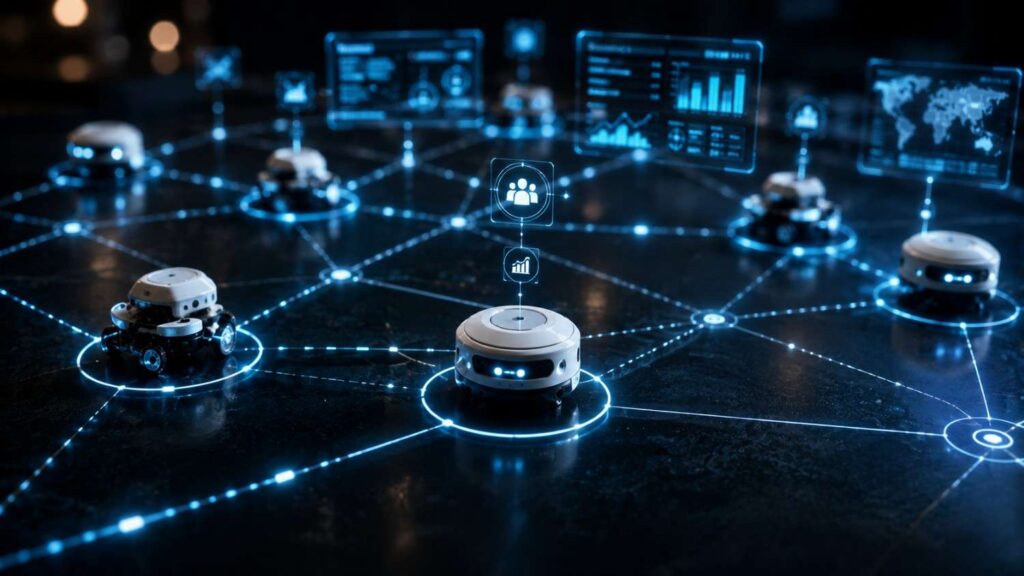
Future Trends in Multiagent Systems Technology
Multiagent systems are moving from experimental demonstrations into practical business, scientific, and industrial applications. In these systems, multiple software agents work toward a shared objective while performing different responsibilities. One agent may create a plan, another may search approved data sources, a third may calculate or verify results, and another may interact with an external application. This division of work can make complex automation more manageable when the responsibilities are clearly defined.
However, adding more agents also introduces additional communication, decision points, tool calls, security boundaries, and opportunities for failure. Agents may duplicate the same work, interpret instructions differently, rely on outdated information, or pass incorrect assumptions to one another. A polished final answer can hide these weaknesses if the organization evaluates only the output and ignores the process used to produce it.
For that reason, the next stage of multiagent systems technology will be driven by engineering discipline rather than agent count. Developers will need reliable communication protocols, structured workflows, permission-aware memory, cost controls, identity management, runtime monitoring, and clear evaluation standards. Human oversight will remain important whenever agents can make payments, modify records, send communications, change infrastructure, or influence high-impact decisions.
The strongest agentic AI trends also suggest a move away from universal agents that attempt to perform every task. Instead, systems will combine specialized agents, traditional software services, small language models, larger reasoning models, databases, and deterministic rules. The architecture will select the right component according to the task.
This article examines the technologies, standards, risks, and practical design choices likely to shape that transition.
What Is Driving Future Trends in Multiagent Systems Technology?
The development of modern multiagent systems is being driven by a practical limitation of standalone AI applications: a single model is rarely equally strong at planning, retrieval, calculation, verification, tool use, and long-running process management. Although one capable model can perform many tasks, complex workflows often become difficult to control when every responsibility is handled inside one uninterrupted conversation.
Multi-agent designs attempt to solve this problem by separating responsibilities. A planning agent can break down the objective, a research agent can collect evidence, a technical agent can perform specialist work, and a review agent can test the result. This arrangement can improve task coverage, but only when roles and communication rules are properly designed.
The field is also being influenced by improvements in language models, retrieval systems, tool-calling interfaces, workflow engines, and distributed computing. These technologies allow agents to interpret natural-language goals while still interacting with structured systems such as databases, APIs, business applications, and security policies.
At the same time, enterprise demand is forcing the technology to become more predictable. Businesses do not only need impressive demonstrations. They need systems that can operate within budgets, follow authorization rules, explain what happened, and recover from errors.
As a result, future development will focus on combining flexible AI reasoning with conventional software controls. Language models will manage uncertainty and interpretation, while deterministic components will manage permissions, validation, state, and execution. Understanding this hybrid direction is important because it explains why modern systems are becoming more structured rather than completely autonomous.
Readers looking for a broader industry overview can also explore how multi-agent systems evolution is influencing modern AI applications across different sectors before diving into the technical concepts below.
From Scripted Agents to LLM-Based Collaboration
Traditional multiagent systems existed long before modern large language models. Earlier systems commonly relied on fixed rules, predefined communication messages, mathematical optimization, game theory, or reinforcement learning. They were often used in simulations, traffic control, logistics, robotics, and distributed decision-making environments where agent goals and possible actions could be defined in advance.
Large language models have expanded what an agent can understand and communicate. Instead of accepting only predefined commands, an LLM-based agent can interpret an open-ended request, explain its reasoning in natural language, select tools, revise a plan, and exchange context with another agent. This makes multi-agent collaboration possible in less structured areas such as software development, research assistance, business operations, and customer support.
The future will probably not involve replacing older methods entirely. A purely language-based system can be flexible, but it may also be unpredictable. A purely rule-based system can be reliable, but it struggles with ambiguity. Hybrid architectures combine both strengths.
For example, an LLM may decide which specialist is required, while deterministic software enforces which records that specialist can access. Reinforcement learning may improve repeated coordination decisions, while fixed rules prevent unauthorized actions. This combination allows systems to adapt without giving the language model unrestricted control over every operational step.
From Fixed Teams to Dynamic Agent Topologies
Many early multi-agent applications use a permanent team structure. The same planner, researcher, writer, reviewer, and executor are activated for every request, regardless of the task’s complexity. This approach is easy to understand, but it can produce unnecessary cost, communication, and delay. A basic classification task does not need the same agent team as a complex scientific review.
Dynamic agent topologies offer a more efficient alternative. In this model, the system evaluates the task and creates a temporary collaboration structure. It may activate two agents for a simple verification request, several specialists for a complicated analysis, or no multi-agent workflow at all when one model or function can handle the request.
The topology may also change while the task is running. An agent could request a legal specialist after detecting regulatory content, add a reviewer when confidence is low, or remove an unnecessary agent after the problem becomes clearer. This allows the team to respond to the actual workload rather than following a rigid template.
Dynamic coordination requires reliable routing. The orchestrator must understand agent capabilities, expected cost, response time, tool permissions, and performance history. Poor routing can assign work to the wrong specialist or create endless delegation loops. Future systems will therefore treat team formation as an optimization problem rather than a static prompt configuration.
For additional perspective on how dynamic collaboration models are evolving across enterprise AI, this overview of the future of multi-agent systems complements the architectural trends discussed here.
Interoperability Will Become Core Infrastructure
Most current agent systems work effectively only inside the framework, platform, or application in which they were created. An agent built for one environment may not be able to discover another agent, understand its capabilities, delegate a task, or interpret its response. This fragmentation limits the development of reusable and cross-vendor agent ecosystems.
Agent interoperability aims to remove some of those barriers. An interoperable agent should be able to identify another approved agent, understand which services it provides, submit a request in a recognized format, monitor progress, and receive a structured result. This does not mean that every agent should communicate with every other agent. It means organizations need consistent methods for enabling authorized collaboration.
Standardization is important because custom integrations are expensive to build and maintain. When every connection uses a different message format, authentication method, error structure, and status system, the architecture becomes difficult to scale. Common protocols can reduce this integration burden and make individual agents easier to replace.
Interoperability will also influence agent marketplaces and internal enterprise directories. Organizations may maintain approved catalogues containing agents for legal review, data analysis, customer records, infrastructure management, or financial calculations. An orchestrator could select an agent based on declared capabilities and access permissions.
However, interoperability increases the security surface. An agent must not trust another system merely because it speaks the correct protocol. Identity, authorization, data handling, provenance, and audit controls must develop alongside communication standards. Open communication without strong verification would create more risk than value.
A2A and MCP Will Serve Different Layers
The Agent2Agent Protocol and Model Context Protocol are often discussed together, but they address different architectural problems. Understanding that distinction prevents organizations from treating them as competing solutions when they may be used together.
A2A focuses primarily on communication between independent agents. It is intended to support activities such as agent discovery, capability description, task delegation, status updates, asynchronous processing, streaming responses, and result exchange. An agent can request work from another agent without needing direct access to that agent’s internal reasoning, private memory, or implementation details.
MCP focuses on how an AI application connects to external capabilities. Those capabilities may include databases, files, business applications, APIs, prompts, search systems, or software tools. Instead of creating a unique connector for every combination of model and service, MCP provides a more consistent client-server structure for exposing approved resources and actions.
A practical system could use both. An orchestrator might use A2A to delegate a financial analysis task to a specialist agent. That specialist could then use MCP to retrieve approved records or call a calculation service. The agent-to-agent relationship remains separate from the agent-to-tool relationship.
Protocols simplify communication, but they do not automatically make an application secure. Each implementation still requires authentication, authorization, input validation, logging, consent, and careful control over what an agent can access or change.
Identity, Authorization, and Discovery Will Matter More
As agents begin communicating across applications and organizations, identity becomes one of the most important technical requirements. A system needs to know which agent is making a request, who owns or operates it, what capabilities it claims to have, and whether those capabilities have been verified. Without reliable identity, agent communication can be manipulated by unauthorized or impersonated systems.
Authorization determines what an authenticated agent is permitted to do. An agent may be allowed to read inventory levels but not change prices. Another may prepare a payment request but require human approval before submission. Permissions should be narrow, temporary where possible, and connected to the specific task rather than granted as permanent broad access.
Discovery also needs careful design. Agent directories may advertise capabilities, supported protocols, response formats, trust levels, costs, and operational limits. An orchestrator could use this information to choose a suitable specialist. However, capability claims should not be accepted without verification, especially when the agent belongs to an external provider.
Future identity infrastructure will likely include cryptographic credentials, signed requests, scoped tokens, policy engines, trust registries, and revocation mechanisms. NIST’s work on AI agent standards highlights interoperability, identity, authentication, and security evaluation as key areas. This reinforces a broader point: secure agent identity will become infrastructure, not an optional feature added after deployment.
Adaptive Orchestration Will Replace One-Model-for-Everything Design
One of the most expensive design mistakes in agentic systems is using the same powerful model for every part of a workflow. A large reasoning model may be useful for uncertain planning or complex analysis, but it is unnecessary for simple extraction, classification, formatting, or rule-based validation. Applying it everywhere increases cost and response time without guaranteeing better results.
Adaptive orchestration addresses this problem by selecting the appropriate model, agent, tool, or workflow for each task. The system may evaluate complexity, urgency, risk, data sensitivity, expected output format, and available resources before deciding how the request should be handled.
A low-risk task could be assigned to a smaller model. A sensitive task might run inside a private environment. A difficult planning problem could use a stronger reasoning model. A deterministic calculation should be sent to a verified function rather than estimated through language generation.
The orchestrator may also decide whether collaboration is necessary. If one specialist can complete the task reliably, creating a team would add unnecessary overhead. When multiple skills are needed, the orchestrator can activate those agents and define their communication sequence.
This adaptive approach changes the main performance question. Instead of asking which model is most intelligent, organizations must ask which combination produces a verified result at an acceptable cost and speed. Mature multi-agent orchestration will therefore depend on routing data, performance history, confidence measures, budget controls, and task-level policies rather than one universal model configuration.
Specialized and Heterogeneous Agents Will Work Together
Future agent teams will not necessarily use the same model, tool set, or infrastructure. A heterogeneous team may include a large reasoning model, a smaller language model, a retrieval system, a rules engine, a mathematical solver, and an API-based business service. Each component can be treated as an agent or specialist with a limited responsibility.
This approach is valuable because different tasks require different forms of intelligence. A language model may understand an unclear business request, but a database query is better for retrieving exact records. A dedicated calculator is more dependable for arithmetic. A local model may protect sensitive information, while a cloud model may handle complex reasoning that does not involve restricted data.
Specialization can also improve evaluation. When each agent has a narrow role, teams can measure its success rate, latency, cost, and common errors. Poorly performing components can be replaced without rebuilding the entire application.
However, heterogeneous systems create translation problems. One component may return free text, another structured JSON, and another a database record. The orchestrator must normalize those outputs and prevent meaning from being lost between steps.
For this reason, future systems will rely more heavily on schemas, contracts, typed messages, validation layers, and capability descriptions. The goal is not to make every agent identical. It is to make different specialists cooperate through predictable interfaces.
Graph Workflows Will Control Long-Running Tasks
Unrestricted conversations between agents can be difficult to monitor and control. Agents may repeat the same argument, delegate work back and forth, or continue operating after the useful work has been completed. Graph-based workflows provide a clearer alternative by representing the process as connected stages with defined transitions.
A graph may contain nodes for planning, research, verification, approval, execution, and reporting. Conditions determine which path is taken. A low-confidence result may be sent for additional review, while a verified result can move directly to execution. Timeouts and retry limits can prevent the process from continuing indefinitely.
Graph workflows are particularly useful for long-running tasks. They allow the system to save progress, pause while waiting for external information, resume after approval, and recover from selected failures. Checkpoints also make it easier to inspect the state of the workflow without replaying the entire conversation.
The agent does not lose all flexibility inside this structure. A language model can still interpret a request, create a plan, or choose between approved actions. The graph simply defines where that autonomy is allowed.
This balance is likely to become a standard design principle. Organizations will use flexible reasoning inside controlled workflow boundaries rather than allowing every agent to decide freely what should happen next.
| Architecture Component | Primary Role | Business Value | Importance |
|---|---|---|---|
| Agent Orchestration | Coordinates multiple agents | Efficient task execution | Critical |
| A2A Communication | Enables agent collaboration | Better interoperability | Critical |
| Model Context Protocol (MCP) | Connects agents with tools and data | Standardized integrations | Critical |
| Shared Memory | Maintains task context | Improved coordination | High |
| Graph Workflows | Controls complex processes | Better reliability | High |
| Identity & Authorization | Secures agent interactions | Strong governance | Critical |
| Observability | Tracks system behavior | Easier monitoring and debugging | High |
| Human-in-the-Loop Controls | Reviews sensitive decisions | Safer AI deployment | High |
Memory and World Models Will Improve Coordination
A multi-agent system cannot coordinate effectively if its agents repeatedly forget earlier decisions, work from conflicting versions of the same information, or duplicate tasks that another agent has already completed. Memory therefore becomes more than a convenience. It becomes part of the system’s operational architecture.
The word “memory” can refer to several different things. Temporary context may hold information needed for the current step. Shared task state may record assignments, deadlines, and completed work. Long-term knowledge may store verified facts or previous outcomes. Private memory may contain information available to one agent but not the rest of the team.
Treating all of this information as one large conversation history creates problems. The history can become expensive to process, difficult to search, and vulnerable to accidental disclosure. It can also preserve incorrect information long after the original error occurred.
Future architectures will use selective memory. Agents will receive the smallest amount of relevant context needed to complete their roles. Important information will be structured, timestamped, attributed to a source, and assigned an appropriate retention period.
World models will extend this idea by representing the environment in which agents operate. A world model may describe inventory, machine status, road conditions, system resources, or the state of a simulated factory. Agents can use that representation to predict consequences and coordinate plans before taking action. The accuracy and freshness of that model will directly affect the quality of their decisions.
Shared Memory Will Be Selective, Not Universal
Giving every agent access to every available message, file, and historical record may seem helpful, but it often reduces performance. Excessive context introduces irrelevant information, increases processing costs, and raises the possibility that confidential data will be exposed to an agent that does not need it.
Selective shared memory addresses this issue by separating information according to purpose and permission. A planning agent may see the overall objective and task progress. A finance agent may access approved transaction records. A communications agent may receive the final decision without seeing internal financial details. Each role receives enough information to work effectively, but not unrestricted access to the entire environment.
Shared information also needs provenance. The system should record where a fact came from, when it was retrieved, which agent added it, whether it was verified, and whether a newer version exists. Without provenance, incorrect information can spread quickly. One agent may generate an unsupported assumption, store it as shared context, and cause the rest of the team to treat it as established truth.
Memory should also include expiration and correction mechanisms. Temporary data must not remain active forever, and an updated record should replace stale information. Future multi-agent systems will therefore treat memory as governed data infrastructure with permissions, validation, versioning, and lifecycle controls.
Simulations and Digital Twins Will Support Planning
Some decisions are too expensive, disruptive, or dangerous to test directly in the real world. Simulations and digital twins allow agents to examine possible outcomes before executing a plan. A digital twin is a software representation of a physical asset, process, or operational environment that is updated with relevant data.
In manufacturing, agents could test different production schedules against a digital representation of machines, materials, staffing, and expected demand. In logistics, agents could compare routes while considering traffic, vehicle capacity, delivery windows, and fuel use. In robotics, agents could rehearse movement and task allocation before controlling physical equipment.
This capability is useful because multi-agent decisions often interact. A scheduling agent may optimize production speed, while a maintenance agent tries to reduce machine wear. A simulation allows the system to identify conflicts and evaluate compromises before either plan is implemented.
However, a simulation is only as trustworthy as its assumptions and data. Agents can coordinate perfectly inside an inaccurate model and still produce a poor real-world outcome. Digital twins must therefore be validated, updated, and compared with actual results.
Future systems will use simulations as decision-support tools rather than unquestionable sources of truth. High-impact plans will still require operational checks, confidence limits, and human approval where appropriate.
Related Articles
Safety, Evaluation, and Observability Will Become Product Requirements
Multi-agent applications introduce risks that are difficult to identify by looking only at the final response. A correct answer may have been produced through unauthorized data access, unnecessary tool calls, excessive spending, or an unreliable chain of reasoning. Conversely, a failed result may originate from one routing decision rather than the entire architecture.
Safety and evaluation must therefore examine the full process. Organizations need visibility into which agents participated, what instructions they received, which data they accessed, which tools they called, how long each step took, and why the workflow selected a particular action.
Agent observability provides this visibility through logs, traces, metrics, and structured event records. A trace can show how a request moved from the orchestrator to individual specialists and back again. Metrics can reveal rising costs, repeated retries, slow tools, or agents that frequently produce unusable outputs.
Evaluation must also occur before and after deployment. Offline testing can measure performance on known tasks, edge cases, and adversarial inputs. Runtime monitoring can identify changing behavior, tool failures, model updates, or new patterns of misuse.
Safety cannot be reduced to a single prompt telling agents to behave responsibly. Controls must be applied through authentication, authorization, validation, isolation, rate limits, budgets, approval gates, and clear stopping conditions. As systems become more autonomous, these capabilities will become expected product features rather than optional engineering improvements.
Evaluation Will Measure the Team, Not Just the Final Answer
Traditional AI evaluation often focuses on whether the final answer is correct. That remains important, but it is not enough for a multi-agent system. Two teams may produce the same answer while using very different amounts of time, money, data, and computational resources. One may also rely on a fragile process that fails when the task changes slightly.
Team-level evaluation should measure task completion, factual accuracy, communication efficiency, routing quality, conflict resolution, cost, latency, security compliance, and recovery from errors. It should also identify whether every agent made a useful contribution. If three agents repeat the same analysis, the system may appear collaborative while wasting resources.
Process-oriented benchmarks such as MultiAgentBench reflect this broader direction by examining collaboration structures and intermediate milestones. These evaluations help researchers understand not only whether a team succeeds, but how effectively its members coordinate.
Organizations should also compare the multi-agent workflow with a strong single-agent and deterministic baseline. The comparison must use the same tasks and success criteria. If the multi-agent design delivers only a minor improvement while doubling cost and response time, it may not be justified.
The correct objective is not maximum collaboration. It is the smallest reliable architecture that produces the required outcome under real operating constraints.
Guardrails Will Operate at Every Boundary
A multi-agent system contains several trust boundaries. There is a boundary between the user and the first agent, between agents, between an agent and a tool, and between the system and external data. Each boundary can introduce manipulation, unauthorized access, or unintended actions.
User input may contain malicious instructions. Retrieved documents may include content designed to override the agent’s goals. An external agent may submit a misleading capability claim. A tool may expose more data or functionality than the requesting agent requires. Guardrails must address each of these risks separately.
Effective controls include input validation, content isolation, least-privilege permissions, short-lived credentials, approved tool lists, output schemas, budget limits, rate limits, and detailed audit logs. Sensitive actions should require confirmation or human authorization. Payments, legal submissions, medical actions, account changes, and infrastructure modifications should not be approved only because several agents agree with one another.
Human-in-the-loop AI is especially important when the cost of an error is high or the system faces unusual circumstances. Human review should be placed at meaningful decision points rather than added as a symbolic final step.
Guardrails should also fail safely. When identity cannot be verified, data is unavailable, or instructions conflict, the system should pause, request review, or choose a limited fallback instead of improvising unrestricted actions.
Embodied and Edge Multi-Agent Systems Will Expand
Many current agent systems operate entirely inside cloud applications. Their outputs are reports, code, messages, or recommendations. The next stage will increasingly connect agents to physical equipment, local devices, sensors, robots, vehicles, industrial systems, and edge-computing environments.
Embodied agents can perceive and influence the physical world. In a warehouse, one agent may assign tasks, another may control a mobile robot, and another may monitor safety conditions. In a factory, agents could coordinate production, maintenance, energy use, and quality inspection. These systems must respond to changing conditions rather than relying only on static instructions.
Edge agents run close to the device or data source they serve. This can reduce network delay, improve resilience, and keep sensitive information inside a local environment. A local agent may handle real-time sensor data while a cloud-based agent performs broader planning.
Combining cloud, edge, and embodied agents creates significant technical challenges. Devices may lose connectivity, clocks may be unsynchronized, sensors may provide conflicting information, and individual agents may hold only part of the current state. Physical actions also have consequences that cannot be reversed as easily as a text response.
For these reasons, embodied multi-agent systems will require stronger real-time validation, local safety controls, and fallback behavior. Language models may assist with planning and human communication, but deterministic control systems will continue to manage many time-sensitive physical operations.
Robot Teams Will Coordinate Through Language and Structured Messages
Robot teams need to coordinate movement, task allocation, shared resources, safety zones, and changing environmental conditions. Traditional robotic systems usually exchange structured messages because machines require precise data about location, speed, battery status, and task progress. Natural-language models add a new layer that can make these teams easier for humans to instruct and supervise.
A person might state a broad objective such as inspecting a storage area and identifying damaged packages. A planning agent could convert that objective into routes, inspection tasks, and reporting requirements. Individual robots could then exchange structured operational messages while using vision or sensor systems to perform their assignments.
Language should not replace precise control. A robot cannot safely rely on an ambiguous sentence when calculating stopping distance or avoiding a collision. Instead, natural language is useful for interpreting goals, explaining decisions, handling exceptions, and coordinating with people. Structured protocols should continue to control real-time execution.
Robot teams also need shared awareness. Each unit may see only part of the environment, so information must be combined without overwhelming the network. The system must determine which observations are important, which are outdated, and which require immediate action.
Successful multi-agent systems in robotics will therefore combine language understanding, structured coordination, local control, verified perception, and strict physical safety limits.
Edge Deployment Will Reduce Delay and Data Exposure
Cloud-based reasoning offers access to powerful models and centralized resources, but sending every decision to a remote service is not practical for all applications. Network delay may be unacceptable for robots, vehicles, industrial equipment, or security systems that need to respond immediately. Some data may also be too sensitive to leave the local environment.
Edge deployment places selected agents or models close to the source of the data. A factory agent could analyze sensor readings on-site, while a cloud agent handles long-term planning. A medical device could process sensitive signals locally and share only approved summaries. A retail system could continue performing basic operations even when external connectivity is limited.
This distributed approach introduces synchronization challenges. A local agent may work with a newer sensor reading while the cloud agent still holds an older state. Agents must be able to detect stale information, reconcile conflicts, and communicate changes efficiently.
Edge hardware also has limited memory, power, and processing capacity. Smaller models and specialized functions may be required instead of large general-purpose systems.
Future architectures will divide responsibilities according to urgency, privacy, and resource availability. Local agents will handle immediate and sensitive operations, while cloud components provide broader coordination. The system must remain safe when communication between those layers becomes slow or unavailable.
How Should Organizations Prepare for the Next Phase?
Organizations should not respond to multi-agent technology by immediately building a large autonomous workforce. The safer and more productive approach is to identify a bounded process where multiple specialists could create measurable value. Good candidates involve several distinct skills, repeated coordination, or verification across different systems.
Before introducing agents, the organization should document the existing workflow. It must know how long the task takes, how often errors occur, which tools are used, where approvals are required, and what a successful result looks like. Without a baseline, there is no reliable way to prove that the new architecture is better.
The first implementation should remain narrow. Each agent needs a specific role, limited tools, clear inputs, expected output formats, and defined stopping conditions. The system should log every important event so developers can understand failures instead of relying on the final response alone.
Security planning must begin before deployment. Teams should identify sensitive data, high-impact actions, authentication requirements, and situations that require human review. They should also determine how the workflow behaves when a model, tool, or external service becomes unavailable.
Finally, organizations need a clear expansion rule. More agents should be added only when testing shows that the new specialist improves accuracy, speed, coverage, or operational efficiency. This evidence-based process prevents a manageable automation project from becoming an expensive and difficult-to-audit network of unnecessary agents.
| Industry | Primary Multiagent System Use | Key Benefits | Future Growth Potential |
|---|---|---|---|
| Software Development | Code generation, testing, debugging | Faster development cycles | Very High |
| Manufacturing | Factory automation and robot coordination | Improved efficiency and accuracy | High |
| Healthcare | Clinical workflow support and resource coordination | Better operational decisions | High |
| Logistics | Route planning and warehouse automation | Lower costs and faster deliveries | Very High |
| Financial Services | Fraud detection and intelligent automation | Faster risk analysis | High |
| Cybersecurity | Threat monitoring and incident response | Continuous security coverage | Very High |
| Smart Cities | Traffic management and infrastructure monitoring | Optimized public services | Medium |
| Robotics | Multi-robot collaboration | Improved task execution | Very High |
Use a Controlled Adoption Process
A controlled adoption process begins with one clearly defined task. The organization should document the input, output, approved data sources, permitted actions, and conditions that count as failure. This prevents the project from expanding into an undefined general-purpose assistant.
Next, build a baseline using the simplest practical approach. That may be a normal software workflow, one language model, or a retrieval system with fixed rules. Measure completion rate, accuracy, response time, human effort, and cost.
Add one specialist only when its purpose is clear. For example, introduce a verification agent if factual errors are a known problem. Give that agent limited access and require a structured response showing what it checked.
The orchestrator should enforce timeouts, retry limits, token or spending budgets, and stopping conditions. Every tool call, message, decision, and approval should be recorded through tracing.
Testing must include more than normal examples. Use missing data, conflicting instructions, unavailable tools, malicious content, stale records, and ambiguous requests. Observe whether the system stops safely or invents a workaround.
Expansion should follow verified improvement. If another agent does not increase quality or reduce meaningful work, remove it. A controlled process creates an enterprise multi-agent system architecture based on operational evidence rather than enthusiasm for agentic technology.
Know When Not to Use Multiple Agents
Multi-agent systems are inappropriate for many ordinary automation tasks. If one API call, database query, function, rules engine, or language model can complete the work reliably, introducing a team usually creates unnecessary complexity. Every additional agent adds messages, runtime, monitoring requirements, and possible failure points.
Avoid a multi-agent architecture when responsibilities cannot be separated clearly. If all agents need the same information and perform nearly identical reasoning, the team may only duplicate work. The design is also unsuitable when evaluation criteria are vague. Without a measurable definition of success, the organization cannot determine whether collaboration provides value.
Very low-latency tasks may not tolerate multiple communication steps. Highly regulated workflows should not use autonomous teams until identity, authorization, audit, and approval controls are mature. The same caution applies when tool permissions are broad or sensitive data cannot be divided safely between roles.
Multiple agents can also create false confidence. Several agents may agree because they use similar models, training data, prompts, or sources. Their agreement does not prove that the conclusion is correct.
The best architecture is not the one with the largest number of agents. It is the simplest system that achieves the required level of accuracy, control, speed, and safety. Restraint is therefore an important multi-agent design skill.
Quick Answer About Future Trends in Multiagent Systems Technology
Future Trends in Multiagent Systems Technology point toward systems that are more interoperable, specialized, observable, and carefully controlled. The next stage will not be defined simply by placing more AI agents inside one workflow. It will be defined by whether those agents can divide responsibilities, exchange information securely, use tools safely, recover from errors, and produce better results than a simpler single-agent system.
Open standards are expected to play a major role. The Agent2Agent Protocol, commonly called A2A, focuses on communication and task exchange between independent agents. The Model Context Protocol, or MCP, focuses on standardized connections between AI applications and external tools, data sources, prompts, and services. These protocols may reduce the amount of custom integration required to connect agents across systems.
Other major developments include adaptive agent selection, persistent but permission-controlled memory, graph-based orchestration, team-level evaluation, edge deployment, digital twins, and coordinated robotic systems. Organizations will also place greater emphasis on agent identity, authorization, observability, human approval, and audit trails.
The main lesson is straightforward: more agents do not automatically produce more intelligence. Multi-agent technology creates value only when collaboration improves accuracy, speed, coverage, or operational efficiency enough to justify the additional cost, latency, complexity, and security exposure. The most successful systems will use multiple agents selectively rather than treating autonomous collaboration as the default architecture for every task.
Frequently Asked Questions About Future Trends in Multiagent Systems Technology
Interest in multi-agent AI has grown quickly, but many readers still need clarity about what these systems can realistically achieve. Marketing descriptions often present autonomous agents as digital employees that can plan, communicate, and perform complicated operations without supervision. Real deployments are more constrained.
A multi-agent system must coordinate models, software tools, memory, permissions, and data sources. Its value depends on whether those components work together more effectively than a simpler alternative. Organizations also need to evaluate the complete process, not only the final response.
The following questions address common search intent from developers, business leaders, researchers, and technology buyers. They explain where multi-agent designs are useful, how emerging protocols differ, which risks require attention, and why human involvement will continue to matter.
These answers are deliberately practical. They avoid assuming that every task needs a group of autonomous agents or that communication standards automatically solve security and reliability problems. The technology is developing rapidly, but the core engineering principles remain familiar: use clear interfaces, limit permissions, validate inputs and outputs, monitor runtime behavior, and keep human accountability for consequential decisions.
Understanding these principles makes it easier to separate valuable multi-agent capabilities from unnecessary architectural complexity.
What Is the Future of Multiagent Systems?
The future of multiagent systems will involve more structured and selective collaboration. Instead of activating a fixed group of general-purpose agents for every request, systems will assemble temporary teams based on the task, required expertise, risk level, and available budget. Some workflows may use several specialists, while others will remain single-agent or fully deterministic.
Interoperability standards will make it easier for agents from different platforms to discover approved capabilities and exchange tasks. Structured memory will help teams maintain shared state without exposing every record to every agent. Graph workflows will add checkpoints, retries, approval stages, and recovery paths.
Evaluation will also become more demanding. Organizations will measure not only answer quality but also cost, latency, communication efficiency, tool use, security compliance, and error recovery. Agent identity and authorization will become major infrastructure requirements as systems begin operating across organizational boundaries.
The field will therefore move away from uncontrolled autonomy and toward governed automation. The most valuable systems will be those that combine AI flexibility with conventional engineering controls and demonstrate measurable improvement over simpler workflows.
Are Multi-Agent Systems Better Than Single Agents?
Multi-agent systems are better only for tasks that genuinely benefit from specialization, parallel work, independent checking, or coordination across different tools and data sources. A research workflow may improve when one agent collects sources, another evaluates evidence, and a third checks the final conclusion. A software workflow may use separate agents for planning, coding, testing, and review.
However, a multi-agent design is not automatically more accurate. Agents can duplicate effort, spread incorrect assumptions, create communication errors, and increase cost. When agents use similar models or sources, agreement between them may create false confidence rather than genuine independent verification.
Single agents are often preferable for simple, low-risk, or tightly scoped tasks. They require fewer messages, respond faster, and are easier to evaluate. Deterministic software may be even better when the task follows fixed rules or requires exact calculation.
The correct comparison should use the same test set, success criteria, and operating conditions. Measure quality, latency, cost, human effort, and failure recovery. A multi-agent system is justified only when its improvement is large enough to compensate for the added complexity.
What Is the Difference Between A2A and MCP?
The Agent2Agent Protocol and Model Context Protocol address different parts of an agentic architecture. A2A focuses on communication between independent agents. It helps an agent discover another agent’s capabilities, assign a task, receive status updates, manage asynchronous work, and collect the result without requiring access to the other agent’s internal implementation.
MCP focuses on connections between an AI application and external resources. Those resources may include databases, files, search services, APIs, prompts, software tools, or business applications. MCP provides a standardized structure for making those resources available to approved AI clients.
The two protocols can work together. An orchestration agent could use A2A to request work from a specialist. That specialist could use MCP to retrieve approved records or operate a connected tool. A2A manages the agent-to-agent relationship, while MCP helps manage the agent-to-resource relationship.
Neither protocol automatically provides complete security. Implementations still need authentication, scoped authorization, validation, consent, logging, and safe error handling. Organizations should therefore view the protocols as communication foundations rather than complete governance or security solutions.
What Are the Main Risks of Multi-Agent AI?
The main risks of multi-agent AI include coordination failure, excessive cost, privacy leakage, unsafe tool use, unclear accountability, cascading errors, and manipulation through untrusted content. One agent may misunderstand the objective, and other agents may continue operating on that incorrect interpretation.
Shared memory creates another risk. If an unsupported claim is stored as a verified fact, the mistake can influence every later step. Agent-to-agent messages can also be targeted by malicious instructions, impersonation attempts, or misleading capability descriptions.
Tool use increases the potential impact of errors. An agent that can modify records, send messages, execute code, or make payments can cause real damage if its permissions are too broad. Agreement among several agents should not be treated as authorization.
Risk reduction requires controls at every boundary. These include identity verification, least-privilege access, approved tool lists, data isolation, input and output validation, spending limits, trace logs, timeouts, and human approval for high-impact actions.
Organizations should also test unusual and adversarial situations before deployment. No control removes all risk, but layered safeguards can prevent one weak decision from becoming a system-wide failure.
Which Industries Will Adopt Multiagent Systems?
Multiagent systems are likely to gain adoption in industries where work can be divided into specialist roles and where results can be checked against clear operational outcomes. Software engineering is a strong example because planning, coding, testing, security review, and documentation can be assigned to separate components.
Manufacturing and logistics may use agents for scheduling, inventory, routing, maintenance, and quality control. Scientific research may benefit from agents that search literature, analyze data, propose hypotheses, and review evidence. Customer operations can use specialized agents for classification, account retrieval, policy checking, and response preparation.
Finance and healthcare may adopt multi-agent assistance more cautiously because errors have greater consequences. In these sectors, agents may collect information or prepare recommendations while authorized professionals retain responsibility for final decisions.
Cybersecurity is another likely area because monitoring, investigation, threat intelligence, and response planning involve different skills. However, automated remediation requires strict controls.
Adoption will depend less on industry popularity than on workflow suitability. Organizations with measurable processes, structured data, controlled tools, and clear approval paths will be better positioned than those attempting to automate unclear or constantly changing responsibilities.
Will Multiagent Systems Replace Human Teams?
Multiagent systems are more likely to change how human teams distribute work than replace entire teams. Agents can collect information, compare records, monitor routine processes, prepare drafts, perform repeated checks, and coordinate predictable workflows. This may reduce the amount of time people spend on administrative or repetitive tasks.
Humans remain necessary for setting goals, understanding organizational context, resolving value-based conflicts, managing unusual situations, and accepting responsibility for high-impact outcomes. An agent can summarize legal information, but a qualified professional must evaluate its relevance. An agent can prepare a financial action, but an authorized person may need to approve it.
Human teams also provide social understanding, negotiation, judgment, and accountability that cannot be reduced to task completion. Multi-agent systems may support those teams by presenting better evidence and identifying options, but that support should not be confused with ownership of the decision.
Roles will change. Some employees will supervise workflows, review exceptions, define policies, improve prompts, and evaluate agent performance. The strongest organizations will design human-agent collaboration deliberately instead of framing adoption as a simple replacement strategy.
Conclusion
Future Trends in Multiagent Systems Technology indicate that the field is moving toward disciplined coordination rather than unlimited autonomy. Open protocols such as A2A and MCP may make it easier to connect agents, tools, and data across platforms. Adaptive orchestration will help systems select the right specialist, model, or deterministic service for each part of a task.
Structured memory, graph workflows, digital twins, and edge deployment will allow agents to handle longer, more distributed, and more context-sensitive processes. At the same time, identity, authorization, observability, evaluation, and human approval will become more important because autonomous actions can create operational consequences.
The central challenge is not teaching agents to communicate. It is ensuring that their communication produces reliable, secure, and economically useful outcomes. A team that generates more messages but does not improve the result is not an advanced system. It is an inefficient one.
Organizations should begin with narrow use cases, measure a strong baseline, add specialists gradually, and test failures as seriously as successful examples. They should also retain deterministic controls wherever the process is known and predictable.
The most successful future systems will not use maximum autonomy. They will use the right amount of autonomy for the specific task. Multi-agent collaboration should be activated when specialization, parallelism, independent review, or cross-system coordination creates verified value.
Comments are closed, but trackbacks and pingbacks are open.