
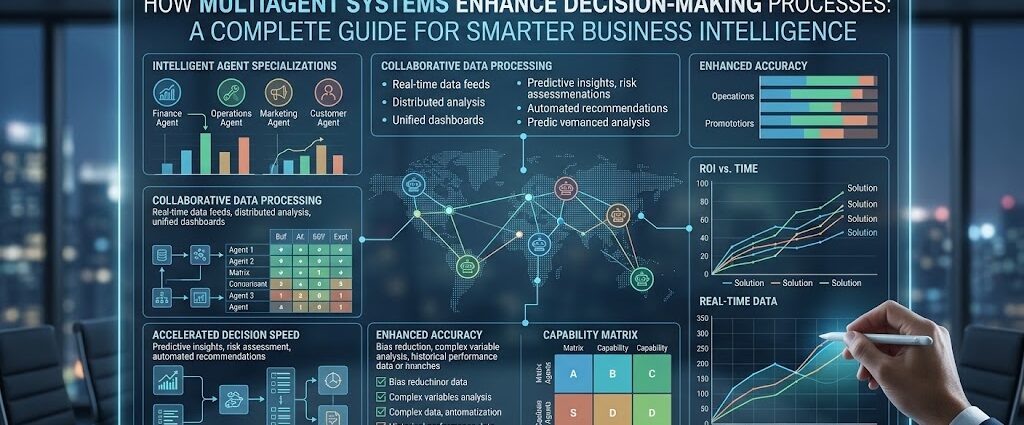
Businesses today operate in an environment where data volumes are increasing rapidly, customer expectations continue to evolve, and competition demands faster and smarter decisions. Organizations no longer rely solely on traditional decision-making approaches because manual processes often struggle to keep up with modern complexity.
Artificial Intelligence (AI) has transformed the way organizations analyze information and automate operations. However, a more sophisticated approach known as Multiagent Systems (MAS) is emerging as a powerful solution for intelligent decision-making.
Multiagent systems consist of multiple intelligent agents working together to solve problems, analyze information, and support organizational objectives. Instead of a single system handling all activities, multiple specialized agents collaborate, share information, and coordinate actions.
This approach improves efficiency, increases accuracy, and creates a stronger foundation for strategic decisions.
In this comprehensive guide, you will learn how multiagent systems enhance decision-making processes, their advantages, challenges, practical applications, and future impact on industries.
Understanding Multiagent Systems
Before discussing their impact on decision-making, it is important to understand what multiagent systems actually are.
A multiagent system refers to a collection of autonomous intelligent agents that interact with one another inside a shared environment.
These agents can:
- Gather information
- Analyze data
- Make decisions
- Communicate with other agents
- Execute tasks
- Adapt to changing situations
Unlike traditional centralized systems, multiagent systems distribute responsibilities among multiple specialized entities.
Characteristics of Multiagent Systems
Several characteristics define modern multiagent systems.
Autonomy
Each agent operates independently without requiring constant supervision.
Collaboration
Agents communicate and work together to achieve common goals.
Reactivity
Agents respond to environmental changes.
Proactivity
Agents can initiate actions rather than simply reacting.
Learning Capability
Some systems use machine learning techniques to improve performance over time.
Understanding Decision-Making Processes
Decision-making refers to selecting the most effective course of action among several alternatives.
Organizations typically follow several steps during decision-making:
Problem Identification
Businesses first identify an issue or opportunity.
Information Collection
Relevant information is gathered from multiple sources.
Analysis
The collected information is evaluated.
Option Development
Possible solutions are created.
Decision Selection
The most suitable solution is chosen.
Implementation
Actions are executed.
Evaluation
Results are monitored and assessed.
Traditional approaches often involve delays because large amounts of information require extensive manual analysis.
Multiagent systems improve this process significantly.
Why Modern Decision-Making Is Becoming More Difficult
Organizations face numerous challenges that increase complexity.
Large Volumes of Data
Businesses generate information from:
- Customer transactions
- Social media
- sensors
- websites
- applications
- internal systems
Rapid Changes in Markets
Market conditions change continuously.
Examples include:
- customer preferences
- competitor strategies
- regulations
- economic factors
Human Cognitive Limitations
Decision-makers may experience:
- information overload
- fatigue
- unconscious bias
- limited processing speed
Increasing Uncertainty
Business environments often contain unpredictable variables.
Examples include:
- supply chain disruptions
- economic instability
- changing customer behavior
Multiagent systems help organizations overcome these obstacles.
How Multiagent Systems Enhance Decision-Making Processes
Distributed Intelligence
One of the most important strengths of multiagent systems is distributed intelligence.
Instead of assigning all responsibilities to one system, tasks are divided among multiple agents.
For example:
A retail company could deploy:
- customer behavior agents
- inventory agents
- pricing agents
- market research agents
Each agent handles a specialized task and contributes information to the overall decision process.
Benefits include:
- faster analysis
- greater scalability
- improved efficiency
Improved Data Collection and Analysis
Businesses collect information from multiple channels.
Examples include:
Internal Sources
- CRM systems
- databases
- sales platforms
External Sources
- social media
- websites
- market reports
Different agents can gather information simultaneously.
For example:
Data Collection Agent
Collects raw information.
Analysis Agent
Processes and organizes data.
Recommendation Agent
Generates insights.
Monitoring Agent
Tracks outcomes.
This approach reduces delays and improves accuracy.
Faster Decision-Making
Speed has become a major competitive advantage.
Traditional decision processes may require:
- Gathering reports
- Reviewing information
- Conducting meetings
- Approving actions
- Executing plans
Multiagent systems accelerate these stages.
Agents work simultaneously rather than sequentially.
Benefits include:
- quicker responses
- reduced bottlenecks
- real-time actions
Better Collaboration Between Specialized Intelligence
Different agents possess different capabilities.
For example:
Financial Agent
Analyzes costs and financial impact.
Customer Agent
Studies consumer behavior.
Operations Agent
Examines efficiency metrics.
Risk Agent
Identifies potential threats.
Combining multiple perspectives improves decision quality.
Continuous Monitoring and Learning
Traditional systems often rely on periodic reporting.
Examples include:
- weekly reviews
- monthly reports
- quarterly analysis
Multiagent systems continuously monitor information.
Benefits include:
- immediate updates
- adaptive recommendations
- faster responses
Key Components of Multiagent Decision Systems
Several elements make multiagent systems effective.
Intelligent Agents
These are the primary units responsible for performing tasks.
Communication Mechanisms
Agents require communication channels.
Methods may include:
- messaging systems
- APIs
- shared databases
Knowledge Bases
Agents use stored information to support decisions.
Coordination Mechanisms
Coordination ensures agents work together efficiently.
Learning Algorithms
Machine learning improves future performance.
Real-World Applications of Multiagent Systems
Healthcare Industry
Healthcare environments involve large amounts of information and time-sensitive decisions.
Applications include:
Patient Monitoring
Agents continuously track patient conditions.
Diagnosis Support
Agents analyze symptoms and medical records.
Appointment Scheduling
Agents automate scheduling activities.
Treatment Recommendations
Systems support healthcare professionals.
Benefits:
- reduced administrative work
- improved patient care
- faster decisions
Financial Services
Banks and financial institutions process enormous data volumes.
Applications include:
Fraud Detection
Agents identify unusual patterns.
Investment Analysis
Agents monitor market activity.
Credit Evaluation
Agents assess borrower risk.
Customer Support
Agents respond to inquiries.
Benefits:
- improved security
- better risk management
- enhanced customer experiences
Supply Chain and Logistics
Supply chains involve many interconnected activities.
Applications include:
Demand Forecasting
Agents predict future demand.
Inventory Monitoring
Agents track stock levels.
Transportation Management
Agents optimize delivery routes.
Supplier Coordination
Agents improve communication.
Benefits:
- lower costs
- reduced delays
- better planning
Manufacturing Industry
Manufacturing operations increasingly depend on intelligent systems.
Applications include:
Quality Control
Agents detect production defects.
Predictive Maintenance
Agents identify equipment issues before failure.
Production Scheduling
Agents optimize resources.
Benefits:
- improved efficiency
- reduced downtime
- cost savings
Smart Cities
Urban systems require efficient coordination.
Applications include:
Traffic Management
Agents monitor traffic flow.
Emergency Response
Agents coordinate services.
Energy Optimization
Agents improve energy distribution.
Benefits:
- reduced congestion
- better public services
- improved resource usage
Major Benefits of Multiagent Systems
Scalability
Additional agents can easily be introduced.
Reliability
System failures become less disruptive.
Flexibility
Systems adapt to changing environments.
Reduced Human Workload
Routine tasks become automated.
Better Decision Accuracy
Multiple agents reduce errors.
Improved Resource Utilization
Organizations use resources more effectively.
Challenges of Multiagent Systems
Despite advantages, challenges remain.
Coordination Difficulties
Large numbers of agents require synchronization.
Potential issues:
- duplicate actions
- communication delays
- conflicting objectives
Security Risks
Information sharing creates security concerns.
Risks include:
- unauthorized access
- data breaches
- cyberattacks
Ethical Concerns
Questions include:
- accountability
- transparency
- fairness
Infrastructure Requirements
Large implementations require:
- cloud resources
- storage systems
- computing power
Integration Challenges
Organizations may struggle with:
- legacy systems
- compatibility
- implementation complexity
Technologies Supporting Multiagent Systems
Several technologies enable modern multiagent environments.
Artificial Intelligence
Provides reasoning capabilities.
Machine Learning
Allows continuous improvement.
Cloud Computing
Offers scalable infrastructure.
Big Data Analytics
Processes large datasets.
Internet of Things (IoT)
Provides real-time information.
Natural Language Processing
Improves communication capabilities.
Best Practices for Implementing Multiagent Systems
Define Business Goals Clearly
Organizations should determine:
- expected outcomes
- key performance indicators
- strategic objectives
Begin with Pilot Projects
Small implementations reduce risk.
Establish Governance Policies
Organizations need guidelines regarding:
- data use
- privacy
- security
Train Employees
Teams should understand:
- system capabilities
- workflow integration
- AI collaboration
Monitor Performance Continuously
Track:
- decision quality
- operational impact
- productivity improvements
Future Trends of Multiagent Decision Systems
Autonomous Enterprises
Organizations may automate larger portions of operations.
Human-AI Collaboration
Humans and AI systems will increasingly work together.
Smarter Learning Systems
Agents may become more adaptive.
Industry-Specific Solutions
Specialized systems may emerge for:
- healthcare
- finance
- manufacturing
- education
Increased Personalization
Systems may deliver highly customized recommendations
Conclusion
Multiagent systems are transforming how organizations make decisions by introducing distributed intelligence, collaboration, and automation into business environments.
Instead of relying on a single centralized system, organizations can deploy specialized agents that work together to process information, identify patterns, and provide strategic recommendations.
As industries become increasingly data-driven, multiagent systems are expected to play a major role in improving speed, accuracy, and efficiency in decision-making processes.
The future of decision-making will likely involve collaborative intelligence where humans and intelligent agents work together to create stronger outcomes.
Frequently Asked Questions (FAQs)
What is a multiagent system?
A multiagent system is a group of intelligent agents that interact and collaborate to perform tasks and solve problems.
How do multiagent systems improve decision-making?
They improve decision-making through:
- distributed intelligence
- real-time processing
- collaboration
- faster analysis
Which industries use multiagent systems?
Industries include:
- healthcare
- finance
- manufacturing
- logistics
- smart cities
- technology
Can multiagent systems replace humans?
Generally, they support human decisions rather than replacing decision-makers entirely.
What are the major benefits of multiagent systems?
Major benefits include:
- scalability
- flexibility
- automation
- improved accuracy
- faster decision-making
What are the biggest challenges in implementing multiagent systems?
Common challenges include:
- coordination complexity
- security concerns
- infrastructure costs
- integration difficulties
Comments are closed, but trackbacks and pingbacks are open.