
Artificial Intelligence has evolved rapidly over the last few years. Businesses initially adopted chatbots and automation tools to streamline simple tasks. However, organizations are now moving beyond basic automation into a more advanced stage known as Agentic AI.
Unlike traditional AI systems that simply respond to instructions, Agentic AI systems can independently reason, plan, make decisions, and execute multi-step workflows. These systems function more like intelligent digital workers than conventional software tools.
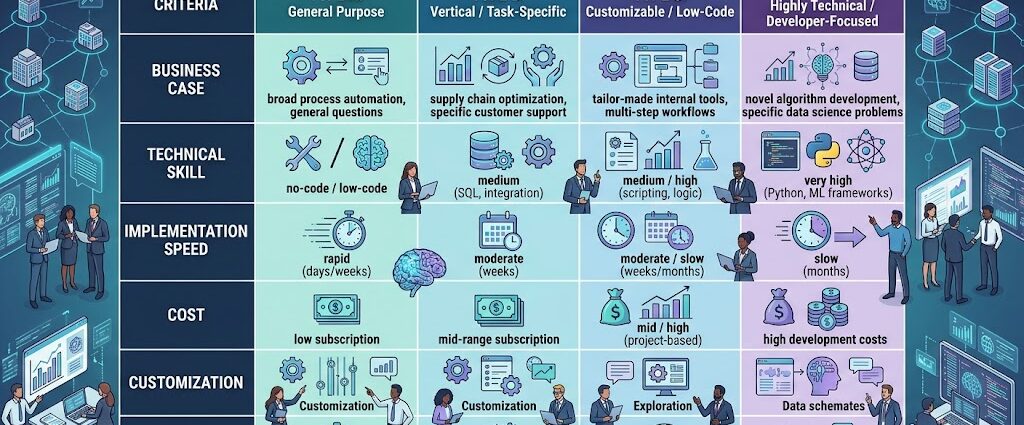
The increasing demand for autonomous AI systems has created a growing marketplace of Agentic AI platforms and enterprise solutions. Organizations face an important challenge: determining which solution aligns with their business goals, infrastructure, budget, and operational requirements.
Many enterprise platforms now focus on orchestration, workflow automation, governance, and autonomous decision-making capabilities. Current industry developments also show increasing investment in agentic systems and enterprise-grade deployment frameworks.
This guide explores the major categories of Agentic AI solutions, compares leading options, and helps organizations determine the right choice for their specific needs.
Understanding Agentic AI Solutions
Agentic AI solutions are software platforms or systems designed to allow AI agents to perform complex activities independently.
Traditional AI systems usually:
- Answer questions
- Generate text
- Process specific requests
Agentic AI systems can:
- Plan actions
- Execute tasks
- Coordinate workflows
- Integrate with enterprise systems
- Learn from interactions
- Collaborate with humans
Instead of functioning as isolated tools, they often operate as intelligent ecosystems.
Why Businesses Are Investing in Agentic AI
Organizations are adopting Agentic AI because of several business benefits.
Increased Efficiency
AI agents reduce repetitive manual work.
Examples:
- Scheduling
- Data entry
- Customer support
- Documentation
Better Decision-Making
AI systems process large amounts of information quickly.
Benefits include:
- Improved forecasting
- Faster analysis
- Reduced human error
Lower Operating Costs
Businesses can automate processes that traditionally required large teams.
Improved Customer Experience
AI agents can:
- Provide faster responses
- Personalize interactions
- Handle requests continuously
Scalability
AI systems can manage increasing workloads without proportional staffing increases.
Many enterprise AI providers emphasize productivity gains and workflow optimization as key outcomes of Agentic deployments.
Categories of Agentic AI Solutions
Not all Agentic AI platforms are designed for the same purpose.
Businesses should first identify which category matches their needs.
Customer Service Agent Platforms
Purpose:
- Customer support automation
- Ticket management
- Virtual assistants
Examples:
- CRM-integrated AI agents
- Support automation systems
Ideal for:
- E-commerce
- SaaS businesses
- Financial services
Workflow Automation Platforms
Purpose:
- Multi-step business process execution
- Task orchestration
- Operations management
Ideal for:
- Human resources
- Finance
- Operations
Enterprise AI Platforms
Purpose:
- Organization-wide deployment
- Integration with existing systems
- Governance and security
Ideal for:
- Large enterprises
- Regulated industries
Multi-Agent Systems
Purpose:
- Teams of AI agents working collaboratively
Examples:
- Research agents
- Decision agents
- Analysis agents
Ideal for:
- Complex workflows
Key Features to Compare Before Selecting an Agentic AI Solution
Businesses often focus on features rather than operational outcomes. However, several important factors should guide decision-making.
Integration Capabilities
An AI platform should connect with:
- CRM systems
- Databases
- APIs
- Cloud services
- Internal software
Community discussions frequently highlight integration challenges as one of the biggest barriers to enterprise deployment.
Security and Compliance
Critical considerations include:
- Data encryption
- Access controls
- Audit logs
- Compliance certifications
Industries such as healthcare and finance require stronger governance controls.
Scalability
Questions to ask:
- Can the platform handle growth?
- Can it support additional users?
- Can workflows expand over time?
Customization
Organizations often need:
- Custom workflows
- Industry-specific logic
- Flexible automation
Multi-Agent Coordination
Advanced systems may support:
- Agent collaboration
- Shared memory
- Task delegation
Cost Structure
Common pricing models include:
Subscription Pricing
Monthly or annual fees.
Usage-Based Pricing
Costs based on:
- API calls
- tokens
- processing
Enterprise Licensing
Custom agreements for large organizations.
Comparing Popular Agentic AI Solutions
Below is a comparison of commonly discussed categories and platforms used by businesses.
| Feature | General AI Platforms | Workflow Automation Platforms | Enterprise Agent Platforms | Multi-Agent Systems |
|---|---|---|---|---|
| Ease of setup | High | Medium | Medium | Low |
| Customization | Medium | High | High | Very High |
| Security features | Medium | High | Very High | Medium |
| Multi-agent support | Limited | Medium | High | Very High |
| Integration flexibility | Medium | High | Very High | High |
| Enterprise readiness | Medium | High | Very High | Medium |
| Development complexity | Low | Medium | High | High |
Enterprise Solutions Currently Gaining Attention
Organizations evaluating Agentic AI often examine several notable platforms and architectures.
AgentsX Official Website
Focus areas:
- Autonomous AI agents
- Workflow orchestration
- Enterprise deployment
Capabilities include:
- Multi-agent collaboration
- workflow automation
- pre-built use cases
Enterprise platforms increasingly emphasize orchestration and scalable deployment frameworks.
Kagen.ai Official Website
Focus areas:
- Enterprise automation
- compliance
- workflow intelligence
Capabilities:
- End-to-end process automation
- governance controls
- productivity optimization
Enterprise AI providers increasingly position governance and measurable ROI as major value propositions.
OneReach.ai Official Website
Focus areas:
- Agent orchestration
- large-scale deployment
Capabilities:
- policy management
- production-grade AI systems
Governance and large-scale management are frequently highlighted as important enterprise requirements.
How Different Businesses Should Choose Agentic AI
Small Businesses
Primary concerns:
- Budget
- Ease of implementation
- quick deployment
Recommended focus:
- Low-code platforms
- simple automation systems
Mid-Sized Businesses
Primary concerns:
- Process optimization
- integration flexibility
Recommended focus:
- workflow automation platforms
Large Enterprises
Primary concerns:
- Security
- compliance
- scalability
Recommended focus:
- enterprise AI ecosystems
Regulated Industries
Examples:
- Healthcare
- Banking
- Insurance
Primary concerns:
- Governance
- privacy
- auditability
Research suggests reliability and governance are often more important than raw AI accuracy in enterprise environments.
Common Mistakes Businesses Make
Selecting Based on Hype
Organizations sometimes choose tools because they are popular rather than suitable.
Questions to ask:
- Does it solve our problem?
- Does it integrate with our systems?
Ignoring Infrastructure Requirements
Consider:
- Cloud environments
- APIs
- databases
- internal systems
Underestimating Change Management
Successful AI adoption requires:
- employee training
- workflow redesign
- stakeholder support
Overlooking Governance
Businesses need clear rules for:
- data handling
- permissions
- monitoring
Questions to Ask Before Purchasing an Agentic AI Platform
Business Objectives
Ask:
- Which problem are we solving?
- Which metrics matter most?
Technical Questions
Ask:
- Can it integrate with current systems?
- Is custom development required?
Security Questions
Ask:
- How is data protected?
- What compliance standards exist?
Operational Questions
Ask:
- How long is deployment?
- What support is available?
Financial Questions
Ask:
- What is the total cost of ownership?
- Are there hidden costs?
Future Trends in Agentic AI Solutions
Several developments are expected to shape the future.
More Autonomous Systems
Future AI agents may require less supervision.
Industry-Specific AI Agents
Examples:
- Legal agents
- Healthcare agents
- Financial agents
Better Multi-Agent Collaboration
Groups of specialized agents will increasingly work together.
Stronger Governance Frameworks
Businesses increasingly demand:
- transparency
- compliance
- reliability
Academic research suggests successful enterprise AI systems should be measured using broader factors such as reliability, cost, latency, and assurance rather than accuracy alone.
Conclusion
Choosing the right Agentic AI solution depends less on selecting the most advanced platform and more on identifying the best fit for business goals.
Small organizations may prioritize simplicity and cost efficiency.
Mid-sized organizations often focus on workflow optimization.
Large enterprises usually require stronger security, compliance, and governance capabilities.
The most effective approach is to begin with a clear business objective, evaluate operational requirements carefully, and scale gradually.
Agentic AI is not simply another software investment. It increasingly represents a shift toward intelligent digital workforces that can transform how organizations operate.
Frequently Asked Questions (FAQs)
What is an Agentic AI solution?
An Agentic AI solution is a system capable of independently planning, making decisions, and completing tasks with minimal human intervention.
How is Agentic AI different from traditional AI?
Traditional AI usually responds to commands, while Agentic AI can act autonomously and manage multi-step workflows.
Which businesses benefit most from Agentic AI?
Businesses that handle large amounts of repetitive work, customer interactions, or complex workflows often see significant value.
Is Agentic AI expensive?
Costs vary depending on:
- Platform type
- Number of users
- integrations
- deployment complexity
Can small businesses use Agentic AI?
Yes. Many low-code and cloud-based solutions now make AI accessible to smaller organizations.
What should businesses prioritize when comparing Agentic AI solutions?
Key priorities include:
- Integration capability
- Security
- Scalability
- Cost
- Governance
- Ease of deployment
Comments are closed, but trackbacks and pingbacks are open.