
The Future of Work: How Agentic AI is Changing Job Roles
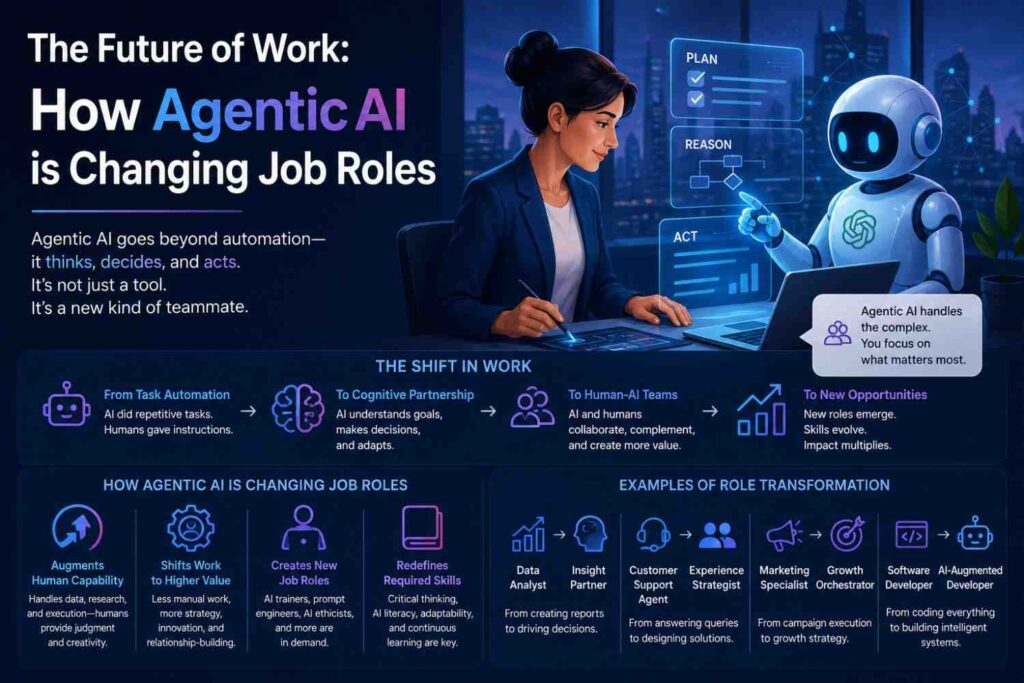
The workplace is moving into a new stage of artificial intelligence. For a long time, most people used AI as a simple assistant. They asked it to write emails, summarize documents, generate ideas, or answer basic questions. That was helpful, but it still required humans to control every step. Now, a more advanced form of AI is entering the workplace. It is called agentic AI.
The Future of Work: How Agentic AI is Changing Job Roles is one of the most important workplace topics today because agentic AI does not only respond to prompts. It can plan tasks, use tools, follow instructions, check information, take actions, and complete multi-step workflows with less human guidance. In simple words, agentic AI can behave more like a digital coworker than a basic chatbot.
This does not mean humans are becoming useless. In my view, the real change is that many jobs will shift from doing repetitive tasks to supervising intelligent systems. Employees will spend more time reviewing outputs, improving workflows, making judgment-based decisions, and handling complex human situations. Businesses will need new job roles, new policies, new skills, and new management models.
According to the World Economic Forum’s Future of Jobs Report 2025, job disruption is expected to affect a significant share of roles by 2030, with new roles being created while others are displaced. The same report highlights that AI, big data, cybersecurity, analytical thinking, resilience, leadership, and collaboration will become more important in the coming years.
That is why businesses should not treat agentic AI as only a software upgrade. It is a workforce transformation. It changes how people work, how teams are structured, how tasks are assigned, and how performance is measured. This article explains The Future of Work: How Agentic AI is Changing Job Roles in a clear, professional, and practical way.
What Agentic AI Means in the Future of Work
Agentic AI refers to artificial intelligence systems that can work toward a goal by planning, reasoning, using tools, and completing tasks. Unlike traditional automation, which follows fixed rules, agentic AI can handle more flexible and complex workflows. It can interpret instructions, access approved tools, make step-by-step decisions, and ask for human help when needed.
This is important for the future of work because many office jobs are made up of digital workflows. Employees read information, update systems, write messages, compare data, prepare reports, and coordinate tasks. Agentic AI can support these activities across departments such as sales, customer service, HR, finance, operations, IT, marketing, and legal.
Agentic AI Is More Than a Chatbot
A chatbot usually waits for a user to ask a question. It gives an answer and then stops. Agentic AI can go further. It can receive a goal and work through the required steps. For example, a chatbot can answer, “What should I write in a follow-up email?” But an AI sales agent can review CRM notes, check the last customer conversation, create a personalized email, suggest the best time to send it, and update the deal record after approval.
This is the difference between response and execution. Traditional AI helps with one task at a time. Agentic AI can support full workflows.
For example:
- A customer support agent can classify tickets, draft replies, and escalate urgent cases.
- A finance agent can compare invoices, flag missing details, and prepare approval notes.
- A recruitment agent can screen applications against job requirements and summarize candidates.
- A marketing agent can create a campaign brief, generate copy variations, and prepare a content calendar.
This does not remove the need for people. It changes the human role from manual task execution to workflow supervision.
AI Agents Can Use Tools and Follow Workflows
The biggest workplace value of agentic AI comes from tool use. An AI agent can be connected to approved tools such as CRMs, email systems, databases, project management platforms, help desks, HR systems, analytics dashboards, and internal knowledge bases.
This means agentic AI can work inside business processes instead of only giving general answers. It can retrieve information, update records, send drafts for approval, create reports, and coordinate handoffs between teams.
A practical agentic AI workflow may look like this:
| Workflow Step | Human Role | Agentic AI Role |
|---|---|---|
| Receive a task | Define business goal | Understand the requested outcome |
| Gather data | Approve data sources | Search approved systems |
| Analyze information | Check assumptions | Summarize patterns and gaps |
| Take action | Approve sensitive steps | Draft, update, route, or notify |
| Review results | Make final decision | Provide summary and next steps |
This type of workflow can reduce delays and improve consistency. However, it must be designed carefully with clear permissions and safety checks.
Human Oversight Still Matters
Agentic AI is powerful, but it is not perfect. It can misunderstand instructions, use incomplete information, create inaccurate outputs, or take the wrong action if guardrails are weak. That is why human oversight remains essential.
The future workplace will need human-in-the-loop systems. This means humans stay involved in sensitive, high-risk, emotional, legal, financial, or strategic decisions. AI can prepare the work, but humans approve the final outcome.
For example, an AI agent may draft a refund response, but a human should approve large refunds. An AI agent may summarize a legal contract, but a lawyer should verify the interpretation. An AI agent may recommend a hiring shortlist, but a human hiring team should make the final decision.
The best model is not “AI replaces humans.” The best model is “AI handles repeatable work while humans handle judgment.”
The Future of Work: How Agentic AI is Changing Job Roles Across Industries
The Future of Work: How Agentic AI is Changing Job Roles can already be seen across industries. The most affected roles are not always physical jobs. Many knowledge-work roles are changing because they depend on information processing, communication, coordination, analysis, and digital systems.
Industries such as banking, insurance, healthcare administration, ecommerce, education, logistics, real estate, law, marketing, and software development are likely to see major role redesign. Some tasks will be automated. Some will be improved. Some will require new human skills.
Office Roles Are Becoming AI-Supervised Roles
Office jobs often include repetitive digital work. Employees write updates, organize documents, respond to emails, prepare reports, enter data, schedule meetings, and track tasks. Agentic AI can help complete many of these activities.
For example, an administrative assistant may no longer spend most of the day manually scheduling, formatting reports, or chasing updates. Instead, they may supervise AI-generated schedules, review reports, manage exceptions, and coordinate more complex work.
A customer support representative may shift from writing every reply manually to reviewing AI-suggested responses, handling escalations, and improving the knowledge base. A finance assistant may move from entering invoice data to checking exceptions, validating AI flags, and improving approval workflows.
This creates a new type of office role: the AI-supervised professional. These workers do not simply complete tasks. They manage AI-assisted task flows.
Technical Roles Are Moving Toward AI Orchestration
Technical roles are also changing. Developers, data analysts, IT teams, automation engineers, and cybersecurity professionals will still be important, but their responsibilities will evolve.
Developers may use AI agents to generate code, test functions, review documentation, or manage debugging workflows. Data analysts may use AI agents to clean data, produce first-draft insights, generate SQL queries, and explain dashboards. IT teams may use agents to monitor tickets, troubleshoot common issues, and recommend fixes.
But technical professionals will also need to design, test, and govern AI systems. This means new responsibilities such as:
- Building AI workflows
- Connecting business tools
- Testing agent behavior
- Monitoring performance
- Reviewing security risks
- Managing access permissions
- Evaluating output accuracy
- Creating fallback processes
In short, technical workers will move from only building systems to orchestrating intelligent systems.
Customer-Facing Roles Are Becoming More Strategic
Customer-facing jobs will also change. Salespeople, support agents, consultants, account managers, recruiters, advisors, and service teams will use agentic AI to prepare faster and respond better.
For example, a salesperson can use an AI agent to summarize a prospect’s business, review previous interactions, suggest pain points, create a personalized pitch, and prepare follow-up notes. This saves time, but the human still builds trust, handles objections, negotiates terms, and understands emotional signals.
Customer service teams can use agentic AI to answer routine questions, route tickets, summarize cases, and suggest solutions. But humans remain essential for angry customers, sensitive complaints, complex refunds, legal issues, and relationship management.
This means customer-facing roles will become less about repetitive communication and more about relationship intelligence.
New Job Roles Created by Agentic AI
Agentic AI will not only change existing jobs. It will also create new job roles. These roles will sit between business strategy, operations, technology, data, and risk management. Many companies will need people who understand both human workflows and AI systems.
Microsoft’s 2025 Work Trend Index highlighted emerging AI-related roles such as AI trainer, AI data specialist, AI security specialist, AI agent specialist, AI ROI analyst, AI media and content manager, AI business process consultant, and Chief AI Officer.
AI Agent Specialist
An AI agent specialist designs, tests, improves, and manages AI agents inside business workflows. This role requires business understanding, prompt design, process mapping, quality review, and technical awareness.
An AI agent specialist may work on:
- Customer support agents
- Sales research agents
- HR onboarding agents
- Finance review agents
- Marketing campaign agents
- Internal knowledge agents
- IT help desk agents
Their job is to make sure agents understand the goal, use the right tools, follow company policies, and produce reliable results.
This role is important because poorly designed agents can create confusion, errors, and compliance risks. A strong AI agent specialist helps businesses turn AI from a general tool into a practical workflow system.
AI Workforce Manager
An AI workforce manager leads teams where humans and AI agents work together. This role is different from a traditional manager because it includes both people management and digital workforce management.
The AI workforce manager must decide:
- Which tasks should humans handle?
- Which tasks can AI agents support?
- Which tasks need approval?
- How should performance be measured?
- How should errors be tracked?
- How should employees be trained?
- How should agent behavior be improved?
Comparison table:
| Traditional Manager | AI Workforce Manager |
|---|---|
| Manages human employees | Manages humans and AI agents |
| Assigns manual tasks | Designs human-AI workflows |
| Reviews employee performance | Reviews team and agent performance |
| Focuses on productivity | Focuses on productivity, safety, and accuracy |
| Handles team communication | Handles communication, automation, and governance |
| Improves human processes | Improves human and AI-assisted processes |
This role will become more common as businesses treat AI agents as part of their operating model.
AI Governance and Risk Lead
The more agentic AI takes action, the more governance becomes necessary. An AI governance and risk lead creates rules for safe, responsible, and compliant AI use.
This role may manage:
- Data privacy policies
- AI access controls
- Human approval rules
- Audit logs
- Bias testing
- Model evaluation
- Security reviews
- Vendor risk
- Compliance requirements
- Employee AI usage policies
This role is especially important in regulated industries such as finance, healthcare, insurance, education, legal services, and government-related work.
AI governance is not about blocking innovation. It is about making innovation safe enough to scale.
Skills Employees Need in the Agentic AI Workplace
The Future of Work: How Agentic AI is Changing Job Roles is also about skills. Employees do not all need to become AI engineers. But almost every knowledge worker will need basic AI literacy.
The most successful employees will know how to guide AI, check its work, improve workflows, and apply human judgment. They will understand that AI is useful, but not always correct.
AI Literacy Becomes a Core Workplace Skill
AI literacy means knowing how AI works at a practical level. It does not mean understanding every technical detail. It means knowing how to use AI safely and effectively.
Employees should understand:
- How to write clear prompts
- How to define task goals
- How to verify AI outputs
- How to protect confidential data
- How to identify hallucinations
- How to review sources
- How to escalate risky outputs
- How to use approved tools only
AI literacy will become similar to spreadsheet literacy or email literacy. It will be a basic workplace requirement.
A simple AI literacy framework:
| Skill Area | What It Means | Workplace Example |
|---|---|---|
| Prompting | Giving clear instructions | Asking AI for a structured report |
| Verification | Checking output accuracy | Confirming facts and numbers |
| Data awareness | Protecting sensitive data | Avoiding private customer details |
| Workflow thinking | Understanding process steps | Designing approval flows |
| Risk awareness | Knowing when AI may fail | Escalating legal or financial cases |
Human Skills Become More Valuable
As AI handles more routine work, human skills become more important, not less. Machines can process data quickly, but humans are better at empathy, leadership, negotiation, ethics, creativity, and social understanding.
Important human skills include:
- Critical thinking
- Creative problem solving
- Emotional intelligence
- Collaboration
- Leadership
- Communication
- Ethical judgment
- Adaptability
- Strategic thinking
For example, AI can draft a performance review, but a manager must deliver it with empathy. AI can summarize customer feedback, but a product leader must decide what matters most. AI can draft a sales proposal, but a salesperson must build trust and close the relationship.
The future workplace will reward people who combine technical confidence with human maturity.
Process Thinking Will Separate Strong Workers
Process thinking means understanding how work actually gets done. Employees who understand workflows will use agentic AI better than employees who only use it for quick answers.
For example, a weak AI user may ask, “Write me a report.” A strong AI user will say, “Create a weekly sales report using these data points, compare this week with last week, highlight three risks, identify two opportunities, and prepare a manager summary.”
Process thinking includes:
- Knowing the goal
- Identifying required data
- Understanding approval points
- Recognizing risks
- Defining quality standards
- Measuring outcomes
- Improving the workflow over time
This skill will separate average workers from high-value AI-enabled professionals.
Business Benefits and Risks of Agentic AI
Agentic AI can create major benefits for businesses, but only when used carefully. Companies that rush into agentic AI without governance may face errors, privacy issues, security risks, and employee resistance.
A responsible business strategy should balance speed with control.
Agentic AI Can Improve Productivity and Decision-Making
Agentic AI can reduce repetitive manual work and help employees focus on higher-value tasks. It can summarize information, route tasks, update systems, generate drafts, and prepare decision-ready reports.
Business benefits include:
- Faster customer response times
- Shorter reporting cycles
- Better internal knowledge access
- Reduced manual data entry
- Improved workflow consistency
- Better task prioritization
- Faster research and analysis
- Stronger decision support
For example, instead of a manager manually collecting updates from five departments, an AI agent can gather approved updates, create a summary, highlight blockers, and prepare next steps. The manager can then focus on decisions rather than chasing information.
Poor Governance Can Create New Risks
Agentic AI becomes risky when it has too much access, too little oversight, or unclear instructions. If an agent can send emails, update records, approve actions, or access sensitive files, the company needs strong controls.
Common risks include:
- Data leakage
- Incorrect actions
- Compliance failures
- Biased recommendations
- Security vulnerabilities
- Poor audit trails
- Lack of accountability
- Employee overreliance
- Customer trust issues
For example, an AI agent that sends customer emails without review may accidentally share wrong information. An HR agent that screens candidates without bias checks may create fairness issues. A finance agent that approves payments without controls may create fraud risk.
Governance must be built into the workflow from day one.
The Best Strategy Is Human-AI Collaboration
The best business model is not full automation for every task. The best model is human-AI collaboration. AI should handle repeatable, structured, and data-heavy work. Humans should handle judgment, empathy, ethics, strategy, and final approval.
A smart collaboration model looks like this:
| Task Type | Best Owner |
|---|---|
| Repetitive data entry | AI agent |
| Report first draft | AI agent |
| Final business decision | Human |
| Sensitive customer issue | Human with AI support |
| Legal interpretation | Human expert |
| Workflow monitoring | Human and AI together |
| Pattern detection | AI agent |
| Strategic planning | Human with AI insights |
This balanced approach helps businesses gain productivity without losing control.
How Businesses Should Prepare for Agentic AI Job Changes
Businesses should prepare for agentic AI with a structured workforce plan. It should not be treated only as a technology rollout. It should be treated as a people, process, and governance transformation.
Companies that prepare early will reduce fear, improve adoption, and create better results.
Step 1: Identify Tasks, Not Just Job Titles
The first step is to study tasks inside each job role. A job title is too broad. For example, a marketing manager may write content, review analytics, manage campaigns, coordinate designers, report to leadership, and communicate with clients. Some tasks can be AI-supported, but others require human judgment.
Task mapping table:
| Job Role | Tasks AI Can Support | Human-Led Tasks |
|---|---|---|
| Customer Support Agent | FAQs, summaries, ticket routing | Angry customers, complex complaints |
| Sales Representative | Research, email drafts, CRM notes | Negotiation, relationship building |
| HR Manager | Onboarding docs, policy summaries | Sensitive employee discussions |
| Data Analyst | SQL drafts, trend summaries | Data validation, strategy insights |
| Marketer | Ad copy, content briefs, captions | Brand strategy, creative direction |
| Finance Officer | Invoice checks, report drafts | Approvals, risk decisions |
| Project Manager | Status summaries, reminders | Team leadership, conflict resolution |
This helps businesses redesign roles without making emotional or rushed decisions.
Step 2: Train Employees Before Scaling AI
Training is one of the most important parts of AI adoption. Employees may feel threatened by AI if they do not understand it. Training helps them see AI as a tool, not only as a risk.
Training should cover:
- What agentic AI is
- How AI agents work
- How to write prompts
- How to review AI outputs
- How to protect data
- How to identify errors
- How to use approved tools
- How to report problems
- How job roles will evolve
Employees should also be involved in designing workflows. Frontline teams often understand process problems better than executives. When employees help shape AI adoption, they are more likely to trust it.
Step 3: Build Governance Into Every AI Workflow
AI governance should not be added after problems appear. It should be included from the beginning.
Every agentic AI workflow should answer these questions:
- What is the agent allowed to do?
- What data can it access?
- What data is restricted?
- What actions need human approval?
- Who is responsible for errors?
- How are outputs checked?
- How are logs stored?
- How often is performance reviewed?
- What happens if the agent fails?
Governance also improves confidence. Leaders can scale AI faster when they know risks are managed properly.
A professional AI governance checklist:
| Governance Area | Key Question |
|---|---|
| Access control | Can the agent access only what it needs? |
| Human approval | Which actions require review? |
| Accuracy testing | How often is output quality checked? |
| Privacy | Is sensitive data protected? |
| Security | Can the agent be misused? |
| Auditability | Can decisions be traced? |
| Accountability | Who owns the final result? |
| Compliance | Does the workflow follow regulations? |
Frequently Asked Questions
What is agentic AI in the workplace?
Agentic AI in the workplace refers to AI systems that can plan, use tools, follow workflows, and complete multi-step tasks with some independence. Unlike basic chatbots, agentic AI can support real business processes such as updating records, preparing reports, routing tickets, and coordinating tasks across approved systems.
Will agentic AI replace jobs?
Agentic AI will replace some repetitive tasks, but it will also redesign many jobs and create new roles. Most workers will not simply disappear from workflows. Instead, they will need to supervise AI outputs, manage exceptions, make final decisions, and focus on human skills such as judgment, empathy, leadership, and strategy.
Which jobs are most affected by agentic AI?
Jobs involving routine digital work are most affected. These include administrative support, customer service, sales operations, marketing production, HR documentation, finance reporting, data processing, and basic analysis. However, many of these jobs will evolve rather than vanish completely because humans are still needed for oversight and complex decisions.
What new jobs will agentic AI create?
Agentic AI can create roles such as AI agent specialist, AI workforce manager, AI governance lead, AI trainer, AI data specialist, AI security specialist, AI workflow designer, AI operations manager, AI ROI analyst, and Chief AI Officer. These roles combine business process knowledge, technical understanding, and responsible AI management.
What skills do employees need for agentic AI?
Employees need AI literacy, prompt writing, critical thinking, data awareness, process thinking, communication, creativity, and ethical judgment. Technical employees may also need skills in tool integration, model evaluation, AI security, workflow automation, agent monitoring, and AI governance.
How can companies prepare employees for agentic AI?
Companies should map tasks, identify AI-ready workflows, train employees, create usage policies, set approval processes, and involve teams early. The goal is not only to install AI tools. The goal is to help employees understand how their work will change and how they can move into higher-value responsibilities.
Is agentic AI safe for business use?
Agentic AI can be safe when companies use access controls, human approval, audit trails, testing, data privacy rules, and governance frameworks. It becomes risky when agents are allowed to take sensitive actions without review or when employees use unapproved AI tools outside company policy.
How is agentic AI different from generative AI?
Generative AI creates outputs such as text, images, summaries, and code. Agentic AI goes further by planning steps, using tools, taking actions, and completing workflows. In simple words, generative AI helps create content, while agentic AI helps complete tasks and business processes.
Conclusion
The Future of Work: How Agentic AI is Changing Job Roles shows that the workplace is moving toward a new model of human-AI collaboration. Agentic AI will automate routine tasks, support complex workflows, create new job roles, and push employees to build stronger digital and human skills.
I do not see agentic AI as only a job replacement story. I see it as a job redesign story. Some tasks will disappear, but many roles will become more strategic. Employees will need to manage AI tools, review outputs, improve workflows, and make better decisions with AI support.
Businesses that prepare early will gain a clear advantage. They will build smarter workflows, train stronger teams, reduce operational bottlenecks, and use AI responsibly. Workers who develop AI literacy, process thinking, communication, and critical judgment will be better prepared for the future.
The future of work will not belong only to humans or only to AI. It will belong to people and organizations that know how to combine both intelligently, ethically, and strategically.
Comments are closed, but trackbacks and pingbacks are open.