
Top 10 Use Cases for Agentic AI in Business
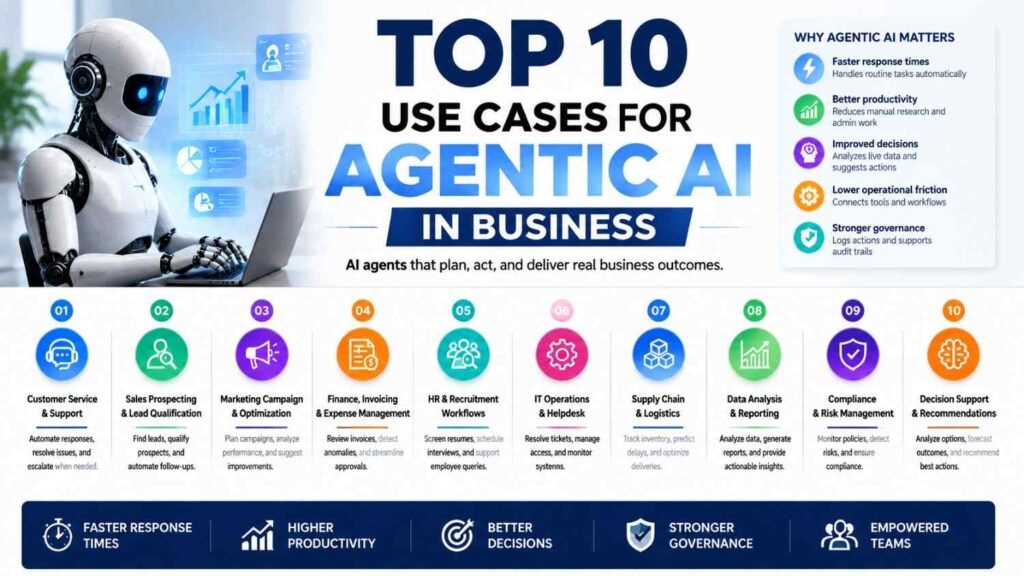
Agentic AI is becoming one of the most important shifts in business technology. Unlike basic chatbots or simple automation tools, agentic AI can plan tasks, use tools, follow workflows, make decisions, and act with limited human input. I see it as the next step after generative AI because it does not only create content. It helps complete real work.
Businesses are now looking for smarter ways to reduce manual effort, improve customer experience, speed up decision-making, and connect data across teams. This is where the Top 10 Use Cases for Agentic AI in Business become useful. From customer support and sales to finance, HR, IT, and supply chain, AI agents can support teams by handling repeatable tasks and guiding complex workflows.
However, agentic AI is not magic. It needs clean data, clear rules, human oversight, security controls, and strong governance. When used correctly, it can become a practical business partner that works beside employees instead of replacing strategy, creativity, and judgment.
What Is Agentic AI in Business?
Agentic AI refers to AI systems that can take action toward a goal. These systems can understand instructions, break work into steps, use business tools, check results, and continue until the task is complete. In a business setting, this may include updating CRM records, creating reports, checking invoices, replying to customers, or escalating issues to the right team.
How Agentic AI Is Different From Traditional Automation
Traditional automation follows fixed rules. For example, if a customer fills out a form, the system sends an email. Agentic AI is more flexible. It can read the customer’s message, understand the intent, check account history, suggest a solution, and decide whether the issue needs a human agent.
This makes AI workflow automation more useful for tasks that involve judgment, language, data, and multiple systems. It is not just “if this, then that.” It is closer to a digital worker that can reason through steps.
Why Businesses Are Moving Toward AI Agents
Companies are adopting AI agents because work is becoming faster, more digital, and more complex. Teams deal with emails, dashboards, CRMs, ERPs, analytics tools, support tickets, and compliance systems every day. AI agents can connect these systems and reduce the time employees spend moving information from one place to another.
The real value comes when agentic AI in business supports high-volume workflows, improves accuracy, and gives employees more time for strategic work.
Quick Data Table: Why Agentic AI Matters
| Business Need | How Agentic AI Helps | Example |
|---|---|---|
| Faster response times | Handles routine tasks automatically | Customer support agent replies to common tickets |
| Better productivity | Reduces manual research and admin work | Sales agent updates CRM notes |
| Improved decisions | Analyzes live data and suggests actions | Finance agent flags unusual spending |
| Lower operational friction | Connects tools and workflows | HR agent schedules interviews |
| Stronger governance | Logs actions and supports audit trails | Compliance agent tracks policy checks |
Top 10 Use Cases for Agentic AI in Business
The Top 10 Use Cases for Agentic AI in Business cover practical areas where AI agents can create measurable value. These use cases are not limited to large enterprises. Small and mid-sized companies can also start with focused workflows, such as customer support, lead qualification, reporting, or marketing operations.
1. Customer Service and Support Automation
Customer service is one of the strongest use cases for AI agents. An agent can answer common questions, check order status, summarize customer history, create support tickets, and escalate complex issues to a human representative.
For example, an e-commerce business can use an AI customer service agent to handle refund questions, delivery updates, product information, and complaint routing. This improves response time and helps human agents focus on sensitive or complex cases.
2. Sales Prospecting and Lead Qualification
Sales teams spend many hours researching leads, writing follow-ups, updating CRM data, and checking buyer signals. Agentic AI can automate much of this work. A sales AI agent can identify potential leads, qualify them based on company size or interest level, create personalized outreach drafts, and remind salespeople when follow-up is needed.
This does not remove the human sales role. Instead, it gives sales teams better preparation and cleaner data.
3. Marketing Campaign Planning and Optimization
Agentic AI can help marketers plan campaigns, research audiences, generate content briefs, analyze performance, and suggest next steps. For example, an AI marketing agent can review ad performance, compare landing page results, and recommend budget shifts.
In content marketing, an agent can support keyword research, competitor analysis, internal linking, content updates, and topic clustering. This is useful for SEO, AEO, and GEO because search is becoming more answer-focused and AI-driven.
Agentic AI Use Cases for Operations, Finance, and HR
Agentic AI is not only for front-office teams. It can also improve back-office processes where employees deal with repeated tasks, documents, approvals, and data checks.
4. Finance, Invoicing, and Expense Management
Finance teams can use AI agents to review invoices, match purchase orders, detect unusual expenses, prepare reports, and send approval reminders. This helps reduce manual checking and improves financial control.
For example, if an invoice amount does not match the approved purchase order, the agent can flag it and send it to the finance manager. This supports faster payment cycles and fewer errors.
5. Human Resources and Recruitment Workflows
HR teams handle job posts, resumes, interviews, employee questions, onboarding documents, and policy updates. An AI HR agent can screen applications based on defined criteria, schedule interviews, answer employee FAQs, and guide new hires through onboarding.
The important point is fairness. HR agents should not make final hiring decisions without human review. They should support consistency, save time, and improve candidate experience.
6. Supply Chain and Inventory Planning
Supply chain teams manage suppliers, stock levels, delivery timelines, demand forecasts, and risk alerts. Agentic AI can monitor inventory, compare supplier performance, detect delays, and suggest reorder actions.
For example, if demand rises for a product and stock is low, the agent can notify the procurement team, check supplier lead times, and prepare a purchase request. This makes supply chain operations more proactive.
Agentic AI Use Cases for IT, Security, and Compliance
IT and security teams are under pressure to manage complex systems, respond to threats, and maintain compliance. AI agents can help by monitoring systems, analyzing alerts, and supporting faster response.
7. IT Helpdesk and Internal Support
An AI IT agent can troubleshoot common issues, reset passwords through approved workflows, create tickets, check device status, and guide employees through software problems. This reduces pressure on IT teams and gives employees faster help.
For example, if an employee cannot access a business tool, the agent can verify identity, check permissions, and route the request to the right admin if needed.
8. Cybersecurity Monitoring and Incident Response
Agentic AI can help security teams review alerts, detect suspicious behavior, summarize incidents, and recommend response steps. It can also support phishing analysis, access review, and vulnerability triage.
Still, security agents need strict permissions. They should operate within approved boundaries because too much autonomy can create risk. Human oversight, logging, and access controls are essential.
9. Compliance, Risk, and Audit Support
Compliance teams often review policies, contracts, reports, and audit evidence. An AI compliance agent can check whether documents meet internal standards, track missing approvals, and prepare audit summaries.
This use case is valuable in regulated industries such as finance, healthcare, insurance, and legal services. However, final compliance decisions should remain with qualified professionals.
Agentic AI for Strategy, Analytics, and Decision Intelligence
Business leaders need faster insight from large amounts of data. Agentic AI can help teams move from static dashboards to action-oriented intelligence.
10. Business Intelligence and Executive Decision Support
An AI decision agent can monitor KPIs, summarize dashboard changes, explain trends, and recommend actions. For example, if sales drop in one region, the agent can check marketing spend, lead volume, customer complaints, and inventory issues before creating a summary for leadership.
This helps executives make faster and more informed decisions.
Predictive Analytics and Scenario Planning
Agentic AI can support forecasting by testing different business scenarios. A finance or operations team can ask what may happen if demand increases, costs rise, or supplier delays continue. The agent can analyze available data and prepare possible outcomes.
This is useful for planning budgets, staffing, pricing, and inventory.
Knowledge Management and Internal Research
Many companies lose time because knowledge is scattered across emails, documents, chats, and tools. Agentic AI can search internal knowledge, summarize policies, find past decisions, and answer employee questions.
This turns company knowledge into a more usable asset.
How to Implement Agentic AI in Business Safely
The best way to adopt agentic AI is to start small, measure results, and build trust. Businesses should not give AI agents full control from day one. They should begin with low-risk workflows and expand after testing.
Start With High-Value, Low-Risk Workflows
I recommend starting with tasks that are repetitive, measurable, and easy to review. Good examples include ticket summaries, CRM updates, invoice checks, meeting notes, and internal FAQs.
Avoid starting with sensitive decisions such as hiring, legal approval, medical advice, or financial authorization unless strong oversight is in place.
Build Human-in-the-Loop Controls
Human-in-the-loop means a person reviews or approves important AI actions. This is important because agentic AI can make mistakes, misunderstand context, or take actions that need judgment.
For example, an AI agent may prepare a refund, but a human manager approves it before money is returned.
Use Governance, Security, and Audit Logs
Every business should define what the agent can access, what it can change, and when it must stop. Security teams should monitor prompt injection, data leakage, tool misuse, and unauthorized actions.
Good governance includes clear permissions, logs, testing, model evaluation, privacy reviews, and escalation rules.
Benefits and Challenges of Agentic AI in Business
The Top 10 Use Cases for Agentic AI in Business show strong potential, but leaders must balance benefits with risks. The goal is not to automate everything. The goal is to improve workflows while keeping people accountable.
Key Business Benefits
Agentic AI can improve productivity, speed, customer experience, and decision quality. It can help teams complete work faster and reduce manual handoffs. It also supports personalization because agents can use business data to respond in a more relevant way.
For growing companies, AI agents can help scale operations without adding unnecessary complexity.
Common Challenges and Risks
The biggest challenges include poor data quality, weak integrations, unclear ownership, employee resistance, and security risk. AI agents can also produce wrong answers if they rely on incomplete or outdated information.
Another challenge is over-automation. Not every workflow should be handled by an AI agent. Sensitive, emotional, legal, and high-risk tasks need human judgment.
Practical Readiness Checklist
| Readiness Area | Key Question |
|---|---|
| Business goal | What problem should the agent solve? |
| Data quality | Is the data accurate and accessible? |
| Tool access | Which systems can the agent use? |
| Human review | Which actions need approval? |
| Security | What permissions and logs are required? |
| Success metric | How will we measure value? |
Frequently Asked Questions
What is the main purpose of agentic AI in business?
The main purpose of agentic AI in business is to help teams complete tasks more intelligently. It can plan work, use tools, analyze data, and take approved actions. Businesses use it to improve productivity, customer support, sales workflows, reporting, finance operations, and decision-making.
How is agentic AI different from generative AI?
Generative AI creates text, images, code, or summaries based on prompts. Agentic AI goes further by taking action. It can break a task into steps, connect with tools, check progress, and complete workflows. In simple words, generative AI responds, while agentic AI acts.
What are the best first use cases for AI agents?
The best first use cases are low-risk and high-volume tasks. These include customer support FAQs, CRM updates, meeting summaries, invoice checks, internal knowledge search, and IT helpdesk requests. These tasks are easier to measure and safer to review before expanding into advanced automation.
Can small businesses use agentic AI?
Yes, small businesses can use agentic AI. They can start with simple workflows such as lead follow-up, customer messages, appointment booking, content planning, and reporting. The key is to choose one clear problem, connect the right tools, and keep human approval for important actions.
Is agentic AI safe for business operations?
Agentic AI can be safe when businesses use strong controls. These include limited permissions, human approval, audit logs, data privacy rules, and regular testing. Without governance, AI agents can create risks such as wrong actions, data exposure, or tool misuse.
Will agentic AI replace employees?
Agentic AI is more likely to change work than fully replace employees. It can take over repetitive tasks, but humans are still needed for strategy, creativity, relationship-building, judgment, and accountability. The best results come when employees and AI agents work together.
Which departments benefit most from agentic AI?
Customer service, sales, marketing, finance, HR, IT, cybersecurity, compliance, and operations can all benefit. The strongest results usually appear where teams handle repeatable workflows, large amounts of data, frequent requests, and multiple software tools.
Conclusion
The Top 10 Use Cases for Agentic AI in Business show that AI agents are moving from simple assistance to real workflow execution. They can help with customer support, sales, marketing, finance, HR, supply chain, IT, cybersecurity, compliance, analytics, and decision support.
In my view, the businesses that win with agentic AI will not be the ones that automate the fastest. They will be the ones that choose the right use cases, protect customer data, train employees, measure results, and keep human judgment in the loop.
Agentic AI should be treated as a business capability, not just a software trend. Start small, test carefully, improve your data, and build governance from the beginning.
Comments are closed, but trackbacks and pingbacks are open.