
Comparing Agentic AI Solutions
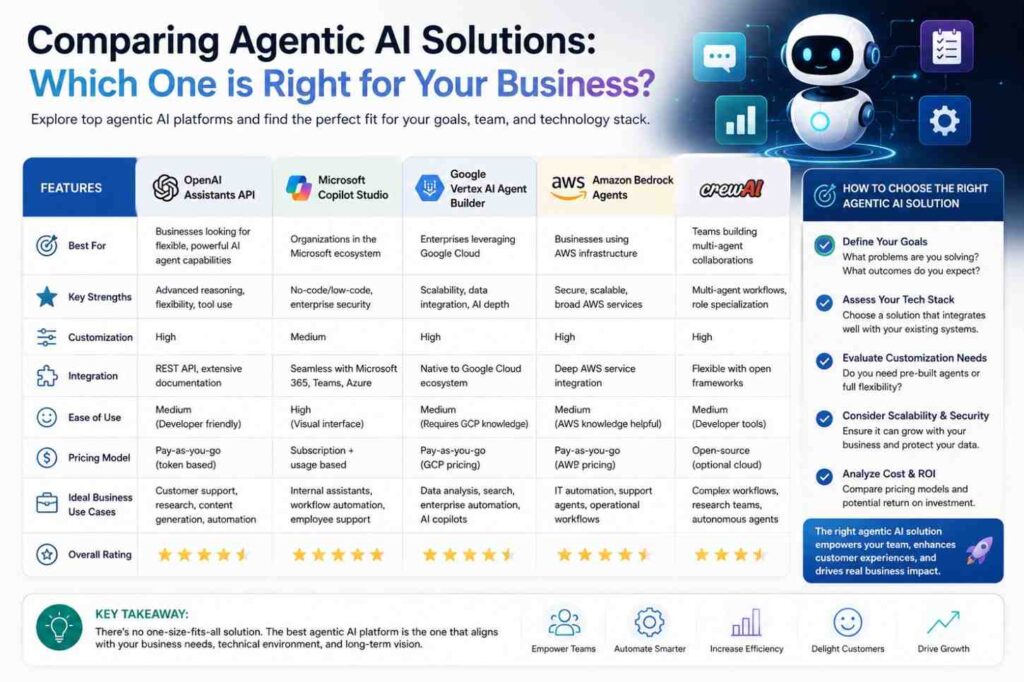
Agentic AI is becoming one of the most important technology trends for modern businesses. Unlike traditional chatbots that only respond to prompts, agentic AI solutions can plan tasks, use tools, access approved data, follow workflows, and complete multi-step actions with a level of autonomy. This makes them useful for sales, customer service, marketing, HR, finance, IT, operations, product teams, and executive decision support.
But choosing the right platform is not simple. There are now many agentic AI solutions in the market, including OpenAI Agents, Microsoft Copilot Studio, Salesforce Agentforce, IBM watsonx Orchestrate, Google Vertex AI Agent Builder, Amazon Bedrock Agents, ServiceNow AI Agents, and developer frameworks such as LangGraph. Each one has different strengths, integrations, governance features, technical requirements, and ideal business use cases.
That is why Comparing Agentic AI Solutions: Which One is Right for Your Business? is a high-value question for business leaders, founders, CIOs, CTOs, marketing managers, operations teams, and digital transformation consultants. The wrong solution can waste money, create security risks, and fail to deliver ROI. The right solution can reduce repetitive work, improve response time, support employees, and create smarter workflows.
In my professional view, the best agentic AI solution is not always the most popular tool. It is the one that fits your business model, internal systems, data maturity, compliance needs, team skills, and long-term automation strategy. A small business may need a low-code AI assistant for customer support. A SaaS company may need a custom AI agent inside its product. A large enterprise may need governed multi-agent orchestration across many departments.
This article gives you a practical, professional, and SEO-friendly comparison of agentic AI platforms. I will explain what these solutions are, how to compare them, which platforms are best for different business needs, and how to choose the right one with less risk.
What Are Agentic AI Solutions?
Agentic AI solutions are platforms, frameworks, or tools that help businesses create AI agents capable of completing tasks with more independence than a normal chatbot. These agents can understand a goal, break it into steps, use tools, retrieve data, make recommendations, and sometimes take actions after approval.
A basic AI tool may answer a question. An agentic AI solution can help complete a workflow. For example, instead of only explaining how to handle a customer complaint, an AI agent can review the ticket, check the customer’s history, classify the issue, draft a response, recommend compensation, and route the case to a manager.
This shift is important because businesses do not only need answers. They need work completed faster, more accurately, and with less manual effort.
Agentic AI vs Traditional Chatbots
Traditional chatbots are usually conversation-based. They answer questions, provide basic support, or guide users through simple steps. They often follow scripted flows or respond to one prompt at a time. Agentic AI is more advanced because it can reason through a goal and complete a sequence of actions.
For example, a traditional chatbot may answer, “Your refund policy allows returns within 30 days.” An AI support agent may check the order date, confirm eligibility, create a refund request, draft a customer message, and ask a human to approve the final refund.
This difference matters because modern businesses are full of multi-step digital tasks. Employees move between CRM systems, emails, spreadsheets, analytics tools, help desks, calendars, and internal knowledge bases. Agentic AI solutions can connect these steps into a smarter workflow.
In simple terms:
| Feature | Traditional Chatbot | Agentic AI Solution |
|---|---|---|
| Main Function | Answers questions | Completes workflows |
| Task Type | Single-step | Multi-step |
| Tool Use | Limited | Stronger tool and API use |
| Business Impact | Basic support | Automation and decision support |
| Human Role | User asks questions | User supervises and approves |
| Best For | FAQs and simple guidance | Sales, support, IT, HR, operations, finance |
Why Businesses Are Comparing Agentic AI Platforms Now
Businesses are comparing agentic AI platforms now because AI adoption is moving from experimentation to real business execution. Many teams have already tested generative AI for writing, summarizing, brainstorming, and coding. Now they want AI systems that can take practical action across business tools.
This creates a more serious buying decision. Companies are no longer asking, “Can AI write a paragraph?” They are asking, “Can AI reduce support workload, improve sales follow-ups, speed up onboarding, automate reporting, and connect with our existing systems?”
The comparison is also important because agentic AI affects security and operations. If an AI agent can access customer records, send messages, update fields, or trigger workflows, the company must think about permissions, audit logs, compliance, accuracy, and accountability.
Before buying any solution, businesses should ask:
- What business workflow do we want to improve?
- Which tools does the agent need to access?
- What actions should require human approval?
- Can the platform handle our data security requirements?
- Does it integrate with our existing software?
- Can non-technical users manage it?
- Can developers customize it?
- How will we measure ROI?
A good agentic AI strategy begins with these questions, not with a software demo.
AEO Answer: What Is the Best Agentic AI Solution?
The best agentic AI solution is the one that matches your business workflow, existing software stack, security needs, budget, and technical resources. OpenAI Agents are strong for custom AI applications, Microsoft Copilot Studio fits Microsoft 365 workflows, Salesforce Agentforce works well for CRM use cases, IBM watsonx Orchestrate supports enterprise orchestration, ServiceNow AI Agents fit IT and service workflows, and LangGraph is useful for developer-led multi-agent systems.
For a quick answer, choose based on your main environment. If your company runs on Microsoft tools, start with Copilot Studio. If your customer data lives in Salesforce, review Agentforce. If your workflows run on AWS or Google Cloud, compare Bedrock Agents and Vertex AI Agent Builder. If you need a custom AI product, evaluate OpenAI Agents or LangGraph.
Key Criteria for Comparing Agentic AI Solutions
Before you compare platforms, you need a clear evaluation framework. Without one, it is easy to choose a tool because of brand recognition, sales pressure, or hype. A better approach is to define the business problem first, then match the solution to that problem.
When I compare agentic AI solutions, I look at workflow fit, integration depth, governance, security, ease of use, developer flexibility, scalability, cost, vendor maturity, and long-term control. These factors matter because agentic AI is not just a content tool. It can become part of the company’s operating system.
Use Case Fit and Workflow Depth
The first question is simple: what do you want the AI agent to do? A platform that works well for customer service may not be the best choice for product development. A tool that is strong for internal knowledge search may not be strong for multi-agent engineering workflows.
A business should start with use cases such as:
- Customer support ticket classification
- Sales prospect research
- CRM follow-up automation
- HR onboarding support
- Finance invoice review
- IT help desk triage
- Internal policy search
- Marketing campaign planning
- Executive reporting
- Data analysis support
Use case fit table:
| Business Need | Best-Fit Solution Type |
|---|---|
| Custom AI assistant or SaaS feature | OpenAI Agents, LangGraph |
| Microsoft 365 workflow automation | Microsoft Copilot Studio |
| CRM, sales, service, and marketing | Salesforce Agentforce |
| IT, HR, and service management | ServiceNow AI Agents |
| Enterprise orchestration | IBM watsonx Orchestrate |
| AWS-native automation | Amazon Bedrock Agents |
| Google Cloud AI development | Google Vertex AI Agent Builder |
| Complex multi-agent architecture | LangGraph |
The deeper the workflow, the more important tool integration and governance become. A simple FAQ bot needs less control. A finance agent that reviews invoices and prepares approvals needs much stronger oversight.
Integration, Security, and Governance
Agentic AI becomes valuable when it connects with business tools. But every integration creates responsibility. If an agent can access customer data, update records, send emails, or interact with APIs, the company must control what it can and cannot do.
Strong governance features include:
- Role-based access control
- Human approval checkpoints
- Audit logs
- Tool permission limits
- Data privacy controls
- Secure API handling
- Monitoring and evaluation
- Error recovery
- Compliance support
- Admin controls
- Prompt and response logging where appropriate
This is especially important in industries such as healthcare, finance, insurance, legal services, education, ecommerce, and enterprise SaaS.
A simple governance decision table:
| Risk Level | Example Workflow | Recommended Control |
|---|---|---|
| Low Risk | Meeting summary | Basic review |
| Medium Risk | Customer email draft | Human approval before sending |
| High Risk | Refund or payment action | Manager approval and audit log |
| Very High Risk | Legal, medical, financial decision | Expert review and strict access control |
The best agentic AI platform should help the business move fast without losing control.
Ease of Use vs Developer Flexibility
Some agentic AI solutions are designed for business users. Others are designed for developers. This is one of the most important differences.
Low-code platforms are useful when non-technical teams need to build or manage agents. Developer-first platforms are better when the business needs custom logic, product integration, advanced orchestration, or unique workflows.
Comparison table:
| Business Type | Better Choice |
|---|---|
| Small business with limited technical staff | Low-code agent builder |
| Enterprise with IT governance needs | Enterprise AI platform |
| SaaS startup building AI features | Developer API or framework |
| CRM-heavy business | CRM-native AI agent platform |
| Cloud-native engineering team | Cloud provider agent platform |
| Business with unique processes | Custom framework or API |
| Non-technical department team | No-code or low-code platform |
There is no universal winner. A business should choose the platform that its team can actually deploy, maintain, and improve.
Comparing Leading Agentic AI Solutions
Comparing Agentic AI Solutions: Which One is Right for Your Business? becomes easier when you group platforms by their strongest business use cases. Each solution has a different center of gravity. Some are best for custom development. Some are best for enterprise systems. Some are best for CRM, service management, or cloud-native workflows.
The following comparison focuses on practical business fit rather than hype.
OpenAI Agents for Custom AI Applications
OpenAI Agents are a strong choice for companies that want to build custom AI agents, AI assistants, internal tools, or AI-powered product features. OpenAI’s Agents SDK and Responses API give developers a way to build agents that use instructions, tools, and application logic.
OpenAI is a strong fit for:
- Custom AI assistants
- AI SaaS products
- Research agents
- Customer support agents
- Internal productivity tools
- Content automation
- Knowledge base assistants
- Developer-led workflows
- AI copilots inside business apps
The main advantage is flexibility. Developers can design agents around specific company needs instead of forcing the business into a fixed workflow. For example, a fintech company can build a compliance review assistant. A marketplace can build a seller support agent. A SaaS company can build an AI onboarding assistant inside its platform.
The main limitation is implementation responsibility. Businesses need developers, security planning, monitoring, evaluation, and maintenance. OpenAI can provide powerful building blocks, but the business must design the full workflow responsibly.
Best for: companies that want custom AI applications and have technical resources.
Microsoft Copilot Studio for Microsoft 365 Workflows
Microsoft Copilot Studio is designed to help organizations build, customize, deploy, and govern agents across Microsoft environments. It is especially useful for companies already using Microsoft 365, Teams, SharePoint, Dynamics 365, Power Platform, and Azure.
Microsoft Copilot Studio is a strong fit for:
- Internal employee assistants
- HR and IT support agents
- Microsoft Teams workflows
- SharePoint knowledge agents
- Power Platform automation
- Dynamics 365 workflows
- Enterprise productivity use cases
- Department-level automation
The biggest advantage is ecosystem integration. If your employees already work inside Microsoft Teams, Outlook, Excel, SharePoint, and Dynamics, Copilot Studio can reduce adoption friction. Teams do not need to move to a completely new environment.
For example, a company can create an HR policy agent that answers employee questions using SharePoint documents. An IT team can create an agent that helps employees troubleshoot common issues in Teams. A sales team can create agents connected to Dynamics workflows.
The limitation is ecosystem dependency. If your company does not use Microsoft tools heavily, Copilot Studio may not be the most natural fit.
Best for: Microsoft-first organizations that want low-code enterprise agents.
Salesforce Agentforce for CRM and Customer Workflows
Salesforce Agentforce is built around CRM, customer service, sales, marketing, commerce, and customer engagement workflows. It is especially useful for companies that already use Salesforce as their customer data platform.
Salesforce Agentforce is a strong fit for:
- Sales pipeline support
- Lead qualification
- Account management
- Customer service automation
- Case routing
- Commerce workflows
- Marketing support
- Customer success workflows
The main advantage is CRM-native intelligence. Agentforce can work around customer data, sales opportunities, service cases, contact history, and business processes inside Salesforce. This makes it powerful for teams that depend on Salesforce for daily work.
For example, a sales agent can review opportunity records, suggest next actions, draft follow-up emails, and update CRM notes. A service agent can summarize cases, suggest solutions, and escalate complex issues.
The limitation is that the platform is most valuable when Salesforce is already central to the business. Companies outside the Salesforce ecosystem may not get the same return.
Best for: Salesforce-heavy businesses focused on sales, service, marketing, and customer operations.
Enterprise, Cloud, and Workflow-Focused AI Agent Platforms
Some businesses need more than one AI agent. They need agent ecosystems, governance, cross-platform orchestration, secure cloud infrastructure, and enterprise workflow control. This is where enterprise and cloud agent platforms become important.
These platforms are often better for larger companies, regulated industries, and technical teams that need scale, monitoring, and integration depth.
IBM watsonx Orchestrate for Enterprise Orchestration
IBM watsonx Orchestrate focuses on coordinating agents, tools, and workflows across business systems. It is positioned for enterprise environments where governance, observability, orchestration, and secure scaling matter.
IBM watsonx Orchestrate is a strong fit for:
- Enterprise workflow automation
- HR and operations processes
- Multi-agent orchestration
- Governance-focused AI adoption
- Cross-application workflows
- Large company productivity programs
- Complex back-office automation
- Secure enterprise deployment
The main benefit is enterprise readiness. Large businesses often have fragmented systems, strict security rules, and complex approval processes. IBM’s approach is useful when the goal is not just to build one agent, but to coordinate many agents and workflows safely.
For example, an enterprise may use agents for HR onboarding, procurement requests, IT service requests, and finance summaries. Watsonx Orchestrate can help connect these workflows in a more governed way.
The limitation is complexity. Small businesses may not need this level of orchestration at the beginning.
Best for: larger organizations that need governed AI orchestration across departments.
Google Vertex AI Agent Builder and Gemini Enterprise Agent Platform
Google’s agent-building tools are designed for teams that want to build, scale, govern, and optimize enterprise AI agents using Google Cloud. Vertex AI Agent Builder and Gemini Enterprise Agent Platform are especially relevant for technical teams already working with Google Cloud, Gemini models, BigQuery, enterprise search, and cloud-native infrastructure.
Google agent platforms are a strong fit for:
- Google Cloud-native teams
- Enterprise search agents
- Data-rich AI workflows
- Developer-led agent applications
- Internal knowledge assistants
- Analytics-driven automation
- Enterprise-grade agent deployment
- Cloud-integrated AI systems
The main advantage is cloud-scale development. Businesses with large datasets, analytics pipelines, and Google Cloud infrastructure can build agents that connect with data and enterprise systems.
For example, a retail company using BigQuery may build an agent that answers business questions from sales data. A product team may build an internal research agent that searches documents and summarizes insights. A support team may create an agent that retrieves answers from approved knowledge sources.
The limitation is that full value often requires cloud and engineering experience.
Best for: Google Cloud users building scalable, data-rich AI agents.
Amazon Bedrock Agents for AWS-Based AI Workflows
Amazon Bedrock Agents help businesses build and configure autonomous agents that can complete actions based on organization data, user input, APIs, knowledge bases, and foundation models. This makes Bedrock Agents a strong option for AWS-native companies.
Amazon Bedrock Agents are a strong fit for:
- AWS-based businesses
- Secure cloud-native automation
- Backend workflow automation
- Custom enterprise applications
- Knowledge-base-connected agents
- Multi-agent collaboration
- Developer-led AI systems
- Operational automation
The biggest advantage is AWS infrastructure integration. Many enterprises already use AWS for data, applications, storage, and cloud security. Bedrock Agents can fit into that environment.
For example, an insurance company can build an agent that retrieves policy information, checks internal knowledge bases, and drafts claim summaries. A logistics company can build an agent that checks shipment data and prepares exception reports.
The limitation is that teams need cloud architecture knowledge and clear governance planning.
Best for: AWS-native companies building secure and scalable AI workflows.
Specialized and Open-Source Agentic AI Options
Not every business needs a large enterprise platform. Some teams need a specialized agent for IT or HR workflows. Others need an open-source framework for maximum flexibility. These options can be very powerful, but they require careful selection.
The best choice depends on whether your business wants speed, control, customization, or ecosystem fit.
ServiceNow AI Agents for IT, HR, and Service Management
ServiceNow AI Agents are designed for service management workflows across IT, HR, customer service, security operations, and enterprise operations. They are especially useful for companies that already use the ServiceNow platform.
ServiceNow AI Agents are a strong fit for:
- IT service desk automation
- HR case management
- Security operations
- Customer service management
- Employee support workflows
- Enterprise request handling
- Workflow-based automation
- Internal service delivery
The main advantage is workflow depth. ServiceNow is already used by many enterprises to manage service requests, incidents, approvals, and internal processes. AI agents can make those workflows faster and smarter.
For example, an IT agent can classify support tickets, suggest fixes, route issues, and prepare resolution summaries. An HR agent can answer employee policy questions and guide onboarding tasks.
The limitation is ecosystem fit. ServiceNow AI Agents are most useful when ServiceNow is already part of the company’s workflow infrastructure.
Best for: enterprises using ServiceNow for IT, HR, customer service, or operations workflows.
LangGraph for Custom Multi-Agent Systems
LangGraph is a developer-focused framework for building long-running, stateful AI agents and multi-agent systems. It is part of the LangChain ecosystem and is useful for teams that want deep control over orchestration, state, memory, debugging, and complex task flows.
LangGraph is a strong fit for:
- Developer teams
- Custom multi-agent workflows
- AI research and experimentation
- Complex task automation
- AI SaaS products
- Open-source architecture
- Long-running agent systems
- Advanced orchestration
The main advantage is flexibility. Developers can build custom agent graphs, manage state, design advanced workflows, and create systems that are not limited by vendor templates.
For example, a software company can build a multi-agent system where one agent researches, another writes, another validates, and another routes output for approval. A data team can build a workflow where agents clean data, generate analysis, and prepare summaries.
The limitation is technical complexity. LangGraph is not a plug-and-play business tool for non-technical teams. It requires engineering skill and strong evaluation.
Best for: technical teams building custom, complex, or open-source agent systems.
When to Choose a Ready-Made Tool vs a Custom Framework
A ready-made tool is better when your workflow matches an existing platform. A custom framework is better when your use case is unique, strategic, or deeply integrated with your product.
Choose a ready-made platform if:
- You need faster deployment
- Your team is non-technical
- Your workflow fits existing tools
- You need vendor support
- You want built-in governance
- You prefer simpler maintenance
Choose a custom framework if:
- You need deep customization
- Your product needs AI features
- Your workflow is unique
- You have developers
- You want more architecture control
- You need multi-agent flexibility
Decision table:
| Choose Ready-Made Platform If | Choose Custom Framework If |
|---|---|
| You need fast deployment | You need deep customization |
| Your team is non-technical | Your team has developers |
| Your use case fits existing tools | Your workflow is unique |
| Governance is built into the suite | You want full architecture control |
| You prefer vendor support | You prefer open-source flexibility |
| You want lower setup complexity | You can manage engineering complexity |
A hybrid strategy is often best. Use ready-made platforms for standard workflows and custom frameworks for competitive advantage.
How to Choose the Right Agentic AI Solution for Your Business
Choosing the right agentic AI solution should be a structured decision, not a quick purchase. I recommend treating it like a business transformation project. You need to understand the workflow, evaluate risk, test value, and scale carefully.
Comparing Agentic AI Solutions: Which One is Right for Your Business? should always end with a practical roadmap. The platform is only one part of success. Implementation, governance, training, and measurement are just as important.
Step 1: Map Your Business Workflows
Start by mapping your current workflows. Identify where employees spend too much time, where work gets delayed, where errors happen, and where customers experience friction.
Look for tasks that are:
- Repetitive
- Rule-guided
- Data-heavy
- Time-consuming
- Easy to review
- High-volume
- Connected to measurable outcomes
Good pilot workflows include:
- Support ticket classification
- Internal knowledge search
- Sales account research
- Meeting summaries
- HR onboarding FAQs
- Finance document checks
- IT help desk triage
- Weekly report generation
Avoid starting with workflows that involve high legal, financial, medical, or employment risk. These areas may still use AI support, but they need stronger controls and expert review.
Workflow scoring table:
| Criteria | Score 1–5 | Why It Matters |
|---|---|---|
| Task volume | Higher volume increases ROI | |
| Repetition | Repetitive tasks are easier to automate | |
| Reviewability | Easy review reduces risk | |
| Data sensitivity | Sensitive data needs stronger controls | |
| Integration need | More integrations increase complexity | |
| Business impact | High impact justifies investment | |
| User readiness | Adoption depends on team comfort |
Choose the first AI agent project based on value and safety, not excitement.
Step 2: Match the Platform to Your Existing Tech Stack
Your existing technology stack should strongly influence your choice. Agentic AI works best when it fits naturally into the tools your team already uses.
Tech-stack fit table:
| Existing Stack | Strong Platform Match |
|---|---|
| Microsoft 365, Teams, Power Platform | Microsoft Copilot Studio |
| Salesforce CRM | Salesforce Agentforce |
| ServiceNow workflows | ServiceNow AI Agents |
| AWS infrastructure | Amazon Bedrock Agents |
| Google Cloud | Vertex AI Agent Builder / Gemini Enterprise |
| Custom SaaS or app development | OpenAI Agents or LangGraph |
| Large enterprise orchestration | IBM watsonx Orchestrate |
| Open-source AI architecture | LangGraph |
This step helps reduce training time, integration cost, and user resistance. If a platform already connects to your business systems, implementation is usually easier.
However, do not choose a platform only because it fits your current stack. Also check whether it supports your future AI strategy, governance model, and customization needs.
Step 3: Test with a Low-Risk Pilot
Before scaling, run a pilot. A pilot helps you measure real business value before committing to a larger rollout.
A strong pilot should include:
- One clear workflow
- One business owner
- One technical owner
- One success metric
- Clear data permissions
- Human approval rules
- User feedback
- Error tracking
- Security review
- ROI measurement
Example pilot plan:
| Pilot Element | Example |
|---|---|
| Workflow | Support ticket classification |
| Goal | Reduce manual triage time |
| Users | 5 support agents |
| AI role | Classify ticket and suggest route |
| Human role | Review and approve |
| KPI | Time saved per ticket |
| Risk control | No automated customer replies |
| Review period | 30 days |
A pilot should answer three questions:
- Did the agent save time?
- Did it improve quality?
- Can the workflow be scaled safely?
If the answer is yes, expand carefully. If the answer is no, improve the workflow or choose a better use case.
Frequently Asked Questions
What is the best agentic AI solution for small businesses?
The best agentic AI solution for small businesses is usually a simple, low-code, or workflow-specific platform. If the business uses Microsoft 365, Copilot Studio may be useful. If it needs custom AI features, OpenAI tools can work well with developer support. The right choice depends on workflow needs, budget, data sensitivity, and technical skill.
Which agentic AI platform is best for enterprise companies?
Enterprise companies often need security, governance, integrations, scalability, and audit controls. IBM watsonx Orchestrate, Microsoft Copilot Studio, Salesforce Agentforce, ServiceNow AI Agents, Google Vertex AI Agent Builder, and Amazon Bedrock Agents can all be strong enterprise options. The best fit depends on the company’s software stack and workflow priorities.
Is OpenAI good for building AI agents?
Yes, OpenAI is a strong choice for businesses building custom AI agents, assistants, and AI-powered applications. It gives developers flexibility through APIs, tools, and agent-building capabilities. However, businesses need technical resources to design workflows, manage security, test outputs, monitor performance, and maintain production systems.
What is the difference between AI agents and agentic AI?
AI agents are software systems that perform tasks using AI models, tools, and instructions. Agentic AI is the broader concept of AI systems that can plan, reason, act, and adapt with some autonomy. In simple words, AI agents are the practical tools, while agentic AI describes the working approach.
How do I choose between Microsoft Copilot Studio and Salesforce Agentforce?
Choose Microsoft Copilot Studio if your workflows are based on Microsoft 365, Teams, Power Platform, SharePoint, or internal productivity systems. Choose Salesforce Agentforce if your main need is CRM, sales, customer service, marketing, or commerce automation inside Salesforce. The best choice depends on where your business data and daily workflows already live.
Are open-source agent frameworks better than enterprise platforms?
Open-source frameworks like LangGraph can be better for teams that need deep customization and have strong developers. Enterprise platforms are better for companies that need faster deployment, vendor support, built-in governance, and native integrations. Neither option is always better. The right choice depends on technical maturity, business goals, and long-term control needs.
What risks should businesses consider before adopting agentic AI?
Businesses should consider data privacy, security, incorrect actions, weak governance, lack of audit logs, biased outputs, over-automation, and poor human oversight. Agentic AI can access tools and take actions, so companies must define permissions, approval steps, monitoring rules, escalation processes, and ownership before deployment.
Should a business build or buy an agentic AI solution?
A business should buy if the workflow is common and already supported by a trusted platform. It should build if the use case is unique, strategic, product-specific, or deeply integrated with custom systems. Many businesses use a hybrid approach: buy for standard workflows and build custom agents for competitive advantage.
Conclusion
Comparing Agentic AI Solutions: Which One is Right for Your Business? is not about finding one perfect platform for every company. It is about matching the right agentic AI solution to the right workflow, team, data environment, and business goal.
OpenAI Agents are strong for custom AI applications and developer-led systems. Microsoft Copilot Studio is a strong fit for Microsoft-first workplaces. Salesforce Agent force works well for CRM, sales, service, and customer engagement. IBM Watson Orchestrate supports enterprise orchestration and governance. Google Vertex AI Agent Builder and Gemini Enterprise Agent Platform are useful for Google Cloud teams. Amazon Bedrock Agents fit AWS-based workflows. ServiceNow AI Agents are strong for IT, HR, and service management. Lang Graph is valuable for technical teams building custom multi-agent systems.
My recommendation is clear: do not start with the tool. Start with the workflow. Identify a high-value, low-risk process, choose the platform that fits your existing systems, run a pilot, measure ROI, and scale only after you prove value.
Agentic AI can transform business operations, but only when it is implemented with strong governance, human oversight, clear goals, and realistic expectations.
Comments are closed, but trackbacks and pingbacks are open.