
The Ethical Implications of Autonomous AI Systems
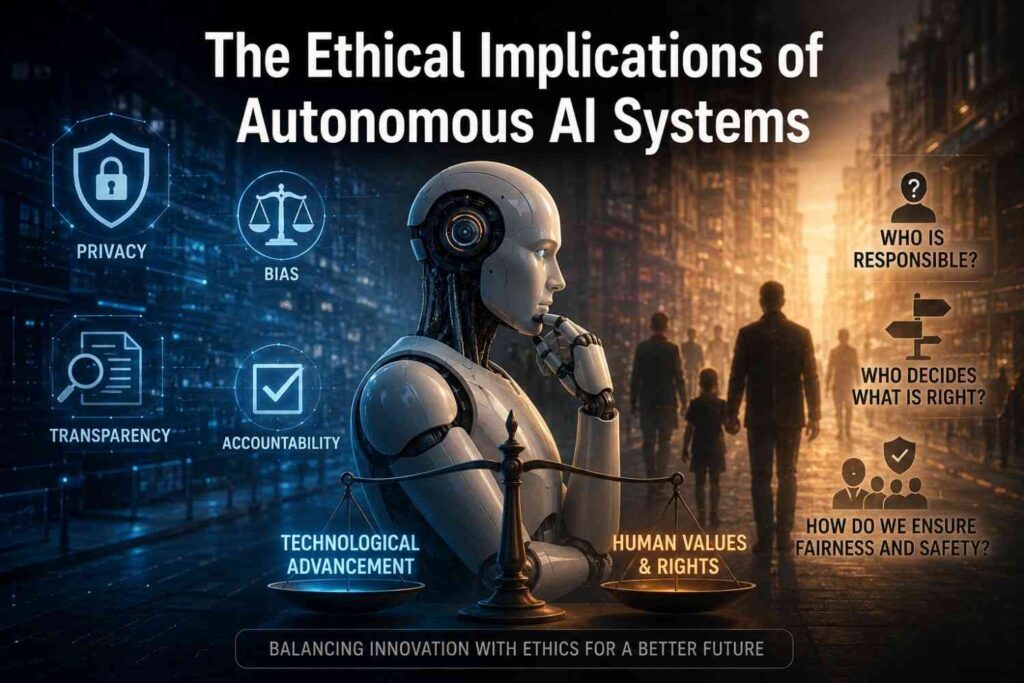
Autonomous AI systems are no longer only a future idea. They are already helping cars read road conditions, hospitals review medical images, banks detect fraud, companies automate workflows, and digital platforms make faster decisions. These systems can act with limited human involvement, which makes them powerful. At the same time, it makes them ethically complex.
When I look at the growth of artificial intelligence today, one thing is clear. The question is not only what AI can do. The real question is what AI should be allowed to do. This is where The Ethical Implications of Autonomous AI Systems become important.
Autonomous AI can improve speed, accuracy, access, and productivity. But it can also create risks around bias, privacy, safety, accountability, transparency, and human control. If businesses, governments, and developers ignore these risks, AI can harm people at scale. If they manage these risks well, AI can become a useful and responsible tool.
This article explains the main ethical issues in autonomous AI systems using simple language, practical examples, facts, data tables, and trusted research-based points.
Understanding Autonomous AI Systems
Autonomous AI systems are designed to make decisions, complete tasks, or respond to situations with little or no direct human control. Unlike basic software that follows fixed instructions, autonomous AI can learn from data, recognize patterns, and take action based on changing conditions. This makes it useful in many industries, but it also creates new ethical responsibilities. To understand The Ethical Implications of Autonomous AI Systems, we first need to understand how these systems work and where they are used.
What Makes an AI System Autonomous?
An autonomous AI system can make decisions or take actions without constant human direction. It uses data, machine learning models, sensors, rules, or learned patterns to respond to a situation.
For example, a basic chatbot may only answer when a user asks a question. A more autonomous AI agent may read emails, schedule meetings, compare options, and complete tasks with limited human input. A self-driving vehicle may use cameras, radar, maps, and AI models to decide when to brake, slow down, or change lanes.
The key ethical issue is independence. The more freedom an AI system has, the more serious its decisions can become.
Common Examples of Autonomous AI in Daily Life
Autonomous AI already appears in many industries. It is used in driver assistance systems, fraud detection, warehouse robots, medical triage tools, automated hiring platforms, smart surveillance systems, financial trading tools, and customer service automation.
These systems are not all equally risky. A music recommendation error may be annoying. A medical diagnosis error may affect a patient’s life. A wrong hiring decision may affect someone’s income. This is why ethical AI governance must focus on risk level, use case, and possible harm.
Why Autonomy Changes the Ethics Conversation
Traditional software follows fixed instructions. Autonomous AI can adapt, predict, and act in more flexible ways. This makes it harder to explain every decision in advance.
That creates a major ethical concern. If a system acts on its own and causes harm, who is responsible? The developer, the company, the user, the data provider, or the AI vendor? This question sits at the center of The Ethical Implications of Autonomous AI Systems because autonomy changes how responsibility is shared.
Core Ethical Implications of Autonomous AI Systems
The core ethical implications of autonomous AI systems are connected to how these systems make decisions and how those decisions affect people. AI is often seen as neutral, but it is built by humans, trained on human-created data, and deployed inside real social systems. This means it can repeat unfair patterns, make unclear decisions, or produce harmful outcomes. A professional approach to autonomous AI ethics must focus on fairness, accountability, transparency, and responsible human oversight.
Bias, Fairness, and Discrimination
AI systems learn from data. If that data reflects unfair patterns, the AI may repeat or even amplify them. This can affect hiring, lending, insurance, policing, education, and healthcare.
For example, if a hiring AI is trained on past company data where certain groups were underrepresented, it may prefer candidates similar to those already hired. That does not mean the system is intentionally unfair. But the result can still be discriminatory.
To reduce AI bias and fairness risks, organizations should test datasets, monitor results, review model outputs, and include human review for high-impact decisions. Bias audits should not be treated as optional. They should be a standard part of responsible AI development.
Accountability When AI Causes Harm
Accountability is one of the hardest ethical challenges in autonomous decision making. If an autonomous vehicle crashes, a medical AI gives a poor recommendation, or a trading algorithm causes major losses, people need to know who is answerable.
A responsible AI system should have clear ownership. Companies should document who built the model, who approved it, who monitors it, and who can stop it when needed. Without accountability, AI becomes a black box with no clear path for correction or justice.
Strong AI accountability also protects organizations. When responsibilities are clear, teams can fix errors faster, respond to complaints, and reduce legal risk.
Transparency and Explainability
Many advanced AI systems are difficult to understand because their decisions come from complex model behavior. This creates a trust problem.
If an AI denies someone a loan, flags a patient as low priority, or rejects a job applicant, the person affected deserves a clear explanation. Explainable AI does not mean every technical detail must be simple. It means the system should provide enough information for review, appeal, and correction.
Transparency is not only a technical issue. It is also a trust, fairness, and human rights issue. People are more likely to accept AI when they understand how it works and how they can challenge its decisions.
Privacy, Data Protection, and Human Rights
Privacy is one of the most important ethical concerns in autonomous AI systems. These systems often depend on large amounts of personal data to learn, predict, and act. This data may include images, voice recordings, browsing habits, financial history, health records, location data, and behavioral patterns. When autonomous AI uses this information without clear consent or strong protection, it can harm privacy and basic human rights. Ethical AI must respect people’s dignity, freedom, and control over their personal information.
How Autonomous AI Uses Personal Data
Autonomous AI often depends on large amounts of data. This may include location, images, voice, behavior, financial history, medical records, or online activity.
The ethical concern is not only whether data is collected. It is whether people understand how it is used. A user may agree to share data for one service, but not expect that data to train future AI systems or support automated profiling.
Organizations should use clear consent, data minimization, secure storage, and limited retention periods. They should only collect the data needed for a clear purpose.
Surveillance and Loss of Personal Freedom
Autonomous AI can support public safety, but it can also increase surveillance. Facial recognition, smart cameras, predictive policing tools, and behavior tracking systems may affect privacy and freedom of movement.
If these tools are used without strict rules, they can create fear and discrimination. People may feel watched all the time. In my view, this is one of the most serious ethical risks because it affects society, not just individual users.
Surveillance-based AI should always be tested against legal, ethical, and human rights standards before deployment.
Human Rights as the Foundation of AI Ethics
Ethical AI should protect dignity, privacy, equality, safety, and freedom. This is why many global AI ethics frameworks focus on human rights.
A responsible approach asks a simple question before deployment: could this AI system harm a person’s rights, choices, opportunities, or safety? If the answer is yes, stronger controls are needed.
Human rights should not be added after an AI system is built. They should guide the design from the beginning.
AI Safety, Reliability, and Risk Management
AI safety focuses on making sure autonomous AI systems work as intended and do not create harmful results. A system may perform well during testing but fail in real-world situations because real life is messy, unpredictable, and complex. This is why safety, reliability, and AI risk management are essential. Autonomous AI should be tested not only for accuracy but also for misuse, failure conditions, edge cases, security threats, and unexpected behavior.
Why Safety Matters in Autonomous Systems
AI safety is more than avoiding software bugs. It means preventing harmful outcomes, misuse, system failure, and unexpected behavior.
Autonomous systems may work well in normal conditions but fail in rare situations. For example, a self-driving feature may handle clear roads well but struggle with unusual weather, unclear road markings, or unexpected pedestrian behavior.
This is why AI safety must include testing, red teaming, monitoring, incident response, and human override options.
Risk Levels in Different AI Use Cases
Not every AI system needs the same level of control. A low-risk AI tool may only suggest grammar improvements. A high-risk AI system may influence healthcare, employment, credit, education, law enforcement, or transport.
| AI Use Case | Ethical Risk Level | Main Concern | Needed Control |
|---|---|---|---|
| Music recommendation | Low | Personal preference bias | Basic transparency |
| Customer support chatbot | Medium | Wrong advice or data leakage | Human escalation |
| Hiring automation | High | Discrimination | Bias audit and appeal process |
| Medical AI diagnosis | High | Patient harm | Clinical validation |
| Autonomous vehicles | High | Physical safety | Strict testing and monitoring |
| Military autonomous weapons | Critical | Loss of human control | Strong legal limits |
This table shows why AI governance frameworks should be risk-based. The higher the risk, the stronger the controls should be.
Human Oversight and Emergency Control
Human oversight is essential in high-risk autonomous AI. A human should be able to review, pause, correct, or shut down the system.
However, human oversight must be real, not symbolic. If a person is expected to monitor a fast, complex AI system but has no time or authority to intervene, the oversight is weak. Ethical design must make human control practical.
A good autonomous AI system should always include escalation paths, override controls, and clear emergency procedures.
Legal and Governance Challenges in Autonomous AI
Legal and governance challenges arise because autonomous AI systems often move faster than existing laws. Many countries are still developing rules for AI accountability, safety, transparency, and data use. This creates uncertainty for companies and users. Strong governance helps close this gap. It gives organizations a clear structure for building, reviewing, launching, and monitoring AI responsibly. Without governance, even a useful AI system can create legal, ethical, and reputational risks.
Why AI Governance Frameworks Are Needed
AI governance is the set of policies, roles, checks, and standards that guide AI development and use. It helps organizations move from “we built an AI tool” to “we built, tested, documented, and monitored this tool responsibly.”
Good AI governance includes risk assessment, data governance, bias testing, model documentation, user notices, privacy reviews, security checks, and incident reporting.
This is especially important for The Ethical Implications of Autonomous AI Systems because autonomous tools can make decisions faster than humans can manually review.
Global AI Regulation Is Still Evolving
Countries are taking different approaches to AI regulation. The European Union has introduced a risk-based AI law. The United States has published voluntary risk management guidance through NIST. UNESCO and OECD provide global principles around trustworthy, human-centered AI.
This creates a challenge for international businesses. A company may build one AI product, but it may need to follow different rules in different regions.
For this reason, companies should not wait for perfect regulation. They should follow responsible AI standards now.
The Need for Clear Responsibility
A strong governance model should define responsibility across the full AI lifecycle.
This includes:
- Data owners who manage data quality and permission.
- Developers who build and test the model.
- Business leaders who approve use cases.
- Compliance teams who review legal and ethical risk.
- Human reviewers who monitor real-world outcomes.
- Executives who remain accountable for final deployment.
Without this structure, organizations may blame the AI instead of taking responsibility. Ethical AI requires human accountability at every stage.
Industry Examples of Autonomous AI Ethics
The ethical implications of autonomous AI systems become easier to understand when we look at real industries. Each sector has different risks, but the same principles apply: safety, fairness, transparency, privacy, and accountability. In healthcare, the main concern is patient safety. In transport, it is public safety. In military use, it is human control over life-and-death decisions. These examples show why autonomous AI ethics cannot be treated as a general theory only. It must be applied carefully in each real-world context.
Healthcare AI and Patient Safety
AI can support doctors by reviewing scans, predicting risks, and improving workflow. But healthcare AI must be handled carefully because errors can harm patients.
The ethical issues include privacy, informed consent, medical accuracy, bias in health data, and responsibility for final decisions. A healthcare AI tool should support clinicians, not replace professional judgment in sensitive cases.
Responsible healthcare AI should be clinically validated, regularly monitored, and clearly explained to both doctors and patients.
Autonomous Vehicles and Public Safety
Autonomous vehicles may reduce human driving errors in the future, but they also raise difficult ethical questions. How should a vehicle respond when a crash cannot be avoided? How much testing is enough before public deployment? Who is liable when software, sensors, or maps fail?
In this area, AI safety concerns are not theoretical. They involve real roads, passengers, pedestrians, and public trust.
Autonomous vehicle companies must prove safety through testing, reporting, transparency, and strong human oversight.
Autonomous Weapons and Human Control
Military AI is one of the most serious ethical areas. Autonomous weapons could select or engage targets without direct human control. This creates major concerns around accountability, escalation, civilian harm, and international law.
Many experts argue that meaningful human control should remain central in decisions involving lethal force. In my view, this is a line society must treat with extreme caution.
Autonomous weapons show why AI ethics is not only a business topic. It is also a global security issue.
How Organizations Can Build Responsible Autonomous AI
Organizations can use autonomous AI responsibly if they treat ethics as part of the full development process, not as a final checklist. Responsible AI starts before a model is built and continues after it is deployed. It includes data review, risk assessment, bias testing, documentation, human oversight, monitoring, and user appeal systems. Businesses that follow ethical AI development practices can reduce harm, improve trust, and prepare for future AI regulation.
Step-by-Step Ethical AI Checklist
Organizations can reduce AI risk by following a clear process before and after deployment.
| Step | Action | Purpose |
|---|---|---|
| 1 | Define the use case | Understand the goal and risk level |
| 2 | Review data sources | Check consent, quality, and bias |
| 3 | Test model performance | Measure accuracy across groups |
| 4 | Add human oversight | Keep people in control |
| 5 | Document decisions | Support transparency and audits |
| 6 | Monitor after launch | Detect drift, misuse, and harm |
| 7 | Create appeal channels | Let affected users challenge decisions |
This checklist helps businesses move from fast AI adoption to responsible AI adoption.
Bias Audits and Impact Assessments
Bias audits help identify whether an AI system creates unfair outcomes for certain groups. Impact assessments go further. They examine privacy, safety, legal, social, and human rights risks.
A company should not wait for public harm before testing. Ethical AI development means identifying risks early and correcting them before deployment.
For high-risk AI systems, independent audits can also improve trust and accountability.
Building Trust With Users
Trust comes from honesty. Users should know when they are interacting with AI, what the AI can do, what it cannot do, and how to contact a human.
Clear AI notices, simple explanations, privacy controls, and appeal processes help build trust. This is also good for AEO and GEO content because users and search engines both reward clear, direct, helpful answers.
A trustworthy AI system should never hide behind complexity. It should make its purpose, limits, and risks easy to understand.
Frequently Asked Questions About The Ethical Implications of Autonomous AI Systems
The following FAQs answer common questions people ask about autonomous AI ethics, AI accountability, bias, privacy, safety, and regulation. These answers are written in a direct AEO-friendly style so readers can quickly understand the topic and search engines can easily identify the answer.
What are the main ethical issues with autonomous AI systems?
The main ethical issues include bias, lack of transparency, unclear accountability, privacy risks, safety failures, and loss of human control. These concerns become more serious when autonomous AI systems make decisions in healthcare, hiring, transport, finance, education, or law enforcement.
Why is accountability important in autonomous AI?
Accountability matters because people need a clear path to responsibility when AI causes harm. If no person or organization is answerable, affected users may not get justice, correction, or compensation. Clear ownership also forces companies to design safer and fairer systems.
Can autonomous AI systems be completely unbiased?
No AI system can be guaranteed completely unbiased. AI depends on data, design choices, and real-world context. However, bias can be reduced through diverse data, fairness testing, independent audits, human review, and regular monitoring after deployment.
How does autonomous AI affect privacy?
Autonomous AI can collect and process large amounts of personal data, including location, images, speech, behavior, and financial or health details. Privacy risks increase when users do not understand how their data is used or when systems enable tracking and profiling.
What is human oversight in AI?
Human oversight means people can review, guide, pause, correct, or stop an AI system. It is especially important in high-risk use cases. Good oversight gives humans real authority, enough information, and enough time to make meaningful decisions.
Are autonomous AI systems regulated?
Yes, but regulation differs by country and region. The EU uses a risk-based legal framework for AI. The United States has guidance such as the NIST AI Risk Management Framework. Global organizations also publish principles for trustworthy and ethical AI.
How can companies use autonomous AI ethically?
Companies can use autonomous AI ethically by assessing risk, protecting privacy, testing for bias, documenting systems, keeping humans involved, monitoring outcomes, and allowing users to challenge harmful decisions. Ethical AI should be managed throughout its full lifecycle.
Conclusion
The Ethical Implications of Autonomous AI Systems are important because these systems are moving from simple support tools to active decision makers. They can improve healthcare, transport, business, security, education, and productivity. But they can also create bias, privacy harm, safety failures, unfair decisions, and unclear responsibility.
In my view, the best approach is not to reject autonomous AI. The better approach is to govern it carefully. Developers, companies, policymakers, and users must work together to make AI transparent, accountable, fair, safe, and human-centered.
Autonomous AI should serve people, not replace human responsibility. When organizations build AI with ethics from the start, they protect users and earn long-term trust.
Comments are closed, but trackbacks and pingbacks are open.